

Micro tomatoes - eventually food
4 years ago
Featured Answer
Sort by:Oldest
Comments (13)
- 4 years ago
 4 years ago
Related Discussions
Tomato Food?
Comments (5)I hate to be a wet blanket about it but about the only thing to be said for using Tomato fert on orchids is that used per Richards recommendation (1/4 strength) it will do no harm. I can't think of two more dissimilar types of plants than orchids and tomatoes. Tomatoes are grow monsters that need tons of cheap nitrogen and pottassium and phosphorous, the other trace elements will be assumed to be supplied by the rich loam (topsoil) in which these plants are usually grown. Orchids on the other hand are very light feeders and in nature grow in a low concentration but highly complex mix of major and trace elements. Grown in the home in semi-inorganic mixes puts the burden on the fert to supply all those micro-nutrients and thus if one really wants to do their best by their orchids instead of Tomato fert one will look at Dyna-Gro or one of several ferts intended for hydroponic culture of many things, including tomatoes. The key difference being that the hydroponic formula does not assume a micronutrient rich loam but a nutrient poor inorganic mix. H...See MoreMiracle-Gro Tomato Plant Food 18-18-21
Comments (42)i guess it's my turn for input, For years i've been using a formulation called dutch master one for flower production one for vegetative growth, found these to work very consistently and also are so minimal in tds I tend to run little risk of fert burns etc etc, the one thing it does have is that they're both loaded with macro/micros which of course is due to the fact that the fert was developed for MJ growers. in addition i apply twice weekly from spring - fall via foliar spray, what can i say i don't like having to flush often Second on the topic of bird poo ferts they've already been packaged. most are actually bat guano but there is a sea bird poop one as well most are sold by hydroponic stores and have been gathered in several different locations globally, more interestingly is that these locations are also the geographical basing for most orchids.(could this mean that mexican bat guano = good for mexican chids?) any ways i wont supply a link simply because it's better in these cases to attain the products from local hydro shops then on line, being that it'll save you some where in the ball park of 20$ i will supply product names and link for product info all manufactured by sunleaves it comes in these flavors Mexican Peruvian Jamaican and Indonesian also sea bird i haven't used them yet because i think i'm thwarted by the possible stench Gaston Here is a link that might be useful: check it out...See More'New' Tomato-tone vs 'Old' Tomato-tone - - Myth-Busters Challenge
Comments (105)With regard to Megpi's post, I totally agree on all points made. And it's still obvious to me that microbes, being living organisms, can move over and across the barrier along the top of the growing medium rather than having to "swim" under the barrier. With regard to Bencjedi's post, I grew about 100 Brandywine transplants for the Master Gardeners Plant Sale and kept a dozen or more at home to give to friends. Right now there are 10 of those Brandywine in 6" round pots filled with identical Baccto Professional Potting Mix with the pots stowed in a pile of bark fines like you might seed trees in nursery tubs with bark chips walled up around the tubs to keep the roots cool. All 10 plants have been treated identically since the time the seeds were planted ... same starter mix, same potting up mix, same fertilizer, same watering, same sunlight ... indentical. And there are marked differences between the plants at this time. Some are leafier, some are taller, some shorter, some have flowers, some don't have flowers, etc. When I look at that particular SWC with the two Brandywines, I see the one closer to the fence is taller and has less dense foliage maybe due to its location with regard to sunlight. I see the sunlight shining between the fence slats. Which way is east or south? I also notice the one nearer the fence is flowering. And the Brandywine farther from the fence seems to have more "mitten fingered" leaves. Hey, who knows about the vagaries of open pollinated heirlooms???...See MoreHow much food is too much food?
Comments (4)In the interest of redundancy, here it is again: With horse manure it is almost impossible to give them too much. Let the cow manure pre-compost, and it is almost impossible to give them too much. When we talk about too much food, we are usually talking about kitchen scraps. Too much food in the form of kitchen scraps will create a pretty yucky environment. The moisture in the food will cause the bin to go anaerobic, and the high nitrogen will throw off the bin's environment. Whatever you feed them, worms will consume about half their body weight each day. Under good conditions, they will eat their own body weight each day. Too much food is simply more than they can eat. Another factor that determines over feeding is the tendency of the food to heat up as it is breaking down. Both horse and cow manure can heat up quite a bit. If they have been aged to the point where they will no longer heat up, you won't have this problem. Any food you put in the bin should be totally consumed by the worms in about a week. Additional food can be added before that to give it a chance to break down before the worms attack it. You are feeding too much if it is not all consumed within a week. So our rule of thumb is to add about 1/2 pound of food for each pound of worms per day. You don't need to feed every day. You could feed 2 pounds of food for each pound of worms every fourth day. Then watch to see how fast the worms eat it and adjust the amount you feed accordingly. Aged horse manure is an ideal worm food. I would add about a pound of horse manure for each pound of worms and see how fast they eat it. You won't need bedding. Your only concern is for over heating. With cow manure, you will need some bedding. I would add about a pound of aged cow manure plus bedding for each pound of worms and see how fast they eat it. Feeding is as much an art as it is a science. In time you will figure it out. If you are feeding aged horse manure, or even small amounts of fresh manure, it is hard to make any big mistakes. You could fill your entire bin with aged horse manure, and your worms will be very happy. Weighing food isn't practical, and weighing your worms is nearly impossible, so add no more than an inch of aged manure over the top of the bin and see what happens. If the manure is still fresh, only cover half of the bin surface. That way, if the manure gets hot, the worms can escape to the other side of the bin. In a few days it will cool off, and the worms will be all over it. Really. Worms devouring horse manure is a sight to see. Your bin will be less than 8 inches deep, so this is what I would do. If the manure is well aged, fill the entire bin with horse manure, and feed enough to keep the depth between 6 and 8 inches. If you are feeding cow manure, you will need a bedding source as well. If there is any question as to whether the manure has aged enough, fill the bin with some form of bedding, and feed enough manure on the top to keep the depth between 6 and 8 inches, only feeding half of the bin surface at a time. If the manure is fresh, you could start with a mixture of manure and bedding and let the bin sit for a couple of weeks before adding worms. After a couple of weeks, turn the whole thing and make sure it does not heat up. If it does heat up, wait another week and try again. This is getting long. Time to post it. If I missed anything, someone else will fill in the holes....See More 4 years ago
- 4 years ago
 4 years ago
- 4 years ago
- 4 years ago
- 4 years ago
- 4 years ago
 4 years agolast modified: 4 years ago
 4 years agolast modified: 4 years ago


Related Stories
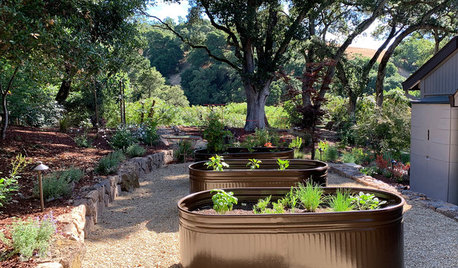
FARM YOUR YARD6 Things to Know Before You Start Growing Your Own Food
It takes time and practice, but growing edibles in the suburbs or city is possible with smart prep and patience
Full Story
KITCHEN DESIGNHow to Waste Less Food
Here are 9 relatively painless ways to throw away less food and stretch your grocery dollars
Full Story
LIFEKitchen Traditions: Tomato Season Meets a Family Legacy
Somewhere a Sicilian great-great-grandmother is smiling at a bowl of American-made sauce
Full Story
EDIBLE GARDENSSummer Crops: How to Grow Tomatoes
Plant tomato seedlings in spring for one of the best tastes of summer, fresh from your backyard
Full Story
FARM YOUR YARDTo Get the Food They Believe In, These Urbanites Grow Their Own
Home gardeners farming on their city lots find that local, organic food isn’t the only reward
Full Story
FARM YOUR YARDFarm-to-Table: Growing Your Food Indoors
A self-admitted plant killer-turned-urban homesteader shares her secrets on successfully growing edible plants indoors
Full Story

HEALTHY HOME12 Ways to Set Up Your Kitchen for Healthy Eating
Making smart food choices is easier when your kitchen is part of your support team
Full Story
FARM YOUR YARDHouzz Call: Home Farmers, Show Us Your Edible Gardens
We want to see where your tomatoes, summer squashes and beautiful berries are growing this summer
Full Story
HOUSEKEEPINGYour Guide to a Sparkling Clean Kitchen
Tackle food messes with this comprehensive collection of targeted and tested cleaning methods
Full Story
sleevendog (5a NY 6aNYC NL CA)