Houzz Logo Print
jrb451

Have you ever “flunked” a sleep study?

last year

I’m not talking about being diagnosed with sleep apnea. Have you ever had a sleep study, at a clinic, and been unable to sleep?


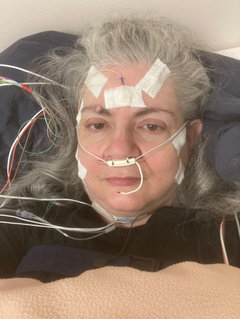
I had my first last night and could not fall asleep. I was greeted this morning by the tech saying “Poor baby, you hardly had any sleep.” And, “I hope you sleep better than this at home.”


In a case like this, what’s the next step?

Comments (51)

  • last year

    Yes! Between a door that kept slamming, the crunchy pillow, the distance to the bathroom, etc., I did not sleep at all. They asked me to come back again and re-do the study and I declined because I knew the environment would be the same.


    I imagine that the clinic would be willing to re-do the study without charge if you can explain why you were unable to sleep. The alternative might be asking for a referral to a different facility. I'm sure your doctor can suggest options if you explain why you were unable to sleep.

    jrb451 thanked Fun2BHere
  • last year
    last modified: last year

    Almost but ultimately no. I'm not sure how it's done now - mine were 25 years ago. I was uncomfortable enough (for various reasons) such that I was unable to fall asleep. I used the call button to speak to the tech at about 12:30am. I told him of my problem (he knew anyway from the instrumentation) and asked what I should do. He said to give it another 30 minutes and if I were stil awake, they had a "mild" sleep medication he could give me. I wound up taking that and then sleeping through to wake up time, which I recall was about 7:00am.

    Sleep apnea isn't the only disorder a sleep test can detect - mine detected two different ones that both served to disturb my sleep. I can't imagine there's any alternative but to repeat it. I'm surprised that offering a medication to help sleep for those who are awake isn't a standard practice. I'd check in advance about that before the next one.

    PS - I'd never taken a sleep medication before and haven't since. My CPAP machines over the years since and the med I take for RLS have provided 25 years of deep, restful sleep. The kind I had as a kid. I can't say enough about how effective these measures have been for me.

    Good luck.

    jrb451 thanked Elmer J Fudd
  • Related Discussions

    Help! 3 my outdoor plms have flunked the spear tst

    Q

    Comments (14)
    Needles vary in individual hardiness. I have two needles. One suffers spear kill, while the other does not. However, the one that fares better in my zone 7b location is in a more protected location. The one in the open away from the house is the one that is struggling. We only had a low of 12! [ zone 8a conditions!] My Chaemerops only seems to have slight foliage burn. It looks great from the street, but a bit tired on close inspection. Time will tell if it is okay. My Sabal minors are fine, even the one out away from the house. The Monrovia nursery tag read "Tropical" zones 8 to 11. In Francko's book "Palms Won't Grow Here, and Other Myths", there is a photo of a large needle in zone 6b Tennessee that survived minus 24 degrees, I believe in the 1980's! Good luck!
    ...See More

    ??? About Sleep Study

    Q

    Comments (28)
    Phoggie.....it is not a cpac as some call it. It is a CPAP (CPAP, or continuous positive airway pressure) and I can tell you know nothing about it. You may want to read up on it. You said they ordered a cpap machine for you, but you never picked it up. That is really not how it works as the company supplying the cpap will send out a Respiratory Therapist with the machine and show you how to use and care for it and also how important it is to use. If one was ordered for you, you must have stopped breathing several times while asleep. Stroke, heart attack or death can happen to those who have sleep apnea and do not have it treated. Mare, please go have the test and do as they say. It is not that bad at all, just uncomfortable and you will fall asleep if you set your mind to. Also they will check the stats on your machine (there is a data card in the machine) every 3-6 months to make sure it is still set properly for your needs. Good luck and hope you don't need this, but I will tell you I have not slept this well for years.
    ...See More

    Speaking of a sleep study...

    Q

    Comments (11)
    Okay, here's my story, just a little different.... Same up to the "they took me to bed" basically. I got there around 9. Here they do a, I think it's called a split night study. If after 1/2 the night they determine you need the CPAP, they hook you up and figure out what pressure you need. Anyway they hook you up to these wires..some on the head to record how deep asleep you are/are not, some on your legs to see if you have restless legs, some on your jaw to see if you clench your teeth or grind them. Some by your eyes I think to tell when you're in REM (Rapid Eye Movement) sleep. I had a sleep number bed even. VERY COMFY. Went right to sleep. About midnight or so, they woke me up and asked me to sleep on my back as i was NOT having any episodes. So I tried sleeping on my back. Well I didn't get a CPAP, didn't need one...so I had to stay the next day for a "nap" study. They would have me lay down every 2 hours for a 1/2 hour to see if I could fall asleep. I'm thinking ya right, I got a pretty good nights sleep, there is NO WAY I can fall asleep, not 4-5 different times. I fell asleep each time within 8 minutes. So although I don't have apnea, I do breathes very shallow, and maybe stop breathing for a bit once or twice a night. So don't be embarrassed, use this as an excuse to by a nice pair of PJ's (not a nightgown), and bathrobe. And think of it as spending the night at a hotel. When DH had his, they started trying the CPAP pressures after about 1 1/2 hours, his was so bad. He got to bring one home that next day, I had to wait a couple of weeks. We have two different kinds. If you need one, be aware too that it may take a while to find out what kind of face mask I'll call it, you will need. Make sure what ever kind you get, it works good for YOU. They will tell you that most people do NOT breathe through their mouth, and so you'll only need a nose one. What they don't take into consideration is those people like me who clench their teeth, but leave their lips open, nose ones don't work for me, I need my nose and mouth covered in order to get the benefits of my CPAP (Okay I actually have an APAP, but didn't want to confuse you) Vickey-MN
    ...See More

    Have you ever been too tired to sleep?

    Q

    Comments (8)
    Sounds like your excited...about your project. Your mind is busy planning the next step. I have had so many projects and remodels now. I can sleep for 4-5 hours under these circumstances. But yes....I still get excited, my mind races, I'm happy to be working and having a project....so it's ok. Construction is work where your results are instant....you do the work and feel the success.....not like when I was in IT.
    ...See More
  • last year

    While a sleep study is ideal they also can use a wrist monitor that tracks your oxygen levels called a oximeter. I have my own (SleepU) and my sleep center uses the information in addition to my less than full information due to my very poor ability to sleep during a study. I had two studies as my center uses one to diagnose and another to help decide if a cpap will help you. It is the total pits. I dont sleep all that well at the best of times but.... Talk to them about the next step. I was not showing any signs of classic apnea but my blood levels were way off. I have severe apnea.

    jrb451 thanked Patriciae
  • last year

    I can’t see going back to repeat the study and expecting different results. I’ve always had difficulties sleeping away from home and especially in a clinical/hospital setting for reasons stated by F2BH and more. My doctor has prescribed Zolpidem for me with the understanding that I only use it sparingly. I did not take one last night because I don’t regularly do that.


  • last year

    Ask if you can have a home sleep study done. I know oxygen levels during sleep can be tracked during home sleep via a wrist worn device. A home sleep study likely doesn’t provide the level of detail an in sleep lab study does but it’s a start. I doubt anyone sleeps ’well’ during a lab sleep study no matter what the sleep issue is. I’ve had 2 studies & barely had enough ’quality’ sleep time for either study to be useful or definitive of my issue. The person needs to be in REM stage for a certain amount of time for the study to be useful & at least asleep for a certain length of time. But, not many of us could sleep well with all the wires stuck on all over during the studies & the less than cozy environment. My issue is C02 retention, an issue identified via routine blood work - it’s one of the levels checked with routine labs. The C02 level issue was confirmed via arterial blood gas check. Sleep studies are done to check for a number of issues. After my first study it was suggested I had RLS / restless leg syndrome. I explained I’d been having severe leg & foot cramps but since all wired up could hardly jump out of bed to walk off the cramps. I should’ve alerted the tech but the whole process was so stressful for me I wasn’t thinking logically I suppose. Leg cramps were an issue for me until I started magnesium supplements. My second study showed no signs of RLS.

    jrb451 thanked KW PNW Z8
  • last year
    last modified: last year

    For my sleep study they gave me stuff to wear at home. Seems to me if they want to observe how you sleep it makes sense to observe how you actually sleep.

    jrb451 thanked foodonastump
  • last year

    I would expect no less from me--which is why I would not ever bother.

  • last year

    Home sleep studies are not as effective or comprehensive as ones done at a sleep center.

    If what you're trying to accomplish is to regain restful sleep, why would you set conditions limiting what they want to do to help you.

    Have another study done. Arrange for a sleep medication, that's a very standard practice and should have been offered to you the first time. And I respectfully suggest you might try to have a bit more of an accommodating attitude for to your health care providers, to help them help you.

    Good luck.

  • last year

    My last one was at home. I was given a choice. Very easy to do.

    jrb451 thanked Kathsgrdn
  • last year

    DH flunked this twice. IDK why insurance paid for this at $8K plus each time. He doesn't have apnea, or so little that side-sleeping puts an end to any infrequent snoring.

    We were looking for the cause of his leg spasms -- not RLS (per the doctor). These are strong spasms that can go on 5 - 15 minutes apart for an hour. He feels muscles above his knee 'clenching', then they release with force.

    A few months after the sleep studies, the spasms stopped as suddently as they started. They were gone for months, but have recently returned. When they start, he has to get up and walk for a few minutes, then they stop until 'next time'. No MD has been able to get a handle on this.

    KW -- Please tell me how much magnesium you take. DH could try that again.

    jrb451 thanked chisue
  • last year
    last modified: last year

    " I cant imagine taking a sleep aid would give as accurate results. "

    From the outset of my seeking treatment for poor sleep, I've been a patient of Stanford Medical School's Sleep Medicine Center. Several of the early "founders" of this practice and research center have been recognized for having made ground breaking discoveries in the field.

    It was at their sleep lab I've had three tests done, all with the administration of a sleep med. Following their advice to the letter as a result of what you think was a flawed assessment, I've had better sleep results in the last 25 years than I had in my prior adult life. I enjoy better sleep than what I hear from so many others describing their sleep issues. I'm never sleepy through the day nor in the evening, I never fall asleep other than in bed, I fall asleep within 5-10 minutes of going to bed, and I sleep through the night and wake refreshed. How's that?

    If you think your background and professional understanding of sleep medicine trumps theirs and suggests that their approach invalidates sleep study results, you should contact them right away.

  • last year

    Elmer, I used the word "as" on purpose. While it worked for you it absolutely would not be appropriate for me. I don't represent the entire set of people who cant sleep during a sleep study and neither do you. Neither of us are representative of all people with sleep apnea. I also have restless legs but there are many reasons for that as well. Calm down.

    jrb451 thanked Patriciae
  • last year
    last modified: last year

    Performing this test at home would surely give better results. I'm lucky not to have sleep issues and never had a need to be tested, but when I'm at a hotel, B&B, beach cottage, or someone's else's home I do not sleep well on the first night, and maybe not the 2nd. Trying to sleep under clinical conditions would not work out well for me either.

    jrb451 thanked vgkg Z-7 Va
  • last year

    Amen @vgkg Z-7 Va. If I needed to be knocked out to take the sleep study, why not have a couple of Margaritas instead? Initially, I think it best to be tested as I sleep, without any aid. Then, after consultation, I might start using a sleep aid. Regardless, I appreciate the comments and will look forward to the opportunity to have this discussion when my test results are back.

  • last year
    last modified: last year

    " While it worked for you it absolutely would not be appropriate for me. "

    Call Stanford tomorrow. You can find the phone number online. Inform them about what kinds of patients they should not be giving sleep aids to.

  • last year

    " Performing this test at home would surely give better results. "

    No, that's not my understanding. More detailed and comprehensive "data" of a neurological and physical functionality nature is obtained from a test at a sleep center.

    Some insurance plans won't pay for sleep center tests and allow only the much less expensive home approach.

  • last year

    @chisue I take 240 mg of Magnesium Glycinate every evening. That’s 2 capsules of Nature’s Bounty brand. I had been taking ’plain’ magnesium with no great result. My doc, who suggested the Magnesium then specified Mag Glycinate. She said it absorbs better & there have been reports of better sleep when taking it. I can’t attest to any improved sleep but my nightly leg & foot muscle spasms are definitely less frequent & also less severe when I get them. The reason I have Nature’s Bounty is convenience - it’s what Costco carries. The 240 mg is what the bottle dosage instructions are.

    jrb451 thanked KW PNW Z8
  • last year

    I’ll second the suggestion to try magnesium glycinate (with your doctor’s approval). My oncologist recommended 400 mg to help me sleep through some of the side effects of chemo and it has been a big help. While not officially part of her protocol, she did say she is getting positive feedback from patients.

    jrb451 thanked heritagehd07
  • last year

    " Neither of us are representative of all people with sleep apnea. I also have restless legs but there are many reasons for that as well. Calm down. "

    Sorry, I missed this last part.

    I couldn't be more calm. Why would you bother ever going to any doctor if your assumption is that you know more than s/he does? That attitude is not helpful.

    Sleep disrupting apnea? Sleep disrupting restless leg syndrome? I have neither, because I follow the medical advice I pay good money for and I don't pretend I know more than experts do. How about you?


  • last year

    Elmer, what I know is me. I tell my doctors about me and what I can or cant do or have. You will be astonished to hear they listen to me even though they dont work for Stanford. None of us are a standard. We are all different. I certainly dont expect you to react like I do. Why do you think your experience will be mine? My medication sensitivities are not going to be yours. I am not offended that you dont have problems where I do. Why are you offended? Rejoice that you dont have to deal with my issues.

    jrb451 thanked Patriciae
  • last year

    Thank you, KW and heritagehd. I found an old bottle Mag Citronate in our cabinet -- guess we had no success with that. There are entirely too many sub types of magnesium!

    heritagehd -- I hope your chemo is doing the job. I love to hear the "Cancer Free" bell rung when I'm at the clinic for my own infusions for MM. Your day will come!

    jrb451 thanked chisue
  • last year

    If sleep apnea is suspected, couldn't one just try a mid-range C-PAP for a few nights? It wouldn't cost $8K. Further adjustments could follow. Also, if you can't/won't tolerate the C-PAP 'cure', what is the point?

    jrb451 thanked chisue
  • last year
    last modified: last year

    Also, if you can't/won't tolerate the C-PAP 'cure', what is the point?

    That's what I'm wondering.......I've had 2 attempts at using a CPAP over the last 20 years (for months, with 3 different mask styles), and so I'm hoping the doctor this time can tell me about some other options. In the past, they've always said that my oxygenation improved with a CPAP and didn't care that I didn't get good sleep with one on. I'm hoping in the intervening years there are some other options.

    jrb451 thanked Toronto Veterinarian
  • last year

    When I had to use a machine, mine is a bipap which is more reactive to your breathing, my younger sister told me to stick with it. It takes time. She encouraged six weeks or more. And she was right. I have been an insomniac since I was a small child and pretty much everything disturbs my sleep but I got used to the thing. I use a nasal pillow with a sort of head tube affair that is the least cumbersome thing you can wear. I can sleep on my stomach and side. My apnea is considered extreme with oxygen levels dropping to 60% so I had to learn how. You can do it during the day by the way. Sitting in a comfortable chair. It gets you used to the rhythm of the thing. I don't feel the air at all. It is a strange sort of thing. So try it every night. You don't have to keep it on all night. Start with two or three hours and gradually add more time. It is worth it. My oxygen rarely falls below 90% now.

    jrb451 thanked Patriciae
  • last year

    Good point raised. People most commonly mention improved "sleep quality" as the benefit of counteracting apnea. I did in my comments. True to a point. Apnea also produces undesirable and often very dangerous drops in blood oxygen saturation and that's a big risk. To the heart muscle, just for a start.

    Getting used to a CPAP machine takes self-motivation. I know no one who went about it in a serious way who has failed. It's awkward at first, it's uncomfortable.

    I think one of the things that has to be accomplished is to get accustomed to the sensation of the air and the feeling of having a mask on. Of whatever type. Someone who's bought in and wants to be successful will be. Half hearted efforts usually fail. Heck, the mask I have is definitely not comfortable and can be irritating - so what? I just use it because I have to. Period.

    I have a friend who I convinced to get a sleep study because he often mentioned he felt tired during the day. The result was predictable and he was prescribed a CPAP. He tried off and on, never very seriously, complained it was uncomfortable and inconvenient, and gave up. He has two houses and he never carried it from one to the other. Switch scenes, the guy started having heart problems and came under the care of a cardiologist. Surgery was needed. Going through his medical history, Doc asked if he used the CPAP machine regularly. The answer was "No". Doc replied that with his heart issues, using it was essential. And that if he wouldn't use it consistently, he would need to find another cardiologist because he would decline treating him unless he followed all of his advice, CPAP included. Guess what? He uses it every night now. Feels much better. Kept his cardiologist. He had no choice so he just did it. That's sometimes the attitude needed.

  • last year
    last modified: last year

    " I know no one who went about it in a serious way who has failed. "

    You can add me as someone you "know" who has failed. I have gotten much lower quality sleep and have been more tired in the mornings so far when using a CPAP. Regularly for months at a time.

    jrb451 thanked Toronto Veterinarian
  • last year
    last modified: last year

    No, I don't think so. I don't know you but the little I've seen of your personality doesn't comport with those who I was describing. I haven't thought much about you but I'm answering your comment. Some encounters with you have reminded me of attitudes of one of my wife's friends. Coincidently, she was prescribed a CPAP about 6 months ago and gave up trying to use. it.

    If you're motivated to get better sleep, TV, what other avenues have you actively pursued? Some dentists with special training are able to custom-make oral appliances that you put in a bedtime that can be effective in treating apnea. Have you been to see one?

    Or, there are surgical procedures that can be done that also can be very effective. Have you consulted with an ENT surgeon too?

  • last year

    " No, I don't think so. I don't know you but the little I've seen of your personality doesn't comport with those who I was describing. "

    So, you think I'm lying when I said said I used it diligently and regularly for several months and didn't sleep any better. I see.

  • last year

    I gave the clinic that did my ’sleep study’ a bad rating for several reasons. The first was that they waited til around 11 pm to hook me up to all the wires, etc, even tho i was the first to arrive at the clinic. They claimed someone else wanted to be hooked up first. Well i wanted to go to sleep! They had told me to prepare for bed at 9:30, so then had to wake me up.

    Then at around 4 am they again woke me up and asked me to sleep on my back for a while. That was the end of my sleep. So not such a great experience.

    jrb451 thanked OutsidePlaying
  • last year

    " So, you think I'm lying ... "

    Not at all. I said I know some people who seem to have similar personal characteristics who also were unsuccessful.

    I'll repeat a question I asked - If you're motivated to get better sleep, TV, what other avenues have you actively pursued?


  • last year

    <I doubt anyone sleeps ’well’ during a lab sleep study no matter what the sleep issue is.>

    I had zero problem sleeping during my sleep apnea tests, and I've had them done twice - the last one was last year. Despite the bed being somewhat hard, I had brought a couple of my own pillows, and I went right to sleep when the lights were out. The only time I woke up during the test (and this was during the second one) was when the machine started blowing water in my face, because the attendant had filled the water container too full. Once that was fixed, I slept fine again.

    I don't have trouble falling asleep at home, although I used to wake up to terrible nightmares, but after taking Gabapentin, that stopped, more or less. I do also take 10 mg of melatonin every night, but it is the 600 mg of Gabapentin that helped me stop having such severe nightmares.

    Lately I have also been taking naps in the afternoon, and this is partly because it has been over 110° here in the afternoon, and I do not want to go outside during this time.

    jrb451 thanked Lars
  • last year

    It's taken me a long time to get used to my cpap machine. I tried a couple different masks and went back to the regular one. I would sometimes feel like I was suffocating, which made it impossible to fall asleep. Some nights I'd get so frustrated I just took it off and didn't wear it that night. I then started to stay up until I was really sleepy. Go to bed, read for a few minutes until my eyes wouldn't stay open and then put my mask on. It really helped. There comes a point when you're so exhausted, apparently, that you don't care if you might suffocate-lol.

    jrb451 thanked Kathsgrdn
  • last year

    I can see peoples point here. If all I was looking for was a better nights sleep I can see not putting yourself through all the heck involved. When the thing is working right you aren't supposed to feel air blowing on you. There are other permutations other than Cpap. As I said I have Bipap which forces air into you but has reduced pressure for you to breath out. It is easier than Cpap which is what I had for my tests.

    jrb451 thanked Patriciae
  • last year

    A BiPap is a CPAP with a different feature. Just as a convertible is a type of car with a different feature than a sedan car has. Both are CPAPs just as both are cars.

  • last year

    Elmer - I think you’re splitting hairs & maybe just to disagree. Patriciae didn’t say Bipap wasn’t like a CPap - only that it was different - and it is. Some conditions aren’t helped with CPap & BiPap must be used. Insurance often requires use of CPap first to justify need for BiPap because it’s more expensive. There’s also VPap.

    Here’s a brief explanation from CPap blog:

    “BiPAP and CPAP machines work by delivering pressurized atmospheric air into your airway. This air pressure may be fixed, as with CPAP. Or it may change based on whether you are inhaling or exhaling, like a BiPAP machine. Ventilators, however, breathe for you, forcing oxygen directly into the lungs and then pushing carbon dioxide out.”

    And,

    What Is a VPAP, and Is It the Same as a BiPAP?

    The two are very similar, but BiPAP and VPAP are not the same thing. The main difference between VPAP versus BiPAP lies in how the pressures for inhalation and exhalation are selected. Like a BiPAP, the VPAP uses a higher pressure for inhalation and a lower pressure for exhalation. Traditionally, BiPAP machines use pre-programmed pressure settings, while VPAP machines are auto-adjusting.”

    jrb451 thanked KW PNW Z8
  • last year
    last modified: last year

    As I've been using these devices for 25 years, I'm pretty familiar with them and the different types. Stanford switched my device type to the BiPAP kind about 20 years ago when they upped my pressure setting. The explanation I was given was that at lower settings, it doesn't matter. But at higher settings, the pressure drop that the BiPAP type does is needed to make it easier to exhale. Blowing against a higher pressure inflow can cause the mask to get unseated.

    The therapy is done by the higher setting, not the lower one, so in that way, they're exactly the same.

  • last year

    Interesting topic!

    A few questions


    What is the reason people get sleep studies done? Is it only for being tired during the day feeling like you haven’t slept?


    Can you move around while wearing the mask? I sleep on my side, then maybe my stomach, or the other side.


    Does the machine noise bother your partner? DH needs silence and no lights to sleep


    Just curious!


    I guess the dental device Elmer mentioned would be much less efficient , but probably much more comfortable. Never heard of that


    Not sure how well I would sleep for a sleep study. i’d feel like the techs were watching me!


  • last year

    @lisa_fla A quick search will provide lots of info on reasons for being sent for a sleep study but the most common is complaints of disordered sleep - insomnia, frequent waking etc. & subsequent fatigue or inability to stay awake & or alert. That is often accompanied by a sleep partner’s observation of snoring, irregular breathing & restless sleep. A friend was sent for a study when she stopped breathing while under twilight sedation for a colonoscopy. She didn’t have any known sleep issues or daytime fatigue. Lack of deep sleep can cause nightmares & or hallucinations. I was sent for study by a pulmonologist because my blood C02 level was well above normal. Long term & untreated that causes organ damage & can eventually cause respiratory arrest. Severe COPD, emphysema, neurological conditions like Parkinsons or being a quadraplegic all are usual reasons for C02 retention - none of which apply to me. BiPap therapy is the only treatment available for helping the lungs inhale enough air / 02 & exhale C02 - so, though I struggle with it I have used my BiPap every single night for over 5 years now. As Elmer said - ” I just use it because I have to. Period.”


    Yes, you can move around while wearing the mask - within the confines of your bed. Yes, you can sleep on your sides & stomach. There are many mask styles - it takes work to find the best one & a person may not be able to use the smaller masks if they are a chronic mouth breather.

    I’m sure the air noise does bother some sleep partners but the machines are surprisingly quiet & more like white noise. I would not be in a relationship with someone who wasn’t supportive & willing to work to make their own adjustments to my needs as I would be to his. I mean - really?


    The oral devices are great if they work for the reason a person needs the non-invasive ventilation assistance. That is, if the problem is obstructive sleep apnea caused by a mouth or throat structure issue. Maybe a nasal issue too. We’ve all likely seen the recent ads for an implantable device - marvelous! If it works for the condition the person has, Won’t help me - mine is a lung function issue not a neurologic one where I stop breathing.


    As far as techs watching people sleep - well - no. They are watching the readouts from all the wires stuck all over your chest, tummy & legs - & in my case forehead. The C02 monitor was stuck to my forehead - it’s not always needed during a sleep study. The first study I had was to ’record’ the issues of not inhaling / exhaling enough through all the sleep stages. The second study was a titration study with a BiPap to figure out the settings needed for the inhale & exhale.


    I will say that from all my research & reading & listening to my doc that I do know there’s a very low compliance rate for any of these types of non-invasive sleep therapy. It’s because it is a huge life adjustment. It does require a commitment to taking care of oneself. The health risks for a person with ’simple’ sleep apnea are a very high risk of stroke, heart issues and lots of other nasty things. One interesting thing I learned is that during later days of Covid after they were running out of hospital ventilators it was discovered that CPAP was often more effective, was more readily available & wasn’t as traumatic as the invasive ventilators.

  • last year
    last modified: last year

    the readouts from all the wires stuck all over your chest, tummy & legs - & in my case forehead.

    I also had 4 or 5 on my scalp and neck, and sensors at my nose and mouth. Somehow, with all of this, I was able to get up in the middle of the night (with the technician's help) to go to the bathroom (no technician involved there, LOL)


    jrb451 thanked Toronto Veterinarian
  • last year
    last modified: last year

    TV, I think I had more. From my report:

    ”Gold plated electrodes were applied to the scalp according to the international 10-20 system. EEG was monitored from C3-A1 and 02-A1. EOG and EMG were monitored continuously by electrodes placed at the outer canthi and the chin, respectively. Nasal and oral airflow was monitored using a triple port thermocouple. Respiratory effort was measured by piezoelectric technology employing an abdominal and thoracic belt. Blood oxygen saturation was monitored by pulse oximetry. Heart rate and rhythm were monitored by surface electrocardiogram. Anterior tibialis EMG was studied by using surface electrodes placed 5cm apart on both legs. A microphone was used to monitor tracheal sounds and snoring. Study scoring was performed following AASM guidelines, using rule 1B for scoring of hypopneas. MD signature indicates 100% review of data obtained.”

  • last year

    @jrb451 And, someone in this thread commented on the $8k cost of a sleep study! Well, it’s easy to understand why from yours & Toronto veterinarian’s posts!

    jrb451 thanked KW PNW Z8
  • last year

    @KW PNW Z8, was it the ”gold plated electrodes” that gave it away?!😀

  • last year

    " What is the reason people get sleep studies done? Is it only for being tired during the day feeling like you haven’t slept? "

    There are many. From a search - Daytime sleepiness, insomnia, sleep paralysis are among them. Snoring is an interesting symptom - not all snorers have apnea, but most people with apnea snore. There can also be psychological or medical conditions for which poor sleep can be a contributing cause. I mentioned above my friend having heart difficulties, whether or not he had and used a CPAP machine was a question the doc asked. Low oxygen concentrations in the blood while sleeping can lead to a heart attack or, less seriously, damage to the heart.

    " Can you move around while wearing the mask? I sleep on my side, then maybe my stomach, or the other side. "

    It's not like you can stand up and walk to the bathroom with it on but if the machine is on a bedside nightstand, there's enough slack in the hose to allow movement in the bed. Funny thing in my case - I used to toss and turn during the night, that disturbed my wife. Since I began using a CPAP, i've stopped doing it. I wake up in exactly the same position I was in when I fall asleep, with no movement at all. The tossing and turning was, for me, perhaps a way of my brain trying to improve my respiration when asleep.


    Does the machine noise bother your partner? DH needs silence and no lights to sleep "

    It makes a soft whoosh. It doesn't bother me (after all, I'm closer to it) and it doesn't bother her. If this is something you need for your health and it bothers your husband, spend a few bucks and get him ear plugs.


    Everyone should keep in mind that there are dozens of health problems sleep disorders can cause and/or exacerbate, dozens of sleep disorders that can only be treated if diagnosed, and many, many ways of treating each of them. Apnea is the most common and CPAP machines are the most common and easiest means for apnea treatment but what affects any one patient among the very many other conditions and approaches are, is domain of sleep experts. Self-diagnosis and/or self-treatment of a problem is a fool's errand. Get real professional care and don't second guess the advice you receive if you want your potentially life ending problem resolved.

  • last year

    I note that earlier in this thread, when Toronto Vet was grousing about an inability to adjust to using a CPAP machine, I twice asked if she viewed her sleep problem as being serious enough to explore other sources. She didn't respond, leaving me now to assume that no answer means a NO answer.

    I'll repeat - other than a few of a particular personality type that I know, no one I know who took seriously their responsibility to adapt to using a CPAP machine every night has failed to do so.

  • last year

    Does anyone have information on the implant for sleep apnea that's so heavily advertised? Obviously invasive, but what else, and how expensive?

  • last year

    " What is the reason people get sleep studies done? Is it only for being tired during the day feeling like you haven’t slept? "

    That's why I got my first sleep study done about 30 years ago - I was never rested when I woke up. I was diagnosed with some abnormal leg movements, and mild sleep apnea. I had another done 15 years later because I still wasn't rested in the mornings, and doctors thought it might be a part of my inability to lose weight - and the severity of my apnea had increased dramatically. The sleep doctor continued to insist on a CPAP, even after the study done after a CPAP trial showed that my sleep was not improved with it on and my movements (legs and arms) were increased.

    My new GP recommended it again, but I told her I would only do it with a different sleep doctor, because the others would only discuss CPAP options rather than discussing the quality of my sleep (which was not improved with a CPAP). We'll see if I get a more responsive conversation with this doctor.


    I love naps, and indulge frequently :)

    jrb451 thanked Toronto Veterinarian
  • last year

    My study mentioned me having a mean O2 saturation of 94% and no measurement below 88%. That seems pretty good to me. I think I’m going to ask for a referral for CBT for Insomnia before pursuing CPAP/ BiPAP/VPAP.

  • last year
    last modified: last year

    " The sleep doctor continued to insist on a CPAP, even after the study done after a CPAP trial showed that my sleep was not improved with it on and my movements (legs and arms) were increased. "

    It sounds like you unfortunately were stuck with a very crappy doctor. A one cure fits all type whose posture to patients is "what you need is what I can do". And nothing else.

    Even 25 years ago, with my first sleep consult, I was offered an appointment with an ENT surgeon as an alternative to using a CPAP machine. Maybe your experience highlights a difference between medical practice in the US versus in Canada?

    Though to be fair, some professionals in general practice fail to refer clients/patients to specialists (or others with greater and more relevant training and practice experience) and try to stretch outside of their own core competences, when a referral would mean losing the business and passing it along to another with no compensation. I've seen this done by lawyers and accountants, and also dentists and veterinarians in general practices.

    Edit to add:

    I remember being told 25 years ago that feeling a need to nap was a sign of ineffective sleep. Funny thing, that, it was prophetic for me. I often spent weekend afternoon and vacation days napping to try to feel more rested. Since starting with a CPAP, I don't nap. Zip, almost never, no more than fingers on one hand could show. I remember the last time was a few years ago - it was the afternoon of the day I came down with Covid symptoms of chills and malaise. I laid on the bed and dozed off (with my CPAP on, of course) for about an hour. I can't remember another instance of doing that though there may have been one or two sometime.

  • last year

    " a mean O2 saturation of 94% and no measurement below 88%. That seems pretty good to me."

    Assuming you're not a doctor, why rely on your own take?

    What does your sleep doctor think about it?

Sponsored
High Point Cabinets
Average rating: 5 out of 5 stars21 Reviews
Columbus' Experienced Custom Cabinet Builder | 4x Best of Houzz Winner