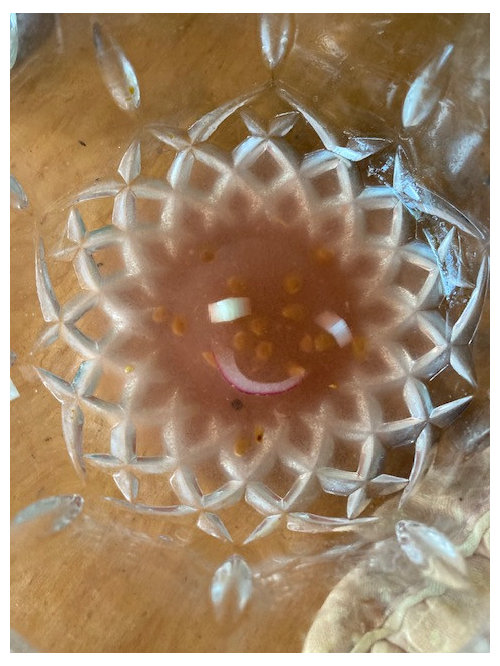
Food face.
3 years ago
Featured Answer
Sort by:Oldest
Comments (12)
Related Discussions
food food food
Comments (34)Here ya go Florey! It was on page 4 I believe. While I'm at it I'll post my vegetarian recipe for chili. It's easily made with meat by starting with browning ground meat or other meat then going from there with this recipe. Saute about 3 cups each of onion, celery and peppers of your choice and two Tablespoons or more of garlic[ I use about 3 or 4 for this amount, smiles]. When these are sauteed a bit, add two cups of carrots and 2 large cans of small diced tomatoes [with their juice]. I don't like to use crushed or sauce in my chili. I think it overwhelms the veggies. A bay leaf and couple tablespoons each of cumin, chili powder, and salt. Add water or veggie stock, if needed, to bring level up to slightly above veggies. As hard veggies begin to soften, add 2 cups each of eggplant[cubed], zucchini and/or yellow squash. Cook another ten minutes and add 2 cups each mushrooms, canned or frozen corn and canned or frozen green beans. Taste now for salt and seasonings and adjust. Next add as many beans as you like. I use the liquid in the beans too. At least 1 lrg can of dark and 1 lrg can of light kidney beans. Also, black beans and cannellini beans are good. Pintos are great too, naturally. As soon as beans are heated through the chili is done. Taste once more for seasoning. Like all chili this is best if made the day before. Does great frozen. I usually make about 3 gallons of this at a time and freeze in 4 or 5 containers....See MoreList of GMO-free Foods & allergies and genetically modified food
Comments (33)Thank you, Dr. Henry, for that paper on toxic GM-effects on goats. Corn & soybean & canola & cottonseed are genetically modified, the Republic Magazine stated that other grains are safe: "Other than corn, no GM grains are sold on the market. Look for 100-percent wheat pasta, couscous, rice, quinoa, oats, barley, sorghum, and dried beans (except soybeans). Most GM ingredients are products made from the “Big Four:” corn, soybeans, canola, and cottonseed. Sugar beets and 50% of Hawaii papaya are genetically modified." **** from Straw: That's why I buy sugar-cane products, rather than sugar made from beets. I fed my kid those Pepperidge Farm cookies (made from cottonseed oil) and she broke out in rashes and scratched herself bloody. I ate those cookies and had the worst hayfever: runny nose & sneezing. Went shopping yesterday: They had strawberries for $2.50 versus organic strawberries for $3.45. I sniffed both: the organic strawberries was more fragrant, versus the regular with a slight chemical scent. After sniffing both for several times, my nose was in pain (I stuck my nose too close). I realized that it's the pesticides sprayed on that inflamed my nose. My nose burned for hours afterwards Two years ago I tasted grape at the store, and had a tummy ache. Strawberries is known for the most pesticides I'm very sadden by UK’s Daily Mail report that an estimated 125,000 farmers in India have committed suicide because of crop failure and massive debt since planting GM seeds. Recent Center for Human Rights and Global Justice report: "Indian farmers bought genetically modified Bollgard Bt cotton seeds from the Gates Foundation-backed Monsanto corporation ... 85 percent of cotton grown in India being Monsanto-controlled Bt cotton by 2009. However, the seeds were expensive, and spiralling prices (coupled with planting restrictions from the multinationals selling the seeds) led farmers to hefty loans. Almost 300,000 cotton workers have committed suicide to date, some of them by drinking the same insecticides they were sold by multinationals." From Straw: Years ago I watched a documentary film "Seeds of deception" where Mexican agriculture scientists voiced concern with GM seeds corrupting the bio-diversity of local seeds, which are well-adapted to drought and adverse local conditions. Dr. Frank Lipman, from http://www.drfranklipman.com/basic-questions-on-gmos/ stated, "The major benefit of all commercial GMO’s is that they are bred to either tolerate direct application of herbicides and/or have the ability to produce their own pesticides. They have not been bred to increase yield, become drought tolerant, improve nutrition or to have any other benefit to the consumer. So at present they have no health benefit, their benefits are purely economic." *** From Straw: It's about power, money, and control. Politics and economic factors are factors, besides ill health. The vindictive dirt-throwing, defamation attacks against international scientists, and bullying tactics of big corporations made me more sick than the ill-effects of GM-foods. We are saved from our wheat being genetically-modified, thanks to the farmers voicing concerns that our wheat can't be exported, if genetically modified. More from Dr. Lipman: "In Europe, over 175 regions and over 4500 municipalities have declared themselves GM-free zones. And in 2009, Germany along with France, Hungary, Italy, Greece, Austria, Poland and Romania banned Monsanto’s MON 810 GM corn because of its documented dangers to biodiversity and human health. Additionally, states in Australia, regions in New Zealand and Brazil and the countries like Venezuela, Zambia, Sudan, Angola and others, all want to be GM-free.The balanced reporting of the press in Europe of the dangers of GMO’s made a significant contribution to the decision to reject GMO’s. Below link is a detailed list from Republic Magazine on which foods are GM-tainted: Here is a link that might be useful: List of GM foods vs. non-GM This post was edited by Strawberryhill on Sat, Mar 1, 14 at 15:06...See MoreDishwasher with inset cabinet
Comments (10)I'm sorry for the confusion in my original post. Yes, the dishwasher is SS and won't have a wood front panel or anything. It's going to be against an outside wall so I'll have to ask DH how he feels about possibly recessing it into the drywall at least (although I suspect he won't like that idea). I don't want to pull the cabinets out from the wall. I wasn't sure what the standard overhang for counter is, perhaps I can discuss extending it with the cabinet maker next week when he comes to take measurements (we're getting the counters through him). I don't think I'll mind that it's not flush, but I'd prefer that it not look totally ridiculous either and stick out from under the counter top. I'd still love to see pictures if anyone would have any. I'm poking around on the FKB this morning to see if there are any on there. Thank you both for your responses!...See MoreRoyal Jelly - the food of the queen bee
Comments (9)ROYAL JELLY - HIVEFUL OF HEALING from Better Nutrition, December 1994 by James F. Scheer Royal jelly is a favorite supplement of Barbara Cartland, mentioned in the Guinness Book of World Records as the most prolific romance novelist of all time -- more than 500 published books. She is also known as England's "First Lady of Nutrition." Several years ago, when I interviewed her in her 55-room mansion, Camfield Place, in Hatfield, Hertfordshire, England, she made a point to mentioning that she uses every product from the hive, including bee propolis and, particularly, royal jelly. "Do you know that the queen bee, nurtured on royal jelly, is 40 to 60 percent larger than worker bees and lives 40 times longer -- for years, compared with seven or eight weeks -- and, each day, lays from 2,000 to 4,000 eggs, weighing two and one half times her own body weight?" Barbara asked me. "One of the last studies on royal jelly coming out of Cornell University in Ithaca, N.Y., revealed that chickens fed royal jelly laid twice as many eggs as the others, and even the older hens on retirement started laying eggs again." "Many remarkable cures have been realized by people who take royal jelly regularly," she added "There are enough such clinical reports to convince me that we should all take royal jelly daily with our other supplements." Ms. Cartland's friends and relatives in Buckingham Palace (she is related to Princess Diana) are also believers in royal jelly. Palace sources say that most of the royal family takes royal jelly regularly, and that Princess Margaret, for example, who was dogged by chronic fatigue, went on this supplement and regained her optimism, zest and energy. Nutrition authorities all over the world are enthusiastic about the myriad health uses for royal jelly. James F. Balch, M.D., and Phyllis A. Balch in their book, Prescription for Nutritional Healing, write: "Royal jelly is known to aid in liver disease, pancreatitis, insomnia, stomach ulcers, kidney disease, bone fractures and skin disorders, and as a potentiator for the immune system." Dr. Alfred Vogel, author of the perennial bestseller, The Nature Doctor, is equally sold on royal jelly and its widespread contributions to health. "Royal jelly not only vitalizes and rejuvenates through its efforts on the endocrine glands, but also successfully combats whooping cough, especially in children," Vogel said. "It has been found that children with a weak constitution soon pick up and have better appetites when on royal jelly." He also said that, "Benefits can also be obtained in cases of bronchitis, mi-graine, stomach and gallbladder troubles, digestive disorders, bad nerves and the peculiar kind of fatigue resulting from weak functioning of the endocrine glands. These and many other health I problems can be improved considerably, if not cured, by taking royal jelly regularly." "Moreover," he added, "it is maintained that people with a predisposition to cancer will benefit from a regular intake of royal jelly...." Royal jelly has some amazing medicinal properties. Some years ago, Dr. Murray S. Blum, of Louisiana State University, and associates from the U.S. Department of Agriculture, discovered that royal jelly contains an antibiotic almost one-quarter as active as penicillin, without the side effects. Further, the researchers discovered that royal jelly stops the growth of bacteria that cause skin infections, such as welts and boils, as well as intestinal infections. Royal jelly is both an antibiotic and bactericide, effective in treating virus-infected patients -- particularly with various types of flu and herpes virus. What is the specific ingredient in royal jelly that does this? English researchers have isolated the antimicro-bial substance and named it 10-hy-droxydec-2-enoic acid. Still other biochemists, working on the hypothesis of Dr. Roger Wyburn Mason, stating that rheumatoid arthritis is caused by harmful bacteria, have discovered that royal jelly is effective in relieving symptoms of arthritis. Given daily injections of 50 mg of pantothenic acid, the B vitamin, along with royal jelly, arthritics -- especially the vegetarians -- showed excellent improvement: less pain and far greater mobility. Why is royal jelly one of the most sought after supplements for the healthy and the not-so-healthy alike? Because it is an incredibly nutritious food. Biochemists find that it contains vitamins A, B Complex, C, D and E � with particular emphasis on the B Complex, namely, B1, B2, B3, B6, Bl2, biotin, folic acid and, of course, is especially rich in pantothenic acid, which is reputed to bolster the strength of the adrenal glands and to help reduce stress levels. "All the water-soluble vitamins of the B group are found together in royal jelly," writes Dr. A. Saenz of the Pasteur Institute in Paris in a paper, "Biology, Biochemistry and the Ther-apeutic Effects of Royal Jelly." He writes, "Physicians and biologists realize the prime role of the B vitamins in cellular respiration and in the metabolism of carbohydrates, fats and proteins." Royal jelly also supplies many min-erals, calcium, copper, iron, phosphorus, potassium, silicon and sulfur, as well as the eight amino acids essential to human life...plus 10 more. Another exciting nutrient found in royal jelly by researchers at the New York Medical College in Valhalla is a complex compound that acts like a natural hormone and stimulates the sex glands of women and men. This discovery tends to underscore the findings of French biochemists who concluded that royal jelly helps to overcome sterility and sexual insufficiencies such as frigidity and impotency. Still another French study discloses that women going through menopause took royal jelly for an unspecified period and appeared, by various physical signs, to look younger. The most remarkable fact was that some were again able to conceive. Royal jelly has widespread use throughout the world, as it is easily tolerated by most people, even the ill. Some research indicates that royal jelly may help life extension by revitaliz-ing endocrine glands in the manner of live cell therapy and by revving up the immune system. The late Paul Niehans, M.D., fa-mous for rejuvenating several wellknown historical figures, such as Sir Winston Churchill, with live cell therapy, once said that royal jelly is truly a rejuvenator. For external health care, as mentioned in Morton and Jean Walker's book, Sexual Nutrition, when royal jelly is spread on the face and neck in creams, lotions or beauty masks, it usu-ally softens skin and causes shallow wrinkles to fade. Also, several clinical researchers have found royal jelly to be effective in managing eczema, neurodermatitis and impetigo, a skin disease characterized by pustules. Such disorders usually accompany an extremely alkaline pH; royal jelly works to restore an acid skin mantle. Argentinean researchers Drs. J.R. Lamberti and L.G. Cornejo discovered that royal jelly contains a gelatinous amino acid which is a basic ingredient in collagen, essential to skin firmness and youthfulness. Collagen is a fibrous protein and a key part of connective tissue, which is a supporter and strengthener for the skin. These doctors use royal jelly for pa-tients in two ways: by mouth and by injection in the veins. When used in-travenously, the youthful-looking skin tone, the strengthened immune reaction and renewed energy were espe-cially marked in pathological cases. French biologist Professor foyer de Belvefer has devoted much of his life to studying royal jelly and finds that it seems to rejuvenate the endocrine glands and boost immunity. It also appears to strengthen the weak patients, benefit bronchitis as well as digestive disorders, gallbladder problems and migraines. Many of the health benefits of royal jelly were revealed by papers presented recently at the Second International Biogenetic Congress in Baden-Baden, Germany. For example, one of its little-known benefits is its ability to help relieve emotional disorders such as anxiety, depression, shock and senility, as well as chronic insomnia. A finding that calls for further testing is that of Chaim Kalman of Israel, whose paper on this subject is entitled "Royal Jelly's Effects on Faded Eyesight." Here is an excerpt from that paper: "A man came to me asking for royal jelly, as fresh as possible. He asked me how much he should take. I told him a tenth of a gram a day for at least three weeks. A week later he came to me and shouted excitedly, "I can really see!" Kalman continued, "When I questioned him, he told me he was under the strict observation of an ophthalmologist, because he could not see clearly. The doctor had not found any inflammation or deterioration or any other detectable fault, but had told the patient: "Take royal jelly. I read in a medical journal that it can improve eye-sight." It certainly did in this instance I received this info when I started with Jafra Cosmetics, as we have several products with Royal Jelly in them Feel free to check them out at www.myjafra.com/MLINDSEY. I hope this does not offend anyone, as I have been a member of GW for years, and have never even mentioned it. None of the people mentioned are associated with Jafra in any way.... Thanks Ladies......See More- 3 years ago
Related Stories
GARDENING GUIDESYes, You Can Grow Food in a Shady Yard
Your shady garden doesn’t have to be forever barren. Berries, herbs and other shade-loving plants can produce a delicious bounty
Full Story

ORGANIZING6 Emotional Challenges You May Face When Tackling Clutter
Decluttering can bring up a lot of unexpected emotions. Learn what to expect and how to get through it
Full Story

FARM YOUR YARDHello, Honey: Beekeeping Anywhere for Fun, Food and Good Deeds
We need pollinators, and they increasingly need us too. Here, why and how to be a bee friend
Full Story

IN CASE YOU MISSED ITIn the Face of Disaster, Architects Are Redesigning Their Role
An energized focus on disaster recovery and resilience is driving new approaches to home design
Full Story

FARM YOUR YARDTo Get the Food They Believe In, These Urbanites Grow Their Own
Home gardeners farming on their city lots find that local, organic food isn’t the only reward
Full Story
FARM YOUR YARDFarm-to-Table: Growing Your Food Indoors
A self-admitted plant killer-turned-urban homesteader shares her secrets on successfully growing edible plants indoors
Full Story

EVENTSThe Changing Face of Kitchens at Milan’s EuroCucina
Held alongside Salone del Mobile, EuroCucina explored the kitchen's transformation into a multifunctional living space
Full Story

HOUZZ PRODUCT NEWSThe Changing Face of Kitchens at Milan’s EuroCucina 2022
Held alongside Salone del Mobile, EuroCucina explored the kitchen's transformation into a multifunctional living space
Full Story
KITCHEN STORAGEPantry Placement: How to Find the Sweet Spot for Food Storage
Maybe it's a walk-in. Maybe it's cabinets flanking the fridge. We help you figure out the best kitchen pantry type and location for you
Full Story

SMALL SPACESCottages: The Comfort Food of Architecture
Soul satisfying and as snug as a favorite sweater, a cottage knows how to roll out the welcome mat
Full Story
chloebud