Houzz Logo Print
jasdip1

Turkey shortage??

4 years ago
last modified: 4 years ago

Usually this week the stores sell frozen turkeys on sale for our Thanksgiving, which is next weekend. I've always been able to buy a turkey for a buck a pound.

This year, the only turkeys advertised are Butterball.

I've never bought a butterball turkey. Aren't they injected with oil or the salt and water solution to make it moist?

Should I buy one? I do have a chicken in the freezer that I can cook but I really wanted a turkey for lots of leftovers.

Comments (68)

  • 4 years ago

    So sorry about the Parkinsons caflowerluver.

    As for wasting money, well, what you consider wasting money, I consider trashing the environment, and filling my body with toxic waste. To each her own.

  • 4 years ago

    We are not big fans of turkey period and wouldn't consider paying even $50 for any bird where ever it came from or how it was raised. We may just get a turkey breast and brine and smoke that this year as I don't think my son and his financee will be coming over for dinner and we don't need all the left overs.

    I would prefer to roast a 10.5 lb. rib roast that I have in the freezer left from the last steer we had processed but that would also be way too much with tons left over. Maybe I will thaw it and slice it into bone-in Ribeye and refreeze what we don't need.

  • Related Discussions

    How Much Are Turkeys?

    Q

    Comments (27)
    plllog, I misspoke, I raised Black/Gray Slate turkeys, not Black Spanish. That said, the poults still cost me $10.25 each for day old birds. I can't really count food, as 5 of them died within the first three days, so I didn't feed them much. Two more died the next week, and one died after about a month. I did factor the mortality cost into the cost of the final bird. When dressed, the turkeys weighed between 11 and 18 pounds and cost $45 to raise. 15 pounds was the "average" that we reached between one small turkey/one big turkey and all others were in the middle as to weight. So, that's $3.00 a pound just to get the poults and feed them. They require a longer growing period and they are fussy, needing light and heat, watching them so they don't forget to eat and starve to death, or drown by falling asleep next to the water dish. Mine got infectious sinusitis and required antibiotics, so much for organic birds. Even after they are big, you have to watch them. One was so dumb that he stuck his head through the fence and didn't realize how to take one step back and take his head out. He just stood there and screamed until I walked over, pulled him a few inches backward and he realized he was no longer "stuck", not that he ever was. They are, without exception, the dumbest thing I've ever encountered, although they were friendly. So, truthfully, I'd say $10 a pound is a bit of a stretch, even for something as labor intensive as those bird brains were, but I'd have to charge someone $7 a pound, at least, to compensate for the time of plucking and cleaning as well as feeding, cleaning pens, rescuing them from the fence, etc. And, of course, I don't have to make a living. I probably spent at least 6 or 7 hours on each bird, so there's approximately 48 hours of work. At minimum wage that's $8.15 per hour, or $391 in labor. Divide that by the 7 birds and there's $55 a bird, plus the $45 to feed it and buy it in the first place. So, $95 if I'm only making minimum wage, divide that by 15 pounds and you get $6.33 per pound just to raise the things and that is if I'm making $8 an hour! More birds, of course, translates into less cost for feed/etc., so someone who raises more than a dozen could probably do it more cheaply and spend about the same amount of time I did raising my 7. And, of course, you're helping to ensure biological diversity, something that I can't put a price on, plus you are hopefully getting a bird that's been humanely and sustainably raised. As they say, "Eat them to save them", otherwise they become extinct. Annie
    ...See More

    Pumpkin puree shortage?

    Q

    Comments (43)
    Saw today that one of the bloggers I subscribe to, Melissa Norris puts 1 1/2 cups of water in her instant pot, pops in a pumpkin, cooks it for, I think she said 13 minutes then lets it do a slow release. She said it practically falls apart when she takes it out. I think she said she removes the rind, seeds and strings then you could use a blender or immersion blender on it. Madonna
    ...See More

    It's finally hit home - current shortages

    Q

    Comments (26)
    Sorry you're having issues finding food for her, Murraysmom. The only issue I've had lately is finding Stok at Wal-mart. They usually will not list it if it isn't available but night before last I ordered some for delivery, only to find the next day when my delivery was being put together, it wasn't available. Wal-mart has been out of the slightly sweet Stok for months now. I had to run to Kroger for some.
    ...See More

    Let the hoarding begin

    Q

    Comments (55)
    I am neither a prepper nor a hoarder.  We had our worst shortages here in Australia back at the very beginning of the pandemic.  Toilet paper was the biggie, followed by rice, flour and canned goods.  The toilet paper shortage came to an end when manufacturers upped production and supermarkets revamped their "just in time" model.  Now, if panic buying strips the shelves, they're restocked the next day.  Same happens with canned goods.  There have been periodic disruptions to the supply chain since, caused by Covid outbreaks in meat packing plants and supermarket distribution centers, so one's favourite items might not be available, but there are always alternatives. If I can't get long grain white rice, I buy jasmine.  No one is going to starve. And we never had a coffee shortage because local roasters who couldn't sell to the restaurant trade sold to supermarkets instead. I'd say I have about two weeks supply of the necessities (of which coffee beans are one - but who wants old beans?) and the versatility to deal with shortages in the optional items. No beef?  Guess we'll have chicken for dinner. Or pasta.
    ...See More
  • 4 years ago

    Personally, I don't like turkey. Only one I ever liked was one marinaded overnight in watered-down orange juice and lots of whole spices. Then it was slowly roasted on an out-door grill.

    In the past I've paid the money for Mary's because others do like turkey. I've never had a Diestel's, but I understand they are the best.

    But, to your point, Jasdip, I'd better warn my DD about the possible turkey shortage since T'Day will be at her house this year.

  • 4 years ago

    I don't see how being frugal and smart with one's money in any way equals trashing the environment.

  • 4 years ago

    I'm not sure where you got that price, caflower. I don't think we've ever paid quite that much for a smaller size turkey. But they're not $30 either, that's for sure. I think more typically in the $75-$100 range but it's been a few years.


    I agree with what Zalco said. You usually do get what you pay for and especially so with products of the smaller scale producers who try to follow more traditional methods, with their usually more environmentally friendly practices a bonus. Some can't afford to pay for higher quality stuff, that's fine. But as Zalco said, for those who can afford to pay for better quality, there can be a big difference. Another example is eggs from small producers. In the Bay Area, we try to find Glaum's, another local family operation that has a superior product and humane practices. I'm sure all areas have similar local choices available, often findable at Whole Foods. You can buy eggs for half the cost but the flavor difference is huge. Most people can afford to spend the few extra bucks, eggs aren't expensive even for the top quality.

  • 4 years ago

    If holiday turkey is a tradition important to you and your family---buy it in advance and make freezer room.

    I'm a placebo heritage snob, lol. 🙄😂

    I do like a good turkey once a year. Love the stock and the next day homemade biscuit sliders and the one or two soups deep cold winter nights pulled from the freezer for quick meals. I like the dressing/stuffing i make...i like the weird cranberry with horseradish i make. Seasonal cooking if you have four seasons well past garden harvest is a classic NewEngland feast.

    Shortages are imminent. Many reasons but mostly packaging.

    A factory holding produce for cans cannot get the tins--- those needing glass for sauce and wine are waiting for the bottles/containers.

    No issues here getting a decent heritage local bird. (not wild).

    Pay what you can afford now. If you find it later on at the 'lost leader' price---buy another.

    So many co-workers for years have dissed turkey. Butterball or heritage. Preach other main meats like expensive beef roasts---meh. When we have had crowds for Thanksgiving years past....turkey, ham, a couple ducks on the rotis...a mixed grill/roast pleases all.


  • 4 years ago

    LoneJack, here is a piece from PBS which explains the environmental consequences of current industrial scale farming practices. This issue has been covered extensively by the NYT, NPR, PBS, WSJ, for decades now. Perhaps your media diet needs to be expanded a bit if you missed this extensive reporting.


    From PBS:


    Beef, chicken and pork have become more affordable staples in the American diet thanks to industry consolidation and the rise of farms with tens of thousands of animals. Yet federal and state environmental agencies often lack basic information such as where they’re located, how many animals they’re raising and how they deal with manure.

    The animals and their waste have fouled waters. The enclosures spew air pollutants that promote climate change and are implicated in illnesses such as asthma. The stench of manure — stored in pits beneath barns or open-air lagoons and eventually spread on croplands as fertilizer — can make life miserable for people nearby.


    https://www.pbs.org/newshour/economy/factory-farms-provide-abundant-food-but-environment-suffers

  • 4 years ago

    Do you have any local Butchers?

  • 4 years ago
    last modified: 4 years ago

    Zalco - I don't doubt the article but let's be real here. Somebody has to feed the masses and small family farms can no longer do that. There are numerous turkey farms in my area that raise however many birds can be raised in the 4-10 turkey barns most of them have. I just looked it up and apparently 5-6 thousand adult birds will fit per barn.

    Yes, the manure is composted and used to fertilize hay fields around the area which to me is helping the environment not hurting it.

    I currently have my own small beef herd along with a partner. We have raised laying hens in the past. I buy locally sourced whole hogs a couple times a year and buy meat chickens from a Mennonite farm near our lake house a couple times a year. I agree that the quality is better but not worth 2 or 3 or X times the price.

    It's fine and dandy that those that can afford to pay high prices for small farm meat and produce do so, but don't go shaming those that can't or won't.

    Toxic waste?????

  • 4 years ago
    last modified: 4 years ago

    Toxic waste = hyperbole, would you prefer garbage instead? Because that is what I call animals pumped with antibiotics and fed an unatural diet intended to fatten them up and get them to market at break-neck speeds. It's also what I call turkeys engineered to be mostly white meat, making them anatomical misfits, who can barelynstand on their legs. I also call it garbage to eat beef which as been raised in CAfO.

    No shaming here, LoneJack. Some people go out of their way to make things personal when they cannot handle an objective discussion. I used to have sympathy for such, I lost it this year.

    Food is incredibly cheap right now. Look at the percentage of income spent on food today compared to the past, try the 1970's as a starting point. Interestingly to me, our obesity epidemic has risen as food prices have fallen.


    ETA Producers like Deistel and Mary's are hardly artisanal. They have plenty of capacity to serve large populations. The problem is not our inability to produce food without environmental degradation, the problem is people who prefer to spend too little on food, allowing the rest of us to clean up their messes.

  • 4 years ago

    Spending on food since the 1960's as a percentage of income, from NPR:


    But our spending on food — proportional to our income — has actually declined dramatically since 1960, according to a chart recently published by the U.S. Department of Agriculture. As the chart shows, the average share of per capitaincome spent on food fell from 17.5 percent in 1960 to 9.6 percent in 2007. (It has since risen slightly, reaching 9.9 percent in 2013.)

    Because of the overall rise in income, and the consistent shrinking of food prices adjusted for inflation, we actually have more disposable income than our grandparents did, according to Annette Clauson, an agricultural economist with USDA's Economic Research Service who helped calculate the data in the chart.

    "We are purchasing more food for less money, and we are purchasing our food for less of our income," Clauson tells The Salt. "This is a good thing, because we have income to purchase other things." (We know, it may not always feel that way these days.)


    https://www.npr.org/sections/thesalt/2015/03/02/389578089/your-grandparents-spent-more-of-their-money-on-food-than-you-do


    And yes, I am aware food prices are up these days due to the pandemic. That is an aberration, not a trend.

  • 4 years ago
    last modified: 4 years ago

    "I don't doubt the article but let's be real here. Somebody has to feed the masses and small family farms can no longer do that."

    Sure. Other modern and industrialized countries are able to produce food without contaminating their environments. And most produce food that is more wholesome, more effectively inspected, and MUCH less dangerously contaminated with bacteria and other pathogens than the food that comes from factory farming and large scale processing in the US. Oh, and much more flavorful too. As just one example, meats, fruits vegetables, etc., are noticeably MUCH more tasty in environmentally conscious Europe than here in the US. How could that be?

    Do you have a home with a well? Do you drink well water or eat food that may have been grown with or processed with water contaminated from industrial or agricultural carelessness? You probably don't know. Do you care? You should.

  • 4 years ago

    If people were prepared to eat less of more sustainably raised food, it would help with both the environmental crisis and the obesity crisis.

  • 4 years ago

    Skipping by the political blah blah, we have Williebird Turkey just down the road, but not sure who's doing TG this year, so haven't ordered.

  • 4 years ago

    I love how city folk presume to be experts on what we rural folk do every day.


    Walk a mile in my shoes ...

  • 4 years ago

    Since it came up, I will point out that the practice of spreading manure on fields does seem like a smart use - but, apparently, the practice is a huge source of phosphorus run off that is polluting Lake Erie, and all the smaller lakes in the state - leading to the toxic algae problems.

    IIRC tilling the manure in immediately would help, but that isn't happening: and our factory farms (in this state) are producing more manure than can be reasonably disposed of by this method.

  • 4 years ago

    Free range turkeys are in short supply in our area, not because there is a shortage of birds, but there is a shortage of abattoirs. They can't find employees. We managed to reserve one for Thanksgiving (coming up soon in my country), but it took a lot of looking, and instead of a smaller bird, we are getting a 20 pounder

  • 4 years ago

    "I love how city folk presume to be experts on what we rural folk do every day."


    I'm not sure what this comment refers to.

  • 4 years ago

    Some of you willingly had

    • 1,2-dimyristoyl-rac-glycero3-methoxypolyethylene glycol-2000 [PEG2000-DMG]
    • cholesterol
    • 1,2-distearoyl-snglycero-3-phosphocholine [DSPC
    • ]Acetic acid
    • Tromethamine & Tromethamine hydrochloride
    • SM-102
    • Sodium acetate

    injected into your bodies, but you're worried about a frozen turkey injected with salt, water and spice or that animal poop is used as fertilizer. Really!

  • 4 years ago
    last modified: 4 years ago

    Oh heavens, the dreaded medicines tested on hundreds of millions. Free choice, don't get one but be considerate enough to stay away from others and mask when in public. But don't pretend you understand or spread the lies that there's any danger, because there isn't.

  • 4 years ago

    Yes, functionthelook, I put medicine in my body. I am 53 years old and healthy thanks to the men and women who have ensured my continued good health through public, and private health measures. To those who endager my well being, and my society's, I have nothing but contempt.

    And no, you are not fooling anyone by trying to turn this into a discussion about injecting brine into a turkey. That is not what was being discussed.

  • 4 years ago

    "And no, you are not fooling anyone by trying to turn this into a discussion about injecting brine into a turkey. That is not what was being discussed."

    Did you read the original post? That is exactly what the discussion is about. Butterball turkeys being injected with brine and if the OP should buy one.

  • 4 years ago

    Jas-check out any Walmart-they had various sizes at the Superstore in Ptbo this afternoon-none anywhere to be found for what we are used to paying, for sure-but a few nice sized ones more suitable for you.

    We are not likely buying a bird this year, but possibly a breast or stuffed breast from M & M.

  • 4 years ago
    last modified: 4 years ago

    "I love how city folk presume to be experts on what we rural folk do every day."

    Of course you don't don't Elmer. Most farmers start work before the sun rises and well into the evening every day without a break and they don' get sick days, or vacations. The animals need to be tended to, field work, machinery maintenance, infrastructure repairs, the list goes on and is non stop.

    To be a farmer it takes physical endurance and mental discipline most city folk could ever maintain. They're a breed of people who are down to earth living in reality and anything they do is never considered a chore requiring praise, it's just something which needs done and they're not looking for a promotion.

    Few thank farmers for the food which makes "city folks" life a utopian paradise allowing them to pursue opportunities they never could if they had to feed themselves. In my book a farmer is a hero, someone to respect and reward with more than gratitude, and farming is the only occupation we could never live without.

    In the 1800's 80 to 90 percent of people lived on farms and fed themselves, today less than one and a half percent live and work on farms and the lowest of all occupations. I know exactly what @bragu_DSM 5 refers to with his comment, it wasn't hard to figure out.

  • 4 years ago

    Kevin, do you have any idea of what your post would sound like if a professional person, that is a holder of a degree in medicine, law, engineering, accountancy were to answer you in kind?

    Of course you don't, kevin.

  • 4 years ago
    last modified: 4 years ago

    kevin, I find your picture of farming quite sweet, though, of course totally inacurate. The days of Little House on the Prairie are long gone, and thank goodness for that. There is a middle ground between the romanticized, non-existent farmer you describe and today's industrial scale behemoths. Farms like Deistal, and Mary's strike eactly that balance. For those of us who are inclined toward even more artisanal operations, there are many CSAs from coast to coast. Full Belly Farm supplies my family with produce, eggs, wool and amazing experiences at their beautiful farm in Guinda, Ca.

    https://fullbellyfarm.com

    From the USDA:

    American agriculture and rural life underwent a tremendous transformation in the 20th century. Early 20th century agriculture was labor intensive, and it took place on many small, diversified farms in rural areas where more than half the U.S. population lived. Agricultural production in the 21st century, on the other hand, is concentrated on a smaller number of large, specialized farms in rural areas where less than a fourth of the U.S. population lives. The following material provides an overview of these trends, as well as trends in farm sector and farm household incomes.

    After peaking at 6.8 million farms in 1935, the number of U.S. farms fell sharply until the early 1970s. Rapidly falling farm numbers during the earlier period reflected growing productivity in agriculture and increased nonfarm employment opportunities. Since then, the number of U.S. farms has continued to decline, but much more slowly. In the most recent survey, there were 2.02 million U.S. farms in 2020, down from 2.20 million in 2007. With 897 million acres of land in farms in 2020, the average farm size was 444 acres, only slightly greater than the 440 acres recorded in the early 1970s.

    https://www.ers.usda.gov/data-products/ag-and-food-statistics-charting-the-essentials/farming-and-farm-income/


    PS Most people who live in rural America are not engaged in farming.

  • 4 years ago
    last modified: 4 years ago

    we rest our case

  • 4 years ago

    Hunter-gatherer to farmer to post-industrial society in ten thousand years. It's no wonder culture is still shifting, the last change being so recent while the prior eras lasted so long.

    Back to turkeys: I'm blessed with indifferent poultry taste buds. I've taste-tested fancy-pants expensive local free range birds and honestly I'm good with a well-cooked grocery store brand. Same for chickens. Same for eggs -- fresh vs grocery store shelf, they're all the same to me. Nevertheless, I buy a local brand of chicken because I do want to support my neighbors here in the Shenandoah Valley, but if you give me a Farmers Focus vs a Perdue or Nature's Promise, doubt I could taste the difference.

    On the other hand, the difference in taste in local beef and local vegetables (especially lettuce) is so huge, I gladly pay more for them, they are worth it.


  • 4 years ago

    Fudd wrote

    Do you have a home with a well? Do you drink well water or eat food that may have been grown with or processed with water contaminated from industrial or agricultural carelessness? You probably don't know. Do you care? You should.


    No, no, yes

  • 4 years ago

    "PS Most people who live in rural America are not engaged in farming."


    whereas a good lot of us still exist in rural Ontario Canada.

  • 4 years ago

    Farming Walleye? ;-) kidding!

  • 4 years ago

    I prefer fresh turkey over frozen so that is what I buy. haha my brother once bought me a frozen pre stuffed Butterball turkey and not familiar with frozen turkeys I thawed it out. It wasn't until I read the label for the cooking time did I notice it said "cook from frozen" We did not have the turkey that Thanksgiving because I was afraid the stuffing was contaminated. We didn't have turkey last year so I am looking forward to having it this year.

  • 4 years ago

    Uh...well...I buy ONLY Butterball. I know it's injected. I don't care. I've never had a bad Butterball -- they're never dry.

  • 4 years ago

    mxk3, you are only one of many :-)) One in 4 Thanksgiving turkeys is a Butterball. Obviously some folks like them.

  • 4 years ago

    I do Thansgiving at my house, so I have had my family on the lookout for turkeys. My mother just called and found the size I need at Walmart, of course it is a Butterball, which I don't usually prefer but it is what it is. I am just going to be happy that I don't have to run around looking for a turkey, Holiday Blessings!

  • 4 years ago

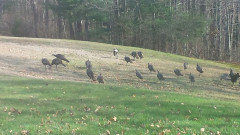
    A couple hours ago I had about a dozen fat tom turkeys scratching around on my property. October is fall turkey season here and I do have my land owner tags but I was in a online meeting at the time and couldn't get away. A few of them were at least 20 lbs.. I'm sure they will be back. I may go out this weekend and see if I can bag one.

  • 4 years ago

    I cooked my Butterball on Saturday. Was very disappointed, I won't buy another one.

    The meat was chewy and when putting the leftovers in the frig, it smelled very gamey. Or perhaps it was just a strong turkey smell.

    I asked my friend how hers turned out, and she said hers was chewy too. Yuk.

    I did make turkey tetrazzini as a leftover meal, plus a meal of heated actual leftovers.

  • 4 years ago

    We love wild turkey I don't think of it as gamey. It has more flavor.


  • 4 years ago

    Elizabeth,

    Come and get them! They visit every day in my back field.


  • 4 years ago

    I have had Butterball in the past that family had cooked, don't remember chewy but more of a mushy texture. It will have to work this year and will be blessed to have family and food to share

  • 4 years ago
    last modified: 4 years ago

    The best turkey I've ever had was fresh wild turkey breast grilled on a Weber kettle over charcoal and cherry wood with indirect heat. If I can bag one I'll be cooking it that way for sure. IIRC I soaked the breasts in buttermilk for a few hours between the kill and the grill.

  • 4 years ago
    last modified: 4 years ago

    I have never had a Butterball turkey turn out chewy or mushy. Maybe it's the cooking method. When doing a whole turkey I always stuff them.

    My DMIL would practically boil a turkey to death, with added water, covering and cooking for hours.

  • 4 years ago
    last modified: 4 years ago

    It's too early in the US for the stores to advertise turkeys. I'm not too worried about it. I have two turkey breasts in the freezer. Last year we seen turkey every evening in our yard at camp. This year we only seen them once. The only difference is we have a bear that took up residence in the area this year.


    I've never had a chewy turkey. When I tried a liquid brine once it did turn out mushy.

  • 4 years ago

    wildchild2x2, I always stuff my turkey and just roast in open roaster, the family member didn't stuff and oven cooked so I am just hoping it turns out fine. The important thing is not dry.

  • 4 years ago

    I don't care for stuffing inside a turkey, it's usually mushy. (another thing that my friend noticed this year. For the first time ever her stuffing stuck together and was gluey).

    My turkey was unstuffed, with onion, carrot and lemon inside the cavity, uncovered. Roasted for 3 hours, temp read 150degrees, so cooked longer till 165 and rested for 20 minutes or so.

  • 4 years ago

    Sorry for your negative Butterball experience, jasdip. We stopped buying those many years back for much the same reasons, we were dissatisfied with the flavor and the texture of the meat.


    We also don't stuff turkeys. Not only does it complicate fully cooking both the stuffing and the turkey, you can't brown the top of the stuffing as you can when it's in a baking dish. Stuffing cooked separately can come out both moist inside and nicely crusted on top. If the internal temp says it's done cooking but not yet brown on top, 30 seconds at a safe distance under the broiler will fix that.

  • 4 years ago

    Was in Walmart earlier today and saw a very small amount of turkeys in one of their freezers and I remembered this post. I decided to grab one. It's a pretty small one. My freezer isn't big and I don't want a ton of leftovers.

  • 4 years ago

    My stuffing is fully cooked before it goes in the bird. Cooled overnight in the fridge and put in the bird in the morning so everything starts at the same temp. My dad used to rise early to make it and stuff the bird while it was hot but I don't do early mornings. Never gloopy or gluey. I make extra that goes in a side dish and then it's all mixed together before serving. I don't eat other people's stuffing. People who dislike stuffing like mine. It's simple ingredients but the process takes time to brown it properly before putting in the bird.

  • 4 years ago

    Fried, roasted, smoked, cooking bag, unstuffed, stuffed, liquid brine, dry rub, oyster dressing, sage dressing, sausage dressing, high temp, low temp, frozen or fresh, there is no right or wrong. It's like pasta sauce, ribs or chili, if you Google it you will come up with pages and pages of different recipes for the same thing. The best way is how you and your family enjoy preparing and eating the bird.

  • 4 years ago
    last modified: 4 years ago

    "so cooked longer till 165 and rested for 20 minutes or so." No wonder your breast meat was chewy and dry. 165 out of the oven is to hot and then resting will raise the temperature another 5 degrees to 170 and it's toast, and it wasn't the turkey brand.

    Over the last 3 months I've cooked two cheap brand turkey breasts in the bone and both were perfect. Nothing special just thaw, season, let sit at room temp for an hour, stick in oven with temperature probe inserted, it beeps at 155, verity with handheld probe, pull out of oven, cover wait a while with the probe in and it they always come up to 160 and even a little more. It's not hard.

Sponsored
Miller Woodworks
Average rating: 5 out of 5 stars23 Reviews
Franklin County's Trusted Custom Cabinetry Solutions