

100% whole wheat bread
6 years ago
last modified: 6 years ago
Featured Answer
Sort by:Oldest
Comments (17)
- 6 years ago
Related Discussions
Mini-Zo versus full sized ZO?
Comments (4)I settled on the Mini Zo because we do a lot of traveling back & forth to our lakehouse and the Mini is very easy to transport. I also like the smaller footprint of that machine. We're empty nesters, too, and the smaller loaf suits our weekday needs. I think it performs really well with all types of bread - whole wheat/grains, sticky doughs, etc. When we have people over and I want larger, or different sized/shaped loaves it can mix & knead ingredients for those larger recipes and I can let them rise outside the machine and bake them off in my oven. The "minus" in the Mini is that most recipes I find and would like to try - even on the King Arthur website - are not given in measurements for the small loaf size. Of course it's possible to recalculate everything but, for me, it's a pain to have to try measuring things out in fractions and trying to "split eggs", etc., - almost seems like less work to just make the bread without using the machine. There are some books - the Hensperger book cited above, for example - that give measurements for 1 lb. loaves, but most do not. Something to consider - Do you plan to always have it on your countertop? If so, I would probably go with the full size one. Yes, it takes up a bit more space, but not that much. If you won't keep it out & will need to store it and lug it in & out a lot, I'd suggest the Mini - it doesn't take up nearly the storage space and is easy as a tote bag to pick up by the handle and move around. If the ease of portability wasn't a big issue for me and I were to buy another, I'd go with the full size. Cost wise, I believe the difference is negligible over the time the machine should last. And for me, a big part of having the machine is for its convenience. There are times when I want to mix, knead, let rise/puch down, & form bread for baking, but most times when I prepping the rest of the meal I want to just read a recipe, measure it out as written, pop in the ingredients & get the finished product. Good luck with your decision. I bet you'll be pleased w/ either machine. Zo's are great!...See MoreWheat Bread- Sticky Dough??
Comments (7)Thanks Teresa, Grainlady and Annie for your help. Mad about Mickey, what a coincidence. The first one was certainly not my best either. Teresa- You answered one of the questions I didn't ask... I wondered if I was supposed to use the paddle then switch to the hook. Do you switch after all ingredients are in I'm guessing? I use my mixer a lot, but for the same few things... cookies, an occasional cake, whipped cream and dog treats. I should probably read the instructions again. Grainlady - here is the recipe... 2 1/2 teaspoons instant yeast, or 1 packet active dry yeast dissolved in 2 tablespoons water 1 1/3 cups (10 1/2 ounces) water 1/4 cup (1 3/4 ounces) vegetable oil 1/4 cup (3 ounces) honey, molasses, or maple syrup 3 1/2 cups (14 ounces) King Arthur Traditional Whole Wheat Flour 1/4 cup (1 ounce) nonfat dried milk 1 1/4 teaspoons salt Mixing: In a large bowl, combine all of the ingredients and stir till the dough starts to leave the sides of the bowl. Transfer the dough to a lightly greased surface, oil your hands, and knead it for 6 to 8 minutes, or until it begins to become smooth and supple. (You may also knead this dough in an electric mixer or food processor, or in a bread machine programmed for "dough" or "manual.") Transfer the dough to a lightly greased bowl, cover the bowl, and allow the dough to rise till puffy though not necessarily doubled in bulk, about 60 minutes, depending on the warmth of your kitchen. Shaping: Transfer the dough to a lightly oiled work surface, and shape it into an 8-inch log. Place the log in a lightly greased 8 1/2 x 4 1/2-inch loaf pan, cover the pan loosely with lightly greased plastic wrap, and allow the bread to rise for about 1 hour, or until it's crowned about 1 inch above the edge of the pan. A finger pressed into the dough should leave a mark that rebounds slowly. Baking: Bake the bread in a preheated 350F oven for about 40 minutes, tenting it lightly with aluminum foil after 20 minutes. Test it for doneness by removing it from the pan and thumping it on the bottom (it should sound hollow), or measuring its interior temperature with an instant-read thermometer (it should register 190°F at the center of the loaf). Remove the bread from the oven, and cool it on a wire rack before slicing. Store the bread in a plastic bag at room temperature. Yield: 1 loaf, 16 slices. I think when I made it by hand, I basically did what you were saying. When I tried to strictly follow directions, the dough was too sticky to work with, so I added the flour until I could work with it. I finished kneading with the oil. I didn't punch the dough, but I don't think that hurt much of anything, I only have one spot with a bigger air bubble, so I must have smushed it enough when I shaped it. I have never tried the sponge, in fact, I had never heard of it before last year when I was thinking about learning to make some different types of bread. I will try that sometime. I was taught how to bake bread by my great aunt when I was in elementary school (early 80's??) I make some here and there, but years go by without making any, so I have to regain the "feel" of it. That's why I posted, I the dough didn't feel right when I followed the directions, and I was second guessing myself. I have also discovered you can learn A LOT from these forums, so I thought it might be educational to ask! I think I need to re-acquaint myself with bread baking the way I was taught, and then I should try out some other methods. There seems to be a ton of variety out there, and I should learn some of it. Thank you, and BTW, this loaf did turn out much better than the first one....See MoreMy first whole wheat bread
Comments (17)This recipe was given to me by a dear friend, Mildred, from Arkansas. She got a similar recipe from Pleasant Hill Grain but wasn't happy with it, and together we "tweaked" it. This recipe is designed for a Zojirushi Bread Machine (make the dough only - not baked in the bread machine), but it will work if you want to make it by-hand. We call it "Mildred Bread" at our home, and there is a 3x5 recipe card with the ingredients safely taped to the bread machine. It's our everyday bread. I make loaves, dinner rolls, burger buns, hot dog buns, cinnamon rolls, etc. all from this same dough. Sometimes I'll make one 1-pound or 1-1/2-pound loaf and use the remaining amount of dough for rolls, cinnamon rolls, burger buns, etc.... This recipe is a bit wordy with explanations (that's the teacher in me from teaching so many bread classes ;-), but once you've made it, you'll be able to follow a 3x5 recipe card with the ingredients listed on it, like I do. CAUTION: Not all bread machines are capable of mixing 100% whole wheat bread dough, so check your user's manual. Enjoy, -Grainlady 100% WHOLE WHEAT BREAD Sponge: The night before, remove the bread machine pan and add the ingredients: 3/4 c. warm buttermilk (I use homemade kefir) 3/4 c. warm water 2\-1/2 c. freshly milled hard wheat (red or white) flour 1/4 t. ascorbic acid (if you don't have, or can't find, ascorbic acid, use Fruit Fresh \- but the acid is important!!!) 2 t. SAF\-Instant Yeast (I suggest SAF\-Instant Yeast and have never used anything else for this recipe) Place the pan into the bread machine and set on the Quick Dough setting and allow the ingredients to mix together well for a few minutes (you may need to scrape down any dry particles with a spatula), then turn the bread machine off (at the button, don't pull the plug or you risk damaging your bread machine computer). Shut the lid, and allow this mixture to set overnight. (If you are in a hurry, let the ingredients sponge for 1\-1/2 hours and then finish making the bread.) \*\*If making the recipe by hand, mix the ingredients well using a Danish Dough Whisk or a wooden spoon. Cover the bowl (using a shower cap, a Quick Cover, or a sheet of plastic wrap) and allow to sit on your counter at room temperature. If you have a dough\-rising bucket, use it for mixing the dough as well as for rising. After mixing in a dough\-rising bucket, snap on the lid and allow the sponge to sit on your counter. The next day (or anytime after 1\-1/2\-hours), remove the bread machine pan and add these ingredients to the sponge: 2 T. coconut oil (melted \- or use vegetable oil or melted butter) 2 T. honey or agave nectar 1 egg (I also add 1/3\-1/2 c. of chia seed gel, but that's optional.) On top of these ingredients in the bread machine pan add: 2\-1/4 c. freshly\-milled whole wheat flour 2 t. salt Place the pan back into the bread machine. Set bread machine to Quick Dough Cycle and start the machine. After it has been working for 5\-minutes, or so, be sure to check the hydration of the dough. You want a nice soft ball that is slightly sticky to\-the\-touch. It's better to err on the side of a wet dough than a stiff dry dough, so adjust the dough by adding more flour, or adding more water, if necessary. As soon as the dough has completed the kneading cycle (don't allow the dough to rise in the bread machine), turn the machine off. Remove the pan from the bread machine and dump the dough out onto a SILPAT (no flour necessary). With oiled hands so the dough doesn't stick, pat the dough into a dough\-rising bucket (I use a 2\-quart plastic food storage container that has graduated measurements on the side. I got the container at the local restaurant supply store, but you can find dough\-rising buckets at King Arthur Flour and elsewhere on\-line. I have them in three sizes for different amounts of dough.) Snap the lid on the dough\-rising bucket and allow it to rise until just under "double". (If the dough comes up to the 1\-quart line, it will be double when it reaches the 2\-quart line.) Check the rise after 20\-25\-minutes. It rises quickly if your kitchen is warm, and slower if your kitchen is cool. \*\*If making the dough by\-hand, add the 2 t. salt, 2 T. agave nectar (or honey) and egg to the sponge mixture, and then add enough of the 2\-1/4 c. of whole wheat flour to make a nice soft dough (add more flour than 2\-1/4 c., if necessary). Add the flour gradually \- a little at a time, and beat each addition of flour into the mixture before adding more. A Danish Dough Whisk is the perfect tool for this process (as well as stirring all batters and doughs), but a wooden spoon will also work well. If you do a good job of mixing, you won't need to spend as much time kneading. When making bread dough by\-hand, you need to spend a good deal of time beating the dough with the spoon or Danish Dough Whisk. You develop the gluten during the mixing, as well as during kneading. When you don't have the strength to mix it with a spoon anymore, place the dough on an oiled counter top and knead until the gluten has developed (6\-10 minutes). If you use an oiled counter top you won't have to add flour to the dough. By doing a good job of mixing, you will need only a little additional flour \- or none at all. If your dough is a shaggy sticky glob, you didn't do a good job of mixing. Oil your hands so they don't stick to the dough while handling it. Place dough in a dough\-rising bucket, snap on the lid, and allow the dough to rise until it's just below "double". Follow the remaining instructions... \-\-\-\-\-\-\-\-\-\-\-\- When the dough has doubled in bulk, you will need to take the lid off the dough\-rising bucket and punch it down. To do that, oil your hand and make a fist. GENTLY drive your fist through the center of the dough. Now grab the outer edge of the dough and pull it into the center hole. Do this all the way around. This moves the cooler outside dough to the inside (you have essentially turned the dough inside\-out.) This method degasses the dough and also redistributes the yeast throughout the dough. Place the dough out onto a SILPAT (a silicone mat). Handle the dough with oiled hands \- no flour necessary. If you are making more than one loaf from this dough, now is the time to scale it (weigh it on a kitchen scale), and divide the dough into equal portions. Round each portion. You round the dough by cupping both hands around the dough ball while it sits on the counter and gently pull the dough from the top to the bottom, moving it slightly each time you pull it down, until you have a nice, smooth ball of dough. A smooth ball of dough will get the gluten strands running in one direction and will hold in the gasses in. Cover the dough (I use a bowl or my dough rising bucket, or a sheet of plastic wrap) and allow it to rest for 10\-15\-minutes. This allows the gluten strands to relax. To form a loaf... With oiled hands, pat the dough out on the Silpat until it's about 1\-inch thick and the width of the pan you are going to use. Roll the dough up and pinch the seam closed. Tuck the ends under the bottom. Place the dough, seam side down, into a greased loaf pan/s and cover with plastic wrap. Allow it to double in bulk. Bake in a preheated 375 degrees F oven for about 25\-minutes, or until it's between 195\-200\-degrees F when you check it with an instant read thermometer....See MoreAny baking experts help me with my bread?
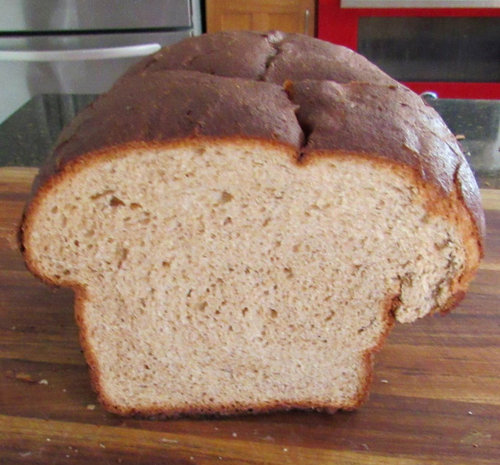
Comments (19)Just looking at that slice, I notice the bottom looks a bit too dense - almost undercooked. I do not consider myself an expert, just competent. For many years, I used to bake bread weekly (no bread machine)and occasionally had problems like that - I always figured that might mean not enough gluten development, dough is too dense, not enough yeast, old yeast without enough activity, or dough raised for too long, and fell in the oven. For yeasted doughs, I learned to mix some unbleached white or bread flour with my whole wheat flour (a bit less than 1/3 part) for a lighter result, proof the yeast, and really knead it very well for the second rise. First kneading I just do enough to mix well. And I also look for whole wheat flour that isn't too coarse, to get bigger fluffier results. King Arthur's organic whole wheat is a finer grind than most of the bulk whole wheat flour around here. My proportions are 1 Tbsp. yeast, 1 1/2 cups water, 3 1/2 cups flour (1 cup unbleached or bread), 1 tsp. salt, and 2 Tbsp. fat - usually extra virgin olive oil or butter King Arthur's bread flour is high gluten, with some barley flour in it, I seem to recall....See More- 6 years ago
- 6 years ago
- 6 years agolast modified: 6 years ago
- 6 years ago


Related Stories

KITCHEN DESIGNA Designer Shares Her Kitchen-Remodel Wish List
As part of a whole-house renovation, she’s making her dream list of kitchen amenities. What are your must-have features?
Full Story
KITCHEN DESIGNKitchen of the Week: A Sophisticated Take on 1920s Cottage Style
An Illinois designer embraces her 100-year-old home’s vintage look while incorporating modern features and finishes
Full Story
HOUZZ TVThis Light-Filled Tennessee Dream Home Was 40 Years in the Making
A retired couple used Houzz to find design professionals to help build a spacious home that can easily host 100
Full Story
KITCHEN DESIGNKitchen Accessory: The Breadbox
The breadbox — freestanding or built-in — still has a place in the modern kitchen
Full Story
LIFESimple Pleasures: The Joy of Baking
Fill your house with a heavenly scent and your heart with cheer by making time to bake
Full Story
FARMHOUSESWorld of Design: See How 9 Families Live and Farm on Their Land
Join us as we visit the homes and farms of passionate food producers and hear about rural life around the globe
Full Story
KITCHEN DESIGNHouzz Call: Tell Us About Your First Kitchen
Great or godforsaken? Ragtag or refined? We want to hear about your younger self’s cooking space
Full Story
HOUZZ TOURSHouzz TV: See a Modern Family Farmhouse That Can Pick Up and Move
In the latest episode of Houzz TV, watch California architect build a beautifully practical cabin to jumpstart his parents' new farm
Full Story
PETSHouzz Pets Survey: Who Rules the House — Dogs or Cats?
New data shows that pets make people happy, and pet owners love spending big to return the favor
Full Story
MOST POPULARDecorating 101: How Much Is This Going to Cost Me?
Learn what you might spend on DIY decorating, plus where it’s good to splurge or scrimp
Full StorySponsored

Central Ohio's Trusted Home Remodeler Specializing in Kitchens & Baths

plllog