

Who is not having Turkey?
8 years ago
Featured Answer
Sort by:Oldest
Comments (37)
Related Discussions
Explain how to cook a turkey...to someone who can't speak English
Comments (7)Unfortunately I have no idea what their plan was. I felt bad because my communication was clearly not getting through, which is why it took so long to get even those basics across. This suddenly reminds me of a story I heard years ago, probably an urban legend, but here it is. A newly arrived immigrant family goes to the grocery store and ends up buying a can of crisco, fully expecting it to contain fried chicken parts as pictured on the label! I don't know if they realized the turkeys were plentiful because of thanksgiving or if they just thought that this was a regularly stocked item. I figured at the time that they were trying to get into the American spirit of things but looking back, I wouldn't be surprised if they'd only been in the country a few days and had no idea about Thanksgiving! I just have to keep telling myself that if they were brave enough to buy it, then they would be able to figure out if it was done after three hours or not....See MoreTurkey, Turkey, Turkey -----------
Comments (38)Thanksgiving is the only day we eat turkey. The rest of the time, give me a roast capon or a duck prepared almost any way at all. DH and I are just not turkey lovers. My niece makes a very fine brined and roasted turkey, but once a year is enough for us. We're sauce and gravy people. Stews, braises, casseroles - we love them. I do a fair amount of cooking and a lot of dining out, and we hold that a fine sauce is a work of art. Even though we eat a lot of steaks and roasts, a great sauce is always to be admired. There are too many bad ones around to not acknowledge when something is done correctly. One of our favorite restaurants does a great poached monkfish. This is the fish known as "the poor man's lobster" for both its taste and texture. It's a great little fish, with wonderful flavor. But nap it with Amoricaine sauce, and it rises to a whole 'nother level. This is a Bretonnese classic, and for good reason. Red wine and marrow Bordelaise on a rib-eye? Absolutely! Black truffle cream sauce on a filet? Yum! Mop that goodness up with a well made starch - roasted fingerling potatoes, barley risotto, fresh pasta, freshly baked bread rolls. Gravy and sauce was the way to extend meat to feed a lot of people. Most of the world still loves sauced dishes as treasured childhood memories. Like soup, they are warmth and comfort, soothing and homey. Chicken strips that are velveted and steamed with lop cheong sausage (classic Chinese technique) are stunningly tender, almost as soft as sous vide but we like the flavor and texture better. Perfect with a roasted garlic-oyster sauce gravy over lots of rice! Far better than stir-frying or roasting. As Charles Phan of The Slanted Door restaurant in SF points out in today's WSJournal, steaming is considered the ultimate test of a professional chef in Asia. Getting back to the NY Times' and Pepin's suggestions for steaming, one of the greatest dishes in Chinese cuisine is steamed sliced chicken breast with thin slices of Hunan ham. My mother introduced me to this dish (she took classes from one of the leading Chinese restaurateurs in San Francisco) and it still ranks with DH and me as one of the three finest poultry dishes we've had in our 45 yrs of dining. A glaze should always be light. Heavy-handedness is the mark of a bad cook. Peking Duck would not be the same without the glaze applied, for example....See MoreWho's cooking their turkey in a Nesco roaster??
Comments (28)Again, if you want dark brown, crispy skin you don't want to use a covered roaster, electric or non-electric. If you put a bird in a covered roaster in the oven it'll not be that mahogany color that some insist on. You need *dry* air to crisp the skin. Roasters keep the moisture in and it partly steams the food. I have the Roast-Air lid for my 6 qt and use it occasionally but I don't eat the skin anymore so I don't bother. I usually only used the lid the last 15-20 minutes, crank the heat up a bit too after I had removed all the juices. (Got to get rid of moisture to get dry, browning heat) You'll also have a lot more juice left in a roaster since it doesn't evaporate like in a dry oven. I've also cocked the lid to let the excess moisture out and cranked the heat up when I wanted it more crisp. Although even then I often microwaved the skin and ate it as a snack. I don't know what they do to the birds these days but I don't like the skin anymore. Even when it's dried out and crisper, I don't like the taste of it. Dry air is also going to give a bigger danger of dry meat. The appliance is a tool. The cook makes it good or bad. You can't always blame the tools when the carpenter is incompetent. FWIW I've never seen an electric roaster that didn't have a removable cookwell. Oh and removing the lid often loses a lot of heat and moisture. I highly recommend a probe thermometer that you can read outside of the oven or roaster. Yes the outside gets very hot. I've never burned myself but I've used some not-so-nice language when I've touched it. I've thought about wrapping it similar to a water heater blanket. Thought it might save some energy too. Target has an 18 qt Oster oven for $29, Menards has the 18 qt Nesco for $38.88 and Target has a Sunbeam 16 qt for $26. I imagine Target will put them on clearance before long too so if you want to wait you can pick up a bargain. Last year they had one on clearance for $17 (not a Nesco though). AFAIK, Nesco has never made a 16 qt unit. Nesco's have come in 4, 5, 6, 12 and 18 qt. If you measured water, it could be they consider the domed lid as part of the capacity, I'm not sure. Virginia Olson of Nesco always used to say that the 18 qt would handle up to a 20# bird, however, I read all the time about people doing 22# birds in the 18 qt. That sounds like about the max but many say if you can stuff it in there, it'll cook! And I'm sure it would. If anything you might have a crisper skin....See MoreFor those who brine the turkey --
Comments (10)I switched to Judy Rogers' Pre-salting method about two years ago. I think that the end result is better and so much easier to deal with. I roast using Barbara Kafka's high heat method (500F). Home Cookin Chapter: Recipes From Thibeault's Table Pre-Salting =========== Judy Rogers' Zuni Cafe method Servings: 11 to 15 Note: This is more a technique than a recipe. It makes a bird that has concentrated turkey flavor and fine, firm flesh and that is delicious as it is. But you can add other flavors as you wish. Minced rosemary would be a nice finishing addition. Or brush the bird lightly with butter before roasting. 1 (12- to 16-pound) turkey Kosher salt 1. Wash the turkey inside and out, pat it dry and weigh it. Measure 1 tablespoon of salt into a bowl for every 5 pounds the turkey weighs (for a 15-pound turkey, you'd have 3 tablespoons). 2. Sprinkle the inside of the turkey lightly with salt. Place the turkey on its back and salt the breasts, concentrating the salt in the center, where the meat is thickest. You'll probably use a little more than a tablespoon. It should look liberally seasoned, but not over-salted. 3. Turn the turkey on one side and sprinkle the entire side with salt, concentrating on the thigh. You should use a little less than a tablespoon. Flip the turkey over and do the same with the opposite side. 4. Place the turkey in a 2 1/2 -gallon sealable plastic bag, press out the air and seal tightly. Place the turkey breast-side up in the refrigerator. Chill for 3 days, turning it onto its breast for the last day. 5. Remove the turkey from the bag. There should be no salt visible on the surface and the skin should be moist but not wet. Place the turkey breast-side up on a plate and refrigerate uncovered for at least 8 hours. 6. On the day it is to be cooked, remove the turkey from the refrigerator and leave it at room temperature at least 1 hour. Preheat the oven to 425 degrees. 7. Place the turkey breast-side down on a roasting rack in a roasting pan; put it in the oven. After 30 minutes, remove the pan from the oven and carefully turn the turkey over so the breast is facing up (it's easiest to do this by hand, using kitchen towels or oven mitts). 8. Reduce the oven temperature to 325 degrees, return the turkey to the oven and roast until a thermometer inserted in the deepest part of the thigh, but not touching the bone, reads 165 degrees, about 2 3/4 hours total roasting. 9. Remove the turkey from the oven, transfer it to a warm platter or carving board; tent loosely with foil. Let stand at least 30 minutes to let the juices redistribute through the meat. Carve and serve. Notes: This same method can be used for chicken, chicken pieces, pork roasts, ribs, chops, etc.. With the smaller cuts just pre-salt 4 or five hours in advance. Even this short period of presalting makes an amazing difference. Don't cover, just refrigerate and then remove from the fridge in time for the meat to come to room temperature before cooking. Home Cookin Chapter: Recipes From Thibeault's Table Simple Roast Turkey - High Heat Method ====================================== Source:Barbara Kafka Roasting A Simple Art Many Thanksgivings at my house have proved the high-heat method to be ideal. A fifteen-pound turkey at room temperature takes two hours to roast. However, it may take several hours for the turkey to reach room temperature. While the turkey is sitting out, cover it loosely with a towel, otherwise the skin will dry out. I prefer a fifteen-pound turkey as it isn't too heavy for me to handle. It usually gives lots of good leftovers and is generally available. There are certain things to think of to ensure success before beginning: Remove the giblet bag from the interior of the bird. Remove the wing tips. Put everything except the livers into a pot and start Basic Fowl Giblet Gravy. By the time the bird is roasted, the gravy will be done. Use the liver in the dressing/stuffing or store in the freezer, covered with milk. Make sure there is a pan big enough for the turkey without it's touching the sides of the pan. Do not truss. Consider whether the bird should be stuffed or the stuffing served as dressing baked separately. If stuffing, think in terms of twelve cups of stuffing for a 15 pound bird, which will allow the big cavity to be stuffed and some more stuffing to be crammed under the skin flap at the neck. I seldom stuff because there are real food safety questions about the bird and its stuffing sitting out at room temperature. The oven must be very clean before roasting, or cooking at this high temperature will cause unpleasant smoke. In any case, there will be some smoke, so turn on the fan or open a window. Don't put the oven rack too high or the skin on the breast will get over cooked. For a twenty-pound turkey, the rack should be in the lowest position. Always put the turkey in legs first - dark meat takes longer to cook and the rear of the oven is the hottest area. If the top skin seems to be getting too dark, slip a doubled piece of aluminum foil on top of it. Don't move the turkey. Use an oven mitt to protect hands and forearms. Remove the foil with the same oven mitt ten minutes before the turkey comes out. Large turkeys are most easily removed from the pan by holding them with two pot holders, which will need to be washed. After the meal, get out a large stockpot to boil up the carcass and leftover bones for turkey soup and stock. 15 pound turkey, thawed, if necessary and at room temperature, wing tips removed, reserving giblets and neck for gravy, liver for stuffing. Fresh ground black pepper to taste 1 cup water or basic turkey/chicken stock Place oven rack on second level from bottom of oven. Heat oven to 500°F. Rinse the turkey inside and out. Pat dry. Sprinkle the outside with pepper. If stuffing, stuff cavity and crop, securing openings with long metal skewers. Lace them. Do not truss. Put turkey in an 18 X 13 X2 inch roasting pan, breast side up. Put in oven legs first. Roast until the leg joint near the backbone wiggles easily, about 2 hours. After 20 minutes, move the turkey around with a wooden spatula to keep from sticking. Remove the turkey to a large platter. Let sit 20 minutes before carving. Pour off grease from roasting pan and put pan on top of the stove. Add water or stock. Bring to a boil while scraping bottom of pan vigorously with a wooden spoon, loosening all the crisp bits in the bottom of the pan. These add intensity to the gravy. Let reduce by half. Serve on the side in a sauceboat or add to giblet gravy. 9 pounds stuffed 1 hour 45 minutes unstuffed 1 hour 15 minutes 12 pounds stuffed 1 hour 50 minutes unstuffed 1 hour 20 minutes 15 pounds stuffed 2 hours 30 minutes unstuffed 2 hours 20 pounds stuffed 3 hours 30 minutes unstuffed 3 hours...See More 8 years ago
- 8 years agolast modified: 8 years agoirma thanked rhizo_1 (North AL) zone 7


Related Stories
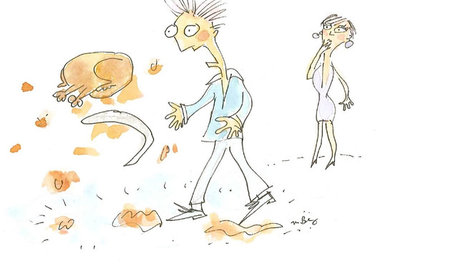
MOST POPULARThanksgiving Tales: When the Turkey Tanks
Houzz readers prove adept at snatching victory from the jaws of entertaining defeat
Full Story
PRODUCT PICKSGuest Picks: Talkin' Turkey
20 kitchen essentials and extras for the star of your Thanksgiving feast
Full Story
FALL AND THANKSGIVINGYour Guide for a Simpler Thanksgiving
Ease the stress of hosting the big day with these tips
Full Story
HOLIDAYSTurkey Day Countdown: 7 Things to Do This Weekend
Get your home ready for guests and the big meal
Full Story
HOLIDAYSHow to Have a Just-Simple-Enough Holiday
Make this the year you say no to holiday stress and yes to joy and meaning
Full Story
KITCHEN DESIGN20 Kitchen Must-Haves From Houzz Readers
We asked you to tell us your top kitchen amenities. See what popular kitchen features made the list
Full Story
FARM YOUR YARDIf You Have Room for Only One Fruit Tree ...
Juice up a small garden with one of these easier-care or worth-the-effort fruit trees for a mild climate
Full Story
KITCHEN DESIGN11 Must-Haves in a Designer’s Dream Kitchen
Custom cabinets, a slab backsplash, drawer dishwashers — what’s on your wish list?
Full Story
THE POLITE HOUSEThe Polite House: How to Have a Successful Potluck
Avoid confusion over food allergies, leftovers, casserole dishes and who gets to drink that nice bottle of wine with these helpful tips
Full Story
Summer