

The Myth of High Altitude Cooking
8 years ago
Featured Answer
Sort by:Oldest
Comments (10)
 8 years ago
Related Discussions
Altitude
Comments (11)Genetic research has, is and shall be unlocking a lot of issues similar to this. Certain studies into the human genome and population migrations have instituted research into how genetics may influence capabilities of humans to adapt to geographical environmental impacts. Most of us can agree that organisms can adapt over time to survive or even thrive because some mutations can cause a successful result and those individuals will have reproductive advantages over previous populations, whose genes may eventually be lost to the pool. However not all genetic material mutates at a constant rate, and some is very persistent in or near its original state over long periods of time. It has been found that mitochondrial DNA changes little over time, and the only mitochondrial DNA passed from mother to child is her line only with no contribution from the paternal line (unlike any other DNA in the body). Therefore a direct line of mtDNA can be traced back for eons through the maternal line only, as the buck stops with a father and his mtDna line is lost to offspring. They will receive the footprint of his wife. But if a person, man or woman can trace back her mother, her mother's mother, her mother's mother's mother the genetic footprint for mtDNA will not change for many, many generations if at all. Where I'm headed with this is: the mitochondria are the powerhouses of the body. They are the organelles responsible for energy and heat production. This obviously becomes a factor for migrations of people who have historically lived in tropical zones and how succesfully or even whether they can survive in far northern areas. I'm thinking ice ages. I'm thinking quality of life for mobile populations and how 'comfortable' they feel in different geographical locations, I'm thinking compensatory body processes. I'm also thinking of how populations where successful mutations didn't occur could eventually be obliterated. I have found I have an extremely rare mtDNA genotype. It is not much researched since it does not represent most populations. It is however considered an ancient mutation, and it is found in every corner of the earth at low frequency. It is still as pertinent to me as it would have been to an ancestor thousands of years ago, because it controls my body's energy production and efficiency. It is also thought that at one time, it was not a rare group and occured in much higher frequency in ancient populations. It has been suggested that since this type of DNA doesn't mutate quickly changes in the earth's environment may have played into a near extinction of my genotype. I find this amazingly interesting. It may also play into why I love hot weather or even in what altitude I am most comfortable....See MoreCooking: Myths or Musts?
Comments (118)When I was a kid, we couldn't jump if a cake was in the oven. Probably angel food cake. My trick to flatten out cookies that are rising too much (usually chocolate chip), is to open the oven 2/3 way throught the cooking time, raise and end of the pan, and bang it down on the rack. Cookies instantly flatten out. So, I have a hunch, at least with a cake like angel food cake, a direct hit like the cake pan jarring, might deflate it. Shouting...not so much. Half myth, half must....See MoreHigh altitude tips?
Comments (12)I'll put in an interlivrary loan request and check out that book. Lee, I'm sorry. I have a case of CRS! Colorado, is it? I'm in NW Nevada. I was campaigning hard for moving to the Csprings area, though. DH has a step-sibling near there. Hi Ellen! Oh, it's a long and boring tale! The Reader's Digest Condensed version is that my MIL talked us into it. She had serious health issues over the past two years. At one point it was serious enough to trigger her medical power of attorney, which is held by DH. Fortunately, she had given us explicit instructions about her wishes several years ago -- a conversation I strongly suggest EVERYONE have with their families. Still, trying to manage her healthcare long-distance was a nightmare and there was no way either of us could leave our jobs. DH finally strong-armed FMLA time, but that's unpaid and a nightmare of a different sort. MIL has since recovered beyond our wildest hopes, for which we are very grateful. Meanwhile, our situtation had changed, and there was no longer anything to keep us in KY. We started thinking about moving closer to DH's family. We were kicking around the idea of NM or CO when MIL offered to rent us her house until the real estate market recovers. It is a win-win solution for all of us. MIL doesn't have to worry about a house that's too much for her to tend anymore, we don't have to worry about selling our place before we can find another, and DH doesn't have to worry about me being stranded BFE while he's on the road for work. I, of course, worry about everything, but that's just what I do. LOL! DH is still back east until the house in KY sells. Neither of us is thrilled with that part of the deal, but you do what you have to do. With any luck, he'll be able to tie up those loose ends, negotiate a transfer with his job and join me here within the next year....See MoreHigh Altitude Baking / Cooking
Comments (12)I'm at about 6500 foot above sea level. I use less yeast in yeasted doughs. I prefer to do mashed potatoes in a pressure cooker and beans long and slow in the crockpot. Baked potatoes are always given a head start in the microwave before going into the oven. Most baked goods I do not modify, mainly from laziness. On most things, I do not find that the extra effort makes a tangible enough difference for my crowd to notice. For the weather, the current storm is a bit of an anomaly. We have had a very, abnormally warm spring with some winter storms that come in that are doozies. In my part of New Mexico I am absolutely ready though for the weather to get on with it and behave a little better....See More 8 years ago
- 8 years ago
- 8 years ago
- 8 years ago
- 8 years ago
 PRO8 years ago
- 8 years agolast modified: 8 years ago
 8 years ago

Related Stories
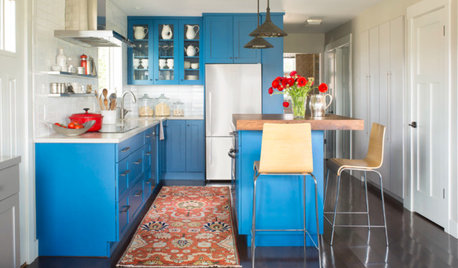
COLORFUL KITCHENSKitchen of the Week: High-Altitude Kitchen Bursting With Blue
A modest-size space gets a cheerful and smart update that improves flow and adds storage space
Full Story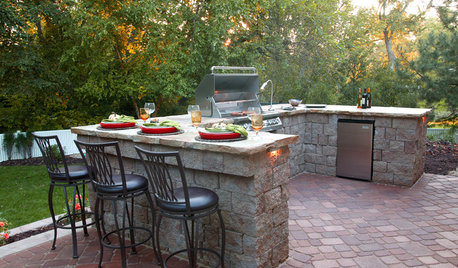
OUTDOOR KITCHENSYour Guide to Grills and More for Great Outdoor Cooking
Learn the pros and cons of gas versus charcoal grills, and about neat add-ons that let you do more
Full Story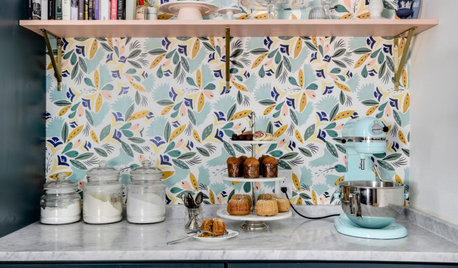
KITCHEN DESIGN12 Items Worth a Spot on Your Kitchen Counter
Keep these useful tools and accessories out in the open to maintain high function without spoiling the view
Full Story
DECORATING GUIDESHow to Get Authentic French Style in Your Home
Move over Shabby Chic and French Provincial. These myths and realities reveal the real look of French decor
Full Story
HOUSEKEEPINGCan-Do Cleaning Strategies for Busy People
While you dream of having a maid (to go with the cook and chauffer), this simplified cleaning routine can keep your real-world home tidy
Full Story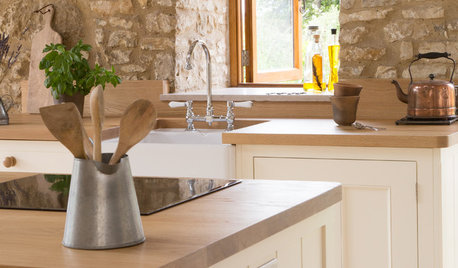
KITCHEN DESIGNHistoric Stone Barn Now a Country Farmhouse Kitchen
A designer carves out a cooking and dining space while carefully preserving the protected 17th-century structure
Full Story
LIFEConsider Avoiding These Plants to Help Keep Your Garden Fire-Safe
Plants that accumulate dead material, are high in oil or have low moisture content in leaves put some homes at risk
Full Story
EDIBLE GARDENSWhy Grow Quince? For Beauty, Fragrance and Old-Time Flavor
Delightfully perfumed fruit and lovely spring blossoms make this apple and pear cousin worth a spot in the garden
Full Story

KITCHEN APPLIANCES9 Places to Put the Microwave in Your Kitchen
See the pros and cons of locating your microwave above, below and beyond the counter
Full Story

writersblock (9b/10a)