

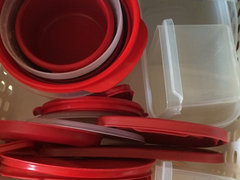
Ugh...too many different lids and different size containers
10 years ago
Featured Answer
Sort by:Oldest
Comments (19)
 10 years ago
 10 years ago
Related Discussions
How to Choose Correct Container Size for Different Plants
Comments (13)Ellen & Jenn - A copy/paste job from a reply I wrote on another thread: How large a container can or should be, depends on the relationship between the mass of the plant material you are working with and your choice of soil. We often concern ourselves with "over-potting" (using a container that is too large), but "over-potting" is a term that arises from a lack of a basic understanding about the relationship we will look at, which logically determines appropriate container size. It's often parroted that you should only move up one container size when "potting-up". The reasoning is, that when potting up to a container more than one size larger, the soil will remain wet too long and cause root rot issues, but it is the size/mass of the plant material you are working with, and the physical properties of the soil you choose that determines both the upper & lower limits of appropriate container size - not a formulaic upward progression of container sizes. In many cases, after root pruning a plant, it may even be appropriate to step down a container size or two, but as you will see, that also depends on the physical properties of the soil you choose. Plants grown in slow (slow-draining/water-retentive) soils need to be grown in containers with smaller soil volumes so that the plant can use water quickly, allowing air to return to the soil before root issues beyond impaired root function/metabolism become a limiting factor. We know that the anaerobic (airless) conditions that accompany soggy soils quickly kill fine roots and impair root function/metabolism. We also know smaller soil volumes and the root constriction that accompany them cause plants to both extend branches and gain o/a mass much more slowly - a bane if rapid growth is the goal - a boon if growth restriction and a compact plant are what you have your sights set on. Conversely, rampant growth can be had by growing in very large containers and in very fast soils where frequent watering and fertilizing is required - so it's not that plants rebel at being potted into very large containers per se, but rather, they rebel at being potted into very large containers with a soil that is too slow and water-retentive. This is a key point. We know that there is an inverse relationship between soil particle size and the height of the perched water table (PWT) in containers. As particle size increases, the height of the PWT decreases, until at about a particle size of just under 1/8 inch, soils will no longer hold perched water. If there is no perched water, the soil is ALWAYS well aerated, even when the soil is at container capacity (fully saturated). So, if you aim for a soil (like the gritty mix) composed primarily of particles larger than 1/16", there is no upper limit to container size, other than what you can practically manage. The lower size limit will be determined by the soil volume's ability to allow room for roots to 'run' and to furnish water enough to sustain the plant between irrigations. Bearing heavily on this ability is the ratio of fine roots to coarse roots. It takes a minimum amount of fine rootage to support the canopy under high water demand. If the container is full of large roots, there may not be room for a sufficient volume of the fine roots that do all the water/nutrient delivery work and the coarse roots, too. You can grow a very large plant in a very small container if the roots have been well managed and the lion's share of the rootage is fine. You can also grow very small plants, even seedlings, in very large containers if the soil is fast (free-draining and well-aerated) enough that the soil holds no, or very little perched water. I have just offered clear illustration that the oft repeated advice to 'only pot up one size at a time', only applies when using heavy, water-retentive soils. Those using well-aerated soils are not bound by the same restrictions. AL...See MoreToo many wasps, not enough bees...different plants?
Comments (33)Hello... Althea...thanks for your link..I just got back to this forum and noticed another post to my question. I agree with you about leaving the sunflower heads for the birds. I tried growing sunflowers many years ago, but my yard just didn't get enough sun and the only place that had the most sun was in the root zone of some trees, so it didn't work well. They didn't thrive so I stopped growing them. I do have one large 15x15 full sun perennial bed in my front yard, but not a great place for sunflowers [g]. I grow cosmos that the goldfinches also love and it is great watching them swaying on the stems to get them. That sounds like a great tip about the paper bag. I think they recommend that for corn from the raccoons too. oh..thanks for the link to NN...It looks like they are a part of gardenweb ring. that will come in handy...didn't know it was there. ftm...well you have more tolerance than I do for nests. I love bumble bees and are not afraid of them at all, but having them in a work area that I needed to access would be intolerable to me. Interesting story of the one that bumped you..[g] I tried googling the miday clavatus, but came up empty. Not sure if it could be a fly, but if it is, it looks exactly like a wasp. [g] Actually just re read your description and this insect has all bright orange legs. Thanks for the try.. :-) Adam...See MoreHow do I divide containers for different seeds?
Comments (24)This year, I bought keg cups from Costco and will plant in individual cups. I think this will help with planting as well. I never did figure out how to get the HOS out of the milk jug, without damaging the sprouts and jug. Austinhannamom.. I did the keg cups indoors last yr to pot up tomato seedlings. I had a problem w/ Dap off when i moved them outside.. If I did not put a "weep hole" on the side of the cup about an inch up I found it retained too much water. I was putting 6-8 holes on the bottom, Just an FYI. And in MA at least it's very hard to get bread trays unless you steal em. The bread guys are mostly contractors and have to pay to replace missing trays. If you have an industrial bake site you could call them and ask for the ones that are deemed unserviceable.....See MoreUsing gallon sized nursery containers...Lids?
Comments (23)token, Tulips are basically annuals here. Don't even think of them returning the following year unless they are very old plants, not the newer hybrids. I got leaves last year, but no blooms. Same here but . . .I learned a trick over on the bulbs forum. Only certain kinds of tulips will return, bloom and multiply, and the specs usually don't say because most people do grow them as annuals, some come back, but some peter out by third year. I guess you are supposed to look for "tulips for naturalizing". Never saw that phrase in all of the many I looked at. Here was my experience, but I don't know how it will be long term. I ordered some yellow and pink from Bluestone. One yellow came back, didn't bloom. A lot of the pink ones did come back and bloom, second year, don't know what they will do next spring. They did not multiply, may have lost a couple. But I ordered an assortment 2 yrs ago called "Purple Rain" from American Meadows. I planted all my tulips and covered w/chicken wire and nailed it down w/landscape pins (squirrels). Now I can take most of that up and didn't nail the latest down. The tulips will come up thru it but I had to cut some holes for some that got stuck. As soon as they are done blooming, cut back the stems way down so they won't use energy trying to make seed, leave all the foliage to die back naturally as that's how they feed the bulbs for the following year. That takes awhile and can be unsightly. At the time you cut back the stems, sprinkle the ground with Scott's Bloom Booster, shows on the container how densely. Repeat in the fall. The result was that my Purple Rain mixture multiplied some and produced more blooms this past spring, and they are on the east side where the technique wasn't expected to work because it's only morning sun. One in the assortment came back and bloomed, the purple w/white border, rest didn't. That one is shorter than the others. But the plain colors did pretty well. I just filled in a gap there and had planted a whole new row for me in front, will see how they do. I would buy other kinds but I know whatever ones are in that mixture work, except the one, and the colors work well for me. I'm still working on this spot and will overplant with something, and shouldn't have used fill flash on the photo. Here is a link that might be useful: Purple Rain Tulips...See More- 10 years agolast modified: 10 years ago
- 10 years ago
 10 years ago
 10 years ago
 10 years ago
 PRO10 years ago
 10 years agolast modified: 10 years ago
 10 years ago
- 10 years ago
- 10 years agolast modified: 10 years ago
- 10 years agolast modified: 10 years ago
- 10 years ago
- 10 years ago
- 10 years ago
- PRO10 years ago
 10 years agolast modified: 10 years ago

Related Stories

MOST POPULAR8 Little Remodeling Touches That Make a Big Difference
Make your life easier while making your home nicer, with these design details you'll really appreciate
Full Story
COLORFUL HOMESHouzz Tour: A Home of a Different Color
An interior designer infuses a Colorado home with daring and drama
Full Story
DECORATING GUIDESSuper-Versatile Storage: Lidded Glass Jars
See-Through Containers for Kitchen, Bathroom, Laundry Room and Beyond
Full Story
LIFECondo, Co-op, Townhouse, TIC — What's the Difference?
Learn the details about housing alternatives so you can make a smart choice when buying a home
Full Story
TILEEpoxy vs. Cement Grout — What's the Difference?
Grout is grout, right? Nope. Cement and epoxy versions have different appearances, durability and rules of installation
Full Story
REMODELING GUIDESCarrara vs. Calacatta Marble: What Is the Difference?
The answer is in the color and veining of these popular Italian marbles
Full Story
DECORATING GUIDESArchitectural Details Make All the Difference
Are you missing an opportunity to enhance your home with brackets, cabinet feet and moldings?
Full Story
DINING ROOMSBuffet, Sideboard, Server, Credenza: What's the Difference?
Learn the definitions and details to make shopping for dining room storage furniture less confusing
Full Story
SPRING GARDENING5 Exotic Rose Colors for a Beautifully Different Garden
Give red a rest. Let these daring hues take the spotlight instead for a rose garden that turns heads
Full Story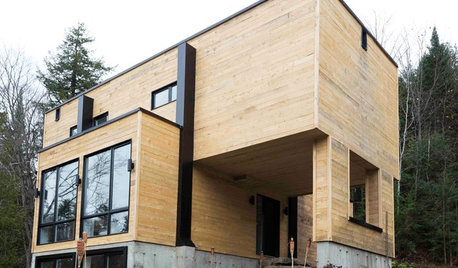
ARCHITECTUREHouzz Tour: Shipping Containers Make for an Unusual Home
Recycling hits the big time as a general contractor turns 4 metal boxes into a decidedly different living space
Full StorySponsored

Customized Award-Winning Interior Design Solutions in Franklin Cnty OH

donna_in_sask