

Okay, let’s talk corn
last year
Featured Answer
Sort by:Oldest
Comments (63)
 last year
 last year
Related Discussions
Growing Two Types of Corn
Comments (1)If you are talking two varieties of sweet corn, for example, a mid-season and a late-season variety, then no, no problem. You are just extending the season. If you are talking about a sweet corn and a flour corn, probably no problem--they will probably tassle at different times (a sweet corn listed as 95 days to maturity means the sweet stage, milk corn, and a flour corn listed as 95 days means dry stage--anyway, the sweet corn would tassle and ripen later than the flour corn). If you are talking about an old-fashioned sweet corn and a new-fangled suggary enhanced super shrunken head honey dripping tasteless sugar cube corn that ripen at the same time, supposedly the cross-pollination will make the sesshhdtsc corn tough. Don't know. Never tried to grow it, as you can kinda read my opinion of the flavor in my description there. And finally, crossing different varieties MAY cause slight differences in flavor and texture (after all, you are eating the seed, and the seed is where the change is developing), but unless you want to plant those seeds next spring and grow a new crop from them, it doesn't really matter one way or another. You are eating the evidence, after all. Catherine...See MoreGlass Gem Corn
Comments (34)Yes Nerys54, if I can find my seed! I thought I put them in my fridge in the shed. I was going through my seed stored there yesterday, while getting ready to start some stuff and I couldn't find the seed!!!!!!! I still have plenty of time to find them, but knowing me, they probably got thrown out with some empty packets of other seed!...See MoreLet's Talk about Late Bloomers....
Comments (23)I don't want anyone to think I was saying people should not post their bloomers no matter what zone they were in. What is not helpful information for me in my garden might be just the thing to know for someones elses garden. As far as what I have gotten in late bloomers. I went for all those Olallie late ones that they list as September bloomers. Then I do have some growing here I hope will be the right bloom time. I have Richard Norris' CORAL MAJORITY which should bloom late. Bloomed here its first year (put in this spring) around peak bloom. But I did get late bloom from Brian Culver's VICTORIANA and Melanie Mason's GUAVA JELLY. Both new this spring. JUM MURPHY's LAST CHANCE FOR ROMANCE is listed as very late and just bloomed. I also have Jim's ALCHEMIST, should be late but first year flowers bloomed earlier. I have Don Herr's IN HIS HANDS listed as late blooming, bloomed earlier on first year plant. I have Bret Clemment's BLAST FROM THE PAST, has not bloomed. New this year listed as very late. I have FINAL DESTINATION from Karol Emmerich. Blooming now. Then I have 6 Dale Thomas intros that I put in late this spring from Perfect Perrenials in PA. Dale hybridizes in PA zone 6 and these all should bloom in August as listed as late and very late. Bloomed at peak bloom here their first year. Hope thats not going to be the trend with them as I really liked the flowers on them and would really be liking to see them in August when there was not much going on here. Even early August would be wonderful. I liked them so much I would like to find more of them but they seem impossible to find. I also would like to find some of Betty Harwoods late bloomers but again, impossible to find. I feel this was a small start to my plans of expanding bloom here into August. Sime I have so many "normal" season bloomers and don't have room for 200 late bloomers (do that many truely lates even exhist?) it means I will probably never have as much bloom in August as July but I will work on it. This of course, doesn't count rebloom. I have no idea when and how much rebloom I will have here as the northern hybridized "guaranteed" rebloomers were just put in this year and too new too rebloom. The exception seem to be many Emmerich intros that are just as new but have rebloom scapes currently....See MoreIt's okay, he really is stupid!
Comments (13)Polly929 I will pass that on to my sis, she will love it. I remember when the show first came out and I watched an interview with the creator. He said he wanted to create a character that was good and safe and no issues. He wanted kids to be able to watch something fun and silly. So any ideas of subliminal issues is hogwash to me. Same with tele tubbies. It is a British creation and I think based on same issues of just wanting to spark babies brains with soft, safe, loving creatures. I did not even think they had sexes?? Did they? And the bag, don't men carry bags in Europe?? Hello, my boss is very European/cosmopolitan, married to a Norweigen, and he carries a manbag all the time. We even saw a new guy doing the same (think my boss is starting a trend). When my boss called all frantic I had to ask what was wrong. He shouted, "I think I lost my manbag". I laughed so hard. I tease him all the time now....See More last year
 last yearlast modified: last year
- last year
 last yearlast modified: last year
 last yearlast modified: last year
- last year
 last yearlast modified: last year
- last year
- last year
 last year
- last year
 last year
 last year
- last year
- last year
- last year
 last year
- last yearlast modified: last year
- last year
- last yearlast modified: last year
- last year
- last year
- last year
- last year
 last year
 last year
- last year
 last year
- last year
- last yearlast modified: last year
- last year
 last year
 last yearlast modified: last year
- last year
 last year
- last year
- last year
- last year
- last year
- last year
- last year
- last yearlast modified: last year
- last year
- last year
- last year
- last yearlast modified: last year
- last year


Related Stories

HOUSEKEEPINGIt’s Time to Clean Your Gutters — Here’s How
Follow these steps to care for your gutters so they can continue to protect your house
Full Story
MOST POPULARKitchen of the Week: Swapping Out the 1980s for the 1890s
Beadboard-backed open shelves, a hearth-style stove surround and a roomy table are highlights of this Massachusetts kitchen
Full Story
HOUZZ TOURSMy Houzz: A Paean to the 1950s and '60s in Pennsylvania
With vintage furniture, a sunken den and pristine original details, this home is a true homage to midcentury style
Full Story
HOUZZ TV LIVETour a Designer’s Home Workspace and Get Layout Tips
Designer Juliana Oliveira talks airy desks, repurposed rooms and cord control in the latest episode of Houzz TV Live
Full Story
SUMMER FRUITS AND VEGETABLESHow to Grow Your Own Fresh, Sweet Corn
Here's how to plant and care for your own mini cornfield
Full Story
FUN HOUZZHouzz Call: What’s on Your Refrigerator?
Magnets, menus, children’s art, coupons, perfect-attendance certificates, song lyrics — what is fridge-worthy in your house?
Full Story
KITCHEN DESIGNExpert Talk: Design Lessons From 9 Stunning Kitchens
Architects share a behind-the-scenes look at the design decisions for some of their most interesting kitchen projects
Full Story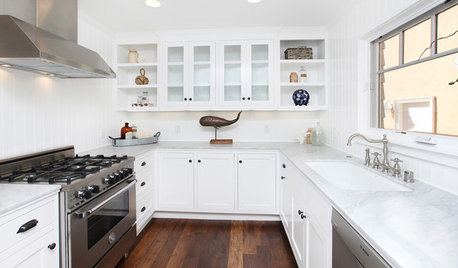
CONTRACTOR TIPSHow to Check the Quality of a Contractor’s Work
Make sure your remodeler lives up to promises and expectations before you make the hire
Full Story
GARDENING FOR BUTTERFLIESGardening for the Bees, and Why It’s a Good Thing
When you discover how hard bees work for our food supply, you may never garden without them in mind again
Full Story
KITCHEN DESIGN11 Must-Haves in a Designer’s Dream Kitchen
Custom cabinets, a slab backsplash, drawer dishwashers — what’s on your wish list?
Full Story
lily316