

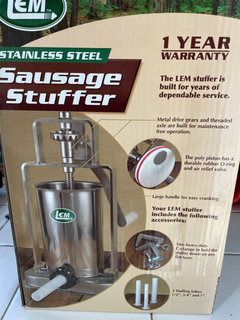
My New Sausage Maker
3 years ago
last modified: 3 years ago
Featured Answer
Sort by:Oldest
Comments (9)
Related Discussions
Meat curing and sausage making
Comments (45)Another post that is now public: I would like to make to a kind of Italian sausage (what else would a Jersey girl make) with the pork and venision -- I don't have a smoker... any suggestions? My reply: OK, start with lots of garlic, and you can even add things like rosemary, oregano, thyme, sweet peppers, onion, and even cheese. The onion and peppers I use are dried and don't add more water. The cheese I use is a high melting point cheddar that's cubed, available from one of my sources. All these are also available from the sausage making suppliers. If you like fennel seeds, add that too with a little anise seed. When I do fennel, I grind some in a small coffee grinder and use some whole as well. Also, ground black pepper and coriander are useful as is sage (easy on sage, its hot spicy). I use fresh and dried garlic and any recipe that calls for it I usually double or triple that amount. If the venison is gamey tasting, you can also add a little ground up juniper berries. They take away some gamey taste, but go easy. Italian sausages are usually all pork, no beef, but as mentioned, salami and pepperoni are OK with beef, and pork or venison, as is summer sausages. Things like hot dogs and bologna are pureed meat with cereal or soy added. For a smoky taste, I use liquid smoke. They sell small bottles of Wrights Liquid smoke in some supermarkets near steak sauces, but I usually buy a half gallon bottle from a sausage maker supplier and use maybe 2-3 tablespoons on a 10 pound batch, unless I want a lot of smoky taste. I also make a really good Canadian bacon that uses a whole boneless pork loin. I get a ham or bacon brine cure mixture and inject it into the pork. Then I place the injected pork in a big vacuum tight vessel and fill it with the brine and pull a vacuum on it for 1-2 days. THis last time, I added some maple syrup to give it a special tang. It too gets liquid hickory smoke flavor. Baked slowly at 200 degrees about 6 hours. Cooled, chilled and sliced. Then, I use a Food Saver machine to pack small amounts of it. Store cost about $6+ a pound, my cost under $2.00 a pound!! I have a decent digital scale that also weighs grams. I use Nitrites in all my sausages as they are not completely done in a refrigerated environment like they do commercially. The Nitrite amounts are tiny and that's what gives cold cuts their red color. They are tinted pink and are mixed with salt, so the ratio is easier and more accurate to measure. That's the main reason I don't use Morton Tender Quick, as you have little control if its added too much. I make pastrami out of corned beef, but simply coating them before they are slowly baked. A year ago, I made about 40 pounds of pepperoni and salami each, and the were not only baked very slowly (8 hours at under 200 degrees), but also dry cured for about a month at room temps and refrigerated. I used fibrous casings that are not edible, as I stuff these casings very tightly with the meats. Using edible collagen or fresh casings will burst if I were to use them. So, when I want to slice the salami and pepperoni I peel it first. I gave some to a kid who though it was a bit tough, until I asked him if he has peeled it beforehand.. DUH!! I have a professional meat slicer too as well as some vacuum systems I use to marinate and do a little home canning with. As mentioned, after mixing and before stuffing, cook a tiny sample and taste to see if it suits your taste buds....See MoreHome Made Sausage Part 2
Comments (45)I have a very large assortment of FS canisters. Sizes from the 6 qt. all the way down to 1 pint. The smaller diameter ones have domed tops instead of the concave type on the big 6 quart models. I have been buying many of the canisters for several years now and was still able to get another of the narrower but taller ones just for the loins. The phosphates help the pork hold onto moisture, as well as acting as a binder. It MUST be dissolved in water all by itself, and can take several minutes of continual stirring. I usually do it in a drinking glass. About a tablespoon or two of the phosphates are used per gallon of brine, more than that and it can bet a 'bleachy' taste. Once dissolved, its added to the balance of water in the brine mixture along with the nitrite cure #1. A good digital scale able to weigh up to 25 pounds can help too. Mine was cheap and is a godsend when it comes to weighing meats before and after injection of brines. I also use it to weigh the ground pork for sausages, so I can usually figure out how much seasonings and salt to use. I like to inject the brine as much as possible into a loin. Its because its quite dry once its cooked, and with the extra brine it helps or retain more moisture. You can't overdo the injection, as it can only hold so much of the brine. I usually use the same injection ratio for pastrami/corned beef. 4 oz per gallon of the nitrites is way too much!! Sausage Maker site- http://www.sausagemaker.com/index.asp?PageAction=VIEWPROD&ProdID=2 Has the cures and usually needs about 1 teaspoon per 5 pounds of meat. With a gallon of brine, the nitrite can be up to about a tablespoon. Keep in mind the nitrites are only about 30% of the actual pink granuated product, the other 70% is salt. They do this so you can measure more accurately by diluting it so it will not be as difficult to measure. Sometimes the bags of brine mix will include the nitrite as an added packet and they also usually have some basic instructions on how much to add to the quantity of water. Think of the measurements of the total liquid in the brine, and not the weight of the pork loin. Adding maple syrup to the brine is fine. In a gallon of brine, a couple of teaspoons of maple syrup is very small. I would add about a half cup to a gallon of brine. Keep in mind it will make it slightly sweeter, but still has a mild maple flavor when used with a little liquid hockory smoke flavor. The brine mixes usually have salt, brown sugar and some other minor things. Usually when I bake mine at that low 175 degree oven its about 3 hours in the oven. After 2 hours I raise the oven temp to about 200 degrees. I use a digital probe thermometer to measure internal temp. 160 is the max, 150 is fine too. Follow the instructions on the cure mix for baking etc. I don't have a smoker here so I use the liquid smoke. When I do beef pastrami that can be in the oven about 6 or more hours before it reaches 140-150. If you plan to make some with the added herbs, they would be chopped up in the brine, but NOT injected as they can clog the needle. In that case but don't add the smoke, maple or any other flavors. Sage, thyme, and even pepper, and garlic are OK, but the amounts you mention are still a bit small for a gallon of brine. If your only going to do a 5 pound piece, then make a half gallon of brine and half all the other additives. Never reuse a brine, never mix it and then refrigerate if its not injected right after mixing. For sugar, they use dextrose which holds up better to heat compared to cane. As mentioned, the brine mixes already contain brown sugar. Bake the loing untrimmed, fat side up. I cover mine with foil so it doesn't dry out too much while baking. Your loins should keep for at least 10 days in the cold part of the fridge....See MoreWill Sausage Freeze OK?
Comments (14)The only reason I’d try sous vide is that the dogs would marinate in their own juices (“purge” is what the cool kids call it) and then get grilled with a coating of that liquid, which I could also reduce down and spice up for a glaze . . . I did about 30 lb of ribs for a party last year. Sous vided in gallon freezer bags with aromatics, salt, sugar, spice, all bags hanging in a cooler that I’d prefilled with hot water. if They spent 12 hours under sous vide, then when I got an “order” for ribs I just grabbed a bag and grilled for ten minutes. This worked well with my limited grill area. I might try similar with the dogs. Hmm, will have to plan the right soundtrack. To pay homage to the Top Dog of my college days, it would be Jimi Hendrix, Grateful Dead, Neil Young, Talking Heads, Steely Dan, Elvis Costello, Pretenders, and the other stuff we were listening to then. I was a Top Dog regular again in 1997-1999, when I returned to Cal for grad school. Things were different, Telegraph had been taken over by chain stores and bubble tea shops, most of the bookstores were gone, only one record shop left, maybe one head shop. The college kids, and they were kids to me, looked a lot more serious and strained. Not so much free spirited kids with sandals and philosophy books. The average kid was an Asian teen, humping a huge backpack of books like a Marine on patrol, grimly trying to maintain a “B” average against 30,000 of the smartest kids in the world. Top Dog was a little bit of the Berkeley of my youth, but I wasn’t. One night a friend and I went to Top Dog, it was about 1 am, we were both in tuxedos, someone called me “sir”, I felt old and gray :-(...See MoreMy first ever sausage roll is in the oven!
Comments (15)Well, just because someone did it on a video doesn't make it right. Yours looks good but it's a lot for one person. Next time, add fresh breadcrumbs (freeze the bread then break it into chunks and whizz in the blender or food processor), a finely diced onion and some dried herbs like parsley, thyme, a smitch of sage. I like to add a bunch of grated cheese and some small diced smoky bacon, but that's me. Get puff pastry and cut into rectangles about 6" x 12" and lay a line of the sausagemeat mixture more or less the size of a link sausage along one long edge. Roll up and cut into two pieces for lunch size serves or 6-8 for parties. Brush the tops with milk and bake until golden. These freeze very well, so once you make a batch you can freeze most of them and just take them out and reheat them as required. If you don't want to reheat them in the oven, you can do a pretty good job by zapping them in the microwave for a few minutes to make them hot, then crisp up the pastry on a dry hot frying pan....See More- 3 years ago
 3 years ago
 3 years agolast modified: 3 years ago
- 3 years agolast modified: 3 years ago
 3 years ago



Related Stories
KITCHEN APPLIANCESConsidering a New Kitchen Gadget? Read This First
Save money, time and space by learning to separate the helpers from the hassles
Full Story
REMODELING GUIDESHow to Survive a Kitchen Remodel
Washing mugs in the tub and getting hooked on Pop-Tarts. Here’s what to expect if you stay at home during construction
Full Story
KITCHEN DESIGNHouzz Call: What’s Cooking in Your Kitchen?
Most of us turn to recipes, videos and culinary shows when we cook. Where do you set your cookbook, tablet or TV screen?
Full Story
KITCHEN DESIGNCoffee Bars Energize Any Room
Love coffee? Wake up to these great designs for a café-style area in the kitchen, guest room and even bathroom
Full Story
LIFEHow to Prepare for and Live With a Power Outage
When electricity loss puts food, water and heat in jeopardy, don't be in the dark about how to stay as safe and comfortable as possible
Full Story
FUN HOUZZDon’t Be a Stickybeak — and Other Home-Related Lingo From Abroad
Need to hire a contractor or buy a certain piece of furniture in the U.K. or Australia? Keep this guide at hand
Full Story
COMMUNITYTour a Pioneering Beach Town That Fosters Community
No cars, mixed-use zones, strict building codes ... a new book takes us inside Seaside, a champion of New Urbanism
Full Story
KITCHEN DESIGN16 Scrumptious Eat-In Kitchens and What They Want You to Serve
Whether apple-pie cheerful or champagne sophisticated, these eat-in kitchens offer ideas to salivate over
Full Story
DECLUTTERINGFoolproof Ways to Declutter Your Kitchen
If you find yourself fumbling through cupboards to find what you’re looking for, it’s time to take action with these simple steps
Full Story
LATEST NEWS FOR PROFESSIONALSHow the Island Is Shaping the Kitchen of the Future
Pros weigh in on why the island is turning into the superstar of the kitchen — and where kitchen design is headed
Full StorySponsored

Columbus Design-Build, Kitchen & Bath Remodeling, Historic Renovations

Islay Corbel