Houzz Logo Print
jyl_gw

To Which Vegetable Would Thee Be Wed?

3 years ago
last modified: 3 years ago

A Weighty Question from DD and I:

What is your favorite vegetable?

Here, “favorite” does not mean you’re being exiled to Mars and only one vegetable will make the trip. In that case it would be hard to rule out the Indispensable Onion, a vital ingredient in so many other seasonings and dishes. It means the vegetable you would choose if you could base your future vegetable dishes on only one “primary vegetable ingredient”. There may be, as they say, trace amounts of onion in whatever dish you make.

”Vegetable” means one particular species of plant, not an entire extended family. You cannot say The Prolific Bean and thereby claim everything from lima bean to green bean, chickpea to mung bean.

This conundrum is posed from the perspective of a *home cook*, not the food industry. Nominating the Commercially Valuable Soybean can get you tofu and dog kibble . . . but only if you make it yourself from the raw bean.

To spare you the arguments DD and I had to enlist the internet to resolve, the Seductive Tomato is a fruit while the Stalwart Potato is a vegetable.

Finally, you can enjoy other non-vegetable foods as you please. We’re not planning for the Vegetable Apocalypse here.

Comments (69)

  • 3 years ago
    last modified: 3 years ago

    Wait, what about Underrated Seaweed? Nori, kombu, wakane, kelp, etc. Super duper nutritious, iodine source (helpful for certain apocalyptic scenarios), and perhaps there are more cooking possibilities than I know of. Maybe one could incorporate enough seaweed in pasta (sort of like how one makes spinach pasta) to have a very nutritious spaghetti, as much veggie as starch?

  • 3 years ago

    Glad it's only a hypothetical, because I also cannot choose and don't want to 😃

    I do love Asian mustard greens like tatsoi, and I think one might be able to survive on just sweet potatoes in a pinch. Broccoli's pretty great - esp. the tender leaves when I grow it myself.

    Is okra (which I also love) a vegetable? It's a seed pod. Technically, squashes are fruits, and so are green beans and snap peas, I think. Fruits bear seeds, but vegetables don't, in my botanical book.

  • Related Discussions

    Planting wedding flowers

    Q

    Comments (9)
    Yes, knowing the timing of the wedding would help greatly .... "So, her picks are Orchids, Lilies, Lily of the valley, tulips, snapdragons and bleeding hearts." ... As others have said, forget about thinking about orchids as something you'd be able to grow in your garden. ... Lilies are a great idea, though tough being able to get the timing right, and also you'd need to plant LOTS of bulbs, and HOPE they'd bloom the first year! Also, this would not be an inexpensive option. ... Lily of the valley, forget about these, unless you know someone who has an established patch ... a new planting would not likely even flower the first season! ... Tulips, sounds like a good idea if you have a spring wedding and the timing is correct. Otherwise, just takes a few days of extreme heat and they'd be toast! ... Bleeding hearts, now these bloom over a longer period, though would be finished flowering in early mid summer or so .... UNLESS, you have some of the smaller flowered fern leaf types that bloom their heads off till frost? ... Snapdragons are likely the best choice of all things you've listed, though not so great if the wedding is early in the season. I'm sorry if I sound rather negative on many of the above selections, though I'd hate to see you do a ton of planting only to be disappointed! ... BUT, BUT, BUT, there's MANY very good ANNUALS you could look into! Asters Ageratum "Lielani Blue" in particular Amaranthus Bachelor Buttons Calendulas Cosmos Rudbeckias Zinnias Sunflowers ... small flowered types ... As with any of the above, select varieties with long stems suitable for cutting. Also, cut some of each as a test to see how individual types hold up without wilting. You don't want a few wilted flowers to spoil the look of your bouquets! HAPPY GROWING! Terry
    ...See More

    Stumped on wedding gift for established couple

    Q

    Comments (18)
    Lpink, You can pick up the generic (pre-paid) Visa cards almost anywhere now. Walmart, Target, some banks (call first), etc. How about a small rustic basket with a nice bottle of wine, some of your homemade jams, pickles, artisan bread, etc. and a gift card to somewhere like Amazon. If you can't find something to spend money on there you really, truly don't need anything!! LOL The basket could be "re-purposed" later as a planter, garden harvest basket, storage (hanging or otherwise if it has a handle). The food goodies will be consumed and enjoyed (even if they preserve themselves, it's fun to try something new). Jars can be re-used, re-purposed or re-cycled in any number of ways! All that's left is the wine bottle.........and I'll bet they can come up with a creative way to deal with that! Deanna
    ...See More

    Daughter's Wedding Reception- please help me!

    Q

    Comments (13)
    Please don't take this the wrong way, but here is another very strong vote for having a caterer do this for you, even if it means much less expensive refreshments. It sounds like you don't have a whole lot of cooking experience (you wrote, "I don't know how to prepare anything"). With all respect, a wedding reception for 120 is NOT the time to learn -- even if it weren't your own daughter's wedding. This would be a daunting job even for those with lots of cooking and entertaining experience. I think even -- perhaps especially -- the most experienced would be inclined to get a caterer for a group this large, especially as mother of the bride. You will have so many other things you'll have to attend to, and even more than that that you don't want to miss. Do you really want to be refreshing the buffet when your daughter and son-in-law are having their first dance? If I were in your position, I would call a few caterers, tell them your budget -- and tell them it's FIRM -- and ask what they can do for that money. You may be very pleasantly surprised. If it's still out of range, consider ordering platters from a food store or inexpensive restaurant, and perhaps hiring a few servers/cleaners. You can supplement the latter and probably even the caterer option with some dishes you or friends and relatives make ahead and have the caterer serve along with his/her food. Your peace of mind, not having to worry about this in the months leading up to the wedding, is really important, too, along with being able to enjoy your guests on the big day. To me, that is worth some money. So if I were in your position, I'd cut way back on everything else if necessary: liquor (certainly a fountain is unnecessary), decorations, types of food, prom-y stuff like limos and favors, and even fancy wedding clothes if necessary. Being able to be a relaxed hostess who can enjoy her guests is more important, in my opinion, than fancy arrangements. Everyone is different, but that's just my experience. Congratulations to you all!
    ...See More

    Wedding-warning, lots of pictures

    Q

    Comments (65)
    Sorry, David, it's hard to take a picture of myself, LOL, and I was so busy in the kitchen I didn't even think to take a picture of Mother! Gina, that is indeed a "spray on" tan. You know she didn't get that tan in Michigan in May, it's 51F and raining right now, not much beach time. :-) RR, it was a bit crazy but it all came together in the end, although I only got out of the kitchen long enough to watch the cake cutting, the bouquet and garter toss and I had ONE dance with the groom. Other than that, it was all cooking, serving and cleaning up. Ah well, it kept me out of trouble and it was Ashley's party, not mine. She was happy, so it's all good! David, I do have a long weekend and I think maybe I'll make Elery take me out for dinner for my birthday. I'm sure not baking a cake... Oh, and for those who wanted a picture of Bruvver, before he ate cake and lasagna and had punch and ate too much candy from the candy buffet and threw up, while his shirt was still white, here's Bruvver: Annie Annie
    ...See More
  • 3 years ago

    I could eat an artichoke every day. But, need half a jar of mayonnaise to go with 😆

  • 3 years ago

    " Fruits bear seeds, but vegetables don't, in my botanical book. "

    Close......but not quite right :-) ALL fruits and vegetables produce seeds - that's how they reproduce. It is the part of the plant that is eaten that determines how it is classified. It is a fruit if it generates from a flower and the edible portion is or contains seeds. Squashes, corn, beans, tomatoes, peppers, artichokes and olives are all fruits. With vegetables, the edible portion is removed from anything to do with flowers or seeds but can be the roots, tubers, leaves or stems. That would include potatoes, carrots, beets, lettuce, spinach and other greens.

  • 3 years ago

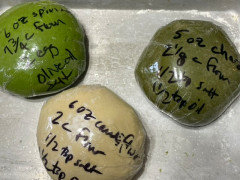
    I got interested in finding the maximum vegetable content that is feasible in pasta, so there’s now three batches of pasta dough in the fridge, each about 35-40% veg by weight. Spinach, cauliflower, and chard. Basically the veg gets cooked, drained , and blended with eggs into a liquid, that replaces the water in a standard pasta dough. I’ll get out the pasta roller tonight and see what sort of pasta we can make.

  • 3 years ago
    last modified: 3 years ago

    FWIW, I used the term 'bear' to mean 'carry', not 'produce'.

  • 3 years ago
    last modified: 3 years ago

    It worked!

    Here’s what I did:

    - 6 oz of raw veg (I did spinach first, then a cauliflower and finally a swiss chard), briefly cooked (sauteed), drained (next time i’ll squeeze it out with a cloth)

    - into the blender with 2 medium eggs, 1/2 tsp salt, 1.5 tsp olive oil, blend to smooth

    - move this to the mixer, and add flour while kneading until you get the right consistency, I started with 1 c of flour and added more in 1/8 c increments. I used the Magic Mill and kneaded for almost 20 minutes, the idea was to develop a lot of gluten that would hopefully hold the pasta together. The spinach batch took 1 3/4 c flour, the cauliflower batch about 2 c, and the chard batch took 2 1/8 c.

    - Wrap dough in plastic and refrigerate awhile, this may be optional but I had added as little flour as possible, and wanted the dough colder for easier handling

    - from here it’s like making and cooking any other fresh pasta, I used my old ”Fantes” manual pasta roller/cutter

    So, this contains

    - 6 oz of veg (it started as 6 oz raw veg, anyway, but lost some water weight in cooking)

    - 3 oz of egg

    - 7-8 oz of flour

    6 / 16.5 = 36% veg so I overestimated the veg content. I forgot about the egg - but hey, half of this pasta is not-flour! How healthy and nutritious can pasta get!?

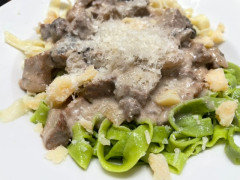
    The pasta holds together fine in cooking. I haven’t made fresh pasta in ages, so I can’t tell if the surface texture is different from normal. The spinach pasta tastes great, more spinachy than the typical store-bought “spinach pasta”. The cauliflower pasta tastes like normal fresh pasta, without any distinct veg flavor.

    SWMBO and DS said ”two thumbs up”, and I smirked knowing that they were eating 36% healthy veggie plus 18% nutritious eggs in my Insanely Healthy Pasta! We didn’t get to the chard pasta.

    I’m going to try to push the veg content higher. I’m also going to make a dough with yeast, and try making bread.


    I don’t know the nutrient loss but the veg is cooked very little - a couple minutes sautee and a couple minutes boil - so I’d think very little.

  • 3 years ago

    Excellent!! I'm getting tempted to try.


    Here's my first try at putting greens (mixed) in bread. https://www.gardenweb.com/discussions/6251379/i-m-getting-better-at-improvisational-bread-d#n=6


    It tasted really good, but was way too wet to be fully successful, and there's not that much veg in structurally sound versions. I hope you have great luck with more veg!

    John Liu thanked plllog
  • 3 years ago

    Oh, very interesting!


    Here’s my theory - the veg, when blended into a thick liquid, can be subbed for the water that normally goes into bread dough. At least that’s how I’ll try it.

  • 3 years ago

    Yeah, that's the theory...before one goes over the cliff.


    Here's the beet bread, which was fantastic, and which is a keeper recipe, which I've made a couple of times, since.

    https://www.gardenweb.com/discussions/6104096/omg-beet-bread#n=9

  • 3 years ago

    Do you think the veg should be cooked and drained, or just tossed raw into the blender to be liquified?


    Cooking and draining reduces the water content of the veg (if raw veg is 6 oz, cooked + drained veg is about 4 oz). Less water should allow a higher veg-to-flour ratio. I don’t know if the lost water takes some nutrients with it. Veg juice has plenty of nutrient, but using a juicer is different from cook+drain.


    plllog, the beet bread is very interesting. Beets reduce blood pressure (nitrates), and if you could make a bread that does the same, that would be useful indeed.

  • 3 years ago
    last modified: 3 years ago

    For your consideration, I present some contrasting contenders. In one corner, the summer stars of tomato and pepper. Both have many varieties and many uses and can be preserved for use in winter. OK, technically fruits, but if you want to get into plant morphology for this discussion, you'll have to be more specific. In the other corner, the old reliable carrots, potatoes and cabbage. Although I like all vegetables, the tomatoes and peppers are the ones I feel worthy of growing at home, in my limited sunny gardening spots, and the other three are what I base my "off season" meals around, as I don't like to buy out of season stuff that is trucked in from far, far away, both for ecological and taste reasons. The dishes one can make with the "big three" of carrot, cabbage and potato, is vast, and it pretty much covers all one's vitamin needs too, if you throw in some canned tomatoes in the winter.

    However, if the issue is avoiding carbs . . . then it has to be the greens, out of all of them I would pick cabbage as the most filling and versatile. Carrots and squash a middle ground for me. Potato very nutritious so good to add to a carb rotation, which is what I try to do, not pig out just on wheat.

    Sea vegetables great, but cabbage grows in more spots. I have not been able to acquire a taste for sea plants, writ large. But fresh not really available anyway. Very healthy. I like seaweed salt, (gomasio) though.

  • 3 years ago
    last modified: 3 years ago

    I don't know anything useful about nutrient carryovers in baking, and little in general, but I do know some vitamins go away when veg are cooked in water or steamed. My opinion is that there are some left! In general, the least water and cooking is good. But nobody wants to eat raw beets. I lightly zap them to soften for the beet bread, and let them cook the rest of the way in the bread. I read one thing (authoritative, not armchair) that said softening (cooking) hard veg, like carrots makes them easier to digest, and thereby get the nutrients, which makes sense. The greens were raw.

    I do veg breads for flavor and variety. I don't count them as vegetable intake. Any additional nutrition is bonus. No matter how you veg it up, it's still bread. I know it's trendy to be anti-carb and anti-grain, but it's not heathy to have zero simple carbs, just as it's no good to go completely fat free. It's all about choosing good ones. Yes, one can get the carbs from fruits and tubers, but a little bread is good too. It is bread, though, even with veg in it. Liquifying or juicing isn't nearly as good as chewing (with saliva, and without demolishing the fiber ahead of time) for nutrition. The nutritionists spurn smoothies, but not too loudly because if drinking is the only way to get the produce into the person, it's lots better than candy for a picker upper.

    After a lot of struggles trying to choke down enough dark leafy greens, which my genetic heritage tells me are poison, I finally lit on blendered. I'm losing nutrients in both the wetness and the cut ahead part (but they don't lose color or flavor, so maybe not too badly), but I can deal with it. I put a bunch of kale, a bunch of spinach, a bunch of chard, (occasionally collard when short of the others), a handful of basil, half a long cucumber and a small apple in the Vita-mix to a rough, not too liquid consistency, and keep it in an airtight pitcher in the fridge. I put anout half a cup at a time in a glass with a spoon of soluble fiber (why not?) and about 7 dashes of Ceylon cinnamon (doesn't have coumadin in it, so okay to consome lots, is supposed to have good powers, and makes the whole thing taste better). Then I fill the glass with the water I'd be drinking anyway. And use my spoon or fork to get the larger bits. There's still a lot of good for nutrition chewing involved, but also a significant amount of general nutrients. I feel remarkably better with this green glug twice a day. Really and truly, if I could have that on Mars rather than a single vegetable, that would be it.

  • 3 years ago
    last modified: 3 years ago

    On nutrition loss, some quick reading suggests that brief dry cooking without water (i.e. not boiling) preserves almost all of the minerals and vitamins in vegetables. Long dry cooking will remove more of the vitamins that are heat-soluble (B and C are called out). If cooking with water, as much as 50% of vitamins B and C is transferred to the cooking water (being water soluble).

    I guess that if one wanted to get maximum veg content into the dough, one could try dehydrating the veg then grinding into a powder which would be substituted for some of the flour.

    Edit: Oh my, I see there are “vegetable flours” which are promoted as healthy gluten-free flour substitutes. People even make pasta from these “vlours”. The FDA credits pasta made from vegetable flour as the nutritional equivalent of vegetables. https://www.fns.usda.gov/cn/crediting-pasta-products-made-vegetable-flour-child-nutrition-programs There are also ”bean flours” (chickpea, etc). Maybe I should get some of this stuff and see how well it works for pasta. I’m skeptical that the result will taste like real pasta, or feel like it (without gluten, only egg as a binder?). I recall my experiments with making gluten-free bread from almond flour and xantham gum, etc, were disappointing - it worked for a few undemanding applications (I recall a decent Cornish pastie crust) but was to crusty, toothy, chewy, open crumbed, Real Bread as Tang is to freshly squeezed orange juice.


    Anyway, I still want to see how much veg content we can get into pasta while still having pasta that measures up well to Real Pasta. If I can get to 50% by weight, I’ll be content.

  • 3 years ago

    Plllog, I don't think your "green glug" has lost much if any fiber or other nutrients by virtue of being blended (as distinguished from juiced), assuming you're not blending for a very long time.

  • 3 years ago

    If you ingest the water or other liquid that a water-soluable vitamin is dissolved in, don't you still get the vitamins? Now some vitamins OXIDIZE, which is degrade when exposed to the oxygen in the air, vitamin C being a prime example, so timing is a factor. But with a smoothie, one drinks it right after grinding . . .

    I have GI issues, so actually cooking or grinding fiber not a problem for me. Softer, sticky foods also have fiber. Eating a lot of harsh fiber not necessarily good for your gut either. Things like chia and flax are "sticky" so they are good. I think they can be added to pastas and for sure breads and the like . . .

    I quite like bean pastas. But they aren't low carb. Just perhaps a little higher in nutrients . . . I dunno for sure. Beans are an interesting food when it comes to GI issues. Well-cooked, they are much less irritating than undercooked, but the long cooking depletes some of the nutrients. It's a tradeoff. Also better to eat beans earlier in the day, since moving around helps them pass through your gut faster, less time to potentially ferment some of their objectionable sugars . . .

  • 3 years ago

    So best as I know, the fiber issue is for the smooth part of smoothies. If you let the blender do your chewing you don't get the digestive benefit of chewing/saliva to release the nutrients and it destroys insoluble fiber, which wants to be chewed. I'm no expert, but that’s what I've learned from those who are. As to general nutrients, source after source say that those are diminish when you cut ahead of time. I might be the oxidation L was talking about. The green glug is rough enough to get a good chew in, but it keeps for at least 5 days, and I don't doubt that a la minute would be better, but it's not going to happen. There might be an advantage that it comes straight from the farm, but who knows if it’s right from the fields, or sitting in the packing house awhile. Since the stuff makes me feel good, I keep with it, and don't worry much more about it.


    Tolerant brand black bean pasta is really good. It doesn't have the spring that gluten pasta has, but really good flavor. The biggest difference is that it goes from crunchy to overcooked and mushy in about 10 seconds. IIRC, the only ingredient is the beans. I think I'd love your veg pasta,

  • 3 years ago
    last modified: 3 years ago

    10 oz cauliflower dehydrates to just 1 oz of cauliflower powder. It should be easy to replace 1 oz of the 7-8 oz flour in the above recipe with this (said breezily, while whistling confidently). That 1 oz of powder should have most of the nutritional content of the original 10 oz raw veg, I think (going to see if I can find any sources).

    13.8 oz beets (one x-large beet) dehydrates to 1.8 oz beet powder. Ditto, shld be EZ etc.

    I’m kind of pasta’d out for now, so will try veg pasta effort #2 later in the week.

    I have some of my effort #1 pasta dough left, and want to use it up. If I re-knead it with some instant yeast, do you think it may rise so I can make a little bread? Or can dough not be ”re-used“ like that?

  • 3 years ago
    last modified: 3 years ago

    It depends on your percentages. Do you have any VWG? I'd dissolve the yeast in a very small amount of tepid water and mix it in once it starts to bloom. Add VWG and/or bread flour, and more liquid, until you have the size and consistency of enriched bread dough. Personally, I wouldn't think it would be worth baking at its current flour measure, especially with the amount of egg. You could add some spices/herbs too, to punch up the flavor. And some salt! But yes, you can repurpose dough if it hasn't been over handled or otherwise damaged, and dough is pretty resiliant.

    Re the veg powder, conservatively, IME, you can go with non-rising mix-ins up to 25% weight of bread flour without screwing up the rise. The veg powder, if it's fine and smooth, should adapt well enough to go higher, but no promises. Or you can adapt a GF recipe to your powder. Think of it as rice flour.

  • 3 years ago

    inspirational! I love your experiment and the outcome looks quite tasty. I wish I knew what you know about pasta making, but I'd have a long way to go to get there ;)

  • 3 years ago
    last modified: 3 years ago

    I know just enough to get myself in trouble, having delved into the chemical preservation issue when I was growing and using herbs and studying them. The availability of active ingredients and their degradation is a swampy issue, a sticky wicket, a bit of a morass . . . I can't think of any more sayings . . .

    I once read an article by renowned herbologist and USDA researcher Dr. James Duke where he handled that issue in his own day-to-day life by just going out in the garden and picking whatever was at its peak (herb wise, this doesn't necessarily work for all vegetables) and letting it steep in gin and fresh lemonade, and then taking a few TBLSPs as a tonic. Not as silly as it sounds, alcohol and citric acid are pretty good preservatives and solvents, which is why all those medieval monastic orders have the liqueurs named after them . . . they were seeking healing tonics. Original gin comes from juniper berries, another resinous berry . . . I don't much care for it. The making of some types of tinctures involves using alcohol as a solvent, as opposed to water, since some active ingredients aren't very water soluble. Vitameatavegimin anyone? :)

    Edited to add that this is one reason that one should beware when buying dried herbal supplements. With some herbs it is useless, as the active ingredient will rapidly oxidize after harvest, and in others, it has a high time factor, as the active ingredients will oxidize over time, so freshness and quantity of the ingredient really matters. A lot of herbal supplements sold over the counter are completely useless, one might as well swallow a capsule containing sawdust. Not all, but some. And of course one never really knows if the company follows best-practice, despite the labeling.

  • 3 years ago
    last modified: 3 years ago

    lpink, I've been trying to find detailed nutritional labels for veg or bean powders or flours, to compare to the nutritional values for the raw veg or bean - if zero nutrition loss in processing, the powder/flour values per gram should be roughly 10X the raw values per gram, given appx 90% water loss. No luck in finding the detailed labels so far - if anyone finds them, I will plug into my spreadsheet and we can get a rough sense of how much loss there is.


    Edit: I'm a dummy, here is a data source, FoodData Central (usda.gov)


    I looked up "Simply Super" beet powder FoodData Central (usda.gov) and compared to raw beets FoodData Central (usda.gov)


    Looking at a few items, minerals and fiber seem conserved:

    iron: raw beet/100 g is 0.8 mg and beet powder/100g is 10 mg, so that's roughly 10X

    fiber: raw beet/100g is 2.8 mg and beet powder/100g is 30 mg, also roughly 10X


    but looking at vitamins is not as coherent:

    Vit C: raw beet/100g is 4.9 mg and beet powder/100 g is 360 mg, that has to be added Vit C, and checking a couple of other brands of beet powder shows 0 mg, 0 mg, 31 mg, 0 mg ???? is this missing data or vitamin loss? 31 mg would be roughly 6X, implying 30% loss.


    Need to study this and other veg/bean powders more.

  • 3 years ago
    last modified: 3 years ago

    I have some Japanese pasta (Ryokuto harusame) that has one ingredient: green mung bean starch.

  • 3 years ago

    what is it like? texture, tooth?

  • 3 years ago

    Aren't mung bean noodles a.k.a. 'cellophane' or glass noodles? I used to make those with the playcampers, back when we did a lot of food projects - they're very kid-friendly.

    And thanks for that link to the USDA site, John! I used to have it bookmarked and referred to it often, but then something changed and I couldn't find it anymore - now I know why.

  • 3 years ago
    last modified: 3 years ago

    I do know this, B vitamins are water soluble. Which is why soaking dried beans to soften them up and make them cook faster, if you discard the water, lessens the B vitamin content in beans significantly. It also lessens the presence of some of the sugars that cause gas, which are also water soluble, so it's a trade off.

    I think it would be very difficult to tell what happens to the B vitamins in a pasta made from ground dried beans, once it is cooked in boiling water. A lot of variables there . . .

    It's sort of a truism that the more processing you expose a plant to, the greater the chance for significant vitamin loss, from one source or another. Take corn for example, the longer the corn on the cob sits around, the more sugar is converted to starch and the tougher and starchier the end product. And of course different corn strains contain differing amounts of sugar vs starches to begin with . . .

  • 3 years ago
    last modified: 3 years ago

    My theory - ok, more of a wishful hope - is that fresh pasta is cooked so briefly (a few minutes) that the vitamin loss might be limited.

    Here is a super interesting (in a geeky way) article on vitamin loss in each stage of making and cooking dried pasta - since we are omitting the "drying" stage, perhaps our vitamin loss is less than this. | BBM Magazine (magazinebbm.com)

    Perhaps the USDA site has nutritional analysis of a cooked pasta product that would provide more hints.

  • 3 years ago
    last modified: 3 years ago

    Next batch is beet pasta

    Wet

    6.0 oz raw beets, diced then cooked in microwave

    3.5 oz eggs (2 med)

    0.5 tsp salt

    1.5 tsp olive oil

    Liquified via 5 sec in blender (Vitamix)

    Dry

    13.5 oz raw beets, dehydrated then blendered to 1.8 oz beet powder

    8.5 oz white flour, which is 2.25 cup

    Mixed and kneaded about 25 min in Magic Mill (Electrolux), trying to develop maximum gluten, got a soft dough, still on the sticky side, dusted with flour and wrapped in plastic to refrigerate 1/2 hour. If I had just dumped all the ingredients in the mixer at once, instead of adding 1 oz flour at a time to see what would happen, it wouldn’t have taken 25 min.

    We’ll see how this turns out. I’m worried I didn’t make a firm enough dough.


    By raw (before processing) weight, this is about 62% beet, 11% egg, 27% flour. The dusting will add a bit more flour.

  • 3 years ago
    last modified: 3 years ago

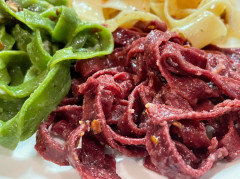
    Success! The 62% beet pasta was well received. It had the tooth and springyness of fresh pasta, just a bit of sweetness but not an especially ”beety” flavor, held sauce (here, a garlic-parmesan-olive oil quick sauce that SWMBO makes when we are worried about vampires, and we did just rewatch the entire “Twilight” movie series), and just yummy.

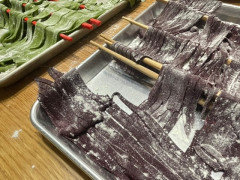
    Shown here with the 36% spinach pasta from round one of the experiments, and a conventional dry pasta. Looks Italian, no?


    The 62% beet dough was harder to work with than standard pasta dough, being stickier, a little less elastic, and a little more grainy. But it rolled through the pasta machine, requiring just a little more care (I couldn’t skip thickness steps like I do with standard pasta dough), and fettucine was easy - thin spaghetti might be harder, large noodles like lasagna should be easy, and I’m not sure how the dough would do in tortellini or extrusions - probably okay for the former but you’d want to test before counting on it.

    The uncooked noodles are dull dark red-brown, but the cooked noodles are brighter and redder. About 3 minutes cooking at a rolling boil, using a chopstick to gently stir out any clumps.


    Was it healthy? I think so, though I have yet to calculate / estimate nutrition content compared to standard pasta. It was interesting to eat pasta knowing it was actually 3/5 vegetables.

  • 3 years ago

    Looks great! Sounds even better. Thanks for the tips. I've been thinking about making lasagna sheets from pumpkin, more pumpkin than in the regular recipe, but for the flavor. :) You give me courage!

  • 3 years ago
    last modified: 3 years ago

    I was really trying hard to figure out why anyone would make noodles out of beef. Then I realized I was seeing a t not an f. So beet noodles sounds tasty plus I like that they are more colourful.

  • 3 years ago
    last modified: 3 years ago

    "why anyone would make noodles out of beef"

    Hmm . . . inspired by JFK,

    "We choose to make noodles from beef and other things, not because they are easy, but because they are hard"

    The general process might work for beef too - liquify some beef + eggs into the wet stuff, dehydrate and powder some beef + flour into the dry stuff, knead, and test.


    But I think I'm going to make some larger batches of 60%+ veg pasta, freeze the dough, and move on to trying high-veg bread. I can only eat pasta so many times per week, and am approaching that limit.

  • 3 years ago

    You guys are funny. Vegetables are not food. Vegetables are what food eats. I'll take whatever Bessie is munching on, just to fatten her up.

  • 3 years ago

    If beef is too daunting, one can always just cook them in beef stock...

  • 3 years ago

    I guess beef has enough connective tissue that you can simply slice thin strips with the grain and voila! beef noodles

  • 3 years ago

    If zucchini strips are "zoodles", I guess what you're suggesting are "moodles". :D

  • 3 years ago

    Then I definitely don’t want to know what “doodles” are!

  • 3 years ago

    Daikon?

  • 3 years ago

    Purely from an aesthetic point of view, those noodles are gorgeous. At some point, you're going to have to start a second career as an avant garde chef!

  • 3 years ago

    "Doodles" and "poodles" are the same thing :-)

  • 3 years ago

    Pumpkin!


    You mind only has to get confused the the nether ends of puppy dogs if you choose (or have a 7 year old boy...).

  • 3 years ago
    last modified: 3 years ago

    I have a low-brow sense of humour.

    Moving on to hi-veg bread experiments. Starting by dehydrating a bunch of veg to make the powder. Cauliflower, chard, and golden beets. The dehydrating is the bottleneck in this process, so I will eventually need to dehydrate a bunch of veg and store (freeze?) it.

  • 3 years ago

    Asparagus, hands down. I love it with salmon, chicken, and steak. I usually sautee it in butter and olive oil, but it's great wrapped in bundles with bacon and sprinkled with a little brown sugar.


    Brad AKA Moonwolf

  • 3 years ago
    last modified: 3 years ago

    SWMBO recently made an asparagus soup that was incredibly easy. Three bunches of asparagus (from the “discount” shelf of our local veg market, because they were kind of oldish). Cut off the woody ends, into blender with a small onion, a couple cloves of garlic, a couple spoonfuls of ”Better Than Bullion” chicken stock concentrate, and water, then liquefy which took a very short time - Vitamix blenders are terrifying - and into a pot to heat up with salt and white pepper. Save the nicer-looking asparagus tips for garnish.

  • 3 years ago

    Roasted garlic, leek and cauliflower rice, (instead of potato), celery with lots of the leaf tops. Great soup. A good use for asparagus that is woody. Has not been so good recently...not even during the holidays. Tips are good. Good idea for blendered soup.

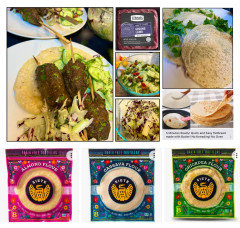
    My recent obsession has been quick flatbreads. Trying different flours taking the lead from Siete. No dough, no kneading. Just a blendered fluid mix like a crepe batter.

    My sister and SIL are avoiding gluten. Another SIL has long Covid and trying to gain her strength back...she is on an elimination diet. Terrible cook that relies heavily on bread sandwiches and tortilla wraps. Siete is silly expensive so this should help her.

    A dozen are done when the usual dough for flatbreads are still on the prep board.


    Soaking chickpeas for tomorrow falafel and hummus. Cucumber salad.


  • 3 years ago

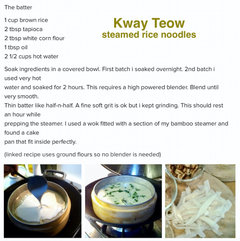
    I need to revisit this one. Probably 10 years old. Maybe cauliflower rice and wild rice. Some greens and seed and/or nut flours...another easy one done in the blender.


    The batter needs a quick pulse on the blender base between pours as the ingredients tend to settle. Fun one but i have no time at the moment.

  • 3 years ago

    Cauliflower is so versatile! I feel it is overlooked nowadays, sitting sadly in the veg trays while everyone goes ga-ga over the garish broccoflower. Look at me, I’m flashy and fractal, the next kiwi fruit, bright and fun, not your father’s dull cauilwhatever.

  • 3 years ago
    last modified: 3 years ago

    Wedded to all one can do with a single vegetable.


  • 3 years ago
    last modified: 3 years ago

    Fennel, I do. But it will be an open marriage ;))