Houzz Logo Print
plllog

Bread without Fear

5 years ago
last modified: 5 years ago
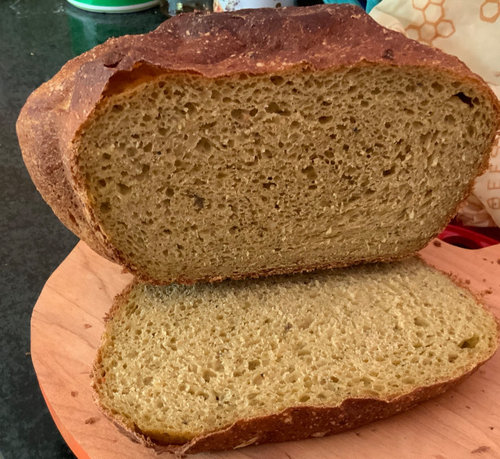
A couple of people in my life have asked me about baking bread in the last week. No problem. But I gave more instructions about ingredients, wanting it to be foolproof than the actual baking. IME, bread is idiosyncratic. In my opinion, the best piece of advice I could give them was not to listen to all the tips out there, but just to dive in and bake. My basic recipes (same recipe, but one has less flour) are easy and flexible. I've also suggested the cast iron pot, even though the bread isn't ultrahigh hydration. Much easier than fussing over the crust, and the cast iron evens out any issues with the oven. So, bread without fear!

This week, buoyed by my success making red beet bread--which I've repeated--emboldened me. I had about 2 cups of cooked veg that I'd already used three way and was tired of looking at, but they were too good to throw away. I attacked them right in the container with the immersion blender and got a textured puree. Vita-Mix will liquify anything, but the veg were about the same texture as the beet puree, so I just went for it. Much less washing!

Not to waste, I went a little over the 2/3 of the water mark, so then the water was a little over too, and I was worried the puree might be a little too bitter, so I cut up four small apricots that had gone squishy. They were too early to be sugary, just lightly sweet and tangy. I just mixed them in, figuring they'd be lumps, but the yeast LOVED them! By the time I was done kneading, the apricots, skin and all, were completely absorbed into the dough, which became so sticky, I had to add some flour, 7.37%, to be terribly exact (35g). Also in the mix were some not so fine black pepper and a small handful of Italian herbs. I should have added extra salt. The only salt in the veg was from the celery.

The bread has a beautiful soft and springy texture. It wasn't so exciting plain or with butter, but warmed it's really tasty! It takes paying attention but the tang of the apricots is there. Unlike beet bread, however, I don't think this is very replicable. I mean how often does one, without a tree, have apricots to spare?

Have you ever had fruit melt into your dough? Do you ever throw random things into your bread? Do you go fearless into the unknown?


Comments (13)

  • 5 years ago

    plllog, that looks so good. I'm impressed since I've always been somewhat yeast challenged. :-/ Not totally sure why since I love to bake.

  • 5 years ago

    Thanks, Chloebud! Do you want the instructions I made for my friends? I think they're probably too basic, starting with the best flour. N.B.: the high hydration no knead breads that have been so popular since the first time the NYTimes published a recipe are much trickier than normal bread. Some non-bakers succeed immediately. I've been baking bread all my life and have yet to get a really good outcome with those.

    Commercial yeast is really easy to work with nowadays. When I was a kid, cake yeast was more reliable than dry, but if it were mishandled it would die. Proofing the yeast was required. Nowadays, unless you let the yeast linger unused for a year or more unrefrigerated and susceptible to heat, or if it got otherwise killed on its way to you, it's pretty undemanding. And you can make a preferment and proof your yeast if you're concerned. Given live active yeast, all you need is patience. If the dough doesn't double in the suggested time, wait until it grows more.

    If you're just going to stir everything up from the go, make sure your ingredients are at at least room temperature (but not more than 85° F), mix the salt into the flour first, make a little well in the flour/salt and put all the (Active Dry) yeast in it. Pour the water gently on the yeast so it all gets wet, then mix gently to get all the flour incorporated. Let it sit for an hour to hydrated, then knead, let rise until doubled (usually about an hour), poke the air out and shape your loaf, let rise until doubled again, and bake. Internal temperature with a probe thermometer should be between 195-210° F, and the loaf should sound hollow when thumped.

    That's really all there is to it. Hm.... I think the biggest thing is to let your yeast warm up to room temperature (assuming your kitchen is at least 70° F) before starting.

  • Related Discussions

    Tropicaleque without fear of frost

    Q

    Comments (2)
    Agreed about the fear factor, but I've dialed that way down these days in my own garden by eliminating any plants that are zone 11 tropicals anymore. I also tend to stick with plants that will easily recover from a freeze and not take years to recapture their good looks, but sometimes can't resist planting exceptions to that rule such as Kentia palms or some new plant interest I stumble across while browsing nurseries in southern California. What I have absolutely given up trying to grow here in the SF Bay Area is any plant that demands hot weather to thrive. Too frustrating to see things just sit there all summer long doing nothing, only to give up the ghost the following cool summer back to back. Still, it is a lot easier gardening where it rarely gets above 80F, no biting horseflies or chiggers to worry about, and hardly ever too humid to want to be outdoors. I do miss those warm summer evenings to be out in the garden, hardly ever happens here more than 7 days in a year. And Tetrapanax is no less invasive here in northern California, I only plant it with a bamboo rhizome barrier to contain it. I've seen it spread to take over an entire back yard locally.
    ...See More

    Amish Friendship Bread without pudding

    Q

    Comments (7)
    Thanks Donna. I saw some recipes on that site for no pudding in the last part but it seemed like the starter still needs a pudding. I need to go through that site more thoroughly. I had looked at it before posting here and couldn't find a totally no pudding recipe but I might have missed it.
    ...See More

    Can I travel with bread while it is rising without ruining it?

    Q

    Comments (3)
    Well, I tried this with bread that was risen. I drove it less than a mile away to bake. A few speed bumps and a turn or two later, it had deflated. I had to punch it down and let it rise again. I guess you'd be okay if it weren't TOO full of air before you begin your journey. A pothole might flatten it otherwise.
    ...See More

    Why was bread from my Hamilton Beach bread maker a disappointment?

    Q

    Comments (25)
    I'm a big user of a bread machine for bread, however, I always just use the dough cycle, and then pop the dough out and knead it at least once real good on my own before the last rise. I don't think that the bread machine can do quite the best job of developing the gluten structure that hand kneading can, if you do it right. That's what gives bread flavor and texture, the interplay between the yeast and the ingredients. Also, a longer rise develops flavor too. I'm always in search of better flavor and texture in my breads, so that's why I am saying these things, I've researched it and tried it out IRL. I also agree that flour quality makes a huge difference. I mail order special flours from Bob's Red Mill and King Arthur and store them in the freezer. I also use recipes specifically designed for the bread machine. I have "The Bread Lover's Bread Machine Cookbook" by Rachel Hensperger, which is also a fun book. Lots of details about using it there, although she bakes in the machine. I also don't care for the hole left by the paddle and the shape of the machine baked bread, which is another reason I convert all the recipes to baking in the oven.
    ...See More
  • 5 years ago

    I'd definitely like to see the instructions when you get a chance. I think most of my problem was lack of patience that pretty much led to lack of interest. Who knows...maybe I'll have success one of these days! I do love to bake and have plenty of patience with other aspects of it.

  • 5 years ago
    last modified: 5 years ago

    So, the thing about deciding to bake bread is to have time. My mother always started bread early, like before breakfast. I might start after my work is done and be willing to have it finally done after midnight. You need to choose a time when you can give it time. You can always shove your dough in the fridge if something comes up, but since you need to bring it back to room temperature before baking, I don't find it saves time. A long ferment in the fridge can do other nice things, but time saving really isn't one.

    Here are the instructions and the recipe for the bread above, with the additions as I specified in the original post:

    Bread is easy. Nearly foolproof and you're not a fool. The good thing about stylish recipes is the cast iron Dutch oven. As with other kinds of cooking, it takes away the variability of the ovens, which is the hardest part.

    The other thing is getting your hands to learn bread. To know when it needs a little more flour or water, more kneading, etc. Just keep trying. Don't go trying to use all the tricks and advice from different people. Just bake. Most times when you try a new recipe you can get a doorstop, or other mess. You can always turn it into bread pudding or crumbs. Try again.

    Bread is much easier with a kitchen scale, especially one that will do grams. You also need a big bowl and something to cover it with (could be a mixer bowl and a tea towel. I also use the Anchor Hocking 2 qt. measuring jug with cover). You need a clear counter space and a baking board or silpat to knead and shape your loaves on. A Danish dough whisk is useful, but not required if you're willing to use your hands to mix your dough. A heavy mixer will mix and knead. KitchenAid Artisan will do one loaf, or up to three if it’s soft dough. Anskarum will do big batches of dough. If your dough is very sticky and drippy, add a little more flour. If it’s too stiff to work, add a little water. A single loaf can be made in a 2 qt. Dutch oven, loaf pan, baking sheet, pizza pan, cake pan.... Make a bed of flour for the dough to rest on for a flat pan,or spray some oil in any pan.

    Ingredients:

    Flour. Malt will help your rise. I add malt powder to many recipes, but for daily bread (eaten daily, not baked daily) I use Central Milling Artisan Bakers Craft Plus. It's 11% protein, which is on the heavy end for All Purpose flour, about equivalent to King Arthur AP, but has the malt already in it. If you want a very hearty, heavy bread with a lot of stretch, a 14-15% protein flour will do you better. I've made bread from Central Milling Tony Gemignani pizza flour, which has fantastic flavor and 15% protein, as well as a fine "00" grind, and it was really good, but it's too much for general bread. Highly recommended for pizza. The high hydration breads need more protein so that fewer of the gluten strands break and you get a better crumb. I'm not fond of King Arthur flours. Gold Medal Better for Bread (12% protein) is a good choice, but King Arthur All Purpose (11.7% protein) will work fine.

    N.B: The protein content on the nutrition label loses the difference as a matter of rounding error. The protein content tells you the ratio of gluten you can develop. Kneading speeds up the gluten forming, but it’ll happen just sitting if you leave it alone long enough.

    Whole wheat breads are a whole different story. The bran cuts the gluten and 100% whole wheat takes some experience and confidence. You can use up to 40% whole wheat flour in a regular recipe without too much problem, but you might not get as much loft.

    Water. Do use spring water or whatever good tasting water you can. There's nothing in bread for it to hide behind if it doesn't taste good.

    Salt. Regular granulated table salt works fine. If you prefer a larger grain,
    grind it up for bread, so it dissolves fast. Tuscan bread has no salt but is mean to be eaten with very salty foods. Generally, breads want half a TBSP (or 1.5 tsp or 11g) table salt per pound of flour. Otherwise, they're exceedingly bland. If you want to weigh your salt, you may need a special scale. They cost about $25. You don't need that kind of precision, however. Your dough should taste salty--unless you use a lot of salt in general and can't taste it in small quantities any more. Salt retards the rise. If you're having trouble with the rise, you can add the salt later, but you shouldn't need to. Stir the salt into the flour first, and you'll be fine.

    Yeast. ADY=Active Dry Yeast. The Instant is for bread machines. It's the same thing but ground up to work faster. It's a pain to use in other applications. Yeast should be stored in the fridge, but set it out to warm up to room temperature before you use it. A packet is the same amount as a small cake (1" square) is the same as 2.25 tsp. Two tsp should work fine if you don't want to be bothered. Jars are much more economical, and if you're going to be baking regularly, get the 2 lb. bag and store most in the freezer.

    Given the above, just follow the recipe and you should have bread. :)

    JC's Daily Bread Lower Hydration

    Adapted from King Arthur flour

    Ingredients

    1 packet ADY (Active Dry Yeast) = 2 ¼ tsp.
    11g or 1.5 tsp Salt
    1.5 cups lukewarm Water
    475g Central Milling Organic Artisan Baker’s Craft Plus malted flour
    Or Gold Medal Better For Bread or King Arthur All Purpose plus a teaspoon of diastatic malt, dried malt extract (powder), liquid malt, or even a heaping tsp. of Malt-o-Meal

    Optional: An egg or milk to brush the top with for sheen and color, and oil spray for pot.

    Optional: Replace up to 1 cup of the liquid with vegetable puree of any kind, beer, juice or other liquid. You may have to add up to half a teaspoon more salt if the liquid doesn’t have salt. You may also add other seasoning, spices, etc. but better to add it to the liquid first to get the balance right.

    Directions

    Combine all ingredients, mix, and knead at least 10 minutes to a well-stretched, smooth, elastic dough Put dough in greased bowl, turn over (grease both sides, thereby), cover, and let rise at (warm) room temperature for about 1 hour, to double volume. If your kitchen is cool, you can run a load of towels and set the bowl on the dryer, or the cable box, or set it on top of a simmering pot of water, or heat your oven for an hour before starting to its lowest temperature and turn it off and put your dough in when it has cooled to pleasantly warm..

    Punch down—i.e., let out the air by poking it, and bake in a 2 qt. cast iron
    pot or other high sided vessel. Optionally spray with oil to fry the sides a little. Cover and let rise to double again. Optionally, brush the top lightly, without deflating the dough, with a beaten egg or milk. You can slash the top of the dough with a very sharp knife, but don’t deflate it.

    Preheat to 415° F

    Bake for 35 minutes. Remove cover and lower temperature to 375° F for 12-15 minutes.

  • 5 years ago

    To go back to your original question - I generally do not put random fruit or vegetables in the bread I bake, with the exception of potatoes. I generally want bread to be versatile, and so I add the other ingredients after the bread is baked.

    Last week in Cathedral City I was making some rye bread and only had one teaspoon of caraway seeds, and so I added some marjoram to make up for it. I often use fennel with rye bread, but I did not have any fennel there either, although I had a huge container of fennel seeds here in L.A. I need to take some fennel back with me when I return to CC, as well as some caraway, since I have a lot of it here.

    I can find large containers of caraway seeds and fennel seeds easily in L.A., but I've not seen them in the stores where I shop in Coachella Valley.

    I like beets and can imagine liking beet bread, but I have an aversion to apricots, which I think might be psychological. I have substituted dates for sugar in bread, but that's the only fruit that I've used in bread that I can think of.

    As for salt, I often reduce the amount of salt in rye bread, since I make it to have with salty ingredients, such as pastrami and sauerkraut. I do not omit it altogether. I'm very careful not to add too much salt to the sauerkraut that I make so that the sandwiches I make with it won't be too salty.

    It might be interesting to add cabbage or sauerkraut to a bread recipe.

    plllog thanked Lars
  • 5 years ago

    plllog, wow...you're so sweet to post all that! I copied both of your posts for safe keeping. Thanks so much for taking the time with so many details...really appreciate it! I just need to find the time. Maybe there's bread baking in my future after all! :-)

    plllog thanked chloebud
  • 5 years ago
    last modified: 5 years ago

    That loaf does look good!

    I haven't made a 'flavored' bread in quite awhile, but used to make sweet potato bread, from my James Beard Bread Book, and walnut onion bread same. I've used herbs and spices, nuts and seeds, and dried fruits that don't melt, but like Lars stated, I prefer a basic plain bread that won't clash with other flavors, since we mainly use it for sandwiches.

    Our bread consumption has gone way down over the years. I only bake a loaf now every couple of weeks. I make flour tortillas/chapatis, and yoghurt naan occasionally - biscuits too.

  • 5 years ago

    I like dill in bread also, but I've mostly used it when I made focaccia. I haven't made dilly bread in a while, and I should probably make it again. I think I used dried dill when I made it.

    It is difficult to keep track of what I have in the two houses, and I left several things in Cathedral City that I meant to bring back - notably the dried cheddar cheese (which I put on popcorn) and the dried cream, which I still haven't used it. They both came in fairly large jars, and I should have divided them up. I go through a lot of caraway seeds, and so I do not like to buy them in small jars, which are too expensive. I should probably just buy another large jar in L.A.

    I need to go to the Lebanese/Syrian Market in Palms (on Venice Blvd across from Culver Center) before we go back, as I have not found a good Middle Eastern market in the desert either. What is impossible to find there is a Japanese market, and so I have to buy my Japanese ingredients here and take them with me. I left most of my rice noodles there, and I should have brought some of them back with me, as I wanted to make a rice noodle salad. I guess I'll just have to go back to Marukai this week-end and buy more specialty noodles.

    I don't know about health food markets in Palm Springs, but I could check. Sometimes it's just easier to do my shopping in L.A. and take stuff with me. I know where to find everything here. I still haven't been to the farmer's markets in Rancho Mirage (and Indio), and I do want to go to them some time. I'm sure they will be very good for dates, especially the one in Indio. Dates are probably the main crop there. The farmers' markets there will probably be best in the winter. The main thing that I have found Cathedral City good for is Latin food, and that is easier for me to find there than it is here in L.A. The market that I go to in CC makes its own tortillas, tamales, guacamole, bolillos, salsa, chicharrones, etc, and so I buy those there rather than make them. It reminds me of markets in Mexico. I have not found a good source for lavash in the desert, and I generally buy it at the Lebanese market, but it is made in Glendale and is probably Armenian. I've tried several times to make lavash with disappointing results. It's easy enough to buy in L.A., but not in Palm Springs.

    I tend to bake bread now only every week or two, and I also make naan and a lot of pizzas. I usually buy flour tortillas, but sometimes I make them, and I should probably get back into doing that, as I like them a lot better. I have two cast iron comals for cooking them - one is 16" diameter and can be used as a pizza pan.

  • 5 years ago

    Carol b, is your James B bread made with some whole wheat flour, red onion, and walnuts? I used to make a similar bread that we called walnut hearth bread. It had such a yummy flavor.

    Pillog, very good info and so nicely presented. More people should be able to feel confident and intuitive as they cook and bake. After many years of not having a scale at home I now do and need to remember to use it.

  • 5 years ago

    Wow! How many loaves did your pureed vegetable bread make? You had 2 cups of vegetables and added 4 apricots and 2/3 cups of water?

    My everyday bread makes 2 loaves and I use 1 1/2 cups of water and that's pretty high hydration for a pound of flour.

    I make my bread very simply. I weigh out 1 pound of King Arthur bread flour, 1 1/2 tsps salt, a tablespoon of honey and about 3 tsps dry yeast. I don't measure, just pour into my palm...the measure of yeast really doesnt much matter...just rises faster or slower.

    I put all that into the food processor ( 7 cup cuisinart) and measure out 1 1/2 cups of ice cold water ( because the action of mixing raises the temp of the dough) and add the water slowly with the processor running. Let run for 30 seconds and dump into a greased bowl with a lid.

    Let rise until double....about 2 to 3 hours....punch down and stretch your dough, let rise again, about an hour to 1 1/4 hours, then dump onto a floured work surface, divide in half and stretch half the dough and fold and stretch and fold again, pinch to seal the seam, place on a baking sheet liberally sprinkled with corn meal, cover with oiled saran and allow to rise until double while preheating the oven to 425. The oven should be preheated for at least 20 minutes, longer is better to insure all is really hot not just the air inside.

    When risen, I brush gently with egg wash, sprinkle liberally with sesame seed,...or poppy seeds....maybe everything mix... make 2 slashes per loaf with a serrated knife, and bake about 23 to 28 minutes....depending on your oven.


    During the first 7 months of the pandemic shut down I baked easily 650 loaves of that bread....and sometimes on weekends I would make something different for just me....maybe pesto bread or what I call breakfast bread filed with nuts, whole grain cereal like rolled wheat or rye flakes, and chopped chopped dried fruit...I mixed those doughs with a danish whisk and did the stretch and fold thing rather than a full on knead.


    Bread is dead on easy....don't get hung up on flours and activ yeast vs insgtant...it matters not more than a whit.

    Mix flour and salt and yeast....add enough water to make a dough....cover and allow to rise...however long that takes, punch down once or twice or three times....shape and bake!

    You can make a million variations with liquids, sour dough starter...olive oil, butter, milk, beer, nuts rough ground grains ( I have added kasha many times and I very often add malt o meal, oatmeal and corn meal) herbs, dried tomatoes and black olives, toasted onion bits basil, oregano and parsley....grated cheese....and the list goes on!


  • 5 years ago

    Linda, you are a very experienced bread baker. You know when it's coming out right. My instructions are for people who have never essayed bread and those who have had failures, both groups of whom are intimidated. I've been baking bread all my life, but only started improvising about six or seven years ago. The recipe I posted is not my “best” recipe, but one that is very forgiving of being messed around with, and doesn't require any skill—as in I can make it without thinking or giving it much time or attention. It should work for anybody. It is not, however, good with the King Arthur bread flour whose bag the original version was printed on.


    One good sized loaf, 2 cups veg, reduced in volume by pureeing. Just over a cup Of puree went into the bread, which is 2/3 of the total water requirement. I still used a half cup of water, so it had a total of liquid and puree between 1 5/8 - 1 3/4 cups total, not including the moisture of the 4 small apricots. That's why it was so sticky that I added the 7% more flour. So it had a little more volume than usual, and rose more, hitting the lid of the pot. It still came out great.


    This recipe is also 1.5 cups of water for a pound of flour (though bread flour really is different). That's 75% hydration. My higher hydration version is the same cup and a half for 430g flour, or 83% hydration. The popular “no knead” “artisan” breads are 100% hydration. In bread baking, the hydration number is based on the weight of flour being 100%, and the proportional weight of the water expressed against that. 1.5 cups of water is 355g.


    I can bake a cake or bread without a particular recipe, and without measuring equipment, but if one wants it to come out in a replicable fashion, measuring sure makes it a lot easier. Using known ingredients in the proper fashion helps a lot too, Nothing wrong with improvisation, if you like the outcome. Nothing wrong with being very specific, either, especially when trying to set up others for success.


    Lisam, thank-you for the kind words!

  • 5 years ago
    last modified: 5 years ago

    @ lisaam: I'm not sure the recipe specifically calls for red onions or part w.w. flour, altho I often use about 1/3 w.w. in my bread doughs. I haven't looked at it in years. It's basically a white bread with sauteed onions and walnuts mixed in after the first rise.