

Tap water or filtered water?
5 years ago
Featured Answer
Sort by:Oldest
Comments (15)
Related Discussions
Aeration and pH increases: Help!!!
Comments (1)I came across the info below, which strongly suggests that greystoke was right and aeration should remove all the bicarbonate from solution in time, and addition of acid finish off any residual bicarbonate ions. Certainly, I've only been aerating my tap water for around four hours now, and the pH has already increased from an initial 7.98 to 8.39: ************************ H2O + CO2 « » H+ + HCO3- Carbon dioxide, hydrogen sulfide, and ammonia are soluble in water under certain conditions to the extent of 1,700, 3,900, and 531,000 ppm, respectively. Rarely are these concentrations encountered except in certain process condensates. In a normal atmosphere, the partial pressure of each of these gases is practically zero. Consequently, the establishment of a state of equilibrium between water and air by means of aeration results in saturation of the water with nitrogen and oxygen and nearly complete removal of other gases. As the equations above show, ionization of the gases in water is a reversible reaction. The common ion effect may be used to obtain almost complete removal of these gases by aeration. If the concentration of one of the ions on the right side of the equation is increased, the reaction is driven to the left, forming the gas. In the case of carbon dioxide and hydrogen sulfide, hydrogen ion concentration may be increased by the addition of an acid. Bicarbonate and carbonate ions in the water will form carbon dioxide, which can be removed by aeration. In a similar manner, an increase in hydroxyl ion concentration through the addition of caustic soda aids in the removal of ammonia. Gas removal by aeration is achieved as the level of gas in the water approaches equilibrium with the level of the gas in the surrounding atmosphere. The process is improved by an increase in temperature, aeration time, the volume of air in contact with the water, and the surface area of water exposed to the air. As previously indicated, pH is an important consideration. The efficiency of aeration is greater where the concentration of the gas to be removed is high in the water and low in the atmosphere....See MoreWater dispenser on new fridge AND filtered water tap?
Comments (4)"......does it make any sense to ALSO have a dedicated filtered cold water tap at my bar/coffee station sink?" If your tap water tastes like mine, it certainly does! Believe you're talking about two issues 1) scale/deposition and 2) taste. Scale/deposition can be handled via water softening. Taste can be handled via filtering -- typically via activated charcoal stack. Taste is a very individual thing. How far you should go is up to you. In my case, local city water is 7-10 grains hard; about 200ppm TDS; and tastes distinctly alkaline, which is a region-wide characteristic. It leaves scale on heating elements and bad tastes in coffee, tea, rice, pasta,.... just about everything. I have a softener delivering zero grains to everything. Also have RO unit with sink spigot delivering water at 2ppm TDS which is also piped to the ref. ice-maker. Anything consumable in my household that is prepared using water gets it from the RO spigot. Many people do not like the taste of soft water or RO water and have their personal favorites among the bottled waters. In any event, you should start out by knowing what's in your water now. Have you had it tested? Interestingly, although you talked about filtration and all your various concerns, you said nothing at all about whether or not your water tastes good/bad/neutral. Nor did you say whether or not you've had trouble with it previously....See MoreEC, PPM, pH meters
Comments (0)EC, PPM, pH meters Posted topics included in this FAQ are: Basics of EC PPM testing--is it necessary? Looking for a nutrient meter Basics of EC Posted by thedude27 (My Page) on Thu, Jan 12, 06 at 16:46 Hello, I'm new to hydroponics growing and have a basic question about mixing the nutrient solution. Currently I'm growing some sage in a homemade DWC system and was wondering if I'm mixing the nutrient solution correctly. When you are mixing to obtain say 1500ppm nutrient solution do you add the 1500ppm on top of the reading of your water without solution? So if I had water that was reading say 500ppm before adding anything would I then add solution to bring the reading to 2000ppm? Or could that provide your plant too much of a certain nutrient (obviously something is in there raising the count). Also at what point (well water) hardness would you consider using distilled/spring water? For me its not such a big deal since my grow (crop) is small for now, but it would be easier to just use tap water (or filtered tap water). Response: Posted by: hank_mili Z11 (My Page) on Fri, Jan 13, 06 at 17:40 The PPM in your tap water is the same whether you have a tablespoon or a gallon. The PPM of the solution from the nutrient concentrate will depend on the volume of water you mix with it. Need to keep in mind that PPM is always a calculated value not like EC (electrical conductivity) which is directly measured. This is why many prefer using an EC meter for measuring nutrient concentration versus a TDS (total dissolved solids) meter, which is an EC meter with a calculation algorithm built in. Unless otherwise stated on the label, the calculated PPM of the solution will assume mixing pure water with the concentrate. But to answer your question the final PPM will be additive and 2000 PPM would be correct. Posted by: thedude27 (My Page) on Sat, Jan 14, 06 at 23:29 Thanks a bunch Hank, that helped a lot :) I guess I should have gotten the EC meter instead of the PPM but I got a really good deal on a Newport DSPH-3 (dissolved solids/PH) that I couldn't pass up. Although I'd imagine I could just get the conversion formula from the company and reverse the calculation (although I suppose I'd need accurate temperature readings too). Thanks again PPM testing--is it necessary? Posted by Luckyleaf 7 TN (My Page) on Sun, Oct 10, 04 at 23:22 Is it necessary to use PPM testing if I will be growing some tomatoes in a bubbler? Also, if you say it is, what should the ranges be for the nutes in the veg stage and the fruit stage? Thanks! Response: Posted by: AdrianaG AL z7 (My Page) on Thu, Oct 14, 04 at 19:09 Only if you want healthy plants...and the meter you want is an EC meter, not a ppm meter. Posted by: hank_mili Z11 (My Page) on Sat, Oct 16, 04 at 2:53 Checking your pH and salts concentration of your nutrients is analogous to checking the fluids in your car. You can get away with not doing it but it is not recommended. It's extra work and expense but gives you important information on the condition of your nutrients. Product.....pH..............cF...........ppm Tomato....6.0 - 6.5...20 - 50......1400 - 3500 Posted by: Luckyleaf 7 TN (My Page) on Sat, Oct 16, 04 at 11:17 How do I get the PPM up to 1400-3500? Just add 2x the recommended dose of the nutes for the plants? The PPM of my water is ~50, so thats a far way to go Posted by: willard3 (My Page) on Sun, Oct 17, 04 at 9:58 It will make a difference how large your reservoir is to get nutrients up to correct ppm. Start keeping a log and how much and when to add and change nutrients will become much clearer to you. PPM and Ph are closely related so you should test and record Ph as well. Posted by: Luckyleaf 7 TN (My Page) on Sun, Oct 17, 04 at 15:49 Well I'm doing 5 gal bubblers, and I wont have a reservoir. It is usually like a tsp or something per gallon for each nute, but since tomatoes have different needs I would have to do something like a tbsp per gal? ...in general I would have to use more than the recommended dose Posted by: willard3 (My Page) on Mon, Oct 18, 04 at 8:49 All nutrients are different; all nutrients have different mineral concentrations. 1. Go buy an EC meter 2. add nutrients 3. Measure nutrient concentration Posted by: Hydro4me z5 IN (My Page) on Tue, Oct 19, 04 at 11:37 Hey there Adriana, I have the (brand name) Nutrient Meter, but it reads, "442", "KCL", and "uS" (which I believe is micro siemens). I have heard that the 442 is good for testing pond water with fish and plants, and KCL is potassium chloride. I have no clue which one to use for testing my Millennium nutrients. I try to keep the blinking LED's in the middle, but peppers or tomatoes require higher levels. Any advice from other hydro gardeners? Thanks, Jason Posted by: willard3 (My Page) on Wed, Oct 20, 04 at 21:25 Most published stuff on hydro is given in ppm. I have on that has been working fine for 5 yrs. RE: meters ppm (ec) and ph Posted by: NLG1 7b-8a (My Page) on Wed, Apr 27, 05 at 18:11 You can find meters for around $30.00. They work, but for how long is the real question. What you want out of a meter. 1: waterproof 2: warranty 3: replaceable probe 4: pH range 1-14 +/- .1 5: ppm range 1-1999 Posted by: willard3 (My Page) on Thu, Apr 28, 05 at 9:20 A good cheap meter is an oxymoron. You should get a good meter, no matter what it costs. Hydro goes sooooo much better if you know accurately and repeatable the Ph and EC of nutrient solution. $50/meter is what I paid and it's worth every penny. Posted by: HydroBotany Indoors (My Page) on Fri, Oct 28, 05 at 18:40 (HydroBotany suggests a double junction (DJ) product). That is the most important thing with hydroponics. A DJ meter handles the environment the best and last the longest. artisan also has a good meter and it can be used continuously if you want it to RE: meters ppm(ec) and ph Posted by: hank_mili Z11 (My Page) on Fri, Oct 28, 05 at 21:49 I tend to be biased toward (another product). Very reliable. No problems so far. RE: Looking for a nutrient meter Posted by marshallwilson z4 CO (My Page) on Sun, Sep 25, 05 at 9:27 New to hydroponics. Basic ebb and flow system. Using 2 part dry nutrients (from CK). Currently outside, will be moving inside under lights soon. I'm looking for an inexpensive way to monitor my nutrient level. Hoping for suggestions on meters. As an alternative; can I just change out the entire solution every 2 weeks (suggestion from the local hydro shop)? I do get a fair amount of evaporation during the 2 week cycle. Should I just top off the nut solution with plain water? Thanks Marshall Response: Posted by: propman Z10 CA (My Page) on Sun, Sep 25, 05 at 11:47 I just got a ppm meter for about $35. Before that I just used the recommended dose on the bottle per gallon of water. What I found when I tested the water was way too stong because my water has 150 ppm before I added nutrients. The meter is a good idea. Here is a link that might be useful: pictures of my lettuce Posted by: hank_mili Z11 (My Page) on Sat, Oct 22, 05 at 1:03 Hope you have a pH meter or strips. One can calculate ppm but you can only measure pH. RE: Looking for a nutrient meter Posted by: HydroBotany Indoors (My Page) on Fri, Oct 28, 05 at 18:03 Just top it off with plain water....See MoreDoes anyone have advice on the placement of the filtered water tap?
Comments (6)I put mine on the left, it just felt ergonomically correct to me. With the lever on the outboard side, it allows holding a glass or coffee carafe in the right hand, and operating the lever with the left, unobstructed by the center faucet. Not sure how or why the dishwasher would be a factor, but mine happens to be on the left....See More


Related Stories

FEEL-GOOD HOMEFeel-Good Home: Water, Water, Everywhere
You can mindfully introduce water features into your landscape no matter the size of your yard
Full Story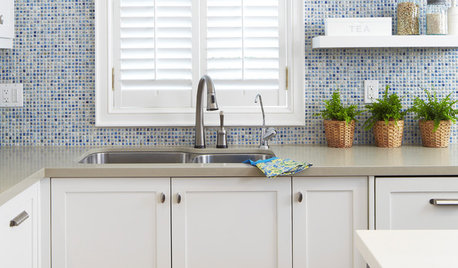
HEALTHY HOMEHow to Choose a Home Water Filtering System
Learn which water purification method is best for your house, from pitchers to whole-house setups
Full Story
GARDENING AND LANDSCAPINGGardens Tap Into Rill Water Features
Rooted in ancient design, this water feature is popular again as a way to help contemporary landscapes flow
Full Story
GARDENING AND LANDSCAPINGSimple Pleasures: Beat the Heat With Water
Quench your thirst and satisfy your need for summery joys by tapping into the many wonders of water
Full Story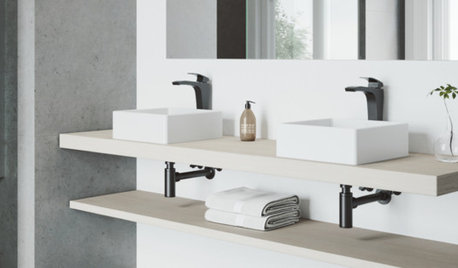
SHOP HOUZZWater-Saving Fixtures
Tap into a more eco-friendly design with these stylish kitchen and bath fixtures
Full Story0
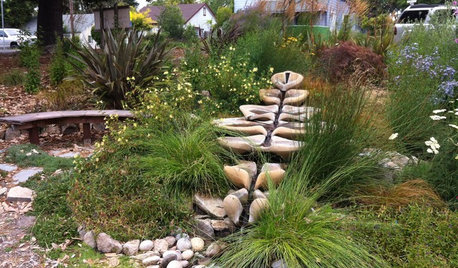
LANDSCAPE DESIGNNew Ways to Design With Water
Go beyond 3-tiered fountains and faux waterfalls to discover water's architectural possibilities
Full Story
SAVING WATER11 Ways to Save Water at Home
Whether you live in a drought-stricken area or just want to help preserve a precious resource, here are things you can do to use less water
Full Story
GREAT HOME PROJECTSHow to Switch to a Tankless Water Heater
New project for a new year: Swap your conventional heater for an energy-saving model — and don’t be fooled by misinformation
Full Story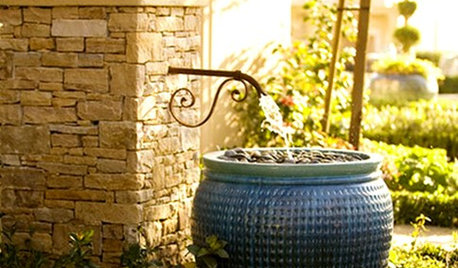
GREEN BUILDINGJust Add Water: Rain Barrel Magic
Take your rainwater storage from practical to beautiful with a new breed of design-friendly rain barrels
Full Story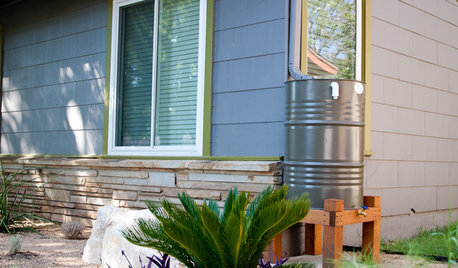
GREEN DECORATINGEasy Green: Big and Small Ways to Be More Water-Wise at Home
These 20 tips can help us all make the best use of a precious resource. How do you save water in summer?
Full Story
lindac92