

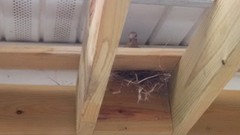
How do I know it's safe to take down a Dove nest?
10 years ago
last modified: 10 years ago
Featured Answer
Sort by:Oldest
Comments (18)
 10 years ago
 10 years ago
Related Discussions
new property and many trees to take down - how to afford it?
Comments (15)Trees for lumbering (where a company would come in and take down a stand of them) are often densely grown and of a particular caliber and species. Open canopied trees are not valuable because of the knots the lateral branches cause. You can usually get a lumber harvester to look at your stand gratis and they can give you an offer for the lumber on the spot. Your stand doesn't really sound promising and three acres worth on a prospective building site might not interest anybody but it's worth a shot. You aren't out anything. Offering free wood on a cut your own basis is very risky because it's dangerous, dangerous work on big trees even for the experienced jack. That's why so many companies go out of business..........the workman's comp part of it. If a person comes on your land and gets injured or killed felling a tree, you better have a good lawyer and insurance. Having them saw up or split already felled tress is not quite the same issue. I know a gentleman, a professional jack who was killed during a clearing operation and my own g'son was injured just limbing up a tree when wooding out. We have acreage and do a lot of tree planting and upkeep, and have worked with a professional tree company for some major stuff and they can be hired out by the day. Still not cheap but not a grand a tree either. I guess you need to look at it from a lot of different perspectives and see what works. Just don't assume there is not liability because your trees aren't in an urban situation....See MoreNew Nepenthes lowii.. How do i take care of it!!!
Comments (6)Hi pampered_g_jr, Many Nepenthes can adapt to your home humidity and temperature, I have heard that lowii is best given a drop in nighttime temperatures down to 60 Fahrenheit and day highs of 80. It is an ultrahighland from Borneo I believe. The alata is much more adaptable and easier to grow in home. In any case, light is one of the most important considerations for any plant, so partial sun, like in a non-south window, or strong flourescents, like a compact 100 watt equivalent or 2 40 watt shop light tubes, are essential. If flourescent light is used, it would be best to place the Nepenthes at least 5-8 inches from the light for proper color and pitcher formation to occur. Water with distilled, rain, or mineral free water from the better R/O units... some do not remove salts which would build up in the soil and kill the plant slowly. Water by top watering and let the water drain through the soil and do not have a tray under the pot, Nepenthes roots will rot if they are left in stagnant water too long and so over watering and under watering are both a problem. Just water like a houseplant a couple times a week and make sure their soil never dries or gets waterlogged. Also, do not put distilled water in their pitchers, that does very little for the plant except make it more difficult for the plant to catch and digest insects properly. Some care sheets say to do that, but they must be joking, the pitchers have lids and produce their own fluid, which is a mix of enzymes and preservatives, after all. Sometimes Nepenthes will stop producing pitchers and have dieback in it's present pitchers when it's environment changes too drastically, like a humidity shock. A slow change from high humidity to low over several weeks will help harden the plant to your home humidity level. The lowii might never adapt easily, so a terrarium or some way to provide consistent humidity (100% at night and 80% in daytime) might help it. It probably will not die, but from reports I have seen, they do not grow their best without their requirements met. Normal household temperatures should be fine for the alata, the lowii can withstand temperatures up to about 80-90 degrees in the day and down to 60 at night with a requirement for that lower temperature at night. Once again, if this requirement is not met, it probably will not die instantly, but it will be distressed and be very unhappy. Some people fertilize their Nepenthes by foliar feed directly rubbed on their leaves with a damp cloth. The fertilizers that work best are orchid blood meal in very dilute solution of 1/4 or less and no more than one time every two weeks, once a month even better. It is easier to overfeed and burn the leaves or kill the plant than to underfertilize. I never have needed to fertilize my Nepenthes, I just make sure it gets an insect every week or two. If it looses it's pitchers, sometimes a little temporary fertilizing will perk it up and make it produce again. Make sure no fertilizer gets in the soil, that can kill carnivorous plants in a few weeks or months slowly. Soil requirements are dictated by acid mix and high level drainage. One part peat moss of the bale variety with no fertilizers or additives and 2 parts plain perlite is good as is one part coconut husk, one part orchid bark, and one part peat moss, making sure that no salts or additives were placed in any of your soil ingredients. It is safe to say that carnivorous plants of virtually all types are allergic to any additive to their soil that would change the Ph from acid. Water with minerals and salts (hard water over 100), fertilizers, and chemical treatments (like copper based fungicides) would all harm the plant if it gets in the soil (copper also inhibits pitcher production if sprayed on the leaves). Fungicides and pesticides should be sparingly used and of the sulfur or neem oil extract type with pyrethrines, no soap based natural insecticides, those would add nitrogen to the soil when bacteria breaks it down. There are not many fungus and insects that attack Nepenthes, but they do occur sometimes. The conditions I keep my N. sanguinea in are as follows: Light: 4 40 watt flourescents of the cool white shop light variety 5 inches from leaves. Watered with distilled water every 3-4 days and misted 1-2 times a day. Temperature is between 65-80 degrees according to seasonal difference indoors. Humidity is relatively high in my region, probably 60-70% indoors with central air. Plant is in a 5 inch pot of coconut husk/peat/bark mix. Each pitcher is digesting a variety of insects as it's fertilizer of choice. Flies tend to be more interested in the Nepenthes than they are in the Venus Fly Trap. Here is a recent photo of the young plant with it's newest 4 inch pitcher. Good luck with your plants....See MoreVerbena: how do I take care of it?
Comments (21)To the last three posters.......you have asked questions on a thread that is 6 years old. The chances of you getting a response when tacking onto a very stale thread tend to be rather slim :-) Posters who would be inclined to provide the answers you need usually ignore or overlook such old threads, especially on this forum, which doesn't get a lot of traffic. The only reason I bothered to open the thread at all was because I was curious as to why it was still getting attention six years later. There are many different types of verbena so I'm going to make a guess that the type you 3 are asking about is Verbena x hybrida or what are typically sold as annual bedding plants in most of the country. Like any annual, they are cold sensitive and won't put out much growth or flower buds if the temps are too low (in the 40's at night). They are also not happy in excess heat and will tend to stop flowering in high temps but will resume again once temperatures moderate in fall or with cooler weather. Some forms of x hybrida are quite upright, mounding plants and others are trailing varieties -- those that are trailing forms will have long drooping stems and are ideal for hanging baskets. They need a fair amount of sun to bloom well, even watering (not too much nor too little) and not a great deal of fertilizing - too much fertilizer will produce lush foliage at the expense of blooms. Verbena grown in a container or hanging basket will need more frequent fertilizing, but use a dilute formulation. Pinching back growth early in the season will encourage bushiness. Deadhead the spent flowers by pinching off to improve and tidy the appearance and encourage continued flower development. I wouldn't bother to attempt to winter over in zones lower than 9 - these are inexpensive plants and not worth the extra effort. You can save seeds in late season and sow indoors in late winter but as these are hybrids, there is no guarantee that what results will look like what you had growing the previous season....See MoreI'm not sure how long I can take it....
Comments (32)You know I've read the OP's statements several times and never did she say how long the dog was crated. I've gone on record as stating that I crate my dogs and i will continue to crate my dogs when I am not available to supervise them. However, 10-13 hours is entirely too long. I know many trainers and many competitors at top levels and none suggest caging up a dog all the time. The dogs I'm involved with come from field lines and positively define high energy. They would very quicly go competely bonkers if not given an appropriate outlet for their energy. If I am to be gone more than 4 hours, I make arrangements for a responsible party to take care of the dogs. Having seen personally or heard of too many "accidents" with dogs who had been completely "trustworthy" in the past, I feel it is in the best interests of the dogs to safely confine them when I am not home. I do not believe in doggy doors either and I will not come home to a dead dog or a dog in need of immediate surgery because of my own pride in my training techniques. Perhaps if it were not the hot button issue of crating, this philosophy wouldn't be under attack? For example, I train my dogs not to counter-surf. I can prepare dinner and know that the 12 course dinner I'm preparing will not disappear behind my back. I expect to still see Tom Turkey on the counter if I leave the room to answer the phone. Tom had best be unmolested when I'm done showering. However, I'm not silly enough to insist that a turkey left alone on the counter for 4 hours would just get up and walk away on its own while 4 loyal dogs lay innocently with heads resting on crossed paws. I trust my training, but dogs are dogs. They are animals and to them, 5 minutes of joyfully devouring a turkey is worth a punctured esophagus. I cannot reason with them after the fact anymore than I could reason with a 3 year old. I didn't leave my 3 year old children home alone either and no matter how much we want to think that dogs are children, they don't ever progress past the mentality of a 3 year old. Could i leave my 10 year old lab out while I'm gone? Probably. She sleeps in her crate while i'm gone and I'm )almost) sure that she would sleep on the floor while I'm gone. But I don't want to find out I was wrong at the expense of my dog's life, especially when they ENJOY their crates and LIKE being in a safe place. I was given charge over these animals - I will care for them and not leave them to their own devices. Part of my responsible dog ownership is ensuring that their minds and bodies are stimulated enough to desire rest and re-charging when I'm not available. To this end, I play with each dog individually for 30 minutes each morning - hard play equivalent to the most strenuous aerobics class. We then take an 30 minute walk and brush up on obedience skills. Breakfast is served while I shower and prepare for the day, followed by potty time and a bit more fetching. Crate time is generally from 11-1. After errands, the dogs go back out to enjoy the fresh air and relieve themselves if needed. Before starting dinner for the human family, the dogs get another 30 minute aerobic workout. They lounge inside (or out if I'm grilling) until after dinner (theirs and mine) Two are competing and they get another obedience session in the evening, followed by a family walk. Before it gets dark, I take the one dog who is competing in field trials out for some bird work. Everyone then gets to watch TV before a final pit stop and retiring to various sleeping spots. I've owned dogs for 40 years now. Always multiples and always highly trained. I've lost plenty, but it was always due to old age or disease and never to something preventable like a car accident or foreign object ingestion. This is due to careful supervision and superior training and I'd like to keep my record and my conscience clean....See More- 10 years agolast modified: 10 years ago
- 10 years ago
 10 years ago
 10 years ago
- 10 years ago
- 10 years ago
- 10 years ago
- 10 years ago
 10 years ago
 10 years ago
- 10 years agolast modified: 10 years ago
 10 years ago
- 10 years ago
- 10 years ago
- 10 years ago


Related Stories
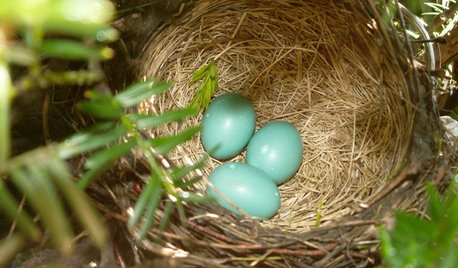
GARDENING FOR BIRDSWhat to Know About Birds Nesting in Your Yard
Learn how to observe, record data and help ornithologists with NestWatch’s citizen science project understand bird trends
Full Story
REMODELING GUIDESWhat to Know Before You Tear Down That Wall
Great Home Projects: Opening up a room? Learn who to hire, what it’ll cost and how long it will take
Full Story
KNOW YOUR HOUSEStair Design and Construction for a Safe Climb
Learn how math and craft come together for stairs that do their job beautifully
Full Story
GARDENING AND LANDSCAPINGTake a Winter Walk on the Safe Side
Learn how to handle snow, ice and other cold-weather landscape factors to minimize falls and damage
Full Story
FUN HOUZZEverything I Need to Know About Decorating I Learned from Downton Abbey
Mind your manors with these 10 decorating tips from the PBS series, returning on January 5
Full Story
WHITEWhat to Know Before You Paint Your Walls White
A coat of white paint can do wonders in one room and wreak havoc in another. Here are tips for using the popular hue
Full Story
BUDGETING YOUR PROJECTConstruction Contracts: What to Know About Estimates vs. Bids
Understanding how contractors bill for services can help you keep costs down and your project on track
Full Story
BOLD COLORThe Joy of Taking Risks in Design
Not interested in playing it safe? Then check out these 14 bold spaces
Full Story
WORKING WITH PROS10 Things Architects Want You to Know About What They Do
Learn about costs, considerations and surprising things architects do — plus the quick route to pinning down their style
Full Story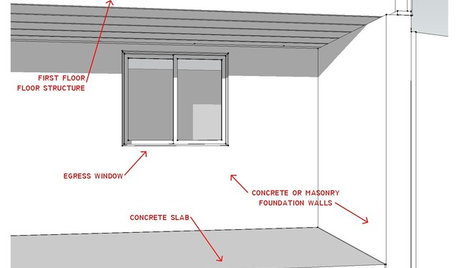
REMODELING GUIDESKnow Your House: The Steps in Finishing a Basement
Learn what it takes to finish a basement before you consider converting it into a playroom, office, guest room or gym
Full Story

Suzieque