

Has anyone tried Alton Brown's meatloaf?
14 years ago
Featured Answer
Sort by:Oldest
Comments (65)
 14 years ago
- 14 years ago
Related Discussions
Has anyone ever tried to grow a Resurrection Plant?
Comments (33)Hi. Stan here. All right, let's put this puppy to rest. First, if you want to keep one of the "resurrection plants" alive, you need to figure out which resurrection plant you have. Here, I'm going to address ONLY the resurrection plant from the Chihuahua Desert, spanning several states in the southwestern USA and adjacent parts of Mexico. (If you have one of the other kinds of resurrection plants, you're on your own.) Botanically, these plants are part of a much larger group called the club mosses. They fall somewhere between the mosses and the true ferns. They are a very old group of plants dating from the Coal Ages. Their scientific name is Selaginella lepidophylla. If you want to get it right, the "S" and only the "S" in Selaginella is ALWAYS capitalized, all other letters are lower case. And both words are italicized. (No italics on your typewriter? Then you can underline them instead.) Almost all other Selaginella in the world are moist habitat plants, living in deep forests, swamps, in or near streams and creeks, or among other plants for protection from direct, scorching sunlight and desiccating dryness. You would grow them the way you grow most of the true mosses. S. lepidophylla is a distinct exception, apparently surviving if not thriving in a desert, and a pretty severe one at that. I am trying to include several photos I took of them growing in their native habitat in western Texas. Note that they most commonly grow on the northern sides of hills and protected in the shadows of rocks or other plants. If they receive any direct sun at all, it's only for a few hours in early morning and very late afternoon. They tend to grow where they're in dense shade throughout most of the day. Note also that the soil in which they grow is comprised mostly of disintegrated, calcareous rock (i.e., limestone soil) with a little organic detritus (mostly naturally composted leaves, grasses, mosses, and other dead plants) mixed in. The limestone base is strongly alkaline, and the organic stuff tends to act as a hydrophilic buffer, holding water for a few precious hours or days after a dew or rain. The climate in which they grow is fierce. In Summer the daytime temperatures often reach 100̊ F. They may receive a few drops of rain from time to time, BUT while the Chihuahua Desert does not receive a lot of moisture in the form of rain, it is often blessed with dense fogs and heavy dews. And these are the resurrection plants' saving grace. Winters are a little less hostile. Nighttime temperatures often drop slightly below freezing, and light, freezing rain and sleet are not uncommon. For S. lepidophylla, life is a lot easier. S. lepidophylla, much like other Selaginella, uses a collection of tine hairlike roots to hold itself in place in the desert, and to absorb what little liquid water might be available, but it probably gets most of its water from the aforementioned fogs, dews, and occasional rains as the water is absorbed directly through the surfaces of its leaves and stems. It almost never sits in liquid water for more than a few hours. No, they are not immortal, and cannot survive forever in a dried state. In fact, if your S. lepidophylla isn't obviously fresh and alive when you get it, it probably never will be, regardless of what you do for it. All reports of them recovering after 50 years rolled into a brown ball are either circus hawkers' sales pitches, or statements by people who can't recognize a dead plant when they see one, and were fooled by the unfurling corpse. (At this point perhaps you should review the Monty Python "Dead Parrot" Sketch on YouTube.) How long can they survive in such a dried, dormant state? I don't know. Apparently no one has ever performed any sort of controlled experiments to determine this, and there is so much hogwash flying around about the matter that it's impossible to even make an educated guess. So, how might you try keeping one alive? I confess I've never been successful, and I've only seen one botanical conservatory with living S. lepidophylla on display. And, I know of a veritable garden of them growing wild in the Chihuahua Desert of west Texas. Here are some suggestions based on general plant care, plant physiology, Botany, and what I've seen in the wild: 1) Almost all plants in nature experience an annual growing cycle based on the change of seasons. This helps all members of a given species flower at the same time to promote cross pollination. It also prevents them from flowering in deepest Winter and trying to go dormant when they should be actively growing. If you try to get one of these to grow as Winter approaches, you're almost certainly wasting your time. Early Spring would be a much better time to try this endeavor. 2) Don't waste your time on a dead plant. If it isn't obviously alive, move on to the next hobby. 3) Soak your newly acquired S. lepidophylla in room temperature tap water for 2 or 3 hours, no longer. This is intended to just "top off the tank" of its water reserves. Soaking it any longer might likely afford harmful molds or bacteria a foothold. 4) Plant it by laying it, right side up, on a layer of barely damp soil. The soil should be composed mostly of a mix or limestone sand or finely crushed oyster shell mixed perhaps half and half with compost or garden loam. Do not use commercial potting soils because they are composed of either peat or composted lumber byproducts. All these things are acid by nature, and these plants have evolved to survive in an alkaline environment, the exact opposite. Commercial cactus soils might work. Maybe, maybe not. 5) Do not use a tall or deep container. A "bulb pan" would be much better than a standard 6" terra cotta pot. The entire soil must be kept only slightly damp, and large masses of soil are sure to develop pockets of wetness in their centers. If the plant or its roots are allowed to set in water or are too damp, they'll rot and the plant will die. 6) For the first week, keep it loosely covered with plastic to maintain a high humidity. Remove the plastic after a week, or as soon as the plant appears to be alive and growing, or begins to develop mold. Mold is a bad thing. Generally, a molding plant is a dead plant. Maybe you need to try a newer, fresher resurrection plant. 7) Give the plant the brightest light available that isn't direct sunlight, except that it can receive a little direct, early morning sunlight for 30 minutes, no more. 8) Do not water the plant like you do your geraniums! Instead, mimic a dew once a week by misting it. The plant itself should end up quite wet, but the soil should be only a little damp. 9) S. lepidophylla should be allowed to dry out a little more in Winter, and moved to a brightly lit but much cooler place for several months beginning in early Winter (November in the Northern Hemisphere). Remember that they routinely survive light freezing weather during many Winters. They may be taken out of their Winter rest period in early Spring (early March perhaps in the Northern Hemisphere) by moving them to a warmer room and beginning their weekly misting. Go easy on the misting at first, but resume normal misting after two or three weeks or as you can see new leaves and branches forming. 10) *USE DISTILLED WATER.* Not spring water, not softened water, not demineralized water, not baby's sanitized water, not holy water, not expensive French bottled water. Reverse osmosis (RO) water might be acceptable, but is a lot more expensive than simple, old fashioned, distilled water. All such water contains some level of dissolved minerals, important ones being lime and/or salt. As you water your houseplants with the wrong water, the water evaporates, but these contaminants merely accumulate. If you don't believe me, look at the mineral crust that's developing around the edge of the soil in your half dead geranium's pot! And before long your gorgeous plant begins to look tired and droops as it tries to fight off the doses of lime and salt that you've been dumping on its roots for months. Soon, it can no longer grow effective roots and it begins a slow, inch a day, march towards the waste bin. I hope this helps you when you try your hand at growing these most fascinating plants. Best of luck....See MoreHas anyone tried canned lemon curd?
Comments (6)I've made it. And I've canned it. The longest I've let it sit canned is about 4 months. Obviously it doesn't taste like fresh - but it is better than the jarred stuff you can buy in the store. But canned tomatoes don't taste like fresh tomatoes either. I don't always have the time to make fresh lemon curd. I usually make it in January - when I'm getting my bulk citrus orders from Florida. There are quite a few lemon desserts I usually make at Easter, and I find it very convenient to have my home made canned lemon curd available. I usually can it in the 4 oz jars. I've never frozen it - so I can't comment on the difference between freezing it and canning it. I know there are tons of people on this forum who have 3 or 4 freezers, and thus always recommend the freezing option. But, like many others, I don't have that type of freezer space - so making fresh or canning are my options....See MoreWhat is the mixer Alton Brown uses?
Comments (19)Yep...definitely a Viking. I have had the 5-qt. one for almost 3 years and love it. When my KA finally did the dance of death, I researched stand mixers until I was sure the Viking was the one for me. It fit all of my criteria, including all metal gear transmission, 800 watts of power (we all know how subjective that can be), a tilt head, low profile (to fit under my low-to-the-counter ceiling cabs) wheels on the back for ease of maneuvering, and the country of origin (the UK or Italy, not China). Granted it's a bit pricey, but it's worth it. The Cuisinart hadn't been on the market at that time, but I still would have chosen the Viking for a couple of reasons, including quality, where it's manufactured, and those great little wheels ;o) The Baker's Catalog/King Arthur Flour folks were extremely helpful with the "real life" application recommendation, as well. I chose the 5-qt. because I like the fact that the bowl isn't too deep. I have made double batches of breads, cookies and cakes, and it's roomy enough. I found that the 7-qt. bowl was a tad too deep for just one smaller batch of ingredients. If I want to make a larger amount I just do two batches, which for me is easier than dealing with a too-deep bowl....See MoreHas anyone tried B.M. Edgecomb Gray on cabinets?
Comments (4)Probably similar to this. Either way, the ONLY way to tell is to find a door, paint it satin finish in Edgecomb. Put it with your selections, flooring, tops etc.. I'd advise limiting it to wall color and an ISLAND. At some point......it's a big commitment for the entire fitted kitchen. Warm and inviting, certainly....See More 14 years ago
 14 years ago
- 14 years ago
- 14 years ago
- 14 years ago
- 14 years ago
- 14 years ago
- 14 years ago
- 14 years ago
- 14 years ago
 14 years ago
 14 years ago
- 14 years ago
- 14 years ago
 14 years ago
- 14 years ago
 14 years ago
 14 years ago
 14 years ago
- 14 years ago
- 14 years ago
- 14 years ago
 14 years ago
- 14 years ago
- 14 years ago
- 14 years ago
- 14 years ago
- 14 years ago
 14 years ago
- 14 years ago
- 14 years ago
- 14 years ago
- 14 years ago
- 14 years ago
- 14 years ago
- 14 years ago
- 14 years ago
- 14 years ago
- 14 years ago
- 14 years ago
 14 years ago
- 14 years ago
- 14 years ago
- 14 years ago
- 14 years ago
 10 years ago
- 10 years ago
 10 years ago

Related Stories
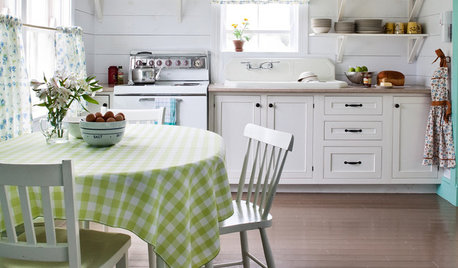
KITCHEN DESIGNThe Cure for Houzz Envy: Kitchen Touches Anyone Can Do
Take your kitchen up a notch even if it will never reach top-of-the-line, with these cheap and easy decorating ideas
Full Story
MUDROOMSThe Cure for Houzz Envy: Mudroom Touches Anyone Can Do
Make a utilitarian mudroom snazzier and better organized with these cheap and easy ideas
Full Story
DECORATING GUIDESThe Cure for Houzz Envy: Guest Room Touches Anyone Can Do
Make overnight guests feel comfy and cozy with small, inexpensive niceties
Full Story
BEDROOMSThe Cure for Houzz Envy: Master Bedroom Touches Anyone Can Do
Make your bedroom a serene dream with easy moves that won’t give your bank account nightmares
Full Story
LAUNDRY ROOMSThe Cure for Houzz Envy: Laundry Room Touches Anyone Can Do
Make fluffing and folding more enjoyable by borrowing these ideas from beautifully designed laundry rooms
Full Story
BUDGET DECORATINGThe Cure for Houzz Envy: Living Room Touches Anyone Can Do
Spiff up your living room with very little effort or expense, using ideas borrowed from covetable ones
Full Story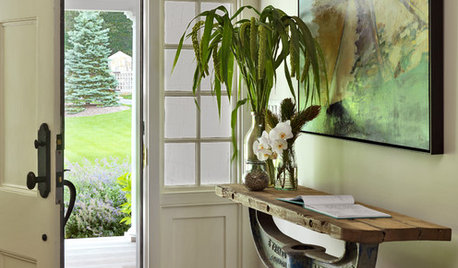
BUDGET DECORATINGThe Cure for Houzz Envy: Entryway Touches Anyone Can Do
Make a smashing first impression with just one or two affordable design moves
Full Story
WOODKnotty and Nice: Highly Textured Wood Has a Modern Revival
Whether it's cedar, fir or pine, if a wood has a knot, it's hot
Full Story
COLORS OF THE YEARPantone Has Spoken: Rosy and Serene Are In for 2016
For the first time, the company chooses two hues as co-colors of the year
Full Story
LIFEHouzz Call: What Has Mom Taught You About Making a Home?
Whether your mother taught you to cook and clean or how to order takeout and let messes be, we'd like to hear about it
Full Story
seagrass_gw Cape Cod