

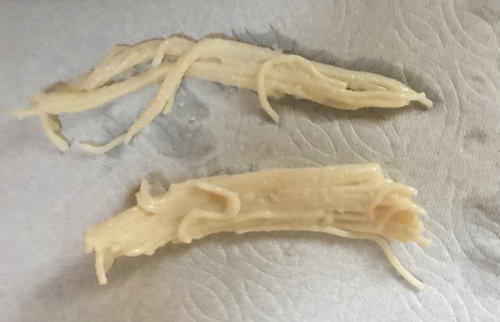
How to avoid spaghetti glop?
2 years ago
last modified: 2 years ago
Featured Answer
Sort by:Oldest
Comments (50)
Related Discussions
Red spaghetti at rim of compost bin
Comments (19)More replies! Thanks, everyone. Nancy - I don't know how hot my pile is but there are worms twisting around all the way through. And there is no smell at all.. Flora, as you're in the UK too, maybe you saw the newspaper gardening Q+A I mentioned: it was Stephen Anderton in last weekend's Times: http://property.timesonline.co.uk/tol/life_and_style/property/gardens/article5724913.ece - it's the first Q after that witch hazel article. He's saying the worms just want a bit of air - which seems to be the consensus here. So I guess I've succeeded in vericomposting? I'm tempted to set up a separate vericomposting bin, scooping a big plate of 'spaghetti' into it and then see what happens with my 'hot pile.' Oh, and off topic but Flora, how did you figure out w hat zone you were in??? I put myself down as USDA zone 6 for outskirts of London but it's just guess work....See MoreNCHFP Spaghetti Sauce without Meat
Comments (21)Oh, patty, just saw your question above. I *knew* I was opening a can (or jar?) of worms there. Yes, you can use peppers or celery or a mix b/c this recipe says so. I said I was going out on a limb and Dave probably wouldn't agree, but gave my rationale. Now, I know the salsa study was an acidification study, but since the spaghetti sauce is a PC recipe too I thought onions instead of peppers was safe but when you get into pickling, you really have to be careful. Just b/c a salsa study and a salsa recipe (Choice Salsa, I think Annie's too) say peppers and onions are basically equivalent (the acid in the recipes is sufficient to acidify either/both), and a PC recipe says you can sub celery for peppers, does NOT equate to peppers=onions=celery in all recipes, either PC or BWB. I'm not a food scientist, but peppers and onions have pretty close to the same pH to begin with. Onions might have more water activity, but the acid in the salsa recipes is enough to allow the substitution, AND it was specifically measured in that study. The pH of celery is just that little bit higher than peppers OR onions, and it's more fibrous than peppers but also seems to have more free water so unless a pickling recipe says you can sub celery for peppers, I'd not assume it was safe. I made a mixed vegetable pickle last month based on the JoP recipe but only after I emailed Linda Z and asked if there had to be a certain proportion of green tomatoes, etc. since I had mostly squash and beans, no cabbage. She said go ahead, feel free to create my own mix, but that's a straight vinegar pickle, the recipe (Picalilli) says you can change up proportions, and I double-checked with her. Oh, and it still didn't look like enough brine (density issue) so I added another cup of vinegar for a total of 3.5C of vinegar for 13.5C of veggies as compared to 3.25C of vinegar for 13.5C of veggies in the NCHFP recipe (actually they use 4.5C vinegar for 18.75C veggies). This post was edited by ajsmama on Mon, Sep 15, 14 at 12:55...See MoreWhat do you do with spaghetti squash?
Comments (13)My family enjoys this recipe. Just make sure the spaghetti squash is tender before baking. Spaghetti Squash With Vegetables & Mozzarella (LOW CARB) This recipe makes a veggie rich, cheesy casserole, almost like a lasagna. Spaghetti Squash substitutes for the role traditionally taken by pasta in such dishes for a delicious, lower calorie alternative. 1 spaghetti squash, cooked by your favorite method and separated into strands (I use the microwave) 1 large yellow onion, diced 1 green bell pepper, chopped 1 red bell pepper, chopped 2 Tbsp. olive oil 1 can (28 oz.) crushed tomatoes 3-5 cloves garlic, minced 1 tsp. basil 1/2 tsp. oregano 1/2 tsp. crushed red pepper (optional) 1 Cup grated mozzarella cheese 1/2 Cup grated Parmesan cheese Serves 6-8 Preheat oven to 375 F. Mix the cheese together, set aside. Heat olive oil in a skillet and add the onion, pepper and garlic. Sauté over medium heat for about 5 minutes. Add crushed tomatoes, basil, and crushed red pepper (if using). Simmer uncovered for about 15 minutes. Mix squash well with the cooked vegetables and put half in the bottom of a large (13 x 9 inch) baking dish. Top with half the cheese mixture, followed by the other half of the squash mixture, then the rest of the cheese. Bake for 30 minutes or until cheese is bubbly and slightly browned. Let cool 10-15 minutes before serving. This also works to assemble it ahead of time and bake later. My kids gobble up huge servings of veggies when they eat this. Karigraphy...See MoreGrowing and freezing spaghetti squash?
Comments (12)After you freeze it and then thaw it and eat it, the flavor itself doesn't really change, but the texture does. Frozen squash that has been thawed is more watery and a little mushy (depends on how you cook it) in comparison to fresh squash. Saved seed, as others have noted, may or may not give you exactly the same squash you had. If the spaghetti squash was an open-pollinated variety that didn't cross-pollinate with another squash in the same species (C. pepo, so that would include zucchini, scallop, acorn, crookneck, straightneck, etc.), then you might get a harvest of squash just like the one from which you saved seeds. However, if your original squash came from a hybrid variety, you might or might not get something similar---it would be just the luck of the draw depending on how the genes sorted. Since hybrids are creating by crossing two (or more) parents lines, you don't know how genes will resort when they are coming from seed created by plants that are children of the original cross. Squash bugs are pretty much a perpetual problem once they find your garden, as are squash vine borers. However, every now and then, you get a year where one or the other, or even both, just don't show up. I think my last year like that was 2011 or 2012. You have to aggressively attack the squash bugs every year, using every organic method at your disposal. It is especially important to find them all and kill them all every autumn, and to dispose of all squash plant debris (via burning it or bagging it up and having it hauled away as trash) so it will not serve as an overwintering location for the squash bugs. Skipping planting squash one year might help or it might not. If someone near you is growing squash, they'll be over in their garden this year, and then come back to yours the next year you plant squash. Squash vine borers show up for 2 and sometimes 3 generations a year in our climate. Each generation seems to last about 6 weeks. I believe a member of this forum who lives down here in southern Oklahoma may have had 4 generations this year, which is very rare. (One generation is one too many, but we cannot do anything about that.....). The best hope of beating them is to grow only squash from the C. moschata species (or some of the cushaws from C. argyrosperma) as they have dense stems (other squash have hollow ones which allow the squash vine borers to bore through them) which prevent the borers from tunneling through them. It also helps if you can move the squash around within the garden, rotating it from one location to another each year, which at least makes the overwintering squash vine borers and squash bugs have to search harder to find your plants. Early plantings sometimes have time to get big and produce a harvest before squash bugs or squash vine borers show up....and sometimes they don't. Growing under floating row cover or in isolation cages helps a great deal, but generally requires you to hand-pollinate your squash blooms daily as the covers prevent pollinators from reaching the flowers. The Cucurbita family is large and very diverse. The different members of the cucurbita family can cross with other cucurbitas, but only with the ones that are in their same genus and species. So, cucumbers, which are Cucumis sativus, can cross with other cucumbers that also are C. sativus, but they wouldn't cross with any of the squash (which are from a different genus (Cucurbia) and any one of several different species, including C. pepo, C. agryrosperma, C. maxima, and C. moschata) or with the melons that are in the Cucumis melo family (true cantaloupes, muskmelons, honeydew, Armenian cucumbers, vine peaches or Asian pickling melons) or with watermelons that are Citrullus lunatas, even though they all are in the Cucurbitaceae family. Watermelons cross with other watermelons, but they don't cross with squash, melons or gourds. Within the Cucurbita family, maximas will only cross with other maximas and pepos with other pepos, etc., for the most part although I won't say it cannot happen or never will happen because I think it can be done at least with some things in lab conditions. If you want to save seed in the future, there are ways to ensure that open-pollinated varieties produce true from seed, and this can include isolating the blossoms by bagging, caging or using floating row cover and hand-pollinating it yourself to prevent insect- or wind-aided pollination. (That's a general comment on saving seed in general, not one specific to squash.) With each type of seed you want to save, you have to know how it pollinates to know how to control the pollination or even if you need to try to control it.) You also can isolate by distance, although the generally recognized isolation distance can be hard to achieve if you aren't on acreage, or widely isolated from farm fields or other gardeners. While squash bugs are a pretty consistent problem almost statewide, I don't think I had squash vine borers for our first 7 or 8 years here, and it was wonderful. I grew up to 30 varieties of squash a year and really loved it. I knew one day the SVBs would find us, and once they did, I now mostly restrict myself to growing only squash from the C. moschata family. Every now and then I'll grow one of the cushaw varieties, or maybe one C. pepo or C. maxima variety, but most years they aren't worth the time it takes because the SVBs will hit them before the squash can mature. While most C. moschata varieties are winter squash varieties, any of them can be harvested a short while (just a couple of days) after the flowers are fertilized for use as a summer squash while young and tender. There also is a summer squash that is C. moschata. It is an Oriental variety known as an avocado squash. I find it easier to grow it than to worry and fret about the squash bugs and squash vine borers getting my C. pepo, C. maxima or C. agyrosperma plants. One year I waited until my C. moschata vines were big and running all over the place and then planted an ornamental pumpkin that was C. pepo variety "Goosebumps", right in the middle of them and the squash bugs and squash vine borers didn't find it until it already had produced a couple of mature pumpkins for Halloween decorations. That is more the exception than the rule, though. If money were no object, I'd build a high tunnel and cover it with mosquito netting or some other kind of netting like the pricey ProTek netting to exclude the squash bugs and squash vine borers so I could grow all the squash I want. However, since I live in the real world where a budget matters, I just focus on growing the types the squash bugs and squash vine borers generally cannot or do not kill. Or, I grow some C. pepos under summerweight floating row covers, but the wind here in OK can make that challenging since it likes to lift up those row covers (even when staked down to the ground) and carry them away on the wind. Don't be afraid to try to grow whatever variety, species and genus of squash you like, but just be aware that with anything that is C. pepo or C. maxima, and most of the C. agyrospermas, you will have to take extraordinary action to keep the squash bugs and squash vine borers from killing the plants. Squash bugs actually harm them by spreading disease, so choosing the most disease-tolerant varieties you can find also helps. Dawn...See More 2 years agolast modified: 2 years agoSooz thanked sleevendog (5a NY 6aNYC NL CA)
 2 years agoSooz thanked dcarch7 d c f l a s h 7 @ y a h o o . c o m
 2 years ago
 last yearlast modified: last year




Related Stories

HOUSEKEEPINGHow to Clean Your Cookware So It Lasts
Avoid damage during everyday cleaning and stain scrubbing, with these tips for pots and pans made of popular materials
Full Story
LIFEModern Manners for Conflict-Free Family Visits
Avoid thermostat wars, pet peeves and the great shower squeeze with these tips for having family as houseguests
Full Story
KITCHEN DESIGNPlain-Sight Storage for the Kitchen Stuff You Use Most
Turn essential cookware, tools and even spices into design assets by displaying them out in the open
Full Story
GARDENING GUIDESMid-Atlantic Gardener's January Checklist
Scatter berries while ye may, be kind to your fair-feathered friends and try a time-saving compost trick that will keep you out of the cold
Full Story
DECORATING GUIDESSo Your Style Is: Southwestern
Does the singular beauty of the American desert speak to you? If so, Southwestern design style may be ideal for your home
Full Story
KITCHEN DESIGNDream Spaces: 12 Beautiful White Kitchens
Snowy cabinets and walls speak to a certain elegance, while marble counters whisper of luxury
Full Story
KITCHEN DESIGNHow to Design a Kitchen That’s Easy to Clean
Eager to reduce scrubbing time? Get expert advice on making easy maintenance part of your kitchen plan
Full Story
KITCHEN DESIGN10 Ways to Design a Kitchen for Aging in Place
Design choices that prevent stooping, reaching and falling help keep the space safe and accessible as you get older
Full Story
KITCHEN DESIGN16 Practical Ideas to Borrow From Professional Kitchens
Restaurant kitchens are designed to function efficiently and safely. Why not adopt some of their tricks in your own home?
Full Story
DECLUTTERING10 Decluttering Projects You Can Do in 15 Minutes or Less
Try these ideas to get organized at home one small step at a time
Full Story
Islay Corbel