

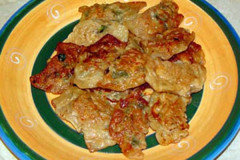
Gyozas - tutorial needed!
6 years ago
Featured Answer
Sort by:Oldest
Comments (10)
Related Discussions
Photo posting tutorial needed, please.
Comments (15)Sorry, it's Angel Face. This rose drives me nuts. It was one I inherited from my mom so it has sentimental value but the dang thing is the worst black spot magnet in the bed. I don't know how it survives every winter because it spends half the season defoliated. But with all the loses I took this year this ones doing great. It's leafed out all over. I'd shovel prune it but mom loved it and I'm afraid she haunt me if I do lol. The blooms are lovely and the scent is fabulous, of course, so I guess I'll hang on to it....See MoreIn need of picture posting tutorial.
Comments (5)The instructions on this page here might help: http://www.pbase.com/weed30/posting_photos Read through the entire page, as people have added additional tips further down. I think that if you put your pictures on something like PhotoBucket, it will display the HTML code that you would copy and paste into your Kitchens Forum thread message to get the picture to show up. The HTML code is something like: <a href="http://s8.photobucket.com/albums/blahblah/?action=view&current=blahblahpic.jpg" target="_blank"><img src="http://i8.photobucket.com/albums/blahblah/blahblahpic.jpg" border="0" alt="test pic"></a> (where "blahblah" will get set by whatever the name of your album is on PhotoBucket and the name of your jpg file). I have not posted a picture yet myself, but plan on using that instruction page. Good luck!...See Morewarm and cool colors - in need of a tutorial
Comments (10)Color temperature is tougher in decorating because you're working with color in a three-dimensional realm. 99.9% of color information available does not addresses color from a three-dimensional scope. That presents many opportunities to deconstruct color and think about it more truthfully and accurately. Someone suggested I start by selecting a "warm" or "cool" palette to help harmonize the rooms. That's one way to look at. Another is to use that level of contrast. Color is about relationships and to make believe that only the cool colors can play well with other cool colors and warm with warm is not the truth of how color works. It's an easier approach, for sure, but it is by no means the only approach. It could be argued that the rule of thumb of cool with cool and warm with warm really isn't a level of color "harmony" at all -- it just matches. It's the very same with intensity. Keeping to all one intensity or chromatic value room to room isn't THE way to do it. It's just one way to color a house. Juxtaposing a clearer color next to a more muted color can indeed make site lines that are interesting and help define architecture -- it's a way to meet certain expectations. how does dark, old woodwork factor into the warm/cool thing? It's a huge factor. Ya know, I'm always saying that paint does not have to be last, you don't have to have an inspiration piece and *pulling a color* is just one way to look at a color challenge. To say that paint color should always be last is implying that it could be first. Paint color can never be first. Not possible. This is where your woodwork comes into play. Like I said before, color is about relationships and you can start building color relationships once you have the non-transient elements established in the room. The woodwork, the flooring, cabinetry, bookshelves, etc. From those non-transient factors, you can build a shell that will gracefully house whatever contents you want to throw in there. Whatever transient elements you choose are going to "go with" the non transient elements of the room -- the shell. You're not going to choose a sofa that pales off once it's set on your hardwoods. So logically, if you craft the wall color to *harmonize* with the known non-transient elements, you're gonna be fine. It's not necessary to have everything in place to paint a room. Can if ya want, but far too many people put off coloring their environment waiting for that last piece of fluff to be installed. It might be right around the corner -- or it might be years off in the future. Waiting on a *thing* that may or may not ever materialize before you bring color into your experience is a waste of architecture, and time, IMHO. You can color for your now. When it comes to paint color per se, you have to be aware of what "warm" and "cool" really means. In situ undertone and color temperature is revealed when the wall color is juxtaposed to the other colors and elements and exposed to the inherent light in the space. What makes a color "cool" or "warm" is determined when it's experienced in the three-dimensional space it will reside. Outside of that experience, on it's own, whether a color is labeled "warm" or "cool" by some other sets of eyeballs is irrelevant to you and your three-dimensional space. Labeling a paint color as warm or cool can be useful but it's not a fact. It's just a temporary way to organize and categorize paint chips for the preliminary stages of coloring. But the blue-greens, which I thought would give the rooms a sense of peacefulness, actually seem to do the opposite when placed up against the dark reddish wood. I'm guessing it's because of the high contrast? According to your tolerance, it's the opposite of peacefulness. To someone else that playing of contrasts would be a spectacular way to set off, highlight, pay homage to the fabulous woodwork. So for you, a calmer flavor of color harmony would be best. For someone else the amped up vibration of the blue-green to the reddish wood is fabulousness. So to say that keeping an even keel of any level of color contrast is the best way to go about coloring environments would be correct in some instances, but not all. What's the saying....??? even a broken clock is right twice a day.... kinda the same thing....See MoreI need a bacon tutorial
Comments (20)Well, I bought some for hubs once and thought, "Hmmm, Canadian bacon." But perhaps it was mislabeled. NJ born and raised hubs said it was what he grew up eating, so maybe his family never had the real deal Taylor ham or else they called Canadian bacon Taylor ham. I do find the name "Canadian bacon" kind of odd since it's not necessarily Canadian. However, I don't know what else to call it other than "Taylor ham" which I am finding out now is wrong. Who were the Taylors?? I would happily get ham for the beans, but really can't get good ham. Sometimes we buy a whole ham and get lucky and it is excellent. I have three huge bags of really awful leftover ham in the freezer right now. Not going to risk experimenting with it on my home grown green beans . . . as for ham hocks, I dunno. I used to see them back east in PA at our farm market. Never made that big of a pot of beans and I am mostly vegetarian, so didn't try one. Can't get good ham here, but the pork is excellent so might be worth a try next time I make beans . . . don't make them that often. With just me and hubs, it takes us forever to use up a lb. of beans. I have two big containers of bean soup in the fridge right now, and hubs refuses to eat it because I made it with the cursed ham . . . sigh. He bought the ham btw, at Easter....See More- 6 years agolast modified: 6 years ago
- 6 years ago





Related Stories

WORKING WITH AN ARCHITECTWho Needs 3D Design? 5 Reasons You Do
Whether you're remodeling or building new, 3D renderings can help you save money and get exactly what you want on your home project
Full Story
GARDENING GUIDESBasic Lingo Every Novice Gardener Needs to Know
Make sense of garden jargon with this beginner’s guide to horticultural terms
Full Story
FURNITUREWhy Your Room Needs a Pair of Vintage Armchairs
Deliver a double dose of style with this interior design trick
Full Story
HOLIDAYS3 Fun Ways to Fold Napkins Into Christmas Trees
Follow this tutorial to add a little holiday flair to your table setting
Full Story
DIY PROJECTSHow to Replace a Button on a Tufted Chair
Fix a popped button on a tufted chair back with this upholstery teacher's step-by-step tutorial
Full Story
LIFEMake Money From Your Home While You're Away
New services are making occasionally renting your home easier than ever. Here's what you need to know
Full Story
FURNITURECutting Corners with Sectional Sofas
Manage most of your seating needs in one fell swoop with this surprisingly manageable furniture style
Full Story
DIY PROJECTSDIY: Pumpkins and Succulents Combine as Holiday Decor
Follow this easy tutorial to turn your favorite pumpkins into a fresh update for your home or a gift item
Full Story
PRODUCT PICKSGuest Picks: A Mirror for Every Wall
Simple to showstopping, these mirrors fit every need — and every room in the home
Full Story
REMODELING GUIDESYour Floor: How to Shop for Tile
Here's how to read a ceramic tile box and get exactly what you need
Full Story

Gooster