

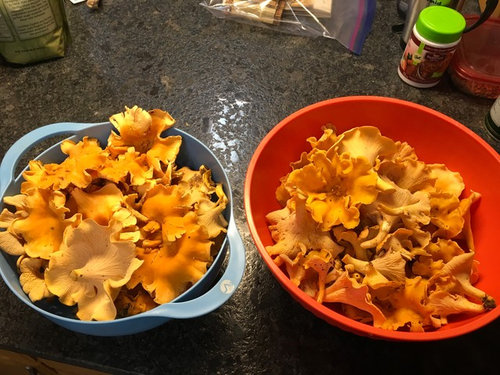
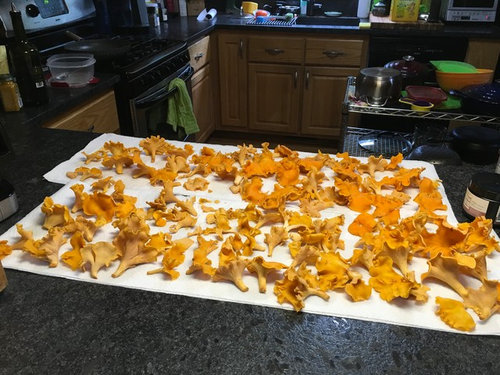
Just harvested a mess of Chantarelles!
7 years ago
Featured Answer
Sort by:Oldest
Comments (7)
 7 years ago
Related Discussions
I may have messed up.
Comments (2)Even planted in March, you probably will end up with multiple but small cloves in this crop. I would still harvest, store, and replant the (largest) cloves from this crop. Use the small stuff for cooking. If you do not do this you will end up with multiple small bulbs with small cloves again next year due to the competition between the expansion of the crowded cloves from this crop. Need to get back to planting single, large cloves IN FALL this year. Hope that made sense. hortster...See MoreOn NO...Did I mess up my corn?
Comments (2)Linda Lou is right. Here, I blanch, and then cut the kernals off the cobs and place them in plastic bags in the freezer. Last night, I wanted an extra cold diet soda (Mountain Dew), and put a can in the freezer to chill it. I was going to get it out a half hour later, but fell asleep at 2am. I woke up at 5:30am and it had exploded and sprayed MD all over the inside my ice cube maker. Had dump out and clean the freezer. Really hard to to do when anything you use to wipe it with freezes in seconds. I had to toss all the ice cubes. Tonight, I just picked a bunck of corn to blanch and freeze. Just as I was to begin with the water heating up, I realized I have NO ice cubes yet! When I blanch, I place the cobs in ice water to cool them down quickly. Can't do that corn until tomorrow.. My grean beans had an 'odd' taste a few years ago, before I started to blanch them. It was more pronounced when I froze some waxed beans, which have a lighter flavor. Now, I usually blanch all the veggies that go in the freezer....See MoreBin harvest...My worms have no class
Comments (7)Well, Chuckie, it's safe to say that those mucky conditions are the favorite environment of the worms in your bin! Earthworms derive most of their nutrients from the microorganisms decaying the organic matter they ingest rather than from the organic matter itself, thus, they thrive best in highly biologically active environments. Think of your compost pile; the fastest rate of decomposition takes place in or near the center or the pile where the mass of material creates an insulated space of optimized conditions for the microorganisms that effect decomposition. The same will be true of a worm bin; the most biologically active areas are not typically at the surface, but several inches below, near the center of bottom of the bin where the environment is more stable and protected, typically more damp, and better optimized to support the massive microbial populations that support the worms. Now, toss into this mix the fact that earthworm castings tend to be more biologically active than the feedstock, even well-rotted feedstock, and it begins to make sense that areas of the bin that contain a mix of castings and decomposing OM will be so microbially rich that earthworms will tend to mass there. Add to this the understanding that the mixture of castings and partially decomposed organic matter hold vast amounts of moisture, which worms are always seeking in the greatest quantities they can find, and one begins to see that the surface material in a worm bin will rarely hold the appeal of the deeper system zones! But the mucky areas are stinky, you say? And stinky like this usually means anaerobic, doesn't it? And worms are supposed to dislike anaerobic enviornments, right? Ah, the complexities of biology! If only the answers were that simple! First, earthworms have an extraordinary ability to attach oxygen, thus, even in relatively low oxygen conditions they are often able to catpure enough to stay alive. Second, earthworms are as happy to consume anaerobes as they are aerobes. It is not the micororganisms themselves that can create problems for the worms, but SOME OF the anaerobic byproducts the anaerobes produce; the terpenes, phenols, and alcohols. The thing is, an earthworm is able to tolerate, even thrive, in some levels of these toxins, meaning "the dosage makes the poison". Further, it is not the terpenes, phenols and alcohols that are the most odorous by-products of anaerobic decomposition, thus, just because the bin smells bad to we mere humans does not mean, definitively, that the bin is toxic to the worms. It may well mean that the anaerobic organisms are generating lots more sulfur gasses than they are compounds toxic to earthworms, thus, the environment is very wet and very microbially rich, which the worms adore, very stinky, a condition about which worms don't really care, sufficiently rich in oxygen to keep the worms respiring even if other aerobic organisms find too little oxygen to function, but not enough toxic compounds to cause worm problems. We make a fuss about keeping bins aerobic because it is nearly impossible to maintain a home verimcomposting or vermiculture bin in an anearobic state that we can be sure will never tip into being toxic, and because the smell of an anearobic bin is offensive to we in or near whose homes the bin will kept. Recommendations that the bin be kept as aerobic as possible can, clearly, sometimes erroneously imply that an anaerobic bin is always, be definition, bad. Chuckie's worms are teaching a valuable lesson! Kelly S...See MoreWhat's Everyone Harvesting Now?
Comments (38)We have a foolish Phoebe who persists in building her nest on the front porch every year. We have cats who sit on the porch most of the day. They pretty much ignore the Phoebe nest, which is up under the porch roof, about 8' above the porch floor, but when a baby bird falls from the nest, a cat gets it. Despite this, the Phoebe stubbornly insists on putting the nest in the same place every year. Every single time we open the front door, she flies away. I don't know how she ever sits on the eggs enough to hatch them. This has gone on for years. She is one stubborn Phoebe. Congrats on the SunGolds. Any tomato you grow yourself is going to be delicious and so worth the wait. We're still getting tomatoes from the first few early plants I bought on Feb. 1st. Our first ripe fruit from plants I raised from seed will be SunGolds but they are just barely beginning to turn, so it will be a few more days. After that, it seems likely the next ripe tomatoes will be Black Cherry, followed by a full-sized black tomato variety called Vorlon. The tomato plants purchased February 1st have done a great job of producing early fruit---we've harvested and eaten about 50 large tomatoes so far, which is the best early crop we've ever had. These plants have done so well that I didn't even get in a big hurry to put our home-grown tomato plants in the ground. There was no need to rush since the early plants were doing so well. I noticed today we have a jalapeno that is about ready to pick. It is pretty comical. It is on a Mucho Nacho plant I planted in the bed with those early purchased tomato plants in March. The plants have not necessarily grown very quickly, but did flower early and set fruit early. The one large jalapeno pepper is one-third the length of the entire plant. I saw it today and just shook my head---the plant kinda reminds me of a Charlie Brown christmas tree with its one lovely 'ornament' of a pepper that is just about big enough to pull the plant over onto its side. I'm tempted to go ahead and harvest the pepper just to relieve the plant from the burden of holding up a pepper that likely weighs more than the plant itself does....See More 7 years agolast modified: 7 years ago
 7 years ago
 7 years ago
 7 years agolast modified: 7 years ago
- 7 years ago

Related Stories
LIFEAnatomy of a Family-Size Mess
Study your home’s dumping grounds to figure out what organizational systems will work — then let yourself experiment
Full Story
URBAN GARDENSHarvest the Bounty of a Patio Garden
Make the most of small spaces on decks and balconies to enjoy your pick of vegetables, fruits and herbs
Full Story
LIFE7 Tips to Get With a New Minimalist Mentality
Feeling overwhelmed by your stuff? Here's how to pare down, simplify and keep just what you need and love at home
Full Story
EDIBLE GARDENS8 Last-Minute Additions to a Summer Edible Garden
It’s not too late to get these vegetables and herbs planted for a bountiful harvest this year
Full Story
TREES10 Spectacular Trees for Courtyards and Tight Spaces
Here are some top small-scale trees for 4-season interest, easy care and little mess
Full Story
GARDENING GUIDESHow to Get Your Prairie On
Have a field day with your landscape, even if you've got just a few modern containers on a paved path
Full Story
KITCHEN DESIGNA Single-Wall Kitchen May Be the Single Best Choice
Are your kitchen walls just getting in the way? See how these one-wall kitchens boost efficiency, share light and look amazing
Full Story
Houzz Call: Show Us Your Paint Makeovers
Let your newly repainted house or room do the "How d'ya like me now?" strut right here — it might just be featured in an upcoming ideabook
Full Story
LIFEHard Winter? 9 Ways to Battle Cabin Fever
We know a lot of you are trapped where it just won’t stop snowing. Here are some ways to survive
Full Story
KITCHEN DESIGNOpening the Kitchen? Make the Most of That Support Post
Use a post to add architectural interest, create a focal point or just give your open kitchen some structure
Full Story
Annette Holbrook(z7a)Original Author