

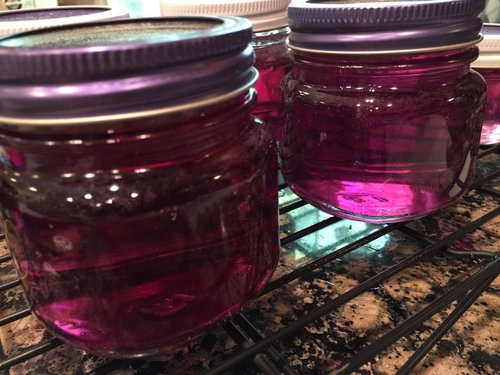
Time to make wild violet jelly
7 years ago
Featured Answer
Sort by:Oldest
Comments (12)
 7 years ago
 7 years ago
Related Discussions
Wild violets
Comments (42)There is no treat-and-forget solution where it has been well-established in a lawn. It requires constant vigilence like being a lawn security guard. I've tried the oxalis-destroyer but fear it has made matters worse. The problem is that the chemical stresses out the lawn grass while it is attempting to control its targeted foe and a stressed lawn makes it that much easier for any weed to take hold. So you may need to just live with a slightly brown lawn until the violets have succumbed. Fall treatment followed by the following Spring is the best success and figure on a few years followed by close monitoring and more treatments when new eruptions occur. Use a surfactant to help break the wax (yes, the violet leaves have been preparing for our attack for thousands of years). And before you violet sympathizers begin to suffer the effrontery of eradicating this natural botanical... try to understand and sympathize with the lawn maintainers. Homeowners who spend years planting and caring for a lawn (in this context, "lawn" means grass!) resent any invader that seeks to undo all their efforts and expense which created the lawn in the first place. It's not the occasional tuft of violets that is at issue but rather an entire lawn covered to the point where the grass has been all but eliminated. If we wanted a field covered with violets we would have planted them in the first place. And trying to bag clippings is near impossible because violet leaves do not shear like grass and discharge through the chute. They create a slurry of green sludge that must be removed from the bag by hand or with a trowel. There is a difference between coexisting and invading. Wild violets are about as invasive a weed as there is and confounds lawn care all over the country. They have ceased to be "cute" additions to a cultured environment....See Moreviolet Jelly, Candy and Syrup
Comments (11)I've tinkered with the violet jelly recipe that is posted all over the Net, so I can share my experiences. Sorry I don't have anything for syrup or candy, though. The recipe I started with is: Violet Jelly (Source: www.prairielandherbs.com) 2 heaping cups of fresh violet petals 2 cups boiling wter 1/4 cup well-strained, clear lemon juice 4 cups sugar 3 oz liquid pectin (Certo) NOTE: Look for fully opened flowers, not partially opened buds, for better color and more intense flavor. The violets you want are the wild violets. Please choose violets that have NOT been sprayed. ) Wash petals well, drain and place in heat-proof glass or nonreactive bowl. Pour boiling water over petals and let steep from 30 minutes to 24 hours. It usually takes about two hours for violets. Strain through a fine sieve, reserving the clear, purplish liquid or infusion. If not using immediately, refrigerate up to 24 hours. Place jars and lids on rack in pan or stockpot deep enough to cover them with about two inches of water, bring to a boil, then reduce heat to a simmer, keeping the jars hot until ready to fill. To make the jelly, stir lemon juice and sugar into reserved infusion in a two-quart nonreactive or stainless steel pan. Bring to a full rolling boil that cannot be stirred down. Add the liquid pectin and continue to boil two minutes, skimming any foam that may rise to the surface. Ladle quickly into jars to within about 1/8 inch from the top; clean each rim and threads of the jar as it's filled, and place flat lid and ring on each before filling the next. Place the jars in a hot-water canning bath and boil for 10 minutes (or the appropriate time for your area). After canning, carefully check to make sure the lids have all sealed. Sealed jars will last up to one year in a cool, dark place. Put any unsealed jelly in the refrigerator. it should keep about three weeks. Makes four or five half-pint jars. Things I tried: Steeping overnight (worked best). Blenderizing the violets to get more flavor (didn't work - too hard to strain out all the little bits of flower petals). Decreasing the sugar - 4 cups was too sweet. I did get a good set from 3 cups and it was still plenty sweet enough for me. Using Pomona pectin (it was cloudy and for the first time, I noticed a chalky texture. I did use honey in that batch instead of sugar, which probably accounted for the cloudiness and perhaps the weird texture. Plus the honey overpowered the flavor of the violets). BWB for 5 minutes instead of 10. That worked great - using sterilized jars. Fresh lemon juice tasted better than bottled. I also threw in a bag of seeds that I had saved, so the set was a bit firmer but still soft, which I didn't mind. Hope that helps....See MoreWild Violets as a companion plant?
Comments (39)Hi! I notice most of this thread is 9 years old and i wonder if you folks are still here, reading this discussion makes me happy. I was researching if i could transplant iris, black eyed Susan, bergamot, and coneflowers into my damp sunny front yard violet patch and expect them to thrive, and I'm going to try it! @Hu of 5 months ago, that would be really pretty, columbine with violets. IDK if it would work but I will try it too after the hardy stuff establishes! My goal is to make a privacy screen so I feel less exposed in my front yard. I want it dense with always something blooming. Right now I have a big forsythia on one end, hollies on the other, and a 100yo rose bush in the middle. I want to be able to put a hammock between the apple trees without my neighbors leering at me. Zone 6 NE KY!...See MoreCan anyone identify this wild violet .. please?
Comments (4)It is V. sororia (or a close ally, but V. sororia is most likely). The 'broken' flowers have been seen before on V. sororia. For instance, Jeana Prewitt (Tennessee) found some, she and I discussed them a couple of years ago, and ended up naming the form 'Jeapurrs' (rhymes with jeepers-creepers). It is good to see your plants looking so well; such healthy foliage. Sometimes, plants (not just violets) with pale-spalshed flowers get that way because of a viral infection, which can manifest itself in the leaves sometimes too. And that can make the whole plant weak; not in your case though. So the colouration of your violets is wither not caused by a virus, or it is due to a virus that is well-tolerated (at least so far). Your dog digging them up will probably have done the population little harm, since new plants will grow from pieces of the rhizomes. In case you are not familar with it, V. sororia has two nicely finely violet/white speckled cultivars called 'Freckles' and 'Speckles' (depending on which colour forms the dots). And there is a form with white flowers with a blue centre (V. sororia f. priceana, the Confederate violet) and a similar one with pinky-purple centre, 'Alice Witter'. There are also pure white forms and at least one pinky-purple one. They all tend to breed true from seed; it would be interesting to see/know if your colour form also comes true from seed....See More- 7 years agolast modified: 7 years ago
 7 years ago
 7 years ago
 7 years ago
 7 years ago
- 7 years ago
 7 years ago
 7 years ago
 7 years ago
Related Stories
EDIBLE GARDENSWhy Grow Quince? For Beauty, Fragrance and Old-Time Flavor
Delightfully perfumed fruit and lovely spring blossoms make this apple and pear cousin worth a spot in the garden
Full Story
GROUND COVERSGive Your Lawn a Taste of the Wild
Consider the joys of an irregularly trimmed meadow lawn: It’s ecofriendly, visually interesting and still good for romping
Full Story
STONEGive In to Your Wild Side With Exotic Granite and Onyx
Go beyond the standard slab with these radiant and rare stones
Full Story
HOUZZ CALLHow Are You Passing the Time at Home Right Now?
Share your thoughts about how you are coping with stress and staying grateful during this difficult time
Full Story
HOUSEPLANTSGardens Under Glass: How to Make Your Own Terrarium
Be the master of a mini ecosystem indoors — the low-maintenance, highly rewarding kind that fits any room
Full Story
FLOWERS AND PLANTSSpring Is the Season for Sweet Violets
These delicate old-fashioned plants will nestle nicely into a shady spot in your landscape or rock garden
Full Story
DECORATING GUIDESBotanicals Gone Wild: Wallpapers that Wow
Sweet Floral Prints Are Bigger and Spreading Faster Than Kudzu
Full Story
FEEL-GOOD HOME10 Ways to Make Your Home an Oasis of Calm
Natural materials, restful hues and a lack of clutter help create a peaceful ambiance
Full Story
PRODUCT PICKSGuest Picks: A Wild Kingdom of Your Own
You’ll roar for these cute, creative or just plain good-looking animal artworks, accessories and more
Full Story
HOUZZ TOURSMy Houzz: Wild Triangular House in Boulder
Bold colors and eclectic vintage finds meet at every angle for a Colorado homeowner
Full Story

UserOriginal Author