

Need advice on donating books
8 years ago
last modified: 8 years ago
Featured Answer
Sort by:Oldest
Comments (7)
 8 years agolast modified: 8 years ago
 8 years ago
Related Discussions
Large ficus lyrata donated to library in need of rejuvenation
Comments (4)It definitely needs repotting. The interveinal chlorosis might be nutritional, but it looks more characteristic of foliage that is in the process of being shed - ie the plant is translocating pigments & nutrients out of the leaves for use in other plant parts. Here is what my thinking is: If you prune it back now, you'll be pruning it back to already compromised foliage that is likely to be shed in the near future - not a good move because it leaves the tree unable to make it's own food. If you REALLY want to rejuvenate the tree, I'll help you, but anything you do, other than a full repot, is only going to give the tree a temporary lift. Actually, I just left this piece (below) from one of my other posts on another forum here. Read through it, please, for an illustration of the difference between a repot and potting up. If you do decide to repot, I can give you step by step instructions, starting with what to do now, so you can have the tree back on track by summer's end. If you decide to go forward, we can talk about suitable soils and a fertilizer regimen the tree will respond well to. The timing of certain procedures is closely related to energy management, which gets too little consideration by most growers tending trees in containers. Because repotting and root pruning seem to be most misunderstood on the list of what it takes to maintain trees that will continually grow at close to their genetic potential, I will include some observations about those procedures to open the discussion. I have spent literally thousands of hours digging around in root-balls of trees (let's allow that trees means any woody plant material with tree-like roots) - tropical/subtropical trees, temperate trees collected from the wild and temperate nursery stock. The wild collected trees are a challenge, usually for their lack of roots close to the trunk, and have stories of their own. The nursery stock is probably the closest examples to what most of your trees are like below the soil line, so I'll offer my thoughts for you to consider or discard as you find fitting. I've purchased many trees from nurseries that have been containerized for long periods. Our bonsai club, just this summer, invited a visiting artist to conduct a workshop on mugo pines. The nursery (a huge operation) where we have our meetings happened to have purchased several thousand of the mugos somewhere around 10 - 12 years ago and they had been potted-up into continually larger containers ever since. Why relate these uninteresting snippets? In the cases of material that has been progressively potted-up only, large perennial roots occupied nearly the entire volume of the container, plant vitality was in severe decline, and soil in the original root-ball had become so hard that in some cases a chisel was required to remove it. In plants that are potted-up, rootage becomes entangled. As root diameters increase, portions of roots constrict flow of water and nutrients through other roots, much the same as in the case of girdling or encircling roots on trees grown in-ground. The ratio of fine, feeder roots to more lignified and perennial roots becomes skewed to favor the larger, and practically speaking, useless roots. Initial symptoms of poor root conditions are progressive diminishing of branch extension and reduced vitality. As rootage becomes continually compressed and restricted, branch extension stops and individual branches might die as water/nutrient translocation is further compromised. Foliage quality may not (important to understand) indicate the tree is struggling until the condition is severe, but if you observe your trees carefully, you will find them increasingly unable to cope with stressful conditions - too much/little water, heat, sun, etc. Trees that are operating under conditions of stress that has progressed to strain, will usually be diagnosed in the end as suffering from attack by insects or other bio-agents while the underlying cause goes unnoticed. I want to mention that I draw distinct delineation between simply potting up and repotting. Potting up temporarily offers room for fine rootage to grow and do the necessary work of water/nutrient uptake, but these new roots soon lignify, while rootage in the old root mass continues to grow and become increasingly restrictive. The larger and larger containers required for potting-up & the difficulty in handling them also makes us increasingly reluctant to undertake even potting-up, let alone undertake the task of repotting/root-pruning which grows increasingly difficult with each up-potting. So we are clear on terminology, potting up simply involves moving the plant with its root mass and soil intact, or nearly so, to a larger container and filling in around the root/soil mass with additional soil. Repotting, on the other hand, includes the removal of all or part of the soil and the pruning of roots, with an eye to removing the largest roots, as well as those that would be considered defective. Examples are roots that are dead, those growing back toward the center of the root mass, encircling, girdling or j-hooked roots, and otherwise damaged roots. I often explain the effects of repotting vs potting up like this: Let's rate growth/vitality potential on a scale of 1-10, with 10 being the best. We're going to say that trees in containers can only achieve a growth/vitality rating of 9, due to the somewhat limiting effects of container culture. Lets also imagine that for every year a tree goes w/o repotting or potting up, its measure of growth/vitality slips by 1 number, That is to say you pot a tree and the first year it grows at a level of 9, the next year, an 8, the next year a 7. Lets also imagine we're going to go 3 years between repotting or potting up. Here's what happens to the tree you repot/root prune: year 1: 9 year 2: 8 year 3: 7 repot year 1: 9 year 2: 8 year 3: 7 repot year 1: 9 year 2: 8 year 3: 7 You can see that a full repotting and root pruning returns the plant to its full potential within the limits of other cultural influences for as long as you care to repot/root prune. Looking now at how woody plants respond to only potting up: year 1: 9 year 2: 8 year 3: 7 pot up year 1: 8 year 2: 7 year 3: 6 pot up year 1: 7 year 2: 6 year 3: 5 pot up year 1: 6 year 2: 5 year 3: 4 pot up year 1: 5 year 2: 4 year 3: 3 pot up year 1: 4 year 2: 3 year 3: 2 pot up year 1: 3 year 2: 2 year 3: 1 This is a fairly accurate illustration of the influence tight roots have on a woody plant's growth/vitality. You might think of it for a moment in the context of the longevity of bonsai trees vs the life expectancy of most trees grown as houseplants, the difference between 4 years and 400 years, lying primarily in how the roots are treated.color> Good luck! Let me know if you would like more help. Al...See MoreNeed Advice on Best Grasses and Annuals Books
Comments (1)I actually like Armitage's book on annuals, but I was just looking for general info. I also appreciate his honesty on which annuals will not look good during the heat and humidity of August....See MoreNet book advice.
Comments (20)yes that is the ethernet cable it looks like a phone cable with a larger plug on the end that is what you will plug into your netbook and into the outlet they provide for the internet in places that do not provide wireless. More places now are doing wireless but many many of them only had the jack for you to plug into, just like you would plug into your router at home for your computer. The cables are not very costly, I found a 25ft pink one with rhinestones on the end covers on closeout at Frys and it went perfectly with my little pink netbook LOL. You should not need 25 ft they make them in various lengths. You may have some if you already have other computers. Here is an example at amazon Ethernet Cable, CAT5e - 25 ft Blue they will usually be cat5 cable. and that is an exceptionally good price on that one, I have a blue one just like that too. You are doing the vacation camping style almost, I am all for saving what you can too. We used to love to take our travel van, which was set up for that with a convertible bed, fridge, sink with water, table and chairs, traveling all over when we were younger. We did the South Carolina area, had a friend that lived there and she took us in and we had a great time there. Also loved to travel the coast line of Florida. We would always plan to set up camp at Grayton Beach at the State Campground there, awesome site near Destin,Fl. You are making me very jealous! Wish I could get my husband to take some time off work and do some of those trips again. I hope you have a wonderful trip....See MoreTo Garage Sale or To Donate, may be long,need solution.
Comments (14)Been checking back in on this thread with interest and hope the original poster lets us know how it might all be resolved. I have a few random thoughts that I hope doesn't put me in the grinch category: 1. Even though the mother is housed comfortably elsewhere and not in need of funds, the possessions left behind are still, in effect, hers. If she wishes that someone benefit from the sale of the things left behind, that "someone" is the person who should be doing the lion's share of the work to dispose of them in a meaningful way. If the OP is the one expected to take care of things, she should have carte blanch to handle it how she sees fit - possibly not taking the niece or brother into account. 2. Again, read up on the possible IRS pitfalls of going over the $500 non-cash donation threshhold. 3. How much time does one wish to spend going through and pricing things right down to the last Flintstone jelly glass everyone seems to have in the far reaches of kitchen cabinets? How much is that beloved family dish really worth to someone not in your family? 4. What charity is going to send a truck to pick up everything that doesn't sell? How many trips do you want to make to the dump or how many months of storage fees at a U Rent It place would you agree to? How much time do you want to devote dragging things back and forth to flea markets? 5. You need a few people to help with garage sales - someone to watch the cash box, and one or two more to see that items don't simply walk away while you're distracted. I'm not heartless when it comes to the disposal of other's things; but I've never had to do it while the owner was still living so that sense of "violation" never came into play. But since the responsibility of having to do these things fell to me and my brother on a couple of occasions, doing what was easiest and most expedient for us was the most basic consideration....See More- 8 years ago
- 8 years ago
- 8 years ago
- 8 years ago

Related Stories

TASTEMAKERSBook to Know: Design Advice in Greg Natale’s ‘The Tailored Interior’
The interior designer shares the 9 steps he uses to create cohesive, pleasing rooms
Full Story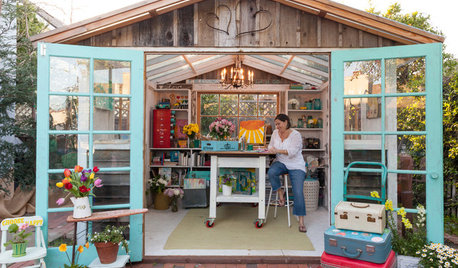
STUDIOS AND WORKSHOPSA New Book Offers Ideas for a Garden ‘Room of One’s Own’
Practical advice and enviable inspiration sheds are all you need to start planning your own backyard getaway
Full Story
LATEST NEWS FOR PROFESSIONALS‘On Style’ Offers Inspiration and Advice From Interior Designers
Peek into the approaches and design philosophies of five of the country’s top interior designers profiled in a new book
Full Story0
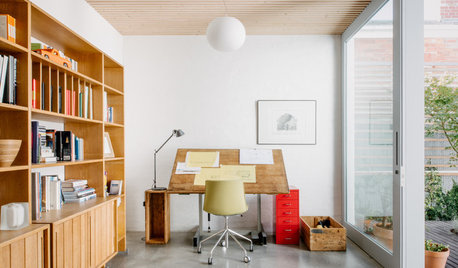
LATEST NEWS FOR PROFESSIONALS‘Your Architecture Career’ Book Suggests Thinking Like a Client
Author Gary Unger shares career and business advice that he wishes he had learned in architecture school
Full Story0
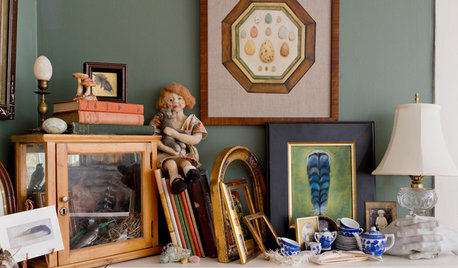
LIFEBuzzworthy Book: ‘The Gentle Art of Swedish Death Cleaning’
Author and artist Margareta Magnusson’s lessons for decluttering are applicable to all, no matter your stage of life
Full Story
BOOKSBook Tour: 'Coastal Modern'
Fresh ways to bring beachy style to your home, no matter how far from the coast you are
Full Story
DECORATING GUIDESBook Tour: Decorate by Holly Becker and Joanna Copestick
1,000 Inspiring and Practical Design Ideas for Every Room in Your Home
Full Story
LIFE'Not My Precious Books!' — Pain-Free Ways to Declutter Your Library
Have your books and neatness too, with these ideas for paring down and straightening up a beloved collection
Full Story
DECLUTTERINGHow to Let Go of Unwanted Books and Magazines
Buried in reading material? This guide will help you decide what to keep and what to give away, sell or recycle
Full Story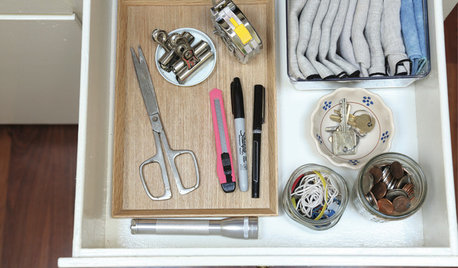
ORGANIZING‘New Minimalism’ Book Offers Fresh Ideas for Decluttering
Professional declutterers share smart ideas for simplifying your stuff for intentional living
Full Story
Rosefolly z5