

Ann T bread help
8 years ago
Featured Answer
Sort by:Oldest
Comments (22)
 8 years agolast modified: 8 years ago
- 8 years agolast modified: 8 years ago
Related Discussions
Ann T: Questions about bread pudding
Comments (9)Here you go Sue. Home Cookin Chapter: Recipes From Thibeault's Table Bread And Butter Pudding With Caramel Sauce =========================================== 5 or 6 slices of bread 1/2 cup butter 1 to 1 1/2 cups sugar 5 eggs 2 cups cream (Or milk) vanilla pinch of salt Caramel Sauce 1 cup butter 1 cup sugar 1 cup brown sugar 1 cup cream pinch of salt 2 teaspoons vanilla NOTE: If you prefer the pudding to have more custard, then use less bread so that all of the custard is not absorbed into the bread when baked. Cut crusts from bread and spread each slice with butter. (Bread slices can be left whole, or cut into halves, quarters or cubes. Place bread buttered side up in a oven proof dish. (may use any shape dish, or glass loaf pan, cutting bread to fit) Beat the sugar and eggs together and then add the cream, vanilla and salt. Pour over bread and allow the bread to absorb. (make be refrigerated at this point and baked later) sprinkle with some white sugar and place dish into a pan of hot water and bake in a 350 oven for 45 to 1 hour, or until pudding is set and golden. To make caramel sauce, bring butter, sugars, cream and salt to a boil and then simmer for 3 or 4 minutes. Remove from heat and add the vanilla. Custard sauce for Chocolate Bread and butter Pudding. The custard sauce was really easy. It was just two cups of milk or cream ( I used coffee cream) heated to a simmer. Mix three tablespoons of flour into 1/2 cup of white sugar and mix into a beaten egg. When the milk is hot, slowly pour the milk into the egg mixture,stirring constantly. Pour the mixture back into the pot and cook over low heat until thickened. Remove from the heat and add the vanilla. Custard should be pouring consistency. Cover the surface directly with plastic wrap and refrigerate....See MoreHelp! Ann T!!!!
Comments (9)Linda, I'm sorry I wasn't around to help you, I was working today. It looks like you were well taken care of though. You can't go wrong at 350°F but for future reference James Beard's recipe calls for baking at 375°F. Sharon, normally you would be right. Not something I make often but I make it occasionally because Moe likes it. It is one of James Beard's recipes. Home Cookin Chapter: Recipes From Thibeault's Table Oatmeal Bread with Cooked Oatmeal ================================= Oatmeal Bread with Cooked Oatmeal James Beard - Beard on Bread There are two or three favorite recipes for oatmeal bread in this coun- try. I first encountered this one in Nevada, in a restaurant that was made famous by Lucius Beebe, and it was so good that I extracted the recipe from the owner and have been using it for many years. It is an interesting, loosely textured bread with an unusual light-brown color and a rich, full flavour. It is delicious with sweet butter, and it keeps well. [2 small loavesj 1 cup coarse rolled oats 1 cup boiling Water 2 packages active dry yeast 1 teaspoon granulated sugar 1/2 cup warm water (100° to 115°, approximately) 1 cup warm milk 1 tablespoon salt 1/4 cup dark brown sugar 4 to 5 cups all-purpose flour approximately Cook the oats in the boiling water until thickened, about 3 minutes. Pour into a large mixing bowl and allow to cool to lukewarm, Mean- while stir the yeast and teaspoon of sugar into the warm water until dis- solved, and allow to proof. Add the warm milk, salt, brown sugar, and yeast mixture to the oats and stir well, then Stir in 4 cups of flour, 1 cup at a time. Turn out on a floured board, Knead into a smooth, pliable, elastic dough, if necessary using as much as 1/2 to 1 cup, or more, of additional flour to get it to the right feel. (This will take about 10 minutes,) Shape the dough into a ball, put into a well-buttered bowl, and turn to coat on all sides. Cover and let rise in a warm, draft-free place until doubled in bulk, 1 to 1 1/2 hours. Punch the dough down. Knead for 2 or 3 minutes and shape into two loaves. Thoroughly butter two 8 x 4 x 2-inch tins. Place the dough in the tins, cover, and let rise in a warm place until about even with the top of the tins, or amost doubled in bulk. Bake in a 375°F oven for about 50 minutes....See MoreWith help from Ann_T, am slowly getting better at the french loaf
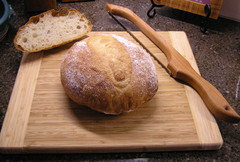
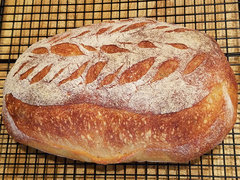
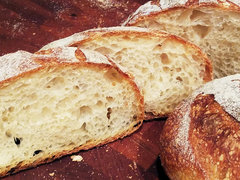
Comments (4)Thanks. It looks better, and this time the crust isnt so thick and tough. It still looks denser than Ann_t's, but it was still good. Her's looks like they came right out of an expensive bakery. Tammy...See MoreBread Question for Ann T. Please
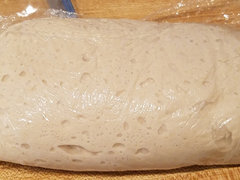
Comments (7)Trudy, I would use the recipe that Linda linked to. You can make the baguettes, long or short, or make short fat loaves if that will work better for you. I often do double or triple batches of the dough and bake loaves of different sizes and shapes. French Baguette Julia Child 1 package dry active yeast (2 1/2 teaspoons) 3 1/2 cups unbleached flour (bread flour) 2 1/4 tsp salt 1 1/3 cups cold water plus 1/3 or so additional water Using Food Processor Place the flour, yeast and salt in the bowl of the food process. Pulse to mix. Add 1 1/3 cups of water and process until the dough comes together. If the dough doesn't form a ball, add a little of the extra water. Process for about 60 seconds, turn off machine and let dough rest for 5 minutes. Turn on the machine again and rotate the dough about 30 times under the cover, and then remove it to a lightly floured work surface. it should be fairly smooth and quite firm. Let the dough rest for 2 minutes and then knead roughly and vigorously. The final dough should not stick to your hands as you knead (although it will stick if you pinch and hold a piece); it should be smooth and elastic and, when you hold it up between your hands and stretch it down, it should hold together smoothly. Preliminary rise - 40 to 60 minutes at around 75�F. Place the dough into a clean dry bowl, (do not grease the bowl), cover with plastic wrap, and set in a warm place free from drafts. (note the French do not grease the bowl because they believe the dough needs a seat to push up from). This first rise is sufficient when the dough has definitely started to rise and is about 1 1/2 times its original volume. Deflating: Turn the dough onto your lightly floured work surface roughly and firmly pat and push it out into a 14 inch rectangle. Fold one of the long sides over toward the middle, and the other long side over to cover it, making a 3 layer cushion. Repeat the operation. This important step redistributes the yeast throughout the dough, for a strong second rise. Return the dough smooth side up the bowl; cover with plastic wrap and again set to rise. Final rise in the bowl - about 1 to 1 1/2 hours or longer. The bread should be 2 1/2 to 3 times its original bulk. It is the amount of rise that is important here, not the timing. To Shape, Cut the dough in half. Set one piece aside and cover with a towel. On a lightly floured work surface pat the dough into a 14 inch rectangle, squaring it u p as evenly as you can. Fold the rectangle of dough in half lengthwise and using the heel of your hand, firmly press the edges together whether they meet. Seat well. Pound the dough flat. Now repeat - patting the dough out again and folding it over and sealing the edges. Pinch the edges well and Rotate the dough so that the sealed edge in on the bottom. Repeat with second piece of dough. Cover with plastic wrap or loosely with a towel and let rise to more than double again at about 75�f. Place stone in oven and Preheat oven to 450�F. Slash three long cuts into the loaves and place on the hot stone. Immediately toss a number of ice cubes on to the bottom on the oven to create steam. Bake until bread is golden and has an interior temp of 200�F. Takes about 30 minutes. Making Dough in a Mixer or by Hand When you are making dough in an electric mixer with a dough hook, proceed in the same general way with the rests indicated, and finish by hand. or mix the dough by hand in a bowl, turn out on a work surface, and start the kneading by lifting it up with a scraper and slapping it down roughly for several minutes until it has body. Let it rest several minutes and then proceed to knead. MY NOTES: I use a Magic Mill to do most of the kneading. The Magic Mill can handle over 20 cups of flour at one time. I use 4 cups for a single batch and 8 cups for a double batch Plus the addition of a Biga. I prefer a wet dough so I add more water. I usually start this bread with a Biga (Italian)/Poolish (French) a pre-fermentation. Made the night before. Contributes to a more complex flavour and a better texture. 1 1/2 cups flour 1/2 teaspoon yeast 1 cup of water. Mix well. Cover and set aside. Other changes: I mix the Biga, Flour, Yeast and water together,without the salt, and let sit for 20 to 30 minutes to allow the flour to absorb some of the water. I add the salt after this rest, and then finish by kneading. This dough makes for a wonderful pizza crust. Place dough in fridge and leave it for two to four, even five days. Take it out early (three hours) to give it time to come to room temperature. Allowing the dough to have a long cold fermentation really develops the flavour and the texture of the bread....See More 8 years ago
 8 years ago
- 8 years ago
 8 years agolast modified: 8 years ago
- 8 years ago
- 8 years agolast modified: 8 years ago
 8 years agolast modified: 8 years ago
- 8 years ago
- 8 years agolast modified: 8 years ago
- 8 years agolast modified: 8 years ago
- 8 years ago
- 8 years agolast modified: 8 years ago
- 8 years ago
- 8 years ago
 8 years agolast modified: 8 years ago
- 8 years ago
- 8 years ago
- 8 years ago
- 8 years ago
Related Stories
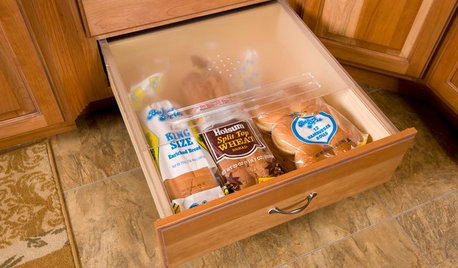
DESIGN POPBakers’ Home Storage Tips for Sliced Bread’s 90th Birthday
In honor of the bread slicer’s debut in 1928, we offer the best bread storage tips since, well ... you get it
Full Story
SELLING YOUR HOUSE10 Low-Cost Tweaks to Help Your Home Sell
Put these inexpensive but invaluable fixes on your to-do list before you put your home on the market
Full Story
HOUZZ TOURSHouzz Tour: Lovingly Resurrecting a Historic Queen Anne
Dedication and a keen eye turn a neglected eyesore into the jewel of its Atlanta neighborhood
Full Story
HOUZZ TOURSMy Houzz: DIY Love Reforms a Dated Cape Ann Home
Handmade touches and classic neutrals transform a dark Massachusetts house into a beautiful home fit for a family
Full Story
HOUZZ TOURSMy Houzz: Honoring the Past in an 1891 Queen Anne
Antiques and respectful renovations give a home in Oregon old-world charm and modern-day comforts
Full Story
DISASTER PREP & RECOVERYHurricane Harvey: How You Can Help
Want to donate or volunteer to aid victims of the storm? Here are groups assisting with disaster relief and recovery
Full Story
SELLING YOUR HOUSEThe Real Scents That Will Help Sell Your House
Ditch the potpourri and baked cookies. Follow these guidelines on scents to use and avoid to help sell your home
Full Story
REMODELING GUIDESMajor Remodel: Restoring a Queen Anne to Glory
Misguided 1970s changes marred this Victorian-era home in Portland, until a dedicated family moved in
Full Story
MOST POPULAR9 Real Ways You Can Help After a House Fire
Suggestions from someone who lost her home to fire — and experienced the staggering generosity of community
Full Story
SELLING YOUR HOUSEHelp for Selling Your Home Faster — and Maybe for More
Prep your home properly before you put it on the market. Learn what tasks are worth the money and the best pros for the jobs
Full Story



2ManyDiversions