

Crock pot rice?
10 years ago
Featured Answer
Sort by:Oldest
Comments (29)
 10 years ago
Related Discussions
is a crock pot a crock pot a crock pot?
Comments (33)Stew pot is actually closer, Linda. The style we currently call "Dutch oven" is a flat-bottomed kettle with a lid added. And is, of course, with its heavy, heat-holding design, ideal for stewing. Kettles originally were round bottomed (and some had legs), designed primarily to be hung over an open fire; either from a tripod or a crane. They did not have lids. There was a point, measured in gallons, where a kettle became a cauldren, but I misremember it right now. Thirteen comes to mind, but don't take that to the bank. Dutch ovens, of course, had three legs and a deeply recessed lid so you could put coals both under and on top, to provide even, dry heat. They were used on the hearth, not in the firebox. In the first quarter of the 19th century, "portable" cast iron stoves became popular. Initially kettles were still used by removing an eye and setting the pot right in the hole, over the open fire. Eventually they began modifying the pieces, flattening the bottom and adding a domed lid. A chicken fryer has a somewhat different configuration; being relatively wide for it's height (for stability), and with sidewalls that slope more sharply than those of a skillet. Chicken fryers, too, have domed lids; many of which are of the self-basting type. Now, if you really want to know about hearth trivia, ask me nicely and I'll tell you were the term "hob nobbing" comes from....See MoreRice cookers, are the new ones worth it?
Comments (12)There appear to be two major types of rice cooker. One is the simple on/off cooker that is available in most oriental groceries in the $20 to $50 range. Then at the opposite end of the spectrum are the 'fuzzy logic' programmable jobs which can handle different types of rice and grains ($100-250). I have a large simple Zojirushi on/off model. At the time I bought it, these fancy-schmancy fuzzy logic models weren't available. I generally only use it when I'm cooking large quantities of rice for company. For just me and the DW, I use a saucepan. Whatever model you get, IMHO it's worth getting one with a nonstick pot. If you do a LOT of rice and grains these new ones are probably worth it for the convenience alone. You don't have to pay attention to it once you load the ingredients. FWIW, here's my foolproof and simple way to cook American long grain rice. All you need is a saucepan with a steamer insert. (You know, the pot with holes in the bottom that fits snugly into the saucepan like the one in the link.) This will produce fluffy and separate grains, not sticky sushi-type rice. Whatever volume of rice you're gonna cook, bring to a boil 3 to 4 times that volume of water. I generally cook 1 1/2 cups of rice at a time, so that means 6 cups of water. You can add salt and some butter to the water if you want. Once boiling, add the rice, stirring to keep it from clumping. Once it returns to the boil, lower the heat to a slow boil and cook for about 9 minutes, stirring occasionally. Then drain the partially cooked rice into the steamer insert and rinse the rice with hot tap water till the water draining out the bottom has cleared somewhat. Rinse the bottom saucepan out and put about an inch of hot tap water back in the bottom of the pot. Put the saucepan on the stove, the steamer insert containing the rice on top of the saucepan, and cover. Bring back to a boil, then reduce the heat to a low boil and set your timer for 10 minutes. When done, the rice will be fluffy and not at all sticky. Basic formula: boil for 9 minutes, rinse, steam for 10. The link is to a picture of the type of steamer insert I mean. It's not one of those collapsible jobs. By the way, there's no reason to spend good money on a pot to cook rice by this technique--all you're doing is boiling water, so using an All Clad pot is overkill. For many years I made perfect rice with a cheapo Revere ware pot. Here is a link that might be useful: steamer insert...See Morewhere to put the fridge . . .
Comments (21)Here is a lesson we learned on a 60" slider, which may translate to French doors. If both doors can be operated on the French doors, it won't matter. But a lot of French doors I see, only one door is made to be opened. If only one side is opened of a 60" door, it is NOT a 30" opening. In our case, the opening of our 60" slider is only about 22.5". This has been a pain many times. Most recently when my wheelchair bound grandfather was here and we could not get him outside onto the deck. If you do end up putting the fridge on the range wall and a pantry plus whatever (oven, MW, coffee) on the stairs wall, you could make your pantry a walk in pantry with the coat closet to the foyer only being behind the oven/MW/coffee area. Leave the interior pantry walls open to the studs and cut the shelving to fit around the studs. This will allow you to have shallow shelves on the left and the right, then deeper shelves on the back wall of the pantry. You can store a lot on shallow shelves and you can see everything at once. Much better to have everything lined up on the front edge than having to move the peanut butter to get to the can of Pam behind it to get to the bottle of olive oil behind it to get to the bottle of balsamic vinegar behind that. Bellsmom did this in her pantry. Here are some examples of her pantry and garage shelving to show what I mean. In these pics, you can see the studs and how the shelving is notched around the studs. Here is one where the shelves are even more shallow - only the depth of the studs. This post was edited by angela12345 on Wed, Feb 26, 14 at 15:29...See Morepls help -Upper Cabinets and Lower Drawers - is there a size to avoid
Comments (27)So you keep asking what other people like, but that is really irrelevant to what will work best for YOU. The correct size of drawers or cabinets depends on what YOU will put there - which might not be what I would put there. Kind of like saying "should I get a sports car or a minivan?", without telling us whether or not you're hauling kids and their cellos to music lessons. You need to go through a whole day in your kitchen - 3 meals, with some baking thrown in - to decide what needs to go where. Items should go near their point of use: prep area has knives, cutting boards, colanders, trash; cooking area has pots and pans, utensils, spices, potholders; baking area has dry goods, bowls, measuring cups; cleanup area has dishwasher, dishes, flatware. Somewhere you need food storage containers, bags and wraps, towels, small appliances, large stock pot, cookie sheets, baking dishes. Once you've determined WHERE things will go, then you evaluate your own stuff, to decide how much space you need. Use tape to measure out the interior of a 24 or 30" cabinet or drawer, and put your things in that space. Don't forget to determine how deep a drawer needs to be - I have cake pans and pie tins on their sides in a drawer, so that drawer needs to be pretty deep. The utensil pullout that decoenthusiaste posted would drive me nuts! I have my utensils in a drawer, with dividers. I can't stand rooting around in a jumble for what I need. What works best for deco would definitely not work for me. Now, going back to your question! After you've measured all your stuff and decided where it will go, you may have a pretty good idea about what size works best. Do you need 12" more pantry space, or counter space? Also think about getting something out of the uppers on each side of the stove. If one of those cabinets has spices or oils, a double door means you have to go around the door to get what you need; a single door is much more convenient....See More 10 years agolast modified: 10 years agolucillle thanked WalnutCreek Zone 7b/8a
- 10 years agolast modified: 10 years agolucillle thanked WalnutCreek Zone 7b/8a
- 10 years ago
- 10 years agolast modified: 10 years ago
- 10 years ago
- 10 years ago


Related Stories
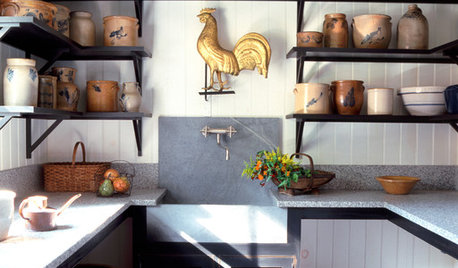
ACCESSORIESStoneware Crocks Strike a Chord
Once just humble pantry items, stoneware containers have become showpieces around the home
Full Story
KITCHEN DESIGNCreate Your Own Checklist for a Well-Stocked Kitchen
Personalize the kitchen with your own must-haves from our list of top cooking tools, small appliances, pots, pans and more
Full Story
SUMMER GARDENINGHow to Grow Basil
Bright color, quick growth and endless uses for cooking make this summer annual a winner in the garden or a pot
Full Story
EDIBLE GARDENSHerb Garden Essentials: Grow Your Own Oregano and Marjoram
Say 'buon giorno' to classic Italian herbs you can grow just as easily in pots as in the summer garden
Full Story
LAUNDRY ROOMSGet More From a Multipurpose Laundry Room
Laundry plus bill paying? Sign us up. Plus a potting area? We dig it. See how multiuse laundry rooms work harder and smarter for you
Full Story
PRODUCT PICKSGuest Picks: Handy Helpers for Small Kitchens
Smart about size or dual use, these appliances, gadgets and pots offer full service while saving kitchen space
Full Story
FARM YOUR YARD10 Easy Edibles to Grow in Containers
These herbs, vegetables and fruits are just as happy in a pot as they are in the ground
Full Story
DECORATING GUIDESDecorating Details: Temple Jars
How to Use These Ceramic Pots — and How to Tell Them Apart from Ginger Jars
Full Story
KITCHEN STORAGEMove Over, Soup Cans — the Kitchen Appliances Are Here
Design a pantry with room for mixers, coffeemakers and more, for less countertop clutter and handy access
Full Story
HEALTHY HOME12 Ways to Set Up Your Kitchen for Healthy Eating
Making smart food choices is easier when your kitchen is part of your support team
Full Story
colleenoz