Houzz Logo Print
chisue

Time To Buy A US Index Fund?

11 years ago
last modified: 11 years ago

I hope this would be of interest to more than just my DH and me. I know there are other seniors in similar situations who read here.

With the current decline in the Dow, is this a good time to buy a broad market index fund? How do you do that -- just call up Vanguard or whatever and charge it? (Excuse my ignorance.) Buy only US fund? Broader?

DH and I are mid-70's and in generally good health. We own two RE properties outright; have income from Soc. Sec. and a small, set-value pension; have a small portfolio of very conservative mutual funds (and too much cash). No debts beyond two CC accounts that we pay off in full monthly; RE and Income taxes; home, auto, and umbrella insurance; the usual household bills. Progeny are self-supporting.

Comments (25)

  • 11 years ago
    last modified: 11 years ago

    What are your investment objectives? Is it for income or net worth growth for yourself and your husband? To maximize what's left to your children or grandchildren? Is it for a charity who will inherit your estate? I think that may dictate what direction you should go in. If these funds are to be left to grandkids who are now young, for instance, suitable investment choices would be different from what would be done for you in your 70s. Because to me in that case, you'd invest it as if it were theirs now.

    Do income tax consequences matter? Growth vs income producing vs tax free?

    I'm a Vanguard fan simply because I don't think the commissions and fees that are incurred with other plan sponsors are well spent. Index funds do tend to be on the lower end of the management fee range and actively managed funds outside of Vanguard are on the other end. Morningstar ratings (obtained via simple Google search) will tell you where funds rank performance-wise in their peer groups, 4 and 5 star ratings are at the top.

    If you had a block of money (whatever the amount is) to invest, any plan sponsor (the people you reach when you call them) would work with you to allocate it among their funds based on your stated objectives.

  • 11 years ago
    last modified: 11 years ago

    First, I gave some opinions in the first thread you posted in. Please feel free to look at those.

    With the current decline in the Dow, is this a good time to buy a broad market index fund? - No. While I am a solid fan of broad market index funds, the decline in the Dow doesn't make it a better time to buy than any other time. I am a big fan of efficient market hypothesis, and weak form efficiency tells us that you can't use trend analysis to predict future prices.

    A simple way of thinking about this is: without specific insider knowledge to the contrary above and beyond that of investment professionals (insider knowledge), the current prices of the stock are as close to accurate as they can be with what we know. Any dip in prices is the stock market adjusting to new information, as are rises in prices and therefore can't be used to predict a higher than normal future value. It helps to remember that a stock price is the present value of expected future cash inflows to owners, thus a drop in stock price results from an increase in risk or a decrease in expected cash inflows, not just the fickleness of the market.

    I will parrot Snidely on the Vanguard funds. I have been a fan for a long time. At 70 I wouldn't typically recommend incredibly broad or whole market index funds. I gave some specific funds in the mortgage thread, feel free to look at those. Of course, that is just general advice without looking at your income, goals, etc.

  • Related Discussions

    Conifer Cultivar Photo Gallery Index, 2010

    Q

    Comments (90)
    Whats just as impressive is that all the pics are still here! I was just thinking of the lack of activity and picture posts here after seeing other forums bumping with activity and picture posts...which by the way DON'T have a separate gallery. This forum was discriminated!
    ...See More

    Memo to owners of stocks, mutual funds who reinvest payouts

    Q

    Comments (10)
    Not that stock issuing entities haven't merged, disappeared, spun off for years, the break up of ATT & T really brought it to a lot of people's doorsteps. But, in your case - Contel became GTE and GTE became Verizon, so your concern would only be with Verizon now. Contel and GTE and any mountain of paper are no longer factors in the sale of some or all of your Verizon stock. As each company became something else, you were probably asked to surrender the certificates eventually receiving new certificates. Now you should be holding only Verizon cerificates. What I would hold on to would be the receipt(s) for your initial Contel purchase(s), the confirmation of the GTE buyout, and the confirmation of Verizon's buyout of GTE. Would also keep all the Verizon statements you've received since the buyout. I kind of look at it like not saving insurance policies and all the paperwork for cars I don't have anymore.
    ...See More

    High Index eyeglass lens question

    Q

    Comments (6)
    I'm an optician and I sell a lot of Varilux lenses. The Varilux Physio 360 is being phased out for the newer Physio Enchanced. Both are types of progressives and both come in many different lens materials. They are both excellent progressives but there are very good progressives for less money if it's a concern. I do suggest high index lenses for you and you shouldn't have problems with these lenses as they come in high index materials. The thinnest lens you could get would be the 1.74 high index but depending on the frame and your pupil distance a 1.67 high index would be cheaper and could be only a little thicker. Do get the Crizal Avance anti refective coating, it's really outstanding and worth paying extra for. I'm glad to answer any questions.
    ...See More

    July Pending Home Sales Index

    Q

    Comments (5)
    I've been keeping an ear open for quite awhile on real estate markets and the dollar. What we need to remember is that as credit tightens, it doesn't make people want or need home ownership any less than it makes them re-think what they really need compared to what they thought they want. There's always a lag in the consequences from market changes. People who are first time prospective buyers or looking at retirement on a pension still want to get on the equity bandwagon and qualify for the tax breaks home ownership give them. Credit isn't the only thing tying into choices of real estate. As energy costs zoom, not only for utilities but for commuting to and from jobs, ultimately there will be a shift toward locating close to work (like there was years ago) and considering things like being able to actually afford to live in the house they bought after they factor in variables like tax hikes and utilities. I'd like to see home sales figures broken down into the $$$ increments of listing prices. When the dust settles after the housing market gets stable, I think what we are going to see are people who start to consider housing they actually can afford.
    ...See More
  • 11 years ago
    last modified: 11 years ago

    It's a useful exercise for me, just to have to put this into words. Thanks for helping.

    We've been pondering where to invest some lazy cash in our portfolio, and index funds are one option. We've were not eager to buy into an inflated stock market, and this correction appears to be a good opportunity. We are not looking to 'time the market' or trade stocks. We just want to put this money to work somewhere rather than add to the conservative mutual funds we already own. For conservative people like us, an index fund is 'risk'. In the past this cash was in MM funds, but high interest rates do not appear to be making a return as we climb out of the Great Recession.

    Snidely -- I appreciate your questions. We have money in RE and conservative mutual funds, but little taxable income. (Illinois does not tax Soc. Sec. -- yet -- although it needs the money.) We've already helped our DS and family, and they will eventually inherit from our trusts. Old folks don't spend on a lot of frills, and we've yet to tap savings; getting closer though. Barring catastrophe in our family, I think we could live as we do now for twenty years once we do tap savings.

    We'd look for growth. I'd hope for some hedge against inflation. We can but plan and hope -- which includes finding a useful investment for some cash. (BTW, how much liquidity is advised as a percentage of holdings?)

  • 11 years ago

    Sorry chisue, I should have said - I wasn't looking for you to respond with personal answers to my questions, I was just offering some questions for you to think about in deciding what investment choices to pursue.


    Over time, the stock market has gone up. Over time, it has provided a much better return than cash deposits, by a long shot. In shorter intervals, the market does go down before it goes up again, and investment balances can erode during these periods. An index fund IS "the market".


    Fund investments are liquid, they can be sold on any day the stock market is open. Whether doing so on a particular day is advisable or not is a matter of market movement, but whatever the balance is becomes cash in just a few days. Real estate value is probably the most illiquid investment most individuals own.


    Maybe you should go through a planning project with a fee-based financial adviser? You'll pay for an analysis and get flooded with questions to help focus your thinking. I'd say a minimum investable amount that would make this worthwhile would be at least $250K-$350K, and expect to spend perhaps a thousand or two for the advice.


    .

  • 11 years ago

    Again - I am a huge fan of buying index funds. But I am not a huge fan of buying them because the market is down.

    Thesimpledollar explains what I am talking about a bit more.


  • 11 years ago

    Snidely -- We used a financial planner to help us sell portfolio in stages when we sold our prior home and built our current home. (Mesirow Group) The first year was a teaser-freebie, but we left after a second year. Our holdings are so conservative; no further withdrawing or buying -- nothing to 'manage'.

    Right now I'm just trying to figure out which index fund(s) are logical for some sleeping cash. (It is a large enough amount to be concerned about, and we have let it slide too long.) Our wills, trusts, deeds and powers of whatsis are all up to date. I don't want to go through the broker for our mutual funds because I don't think we need the 'managed' funds he offers.

    Vanguard apparently is just an order taker. Must I hire someone to advise which of their MANY index funds is most logical for our needs?

    Bry -- I understand investing over time and letting things average out. I understand that there may be more severe 'corrections' ahead. Don't you agree it is better not to have invested at the *peak* of an overvalued market, and that it is an advantage to buy post-correction -- when we planned to invest anyway? (Am I missing some point here?)

  • 11 years ago
    last modified: 11 years ago

    Don't you agree it is better not to have invested at the *peak* of an overvalued market - I am not sure it is worth getting into, but I will try (nothing bad about you, this just gets very academic and sometimes I feel like I am going way overboard when I do).

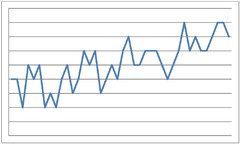
    What I am saying is that there is no such thing as an overvalued market, or an undervalued market, for that matter. Let me show you what I am talking about - I copied a few weeks of the stock market to excel and made a graph of them without numbers, look for the pattern, once you find it, see if you can predict what the stocks will do next.

    I am sorry I did this to you, but this is actually not stock market data - this is just a set of random numbers chosen from a set that increases by 10%. There is no pattern here, but we see patterns where none exist, this is called apophenia.

    Now this makes sense, given what we know of the stock market. Instead of looking at the entire market, lets look at one company. This company is in a fairly risky business so investors in this company risk losing more money than most, so the investors demand more return. Let's say 15% is the minimum return for which we consider the risk a good investment, suppose that we believe the company will pay us $1 dividend per year for the next 10 years then we will sell the stock for $20. We will price the stock at $9.96 - Which is the present value of $1 per year for ten years plus $20 in ten years at a 15% discount. For this company the only way the price changes is if new information comes to light about risk (changing the 15%), or returns (changing the $1 or $20).

    Now stock prices move all over the place because we are guessing at these things constantly. This example can be extrapolated to the market. Let's say for the sake of ease that the expected return for the overall market is 8%, then at any one time the index is at the point where it needs to be to get an 8% return, given what we know. Which means there are no under or overvalued. The guy who bought yesterday (before the market "corrected") had information that led him to believe that his index would get him an 8% return...He was wrong. If he had waited a day he would have been better. But just like the random example above there is no real way to tell if you are in a valley or not. In other words, you can tell if the guy yesterday was right or wrong, but you can't tell if you are.

  • 11 years ago

    An attempt at humor.... I dang sure wish I had sold everything I held a week ago yesterday. The 500+ Dow "correction" yesterday capped off a terrible week.

    It'll come back. lol

  • 11 years ago

    Bry -- I think you are saying the market is a constantly ebbing and flowing river. I'd prefer not to push my raft out on it when it's in flood stage. Hmm? (I get what you're saying about seeing 'patterns' that don't exist. Explains religion.)

  • 11 years ago
    last modified: 11 years ago

    bry is one of those guys who likes to impress people with mumbo jumbo. The stock market is easy to understand and easier to predict. Tomorrow is Monday, the markets will be open. Stocks will trade and the prices will close either higher or lower than Friday. There are no other options. The same thing will happen on Tuesday. Et cetera. See, it's not so hard.

    chisue, if what you're happiest with is bank deposits, then you're really not looking for advice. But that's fine, everyone needs different things to sleep at night. You must know that bank interest rates are unattractive and have been so for a number of years, you've been losing to inflation on those funds. It's been a good time to be a borrower, not a depositor. Yes, that's the other discussion.

    Who you're cutting short is your heirs. If you don't need the money and don't foresee needing it, why not start to pass it along to them? Let them invest what will be theirs their way, instead of your way.

  • 11 years ago
    last modified: 11 years ago

    I really wasn't trying to impress. I was trying to add some proof to the fact that the market is always where it is supposed to be. It may go up tomorrow or down tomorrow but today it is neither higher nor lower than it should be.

    Ebbs and flows exist in hindsight only.

    And I said it was academic to begin with. I am not even sure that as a whole I am a fan of EMH. But I am a huge fan of weak form efficiency.

  • 11 years ago

    Who you're cutting short is your heirs. If you don't need the money and
    don't foresee needing it, why not start to pass it along to them? Let
    them invest what will be theirs their way, instead of your way.

    Wow! I had no idea someone else saw it my way. We've been doing that for a year since retirement. My children (35&40) and grandchildren (2,6,8) have many more years to grow our money than we do. Since we won't be needing it, we don't have to concern ourselves about what the market does today or tomorrow.

    If you're 70 and don't need it, give it to your kids. Stop worrying about it!

  • 11 years ago
    last modified: 11 years ago

    Maybe I wasn't clear. I can't say with *certainty* that DH and I are 'set for life'. We don't have THAT kind of money! LOL

    We have given money to our DS. I agree that 'kids' need funds more in their youth and middle years than they are likely to need it after we die. Giving more isn't wise, though -- for him or for us. Our grandchildren (10 and 4) have money for college and a start in life -- from both sides of the family. Nobody's being threatened with being nice or being written off!

    It was nice to 'earn' double digits on totally safe CD's, but now we need another avenue for some cash. We need to keep pace with inflation or fall behind. We have conservative investments. We need more *balance* -- which is where the idea comes for index funds. We certainly don't want to have to ask for money BACK in our old old age. (Old Old Age is something older than mid-70's, just so you know.)

    So.. can someone help me parse index funds, please.

  • 11 years ago

    I have some cash parked in a CD at 2.25%. It's not the best return in the world, but it's not at risk either.

    There's nothing wrong with asking for some of your money back in your old age.

  • 11 years ago

    Not everything has to be simple. Simple answers are very appealing, but the stock market isn't simple and complex things can actually have complex answers.

    To SnidelyWhiplash - If your significant other asks if they will need an umbrella, do you respond by saying, "if it rains today you will need one, and if it doesn't you will not."? Because that is your stock advice.

  • 11 years ago

    Chisue - As the person in charge of our family's investments, I say yes, go ahead and buy into an index fund. With your already good diversification and common sense and understanding of the portfolio you already own, and with your children established, you are in an excellent position to do this. You do not need any detailed understanding of how the market works to invest in something as simple as an index fund. 23 years ago I invested in Vanguard's Index 500 fund and our investment has quadrupled over that time despite some pretty significant dips. I have withdrawn a small amount of money perhaps 4 - 5 times over the duration, when I didn't want to touch cash or our IRAs. The taxes and expenses on index funds are extremely low, another reason they are so attracitve. Despite all this, four times my original investment makes me happy!

    Just to establish my street cred. DH and I are nearing your age group and have similar concerns. Our children are grown and gone and on their own (and I do like to gift them with cash occasionally), so we are mainly involved with concerns of retirement right now, plus health issues, travel expenses, etc. We are in a fairly good situation and we have never used a financial advisor (although we've had good discussions with our accountant). I saw what "advisors" did to my mother. No thanks.

    Here's another thought: Money gurus recommend that senior citizens keep some money in stocks. People are living longer and need the financial growth that stocks provide, even if they don't plan to touch the money.

    I would suggest an Index 500 fund. This invests in the 500 largest companies in the USA, although sometimes fewer than 500 stocks are held. That really doesn't matter. Some recommend a total market index fund, which holds every domestic stock (more or less). I like the index 500, it follows the DOW (our 40 largest companies) pretty closely, so when I check CNBC I know pretty much where this particular investment is. I would do the Index 500, because it's so easy to understand. I would not invest outside the USA right now. I have held a little money in an international fund for almost 20 years, a good fund from a solid brokerage (T. Rowe Price), and it has barely doubled in that time. You can also ask the agent if a small cap index fund would be good now. It might be good to put most in the 500 and some in a small cap. But remember - these brokerage houses - Vanguard, Fidelity, etc., - are BY LAW not allowed to give you advice. They can only explain, very thoroughly, but they cannot tell you what you should do. There is no charge for your conversations with them, and they may not give you advice. Maybe a few little suggestions, but nothing that you could hold the company accountable for.

    Any time is the best time to invest. Get In and Stay In. Do not panic. I have always withheld a modest amount of money in case of severe crashes, so that I could buy a bit more on a serious dip, but I never bought a lot more, because I try not to market-time. One can go crazy trying to time the market! Fidelity has a great story about this. The market crashed badly in 1989-1990, just before the first Gulf War. Fidelity's people were innudated with calls from panicked customers. One of them answered a call and there was an elderly gentleman on the line. He was apparently not aware of the crash. He said that he had put a bit of money into the Fido's first mutual fund many years before and was wondering what it was worth. The callperson looked at his chart and saw how much that fund had just lost, but also, that it was up tremendously from his initial investment. "$300,000" she replied, worried about his reaction. "Yippee!" he yelled, and hung up. It's all a matter of perspective.

    Anyway, sorry for blathering on. How you do this: Call Vanguard from its online number and tell them that you want to invest in a mutual fund. They will transfer you to one of their agents. It is so simple. He will explain what to do and tell you that he will send you the forms. When they arrive, you fill them out, write the check and send it all in. Or you can probably do this over the phone if you have the money in a checking account, which can be linked to your Vanguard account. You can also do everything online with a linked account, but am not sure if that's possible for an initial investment. It would probably be good for you to talk to an actual human being on your first visit. These people are very accommodating! They are used to dealing with all kinds of people, of any age, any language ability, crabby, pleasant, whatever.

    Apologies for the lecture. I hope it helps. If you have any questions for me, I usually go to the Home Decor Conversations forum a few times a day. I might forget that I've been here. So give me a shout-out over there if necessary. And good luck. You are thinking very wisely.

  • 11 years ago

    Dear Trust,


    You and I may have had different experiences In my career in a highly demanding and dynamic financial environment, I was exposed to (and always tired of) way too many individuals who thought they could demonstrate intellectual capablitity and prowess by using words and explanations that were above the level of their listeners. Whether lawyers, I-bankers or other Wall Street types, VCs, accountants, or whatever. The best of the best aim their languange and their explanations to the lowest level needed for the group listening. It was a practice I tried to follow myself.


    So yes, when a novice asks a basic question, a simple answer is most suitable. I'm not sure which of my comments you refer to, one of the serious ones or one of the silly ones, but you're more than entitled to your views.


    And yes, if no rain is expected today, there's no need to carry an umbrella.

  • 11 years ago
    last modified: 11 years ago

    I think he was referring to the idea that the stock market is easy to understand and easier to predict. In truth the stock market is actually one of the two most often cited examples of a complexity based system, the other, oddly enough, is the weather. The stock market is a testament to the complexity of modern life.

    Put simply, if you think that you can predict a stock price, then you don't understand the market. We know the market trends up, we know that sometimes the market seems irrational, we know it can stay that way for longer than you can stay solvent, and we know that diversity has a smoothing effect. For the rest, we might as well be throwing darts.

  • 11 years ago

    I would add one thing to the good advice from sableincal. Decide how much you want to invest in the Vanguard index fund you have chosen. Once you have met the minimum amount required to open the account for that fund, do not invest the remaining amount at that time. Instead, fund the account with equal monthly payments over some period, for example two years, until you reach your desired level of investment. You can find out what the minimum "additional investment" amount is for the fund to use as a guideline. This removes any stress associated with the idea of timing the market, which as noted above is not a good idea. Just stick to the plan no matter what the market does.

  • 11 years ago
    last modified: 11 years ago

    Thanks bry, so the reference was to an intentionally silly comment I made.

    If you pick a long enough time frame to assess, the stock market will have always gone up. So long as any investor's stock pick isn't too extreme, a rising tide lifts all boats. Extreme picks are avoided by buying a broad fund or index, because as said before, an index IS that market it mirrors. Self-professed stock pickers are like nose pickers - they like what they do but accomplish little.

    As I said before (in this or another thread), what guarantees a nest egg at retirement is an early start on regular savings and consistent application through the years. The investment choice DOESN"T MATTER for this purpose, consistent action will make a bigger contribution to the nest egg in the end than the investment choice.

    Omelet, your "spread it out over time" suggestion has an equal likelihood of being wrong as being right. If the market is up over the next 12 months, when viewed a year from now, it was a bad idea. If it's down, in hindsight, the person should wait a year before buying anything. There's no way to know what will happen. See what I'm saying?

  • 11 years ago

    Have any of you financial wizards applied or tried to apply Elliot Wave Theory to any mkt averages?

  • 11 years ago
    last modified: 11 years ago

    First, I am not a huge fan of technical analysis. It offers no meaningful information to the average investor, and lends itself to exploitation. Technical analysis is often very wrong while fundamental analysis can be wrong but is less likely to be wholly wrong.

    The problem with Elliot waves is that they are loosely enough defined that they fit every segment of the history of the stock market. However, they are largely useless as predictive models, they explain the wave you are on, but not really its start or end. Also, there have supposedly been recent violations as the market becomes more international it is hard to use the mass psychology on socially dissimilar groups. However, I will admit that Prechter's results were phenomenal. But then again, so are Warren Buffet's and he doesn't use technical analysis.

    In the end, even if it were incredibly accurate at prediction and not just explanation, it would be of no real use to the average investor, as it breaks the golden rule, invest in what you know.

    But I guess the fact that it is supposed to be a Fibonacci sequence is cool in a mystical way.

  • 11 years ago

    I've never been able find any coorelation except looking back. Interesting concept about cross cultural differences affecting the results. A month or so ago I did try it on NFLX and got a point target of $731 (I think) and the next day some big outfit announced their new PT the same $731. Odd. Do you suppose they?....naw couldn't be.


  • 11 years ago

    Elliot waves have their heart in behavioral economics. A way oversimplified way to look at is, people buy a good thing until they have bought too much then they sell because they are concerned about the sudden rise. Once the prices have "corrected" enough they buy again, now happy to ride the stock up past their previous comfort zone, this can also work backwards. It has been found that these socialized risks happen in a roughly specific sequence and magnitude, which behaviorists praise as the power of socialization.

    While this still applies today, the waves are getting much less predictable. While a single company might still be OK to look at for a period, the overall market is much more susceptible to foreign influences. Even ignoring the effects of cultural risk appetites, the U.S. market is far more susceptible to foreign markets than ever before. There was a time, not so long ago, that a Chinese crash would have only caused a hiccup in our market. Those influences are only going to become more pronounced as time goes on.

    As for looking at Netflix and coming out with the same price target that someone else did...I got nothing.

Sponsored