

Revisiting artificial plants
11 years ago
last modified: 11 years ago
Featured Answer
Sort by:Oldest
Comments (9)
 11 years ago
 11 years ago
Related Discussions
High-Density Tree Planting Revisited (ONLY 2 trees:1 hole).
Comments (3)Hi Scott, It would save me a tremendous amount of space and make me extremely glad if I could fit all 4 varieties into a single 30' x 30' circle area dedicated to the 4-in-1 tree's life-long spread. I want to bounce still a couple of potential complications with this senario, all of which may be resolvable. And believe me: I am willing to be vigilant and careful in maintaining the tree's 4-way balance if it turns out that I decide to things this way. 4 Separate rootstocks/cultivars in one hole: 1. Peach trees are, even when left unrestricted, smaller trees with smaller trunk and root systems then American persimmons. If I give each cultivar its respective 1/4 room to spread its foliage, I fear that each tree will struggle to obtain enough solar sourced energy to support itself; although, one point could be to note that pruning will keep the trunk and roots small and potentially/hopefully proportionate to each tree's respective trunk/root-stem/needs. The 4+ major scaffolds arising from the base of the peach, cherry, wild-growing persimmon, etc. are sharing the same nutrients via the same root-system. If I ever decide to let the tree grow to full form and size, the 4 trunks would grow so large and strive to get away from the other trunks that they would fall down. 2. Jerry Lehman convinced me that it is not likely that American persimmons would properly inosculate, that instead of fusing they would bruise and rot - specifically American persimmons, not all trees. This doesn't, however, have anything to do with spacing the four trees in the same hole 20" apart. 3. However, it seems to me pretty feasible: which is to carefully keep the 4 trees in relative 1/4-balance within the 4-way circle. 4. Your description of that cherry tree above makes me think that we are talking about not many trees in the same hole, but a single tree bearing various root stocks in-grafted? Is that what you recommend? I've been told that persimmons are notorious from dropping former limbs when new ones are added. Let me know which situation you recommend for me: 4 trees in one hole or should I do a multi-graft tree - if I could do the later and be secure that it would work, I could just keep my 4 saplings for the future purpose of being the scion bank for the multi-graft tree. I keep hearing that I shouldn't do a multi-graft persimmon tree. I just got my persimmons in the mail and I quickly put them in the ground pending what I finally decide upon. I really appreciate discussing my options on this with you - at least when I do choose a plan, I'll have considered practically every option. Thanks, Steve...See MoreBalcony ideas: Artificial plants for rainy cold Seattle winters?
Comments (12)The OP's challenge may be finding evergreen plants that will survive the winters. Having something that dies back to bare branches during the winter will negate privacy during that period. That said, I fully agree to do some research both online and at professional nurseries -- do NOT rely on folks working at HD or Lowes. While ivy looks nice, it is also highly invasive in many areas. (Check with your local univerisity or county extension offices to find out if it is a problem plant in your area.) A trellis has strong possibilites. For summer greenery and flowers, you could check to see if there are clematis which would survive the winter on your balcony. Otherwise, you might have to look at annual vines to train up the trellis for summer interest. For the winter, you could consider decorating the trellis with seasonal items -- either artificial or not -- such as dry cornstalks + small pumpkins/gourds for autumn, and evergreen boughs or wreaths for winter. In addition to the trellis idea, if your balcony has the space, I'd say consider checking into a large planter with an evergreen tree/shrub. I would expect there will be ones available in your area that would survive your winters....See MorePlants not growing in artificial light.
Comments (13)I sincerely doubt it, but I don't know enough about where you are to say for sure. For instance, where I am, energy bills are by the kilowatt hour: 3 23 watt bulbs running 15 hours a day for 5 months (average time to harvest for eggplant is 4-6 months) is 3 bulbs * 23 watts each * 15 hours a day * 30 days average month * 5 months = 155,250 watt hours = 155.25 kilowatt hours. Where I live, typical energy costs are between 0.12 and 0.14 US dollars per kilowatt hour, so let's use 0.13 US dollars as an average. The total electricity cost for running those 3 bulbs for 15 hours a day for 5 months is then 155.25 kilowatt hours * 0.13 US dollars per kilowatt hour = 20.18 US dollars. Realistically, those 3 bulbs are only going to be enough light for one mature plant - if you're lucky. I honestly doubt they will be enough to produce much of a yield at all (flowering and fruiting require much higher light levels than vegetative growth). Perhaps you can get 2 or 3 actual eggplants from that one plant? Where I am, eggplant sells for 1.50 to 3.50 per pound, with an average eggplant weighing about 2 pounds. That's 3.00 to 7.00 US dollars per eggplant. So your 20.18 in energy costs might save you 6.00 to 21.00 US dollars at the grocery store. Realistically, I doubt you are going to grow anywhere near 6 pounds of eggplant (that's 3, 2-pound eggplants) from those 3 tiny fluorescent bulbs. So chances are, you can buy at the grocery store far more eggplants for that 20.18 (in electricity costs) than you can grow. The sun is an incredibly powerful, free energy source for growing plants. Grow lights are expensive to operate. Herbs might be more cost effective. Where I am, things like fresh basil are actually not that cheap - and since most herbs are grown for their leaves instead of their flowers/fruit, you can get away with lower light levels. You will probably still pay more to grow them under artificial light than to buy them at a store, but it probably won't be as much of a difference as for larger, high-light plants like eggplant or tomatoes....See MoreHow to artificially color Air Plants
Comments (2)I wouldn't know how, but wouldn't recommend it if I did. Probably not good for the plants; just buy a plastic one & paint it however you like. Why do you need it to be live?...See More 11 years agolast modified: 11 years ago
 11 years agolast modified: 11 years ago
- 11 years ago
 11 years ago
 11 years ago
 11 years ago
Related Stories
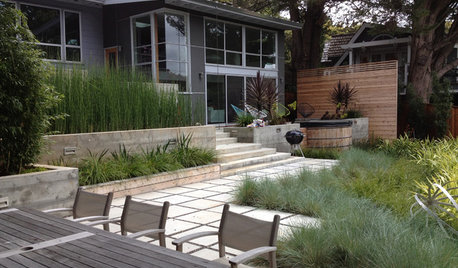
LANDSCAPE DESIGNLet's Revisit Some Revolutionary Garden Thinking
One book changed the vision of postwar British garden design forever. See how it's influencing your garden today
Full Story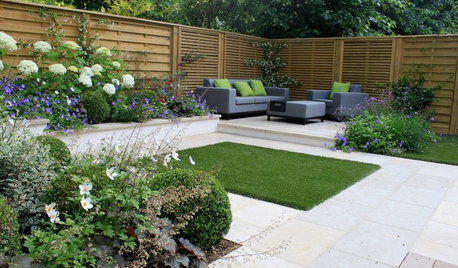
LANDSCAPE DESIGN10 Ways to Use Artificial Turf Where It Actually Looks Good
Fake grass is not for everyone, but it can be a problem-solver on balconies, on driveway strips and in urban courtyards
Full Story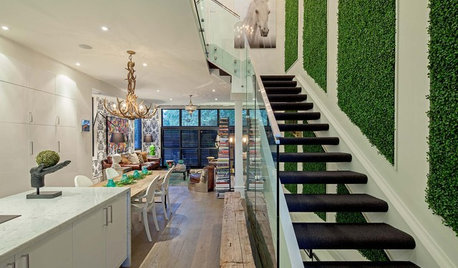
DECORATING GUIDESGo for the Green: Artificial Grass Surprises, Inside and Out
Synthetic turf springs up on patios, living rooms, furniture and walls. Basement golf, anyone?
Full Story
SHOP HOUZZShop Houzz: The Forever-Green Faux-Plant Sale
Save 20% on artificial plants, flowers and bushes
Full Story0
SHOP HOUZZShop Houzz: Faux Floral Sale
Save up to 50% on artificial floral arrangements, plants and wreaths
Full Story0
SHOP HOUZZShop Houzz: Up to 70% Off Picture-Perfect Faux Florals
Save on artificial plants and flowers to enliven your rooms
Full Story0
GARDENING FOR BUTTERFLIESGreat Design Plant: Coyote Bush
Remarkably resilient, this coast-happy shrub attracts native wildlife — and its leaves have an unusual attribute
Full Story
SHOP HOUZZShop Houzz: Bestselling Faux Florals and Plants Under $100
Revitalize your space with lifelike blooms and plants
Full Story0
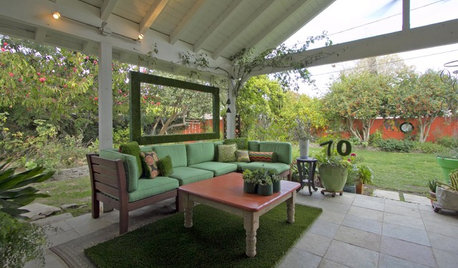
HOUZZ TOURSHouzz Tour: Firmly Planted Southern California Home
Clear garden views, turf-covered accessories and one very green outdoor room make this sunny home just right for a garden designer
Full Story
GARDENING GUIDESPlant Black Cherry Trees for the Birds and Bees
Plant Prunus serotina in the Central and Eastern U.S. for spring flowers, interesting bark and beautiful fall color
Full StorySponsored
plllog