

I've lost ten pounds. (so far)
11 years ago
Featured Answer
Sort by:Oldest
Comments (22)
 11 years ago
 11 years ago
Related Discussions
A summary to everything i've grown so far
Comments (7)Anthony, "...the soil im using is Pro-Mix BX but it dries out very fast." Premier's Pro-Mix BX is good stuff and I would be using it myself if I could find it here in this area of Kansas. I used a lot of it when we lived in Maine. It retains water better than the bark-based stuff I am using here. However, BX has a very limited amount of nutrients, and is designed to nourish seedlings for only a few weeks. I am treating my fast-draining medium as if it were a hydroponic substrate and watering it with a dilute solution containing a complete hydroponic diet. Since my operation is quite small compared to yours, I can afford to use premium quality urea-free nutrients like Better-Gro's Orchid Plus and Better-Gro's Orchid Bloom Booster, but that stuff costs about $7 a pound, so for greenhouse quantities you would probably be looking for a cheaper source of nutrients. My hand-pollinated zinnias love the orchid food. There are a lot of commercial-sized hydroponic operations, so there are hydroponic nutrients that cost much less per pound. Most "complete" nutrient formulas, like Miracle-Gro and Better-Gro, don't have calcium, because if they did it would precipitate with the phosphates and sulfates in the solution. Both calcium phosphate and calcium sulfate are relatively insoluble in water. I discovered the need for calcium nutrition the hard way a few years ago, after my indoor zinnia plants developed severe calcium deficiency symptoms growing in Pro-Mix BX, even though BX does have enough calcium for a few weeks. I ordered a pound of calcium nitrate from EveryBody's Garden Center and, by feeding calcium nitrate solution separately, I solved the calcium deficiency problem. With the added calcium nitrate, my zinnias became quite healthy and went on to produce big blooms indoors under my fluorescent lights. Since I dilute the calcium nitrate to one-half teaspoon per gallon, a pound of it goes a long way. Plants use a lot of calcium, and it is classified as a macronutrient instead of as a micronutrient. I later learned that if you predilute the calcium nitrate and predilute the other nutrients, that you can combine the solutions without precipitation. But it is OK to apply them separately, too. ZM...See MoreI've lost 20 rose plants so far!
Comments (22)Ann's idea to contact your county agricultural extension agent sounds like just the ticket to me. We contacted our county extension agent once a long, long time ago, in trying to find out why we were having a problem with growing azaleas and rhododendrons in one particular area of the yard but not in others. With all the budget cutbacks they might not still do that, but it's a wonderful service. Someone actually came out to see the problem here onsite and didn't charge us anything to do it. The fellow who came out was extremely knowledgeable and pleasant to deal with. He almost instantly guessed what the problem was, semi-confirmed it by shifting a few plants within the ground from pushing gently on their stems, and sent some soil samples off to the state lab for confirmation: a moderately heavy infestation of nematodes (the bad kind of nematodes) that were eating away at the roots of the plants. I know this isn't your problem, but your roses might have something that a local county agricultural agent can diagnose just as quickly there. Our service was free, and I assume yours would be too, or at least not too expensive. Even if your agent isn't quite so sharp as ours was, you still probably wouldn't lose anything by spending a few minutes with him/her. We've had two (very mild) cases of downy mildew here. I double-checked those photos and the roses didn't have any ridges on the canes. But perhaps ridges might have appeared if the disease had gotten worse, so telling you this might not be especially helpful--unless you can look or have pictures of the plants in different stages of coming down with the disease. If the ridges are there from the very start of noticeable symptoms, then it likely isn't downy mildew. Your county extension agent is just the right contact for checking out Ann's other ideas regarding the potential for verticillium wilt and sudden oak death. Since they affect plants other than roses too, he might have had a better chance of hearing first about the presence in your area of those diseases before someone mainly concerned with growing roses would have. (I hope it's neither of those diseases. Fingers crossed for you.) One other obvious thing to think about that I didn't think to mention earlier... Try analyzing in every respect the locations of each of the plants that have come down with the disease, and be sure to tell your extension agent about the locations of the goners and whatever connections you might be able to come up with from an analysis of those locations. Example: You have your 180 plants spread among 6 different beds, but all the plants but one that died recently were located in the front beds as opposed to from the back of the house (maybe more likely something like a gradual spreading of chili thrips?). Or, you have losses in all your beds, but they all are located near the new stone edging you've given your beds (maybe too much reflected heat added now?). Or, your losses are in front and in the back, but started out only in those beds that you added some extra bags of ___ to last winter to improve the soil (maybe the bags' contents weren't insect/disease free). Or, your losses are all in places less protected from an especially cold winter that might have set up the roses for succumbing to the first disease to come along. Or, the losses are all close to the swimming pool (spilled some chemicals intended for a pool there?). One other suggestion that might help would be adding mycorrhiza, though it's some trouble when you already have the rose planted, and if it's something like verticillium wilt it might not help enough anyway. I once added mycorrhiza to two ailing established plants and I don't think I'd ever bother with that again, though I do still think mycorrhiza is overall a good idea and we use it when planting a new rose, when it's relatively easy to use. Those two roses I was hoping to help were virused and no amount of adding anything would have changed that. With this kind of (extensive and serious) problem that your roses are having, it might amount to a situation such as ours was. Or maybe not; it's hard to know, especially since the problem is still unidentified. In favor of adding mycorrhiza... would be the firm conviction of someone very knowledgeable in organic gardening circles that plants with this added boost actually can more easily repel disease, and that it's not simply a matter of additional pathways for more water and nutrients (that's a good hedge during droughts and also especiaally severe winters). You can't know whether or not a plant thus reinforced can repel something as serious as verticillium wilt, but if you are willing to go to the trouble, it's unlikely to cause harm. At least what I did in adding it to our already-planted roses caused no harm at all that I could see. For adding to established plants, use something like an especially large and long pencil for punching holes in the ground. (I had an extra knife sharpening steel that was about the diameter of two and a half pencils and it worked perfectly.) You want to punch 4-6 holes in the ground all around the rose, starting from maybe 6 inches out from the center of the plant and directed at the center of the plant maybe a foot down. Pour a small amount of mycorrhiza into each hole, and then spread the dirt back into and over the holes. You're counting on at least one root making contact with some mycorriza, either directly from the hole placement or soon as it grows some more to that spot. If you do decide to try mycorrhiza, be sure to never use any fertilizer that is higher than 1 or 2% in phosphate, as this will harm the mycorrhiza and might end up killing the plant that will have become somewhat dependent on the mycorrhiza working for much of its water and nutrients. One last thought: I still think it's a good idea to water very deeply every now and then if you can, because of the potential for a soil PH that is too high in a low-rainfall climate. This would be true even if your roses have enough water available for takeup; what you want is a flushing of the soil downward to get rid of any salt buildup, if one might exist (though it sounds as if you're giving a good bit of water). In a desert climate, there ought to be plenty of dry soil underneath the plant to take up the excess coming from a heavy watering, and a system flush is unlikely to make matters worse. If this summer was a bit hotter there than in the previous years where you've not had these problems, a higher-than-ideal PH might combine with the main problem, whatever it is, and make it worse by creating extra stress overall. If you are able to fill some watering cans for spreading water around while doing some deep watering, it wouldn't hurt to add a tiny bit of cider vinegar to the watering can, just on a guess that your soil's PH is very unlikely to be too low already and that adding a tiny bit of extra acidity probably won't do any harm. Big beautiful roots likely means no severe root-eating nematode problem. That's all I can think of. In spite of lots of people thinking about your problem from afar, I doubt that you are going to figure this out via internet suggestions. But if possible, do post pictures. The county extension agent idea is probably by far the most important suggestion to try. Best wishes, Mary...See MoreWindstorm #6? 8? 50? I've lost count....
Comments (19)The soil is fairly nutrient rich, heavy clay with varying degrees of 'hardpan' about 8-12 inches down. None of it has great drainage, but it is not a permanent swamp. In summer it all dries up and turns brown, even most of that lush looking stuff. We'll see what that means in the next 10 years, maybe most of my eucs will fall over during that time period. But so far, those that have had problems are in the minority. The E. viminalis did hit the fence, but the fence wasn't damaged. Thanks for the thoughts... it was a beautiful tree. It had a better than usual weeping habit for E. viminalis, and narrower than usual leaves and smooth white bark. This winter has been stormier than usual.... one of the stormiest I can remember, in fact. 1996-97 was pretty bad but I think this winter has been worse. Now whose ready for a nice arctic blast? Actually, it doesn't look too apocalyptic at this point.... just another moderate blast, not enough to make this the next landmark winter. On another note... I went and visited the Chrysolepis population near Hood Canal in early November. I found a lot more trees than I had managed to discover previously, including some that can be viewed from Highway 101 if you know just where too look, and some growing deep in the forest far away from salt water. This is a very interesting area in that it is very wet, receiving 80-100" of rain annually, but still dries out sufficiently in summer to support extensive populations of manzanita, madrona and Ceanothus velutinus....See MoreHow many Palms do you think you lost so far
Comments (12)Sorry to hear about the damage Prinbama and everyone else reporting their damage. I really hope your palms surprise you. I've got plenty of damage to report too unfortunately. So far I know I lost my Saw Palmetto for sure and my Med Fan palm is very close to death. I will always regret the fact that the lights were not turned on for the coldest night of the winter 3F for all the plants in the front yard. Because of it, my med fan palm is about 90% fried and one oleander is completely dead and my 6 foot tall oleander is going to completely defoliate and possibly die to the ground (or die completely). My Frostproof gardenia has some leaf drop already but I'm optimisitc that it will survive. My Camellias all look okay but I noticed some light damage on my most cold tolerant one! I have a zone 8 camellia that is currently showing no signs of damage but this camellia that is rated for zone 6 has a few leaves with some discoloration. I'm sure it will grow with no problem in the spring, but I was surprised with the damage. My newly planted southern magnolia is showing a little damage to a few leaves but I think it will pull through (I sure am hoping at least!) This has been a miserable winter. My Trachys were well protected but with my white fence, it is impossible to keep them from overheating on sunny days (I have tried everything and I'm not usually home to take protection on and off throughout the week) so they are experiencing some burn where the lights touched the fronds but I'm hoping it survives and looks good in spring. So my count so far is 1 dead palm, one severely damaged palm, and lots of so-so things in the yard. The one good thing will hopefully be less bugs. I have so many mosquitoes in my yard so maybe this winter is what we needed to get rid of some of them. The ponds here haven't been frozen over like this in years. I saw some people playing ice hockey on a pond this week! (probably not the smartest thing though haha) Good luck everyone! 28 more days until the first day of Meteorological spring! -Alex...See More 11 years ago
 11 years ago
 11 years ago
- 11 years ago
- 11 years ago
 11 years ago
- 11 years ago
- 11 years ago
- 11 years ago
 11 years ago
- 11 years ago
 11 years ago
- 11 years ago
- 11 years ago
 11 years ago
- 11 years ago
- 11 years ago
- 11 years ago
- 11 years ago

Related Stories
FEEL-GOOD HOME12 Very Useful Things I've Learned From Designers
These simple ideas can make life at home more efficient and enjoyable
Full Story
MOST POPULARSo You Say: 30 Design Mistakes You Should Never Make
Drop the paint can, step away from the brick and read this remodeling advice from people who’ve been there
Full Story
HOME TECHAll Is Not Lost: New Gadgets Help You Find Your Stuff
If you lose it when you lose things around the house (and who doesn't?), one of these wireless finders may be to your gain
Full Story
CONTAINER GARDENSPatio-Perfect Berry Bushes Like You’ve Never Seen
Small enough for pots but offering abundant fruit, these remarkable bred berries are a boon for gardeners short on space
Full Story
GARDENING AND LANDSCAPING19 Spectacular Pools Near and Far
These incredible infinity pools, heavenly oceanside pools and luxurious lap pools around the world have unmatched allure. Take a dip
Full Story
KITCHEN DESIGNSo Over Stainless in the Kitchen? 14 Reasons to Give In to Color
Colorful kitchen appliances are popular again, and now you've got more choices than ever. Which would you choose?
Full Story
PETSSo You're Thinking About Getting a Dog
Prepare yourself for the realities of training, cost and the impact that lovable pooch might have on your house
Full Story
PETSSo You Want to Get a Cat
If you're a cat lover, the joys outweigh any other issue. If you haven't lived with one yet, here are a few things to know
Full Story
ARTBring In a View Like You’ve Never Imagined
See how art photographers turn a plain white wall into a magical window with a centuries-old camera technique — and how you could try it too
Full Story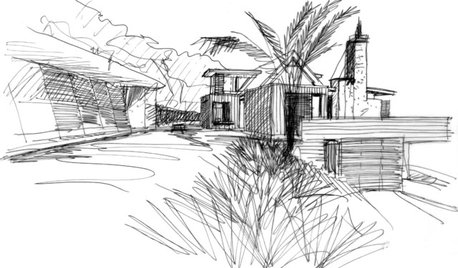
THE ART OF ARCHITECTUREBack of an Envelope: Architects’ Sketches and the Homes They’ve Made
There’s something evocative about a hand-drawn architectural sketch that a computer just can’t replicate. Here are some great examples
Full Story
vicsgirlOriginal Author