Houzz Logo Print
laurie_2008

What cooks up best in this type of Roasting Pan?

15 years ago

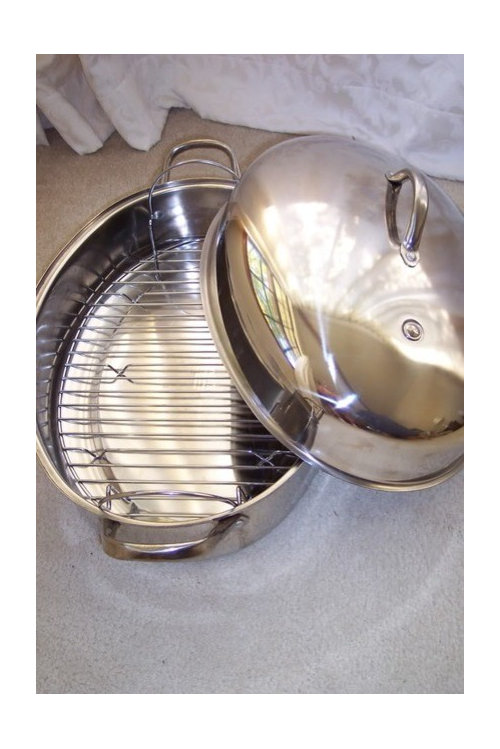
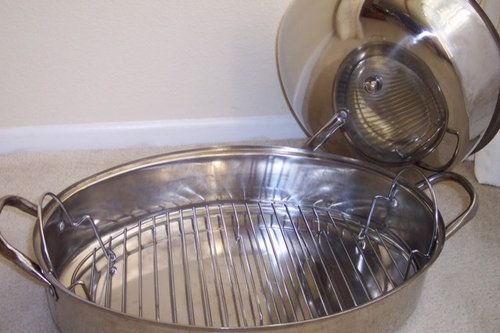
I've had this large stainless roasting pan for several years. It has a button type thing on the lid that pops up to vent out the steam. The vent is not self adjustable (I have no control to lock it in any position). When the internal temp/steam builds up, the vent thing raises and steam escapes.

Many years ago, I tried to roast a turkey in this. It took much longer to cook than any other turkey I have ever made.

I've tried a beef roast a few years ago, but can't remember why I wasn't so excited about they way it turned out.

I would like to find out your thoughts, recipes and ideas so I can make better use of this pan.

Thanks!

-Laurie

Comments (20)

  • 15 years ago

    Well, it's a beautiful pan, Laurie. I don't know why it would take turkey longer in that pan, though; my ancient, rusty, speckled blue roaster does a great job on turkey. I remove the lid for the last 30-45 minutes for browning.

    I always cook roast beef without the lid or rack, then make au jus or gravy right in the bottom of the roaster. I used to use it for making pot roast, without the rack but full of veggies, but that was when all the kids were home and I needed to make huge amounts of food. Now I do pot roast in the pressure cooker.

    I'm sure others will chime in with good suggestions for you. I think you should give turkey another try, or maybe roast a chicken for a trial run.

    Now I wish it would get cooler so I can get to cooking again. I love heavy, hot winter foods!

    Sherry

  • 15 years ago

    I assume you know that with the cover on it is just a steamer, not a roaster.

    It makes no difference if the the steam vent is adjustable or not. Once the steam is going, (boiling inside) the temperature inside is always the same, regardless of how high the fire is.

    dcarch

  • Related Discussions

    Domed lid roasting pan... how do I cook in it?

    Q

    Comments (1)
    How big a roast? What kind of roast? What temp? Pre-heated or cold-start? For example, 50 minutes at 325 won't do much. Another example -- when I do a 4-5lb. potroast, I leave it in there for four hours. There are MANY variables to "roasting". Can you tell us more about what you're doing and what you'd like to do? Cookbooks and internet sites are jam-packed with instructions for producing successful roasts of all kinds. I suspect there's nothing at all wrong with your roasting pan.
    ...See More

    Help for newbie, roast turkey, water in pan???

    Q

    Comments (8)
    Jennifer, my new roasting pan has a rack, and I'll use that so the skin on the back of the turkey gets crispy (for those that actually eat the skin). However, for years I've used an old enameled aluminum roaster with a lid that belonged to my Grandmother. She never put liquid in the bottom of the pan and neither did I. 30 years of turkeys got roasted in that pan, without any water at all, LOL, and they were all OK. Enough "juice" has always collected in the bottom of the roaster for gravy without added liquid. Annie
    ...See More

    Can I cook a roast in this pot?

    Q

    Comments (8)
    I don't like my boneless leg of lamb cooked to "stew"...I want it a bit pink on the inside like a rolled beef roast. I would just roast the lamb ON ( not in) any pan...a jelly roll pan...a 9 by 11 cake pan....or put it on the grill. If you roast it in that drip drop pan it will end up either tough or like a well done potroast. Try butterflying it....just cut it so it lays flat...sprinkling the cut side with garlic, a little olive oil, about 1 teaspoon of oregano and zqueeze over it 1/2 a lemon. Grill it as you would a steak...and its' wonderful sliced cold! Linda C
    ...See More

    Best affordable not-nonstick roasting pan???

    Q

    Comments (12)
    I have an All-Clad roasting pan with the V-rack. There is a feature - might be good or might be bad, anyway I wanted to mention in case it helps you with your decision. The bottom of my pan has a channel running around the edge. Put another way, the center of the pan bottom is slightly raised. When browning meat in fat, the melted fat runs into the channel, leaving the meat high and dry. The meat does brown well there, but the stainless of the pan also scorches and blackens at those dry, hot spots. This is not a big deal, but requires a bit of extra scrubbing. If I were to buy a roasting pan again - which I won't, this one has lasted >15 years and will outlive me - I'd look for one without this channel. Otherwise, the All-Clad is a high-quality, sturdy piece with good handles and a nice thick bottom for browning.
    ...See More
  • 15 years ago

    Laurie:
    I use a Waterless Cooker similar to that for Chicken and Roast beef but it made of heavy Alluminum.
    It has a lid and no rack. I just put in a 1/2 cup of water and Spices, put the lid on and
    in the oven at 350.

    For a large turkey , I use a military Roasting Pan, Porcelin Enamel.

    Cover it with Alluminum Foil, sealed tight and bake the same as the Chicken.
    If they don't brown enough , take the lid of for awhile.

    Here is lasts years Thanksgiving Turkey. The PC photo color is off, it should be darker.

    Always had a good Turkey or Chicken. The Breast is always
    Juicy.

    Here is a porkloin baked in my Cooker.

    Also a Pork Roast. They cook well and brown nicely.

    LOU

  • 15 years ago

    Sherry - so nice to hear from you. I remember your support on the sewing forum during the efforts to make a dress and jacket for my daughter's wedding : ) I am looking forward to the cooler weather, as well! I plan to give turkey and a roast another try in this pan.

    dcarch - maybe my turkey took so long in this pan because the steam was allowed to escape through that vent thing? Usually, when I cook a turkey I use a different pan that's a little thinner/lighter gauge and enameled (black & white speckles). I cover it with aluminum foil & remove the foil for the last 30-45 min.

    Lou - Thank you for those beautiful pictures! You say you use a pan similar to this for chicken & roast. Does your pan lid have the steam vent thing, too?
    P.S. I love your turkey platter!!

    -Laurie

  • 15 years ago

    Laurie....the pan is lovely!! But a bright shiny stainless pan does a poor job at roasting meat.
    I like my grandmother's blue Savory roaster when I want a covered roaster and a dark anodized aluminum roaster when I don't want a lid.
    For family holidays I prefer to cook my turkey with a lid at 325...it allows time for getting distracted with out seriously making an over cooked and tough bird.
    With a heavy covered roaster, it actually does get hotter then 212, because the lid allows a little bit of steam pressure to build and raises the boiling point of the contents.
    A bright shiny pan looks lovely but doesn't cook very well.
    Linda C

  • 15 years ago

    Laurie:
    I couldn't find the photo of the Waterless Cooker but

    here is one of the bottom with a Chicken almost done.
    Sometimes I leave the Lid on all the way, til done.

    Here are some Roasted Chicken Legs and Thighs, cooked in
    SS Pan( Alluminum Foil for easier cleanup ).
    In the Army all we had is SS Cookware, cooked great.
    Don't give up on your's. Just learn when to use the lid.
    Lou

  • 15 years ago

    I've not used a pan like that, but wouldn't the idea be essentially to steam the contents, and then remove the lid to allow for browning?

    I do something similar (but more crudely ;) ) when I roast large pieces of meat...placing the meat on a rack over a pan containing water/broth and covering it tightly with foil for most of the roasting time. The foil is removed toward the end of cooking time to brown the meat.

    I suspect the little steam valve is to prevent the liquid from boiling over and making a mess while retaining the benefit of moisture in long roasting.

  • 15 years ago

    Linda C - I am learning that pretty is not necessarily better!
    I wish I had my grandmother's old roaster like you've got.

    Lou - Your food looks yummy! The top picture appears to be a real heavy duty roaster made out of something special...iron?
    I won't give up and I will learn how and when to use this lid.
    Thanks for the lovely pictures and the encouragement!

    rachelellen - I guess you may be correct. This pan would be more of a steamer for the meat. Keeping it moist and preventing liquid from boiling over. I'll try cooking the meat longer and taking the lid off and allowing plenty of time for browning.

  • 15 years ago

    That is a cool pot.

    Water boils at 212F. So when that pot is covered, as long as it still has liquiPd or steam in it, the temperature inside will not be much above 212F. A chicken or a beef roast has a lot of liquid - like people, chickens and cows are mostly water - so even if you put just the bird in that covered pot, you are effectively cooking it with liquid. It is acting as a ''steamer'', as dcarch said, or as a ''braising'' pot if the liquid is deep enough. But not a "roaster". Steaming and braising are low heat, moist cooking methods. They will produce tender, moist meat but not browned exterior or crispy skin. Roasting is a high(er) heat, dry cooking method, which gets you the browned exterior and crisp or crusty skin. If you want to roast a chicken in that pot, you would leave the lid off, either the whole time or, start the chicken covered then remove the lid for the last 15 (?) min at the end with the heat turned up. Even then, because the pot has high sides, the chicken's moisture will tend to be trapped in the pot so the lower parts of the bird may not brown well. You might want to lift the chicken on the rack out of the pot and set it on a baking sheet for the final browning. If you want to roast meat, you might do it with the meat covered, then take the meat out and brown it in a frying pan. These will in effect combine moist and dry cooking methods. Bottom line, I think you can make a succulent moist roast with a crisp browned exterior in that pot, but it will take a couple of extra steps. Of course you can make a straight ''pot roast'' in that pot without lifting the lid, as a pot roast isn't really roasted, it is braised.

  • 15 years ago

    I am going to have to buy a big chicken or a small turkey to show you that you can roast and brown and get crispy skin with a covered roaster...really...I have done it easily 60 times!
    A shiny surface reflects hear....a dark surface absorbs it.
    That beautiful pot is best suited to perhaps poaching a whole fish.

  • 15 years ago

    John and dcarch - I'm going to have to disagree with your science. While water won't get hotter than 212 (at standard temperature and pressure) I don't believe there's anything preventing steam from getting hotter.

    Using a similar roasting pan and a cucumber to approximate the chicken, oil in a pan easily got hotter than 212:

    {{gwi:1552419}}

    Even taking it to the extreme and "steaming" the oil, it got hotter than 212:

    {{gwi:1552420}}

    There's lots of physics at play and certainly differences in the cooking, but really the roasting pan is just a smaller oven. Sure, the water moderates the temperature within the roaster. So will a brick, until it comes up to temperature.

  • 15 years ago

    FOAS, no disagreement really.

    Perhaps I need to be a little more clear in my statement.

    If the water and steam are not under pressure, as long as they are boiling, they will always be at the same 212 degrees F temperature, regardless of how hot the fire is.

    However, the dynamics are a little different with the roaster inside an oven:

    If you cook with a roaster without the cover inside a non-convection oven:

    1. First , as the oven warms up, the contains of the roaster will slowly warn up by convection and radiation from the oven. The part of your food underwater will cook much faster then the rest because the metal roaster conducts heat faster to the water.

    2. Then, the oven gets very hot and the water in the roaster starts to boil. Part of your food will be cooked by boiling water at 212 degrees, and part of you food will be steamed at 212 as well as cooked by radiation and convection.

    3. Finally, the oven reaches your set temperature, your food under water will be boiled at 212 degrees, and the upper part would be baked.

    If you cook with a cover on:

    In this situation, the material and finish of the roaster will be an important factor. Based on the law of "black body radiation", dark colors will absorb as well as radiate radiation better than light colors. In the absence of convection and conduction, a 100% reflective mirror cannot be heated up no matter how long you put it in a very hot oven.

    1. First, the water will get hot faster because of the metal, and the food under water will cook faster. The food above the water will be warmed by internal convection and radiation from the hot cover.

    2. Then water reaches the boiling point of 212 degrees, you food will be boiled in water, and steamed at 212 degrees. Mean while, the cover, by radiation and convection, is trying to reach an equilibrium temperature between the temperature outside and the steam temperature inside.

    3. Finally, the cover of the roaster reaches close to the set oven temperature and start to radiate down to you food at temperature higher than 212 and start to bake your food. Still, the temperature under water is just boiling at 212 degrees boiling you food.

    In all situations, the temperature of steam under normal atmospheric pressure cannot be higher than 212 degrees. However, air temperature can be higher, (Like your hair dryer) in air hotter than 212 degrees, steam is not steam anymore, it becomes "relative humidity" of air at any given temperature.

    Water cannot be in oil hotter than 212 degrees, it will boil violently (DonÂt deep fry while naked). You can measure oil temperature higher than 212 degrees while there is still some water in oil because oil is a very poor heat conductor.

    All this fun stuff will give you some flexibility when you are following recipes in cooking time so that your food will come out perfect.

    dcarch

  • 15 years ago

    Oh my, Laurie, that's one pretty roaster.

    Like LindaC, I can get a browned bird in a covered roaster. Not as browned as uncvered, but still browned, I do it in my electric roaster regularly.

    So, with the lid off I'd do chicken/turkey/duck, etc. With the lid on I'd do stews, pot roasts and other braised items. In between I'd use it to reduce apple butter for canning!

    Annie

  • 15 years ago

    LOL dcarch, every time I post physics I end up realizing I'm wrong and wishing I hadn't. Yes, at STP steam won't exceed 212.

    BUT, I submit that there's more at work in a roaster than meat juice steam, in particular radiant heat. That's why Linda C and Annie can turn out a browned bird in a covered roaster. Bet they can't do that in a steamer!

  • 15 years ago

    "While water won't get hotter than 212 (at standard temperature and pressure) I don't believe there's anything preventing steam from getting hotter.
    Using a similar roasting pan and a cucumber to approximate the chicken, oil in a pan easily got hotter than 212:
    Even taking it to the extreme and "steaming" the oil, it got hotter than 212"

    Here's how I believe if works. Sorry if I'm overlapping w/ dcarch's posts, or repeating myself.
    - Steam can get hotter than 212F if it is under pressure higher than standard sea-level atmospheric (14.7PSI). The link gives the temp-pressure relationship.
    - Since the pot is not a pressure cooker, the pressure inside is not much above 14.7PSI and the steam in the covered pot is not much above 212F.
    - The atmosphere in the covered pot is a combination of steam and air. Unlike steam, air can be hotter than 212F even at 14.7PSI. Since the steam and the air are mixing, the atmosphere's temperature will be somewhere between the steam temperature (appx 212F) and the air temp (hotter).
    - Early in the cooking process, there is lots of steam in the covered pot, so the pot's atmosphere's temperature is close to 212F. During this time, the chicken is being moist-cooked at low temperature.
    - If you keep cooking and boiling off the liquid in the pot, turning it into steam that escapes through the vent or around the lid, the atmosphere inside the pot will beome drier (less steam) and hotter (closer to the air temperature). Eventually, if you boil the pot dry enough, the atmosphere in the pot can come close enough to the oven's temperature (400F, let's say), and the chicken will start to roast and brown.
    - But the chicken has lots of internal liquid. If that liquid is dripping and boiling into steam, as is pretty much bound to happen, it has to be dried out too. So if you did want to get a chicken in a covered pot to the same degree of all-over brown as an uncovered chicken, the covered chicken could be a bit more dried out. I'm not sure, have never compared them side-by-side.
    - Using oil as a comparison doesn't work because oil does not boil at 212F like water, so it can be heated up way past 212F. Vegetable oil starts to smoke around 500F (soybean, safflower, etc - olive is much lower, like 375F). The oil's boiling point is well above that (around 570F for soybean). And above that, somewhere around 600F, is the oil's flash point and around 700F the oil will ignite. Most of us have never seen ''boiling'' oil, and hopefully we never will because it is dangerous.
    - I believe this is why it took laurie_2008 so long to roast the turkey. The liquid in the turkey and whatever else was in the pot (veg? stuffing?) had to boil off. Until that happened, the turkey was cooking at not much above 212F, which is of course an awfully low temperature.

    Here is a link that might be useful: Steam Temp-Pressure

  • 15 years ago

    "Posted by foodonastump ---------------- LOL dcarch, every time I post physics I end up realizing I'm wrong and wishing I hadn't. Yes, at STP steam won't exceed 212.------"

    But you are not wrong. ItÂs just that you have not specified the conditions completely.

    Water is the strangest material around. It misbehaves sometimes. ItÂs crazy the way it works. I didnÂt go into the complete details because it is not important for general cooking. For instance, steam can actually go hotter than 212 degrees under normal atmospheric pressure (Superheated steam). It can also go from solid to vapor without becoming a liquid.

    The other interesting thing is radiant heat (Radiation). Theoretically, you will be overcooking a silkie chicken in a roaster if you are timing it the same way as a regular chicken. On the other hand, you can actually brown a chicken in freezing air temperature if you use a radiant heater.

    Or, if you were to paint a chicken (who would be so crazy? A mad scientist may be?) 100% black, and put it in an oven that has 100% black walls which are cooled to, say 0 degree, it does not matter what the air temperature in the oven is, and the chicken will never be cooked.

    What does all these garbage have to do with cooking?
    Nothing much except you can see what a fascinating way to teach young people cooking and science at the same time.

    Off-topic:

    In another cooking forum, a few of us is trying to figure out how you can make completely crystal clear ice.

    dcarch

  • 15 years ago

    Speaking of superheated steam, anyone have one of these Sharp superheated steam ovens?

    Here is a link that might be useful: Sharp Superheated Steam Oven

  • 15 years ago

    Dcarch:
    I didn't want to get into a political discussion but I agree with the part of your thread,

    " If you cook with a cover on "
    The first 3 sentences.

    I knew this from using my Waterless Cooker.
    It was made in the late 30's and handed down to me, from my mother.
    I've had it about 40 years.
    I've cooked many Chickens with the lid on all the way.
    Besides the steam I thought it cooked by Radiation and Convection.

    Laurie:
    I found the Photo of my Waterless Cooker.
    It is made of Heavy Cast Alluminum with an Orange Peel Finish.

    Try your cooker with a Chicken ( no rack ). Add 1/2 cup of water and whatever Spices you like.
    When it is almost up to temp and is not Brown enough, remove the lid, until it browns to your liking.

    If it is not good , I'll pay for the Chicken.

    I Double Dare you !!! LOL!
    LOU

  • 15 years ago

    John - I already agreed about the 212 thing as far as water and steam goes. Whether in a covered roaster or just on a pan in the oven, the chicken is being exposed to heat via convection, conduction and radiation. Just in varying degrees. I think you're ignoring radiant heat. That's what made my oil hotter than 212. (BTW I picked oil precisely because it could go over 212.) I also believe it's what just toasted a slice of bread, despite the bread sitting on a rack above boiling water in a covered roaster the entire time. The left slice is just for comparison.

    {{gwi:1552423}}

  • 15 years ago

    johnliu , foodonastump, & dcarch - You all bring up some very interesting points! Lots of chemistry and physics involved in cooking...Much of which is beyond my full comprehension. But, I admire your thought processes and your experimentations..with pictures even!

    Linda C - good point you mention about shiny reflecting heat and dark absorbing heat. Your suggestion of poaching a large whole fish may be a good idea for this pan.

    Annie - I bet your house smells great when reducing apple butter!

    Lou - What a dandy that 1940's cooker is. You must always keep it in your family!
    I will cook a chicken in my cooker as you described above.
    Probably wait until our hot weather cools off a bit.

    -Laurie