If you were trusting Taylor Farms to provide safe food....
25 days ago
Featured Answer
Sort by:Oldest
Comments (43)
Related Discussions
Urban farming 2.0: No soil, no sun
Comments (25)I think that the "empty big box store" part of idea is terrible for a number of reasons. One would be infrastructure problems in old or even newer dissimilar buildings. A fast-food restuarant or even a large retail store doesn't buy and raze the lot next door to put up a newer building just because they need more space - there are functional flaws in the older building design even though it was purpose built for that business at one time. It would be prohibitively expensive to repurpose these buildings (or it would have been done $$$.) Another reason would be zoning laws and concerns. For example - if I owned a furniture retail store next to a large grocery store that shut down I doubt that I would be much more upset over a livestock auction moving in next door than over a lettuce factory because I would want the traffic from a compatible business or barring that traffic at all. It would have been great if the article was about q business succeding because of their beliefs against long odds because local consumers wanted their product (this can be done). What I read the article as was that a government supported group in Vancouver *CANADA* (because IMO the writer wants to confuse Vancouver BC with Vancouver WA) has a "system" that they think has potential and then all of a sudden the article shifted with no transition to the *US* where it appears that not a leaf of lettuce has been grown. The phrases "might yield", "should finish" and "plans to grow" should send "investors" running, Well meaning people and government at different levels can do a lot of damage to progress by favoring one idea (or person) over another. Many should step aside and let things take their course. There seems to have been quite a bit of *REAL* success in CSA (Community Supported Agriculture) and farmer's markets recently....See MoreWhole Foods To Label GMO Foods
Comments (33)Thanks for the link Annie, I checked it out, and as of the date of that article, Seminis did sell to Territorial and Johnny's as well as Fedco. It could be that a couple of the brassicas I just bought from Fedco, as well as the Lollo Rosa lettuce from Burpee could have come from Seminis. I will have to call the companies and check. A short snippet from the article Annie posted: " Taking spinach into his own hands: Nash Huber doesnâÂÂt want to get stuck depending on a hybrid that might get dropped by a mega-company owner on a whim. He also doesnâÂÂt want to lose any of the vigor, disease resistance, etc. that hybrid has provided. So Nash is working on dehybridizing �" breeding an open-pollinated spinach that is well adapted to his needs. (pictured: Huber, left; Matthew Dillon, right) Posted February 22, 2005: The news of MonsantoâÂÂs agreement to purchase Seminis has received little attention from the media other than the financial pages and a few seed industry and anti-globalization web sites. But then again, why should it? How many consumers �" of food or seed �" have even heard of Seminis? And yet, as Seminis spinmeister Gary Koppenjan said, âÂÂIf you've had a salad, you've had a Seminis product." It is estimated that Seminis controls 40 percent of the U.S. vegetable seed market and 20 percent of the world market�"supplying the genetics for 55 percent of the lettuce on U.S. supermarket shelves, 75 percent of the tomatoes, and 85 percent of the peppers, with strong holdings in beans, cucumbers, squash, melons, broccoli, cabbage, spinach and peas. The companyâÂÂs biggest revenue source comes from tomato and peppers seeds, followed by cucumbers and beans. In large part, these numbers reflect usage of Seminis varieties within large industrial production geared towards supermarkets, but Seminis seeds are also widely used by regional conventional and organic farmers as well as market and home gardeners. JohnnyâÂÂs, Territorial, Fedco, NicholâÂÂs, Rupp, Osborne, Snow, and Stokes are among the dozens of commercial and garden seed catalogs that carry the more than 3,500 varieties that comprise Seminisâ offerings. This includes dozens of All-American Selections and an increasing number of varieties licensed to third parties for certified organic seed production. The brand-name companies under Seminis (such as Petoseed) have developed, released, produced and distributed varieties common to the market farmer and even home gardener. These include Big Beef, Sweet Baby Girl and Early Girl Tomatoes; Simpsons Elite and Red Sails Lettuces; Red Knight and King Arthur Peppers; Gold Rush and Blackjack Zucchinis; Stars & Stripes Melon; and Bush Delicata and Early Butternut squashes (see sidebar for other popular varieties)." So home gardeners DO have to check their seed, these are very popular varieties though the article is NOT saying that these......See MoreDo You Care Where Your Food Comes From?
Comments (43)The more information the better. DDT was found in the brain tissue of many who died of Alzheimers. It is coming in on produce grown outside the USA. We should care what is going on. Why watch loved ones suffer from Cancer or a hundred other diseases caused by impure foods. You cannot eat these chemicals in your food every day and not get sick later on. Please protect yourself and the ones you love and eat the best food you can get. We have the right to know what is in our food. It's hard to not buy that tasty stuff on the shelf. If food companies could make sawdust taste great and sell it to us as food they would. You need to try it for yourself. After you get used to food without the extra salt, sugar and flavorings you can really tell the difference between fresh food and the doctored up food. I used to get headaches all the time and now I don't. I would never go back to eating the way I used to. I think they should have to disclose every chemical in the food and that would be a very long list indeed. Remember too that if your liver is working overtime to break these chemicals down and get rid of them, it has a hard time working on fats to keep your weight in balance. What worries me the most is products that contain ingredients that are loaded with chemicals but are only listed as "tomatoes", "chicken", etc. What about oils like cottonseed that are loaded with toxic cancer causing chemicals because cotton isn't a food regulated crop. They use it in snack foods that kids eat. Most of the soybean oil is GMO and is extracted by a petrochemical solvent process. But all the label says is cottonseed oil or soybean oil....See MoreIs any food safe to eat - fruit recall
Comments (26)You may not be aware soil in the western U.S. from the Rocky Mountains to the Pacific Ocean contains a particularly high count of Type A Clostridium botulinum spores, the type of spores that produce the toxin most dangerous to humans, and Colorado and other states in the West have higher per capita rates of food-borne botulism than other parts of the U.S. This time of the year we get peaches from Colorado and I'm always careful to wash them carefully as soon as they get home. This is a concern because you may get windfall fruit that has been sitting on the ground where it can pick up the bacteria spores. It's not that many years ago we were cautioned NOT to can pie filling at home because of safety problems. Dr. Stan Wallin, Food Technologist at the University of Nebraska, developed safe recipes and procedures for home canned apple and cherry pie filling that are acidified with lemon juice. If your recipe doesn't include lemon juice, you may want to up-date it. Dr. Wallin also cautioned windfall apples should NOT be used due to bacteria picked up from soil. So you NEVER know.... You just need to do what you can, and that includes proper handling, washing, and preparation. -Grainlady...See More- 22 days ago
- 22 days agolast modified: 22 days ago
- 19 days agolast modified: 19 days agoOlychick thanked carolb_w_fl_coastal_9/10
Related Stories

FARM YOUR YARDHello, Honey: Beekeeping Anywhere for Fun, Food and Good Deeds
We need pollinators, and they increasingly need us too. Here, why and how to be a bee friend
Full Story
FARM YOUR YARD6 Things to Know Before You Start Growing Your Own Food
It takes time and practice, but growing edibles in the suburbs or city is possible with smart prep and patience
Full Story
FARM YOUR YARDTo Get the Food They Believe In, These Urbanites Grow Their Own
Home gardeners farming on their city lots find that local, organic food isn’t the only reward
Full Story
FARMHOUSESWorld of Design: See How 9 Families Live and Farm on Their Land
Join us as we visit the homes and farms of passionate food producers and hear about rural life around the globe
Full Story
FARM YOUR YARDMy Houzz: Backyard Farming for a Kansas City Family
A backyard garden provides a family of 5 with organic seasonal produce. Here's how they do it
Full Story
EDIBLE GARDENSFood and Community Thrive in a U.K. Allotment Garden
Get a peek at a rented garden plot in England where edibles and flowers mix and local residents can mingle
Full Story
LANDSCAPE DESIGNYard of the Week: Beautiful Blend of Old and New on a Former Farm
Designers adapt a 6-acre Massachusetts property to suit a family’s modern needs while honoring the land’s agrarian past
Full Story
LIFEConsider Avoiding These Plants to Help Keep Your Garden Fire-Safe
Plants that accumulate dead material, are high in oil or have low moisture content in leaves put some homes at risk
Full Story
HOUZZ TV FAVORITESHouzz TV: Life, Love and Purpose Down on the Farm
A Missouri native proves that you can go home again — and discover something entirely unexpected
Full Story
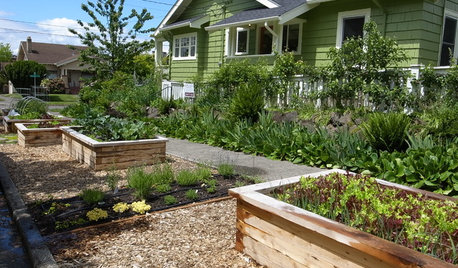
FARM YOUR YARDHow to Farm Your Parking Strip
Get an up-close look at a thriving street-side edible garden, one of many sprouting up in Seattle
Full Story
lily316