

Whetstone suggestions
8 months ago
Featured Answer
Sort by:Oldest
Comments (11)
- 8 months agolast modified: 8 months ago
Related Discussions
Best gadgets?: knife sharpener, garlic press, immersion blender
Comments (26)To the OP - the reason you never found the sharpening steel very effective is because a steel does not sharpen, it hones; there's a difference, and its simple and important to remember. Basically, the edge of a knife is very very thin. German knives, in particular, use *relatively* soft metal in their blades (compared to modern Japanese knives, especially). Just in normal use, the edge deforms on a microscopic level, interfering with cutting ability...when you hone using a steel, you are essentially bending the edge back into shape. You are not, however, removing any metal at all. You should hone often. Doing it everytime you start a job is not too often. If you do this, you will maintain your initial sharpness much much longer. Note that on many of the manual pull-through systems, and some electric, the "final" sharpening level is actually a honing level, so you can use that instead. Note also that "diamond steels" are a different beast entirely; they are much more abrasive, and are best treated as true sharpeners. Regardless of how often and religiously you hone, however, at a certain point the edge will still get dull...and at that point, you need to sharpen by actually removing some metal to reshape and sharpen the edge. To do this, you need something more abrasive than a steel - a diamond rod, ceramic rods, stones, a mechanical sharpener, etc. Practically speaking, this is something you probably only *have* to do once or maybe twice a year. Learning to use sharpening stones is relatively easy, and they can be relatively affordable, but it does take some commitment and a bit of practice to be able to hold the correct angle. The systems like the the EdgePro and Wicked Edge get you the same results consistently without requiring as much user skill/commitment, but they are a bit expensive initially. For a cheaper option that still requires less commitment/skill than flat stones, and is very well reviewed, you might look at the Spyderco Tri-Angle Sharpmaker. Note, however, that all of these methods take a while to use - they aren't a quick 5 minute task. The electric sharpeners are quicker and have almost no learning curve. The downside is they are harder on your knives (removing more metal more quickly), and the edges they produce are serviceable but not at the same level a skilled manual sharpener can achieve. For many people, the tradeoff is worth it. Do you live close to a Williams Sonoma? I believe they are currently offering to sharpen one knife free, with an electric sharpener (Chef's Choice, I think) on Saturdays. I would recommend you take one in to them and get a hand's on demonstration, and then you will have an actual edge on your own knife to test with. If possible, I would also take another of your knives to a good professional hand sharpener (will probably cost between $1 an $2 per inch). Then, I would see whether the difference is worth it, to you. I'd also second the recommendation for the "An Edge in the Kitchen" book. There is also a book you can get a Sur la Table called "Knives Cooks Love" which is a good overview and is currently on sale for $4.99....See MoreWusthof: love it/hate it
Comments (14)dcarch, I agree with some of your points if we are talking about the usual "steel" sold in most shops, which is a rough grooved rod. Those so-called steels are in fact meant to "sharpen" meaning to remove metal. They do it terribly. I used my kids' microscope once to examine a kitchen knife edge as I did different things to it. I found out that the grooved rods actually tear the blade's edge into a jagged shape, sort of like a saw. You cannot see this with the naked eye, but you can feel it. Take a knife you don't care much about. It is easier to do this if it is a fairly soft steel, like a Victorinox. Run your finger along the edge, not applying enough pressure to cut yourself, and note how smooth it feels. Then go at it vigorously with a grooved rod type of "steel". Now run your finger along the edge. You will feel a slight roughness. Those are the jaggies torn by the grooved rod. When you first use that knife, it will cut effectively, as the jagged edge works just like a saw. But the jaggies are soon torn off. Again, you can only see that in the microscope. I think I was using 100X. The blade then ceases to cut well. And you reach for the grooved rod again. A smooth rod, which is what I consider an actual steel, does not tear jaggies into the edge, at least none visible at 100X, and not as far as my fingertip can feel. But an edge that feels like it to has recently dulled, can be restored to keen again, with the rather gentle use of the smooth rod. Much gentler than the pressure you exert to grind a new edge using a whetstone. If the smooth rod is not grinding away metal - as the microscope seems to show and as the gentleness of our steeling would suggest - how is it making a seemingly dull edge feel sharp again? That is, I believe, the edge re-alignment that I mentioned. Note that all my experience is with Western knives. Victorinox, Wusthof, Henkels, etc. I have never owned a genuine Japanese knife with the much harder steel that they use. Though I sure hope to, someday. I know it is considered absolutely verboten to use a steel on a Japanese blade. I don't know why, not having personal experience, though I have theories (e.g. ruining the single-bevel geometry of some Japanese blades). I have sharpened a genuine Japanese knife once, for a friend. She asked me to sharpen a whole bunch of knives. She has dozens of knives, all thrown together in a big drawer, the fine ones with the cheap ones, all as dull as can be. Really sad. I used my waterstone on that knife, got it very sharp though I'm sure not nearly as sharp as it could have been, and wrapped it up in paper before replacing it at the very back of the drawer. It took several hours to sharpen a couple dozen of her 40 or 50 knives. I gave her a Chef's Choice after that. Stropping - I don't do it, and didn't study it under the microscope. I'd guess it is simply polishing the edge a bit. After you sharpen a blade on even a very fine whetstone, under the microscope you see a pattern of diagonal furrows on the bevel of the edge, that show how you ground the bevel on the stone. Those furrows continue all the way to the edge itself. So the V-shaped cutting edge has a very slight micro-level serration. If you want to polish out that serration, I would suspect stropping could help do that. But I don't mind the micro-serration. Here is something fun. My son's science class will have an electron microscope for a few months. I have no idea how good it will be, or how a middle school classroom gets loaned such an instrument. The science teacher asked for parent volunteers to be trained on the electron microscope and to then supervise kids. Naturally, I have signed up. He said we could use it on our own too. If it is able to give a useful picture of a knife edge, I'm bringing a whole quiver of knives in different stages of sharpening, steeling, and even stropping....See MoreOne More Time! Vote paint color, this is it!
Comments (43)Marose, that is my all-time favorite inspiration kitchen! I actually chose Gray Owl because of that kitchen! And it is the main reason why I wanted the beadboard to match the cabs. But she has other things going on in her kitchen that make that choice to be a good one. I am still drawing significant inspiration from her room to finish off my dining room. I have narrowed TEN good color choices down to two, in addition to the option of Gray Owl. I am taking the "white" off the table. I am not sure the new ones will photograph well, but I will give it a try! Tomorrow!...See MoreHow are you keeping your tools in good shape?
Comments (5)I occasionally take my small hand trimmers and all the household shears in to a local gardening center/ grain store that sharpens them. (In fact they badly need a trip to the sharpeners this year.) I'm afraid my long handled and short handled pruners have never been sharpened, but I do occasionally spray their joints and blades with WD40 to keep them operational and to allay rust. Kitchen knives I sharpen myself with a whetstone or knife sharpener. I once attempted to sharpen a pair of cheap scissors, and did improve them somewhat, but I would hesitate to try it on a more valuable pair of shears, garden or household. As others said, getting the angle right is tricky....See More- 8 months ago
- 7 months ago


Related Stories
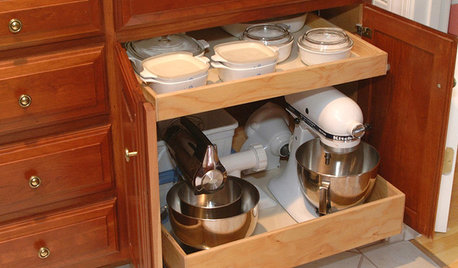
KITCHEN APPLIANCESConsidering a New Kitchen Gadget? Read This First
Save money, time and space by learning to separate the helpers from the hassles
Full Story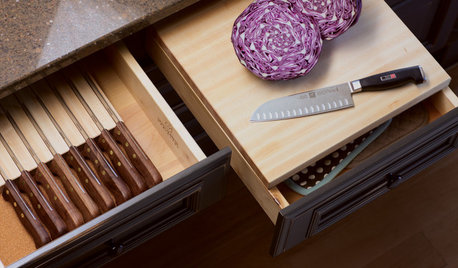
KITCHEN STORAGEKnife Shopping and Storage: Advice From a Kitchen Pro
Get your kitchen holiday ready by choosing the right knives and storing them safely and efficiently
Full Story
FRONT DOOR COLORSFront and Center Color: When to Paint Your Door Deep Red
Rich reds draw the eye and send an inviting message. See if one of these palettes speaks to you for your own front door
Full Story
MY HOUZZMy Houzz: Pursuing Their Life’s Work in Rural Oregon
This creative couple craft a live-work world all their own in the high country of eastern Oregon
Full Story
archie hess