

Do you like science? I love science.
last year
last modified: last year
Featured Answer
Sort by:Oldest
Comments (41)
Related Discussions
Polling Data, or why Johnny can't do science
Comments (69)Here's a follow-up to Edna DeVore's column ~6-7 posts back : Evolution: It's Only a Theory, But One Worth Teaching By Edna DeVore Director of Education and Public Outreach posted: 03 March 2005 06:13 am ET My prior column was composed at 35,000 feet above North America as I surveyed the landscape from the air. The patterns etched by geological evolution are visible at altitude. Closer up, fossils tell the story of earlier life upon our continent. Gazing to the heavens, astronomers gather evidence of the evolution of planets, stars, galaxiesthe whole universe evolves. Natural history museums host large collections of extant and extinct life that document biological evolution. Yet, as I noted, teaching evolution remains controversial in America. A flood of email ensued. Many were supportive; some asked questions. Several negative and hostile emails were openly critical of my assertion that American schools should teach evolution in science classrooms to "leave no child behind". In addition to rejecting evolution for religious reasons, several people claimed that there was not sufficient evidence, that scientists could not all agree, or that evolution is "only a theory" which they equate with an unfounded idea. Evolution is supported by evidence. There are several thousand peer-reviewed scientific journals where the evidence is presented in article after article. Natural history museums house large collections of fossils that document the history of life. Geologists and astronomers have a massive amount of observational evidence of the long-term change in physical systems: stars, galaxies, planets, interstellar dust, asteroids, etc. Biologists observe and document the patterns of the evolution of life: for example, the fossil record, DNA, and the observation of evolution in action such as the adaptive evolution of antibiotic-resistant strains of bacteria that now pose a serious threat to human health. Selective breeding in agriculture generated our crops and domestic animals over thousands of years; agriculture is evolution in action. Certainly, there are continuing debates among scientists about the particulars of cosmic, planetary, and biological evolution. The nature of science requires continual questioning of ideas, evidence and theories. Theoretical scientists consider what we know, and pose new ideas and models to explain the natural world. New models and ideas generate new scientific tests of theory: observational experiments at Earth and space-based observatories, high-energy collisions of particle physics, deep-sea dives at the plate boundaries, and lab experiments in molecular biology to cite a few. Science is based upon observational and experimental evidence. Concepts that dont match observations are altered or tossed out. Its an iterative cycle. Likewise, if a scientist makes an observation or does an experiment that cannot be replicated, the results are suspect. Scientific explanations of the natural world are tested against nature, and discarded if they do not work. Consider cold fusion. Science is a self-correcting system that provides humans with powerful descriptions that allow us to understand and predict how the natural world works. Consider Johannes Kepler, a mathematician who is often cited as one of the first modern astronomers. He took observational data collected by Tycho Brahe who was a terrific observer and had mounds of measurements for Mars. Brahe challenged Kepler to make sense of these Mars data. Tycho had his own ideas, but he didnt have Keplers mathematical skills. Kepler spent months trying to fit the Mars data to the circular epicycles and deferents that explained planetary orbits in the astronomical tradition of his day. The data just didnt fit. Unlike his predecessors, Kepler took a leap toward modern science. He elected to trust the data, and abandoned the ancient model of circles upon circles for a new description of planetary motion. His ideas can be condensed into three statements which we call Keplers laws. In their simplest form, they are: planets orbit on elliptical paths with the Sun at one focus; the period of a planets orbit is proportional to its distance from the Sun; and a planets speed in orbit is proportional to its distance from the Sun (equal areas are swept out in equal time). Kepler didnt know why the planets orbited as they did, but he could describe their orbits and make accurate predictions about future positions. The next big step came with Isaac Newton who explained that why planets orbit the Sun: gravity. Only Mercury didnt behave as predicted by Newtons physics. Einstein remodeled physics once again with special and general relativity, and was able to explain Mercurys motion. The theory of gravitation is a powerful explanation of how objects interact in space-time. Its heritage goes back to Keplers description of planetary motion based upon Brahes observational data. Its funny how no one argues that gravity is "only a theory," yet many dismiss evolution as "only a theory." At a fundamental level, popular English and scientific usage are at odds here. In popular culture, a "theory" is understood to be a guess or speculation that may or may not be based upon evidence and analysis. In science, a theory is "a well-substantiated explanation of some aspect of the natural world that can incorporate facts, laws, inferences, and tested hypotheses." (Teaching About Evolution and the Nature of Science,National Academy of Sciences, 1998: 7). A scientific theory is the larger explanation of how the well-tested "laws" fit together to describe the natural world. Dismissing evolution as "only a theory" is, at the simplest level, a misunderstanding of the meaning of "theory" in science. But, in the current controversy, discounting evolution as "only a theory" is more than a semantic debate. Its a political statement at the heart of the attack upon teaching evolution in science classrooms in America. Science is a powerful tool for understanding the natural world, and has a dominant role in modern economics and culture. Scientific theories are at the heart of the enterprise. In the science classroom, children should learn about major scientific theories such as gravitation and evolution. Science is a way of knowing, but not the only way of knowing. There are things that science does not address. For example, music, art, emotion, and religious beliefs are all outside the domain of what science can address. I find it unfortunate that the controversy over the theory of evolution continues as science offers all humans a way to know about the natural world and how it works....See MoreI'm Learning Choosing Roses Is A Science!!!
Comments (14)It is science but it is ruled by emotion. What?!? There will be some roses suited to your climate but they "just don't excite me" and there will be roses that shouldn't thrive in your garden, but you are so enamored that you must have them and will do whatever it takes to grow them. Some will work out and some won't. That's the fun and passion of rose gardening! And you will learn so much the hard way. I am trying to find some room for more Chinas and teas by SP'ing more DA roses that I "had to have" but have not thrilled me like the Chinas and teas which were bred for my climate. But if I hadn't tried the DA's, I would still be lusting after these roses, grown in more temperate climates, from pictures in the catalogs and here on the web. Now, I know I can rarely have a quality DA plant. But Chinas and teas.... they will be happy in my garden and I will be happy with them. Have fun! Buff...See MoreKAW...why I love soapstone ! Science at work..
Comments (12)Suzanne...it is very easy. My Momma cut it out of the Orlando Sentinel newspaper in the 80's. Cat..you are fresh !! just like the peanuts :) Mix 2c honey 2c peanut butter 1c hot water 2 Tbsp cinnamon 3 tsp salt ( depends on how salty pb is ) may add other spices if you like and vanilla Heat till smooth. Mix 12 c rolled old fashioned oats , 2 c sunflower seeds, 2 c coconut ribbons ( I don't like small pieces ) 1 c sesame seeds, 1c wheat germ, 2 c chopped nuts. Add above warm dressing and stir well. This is a double batch so you can halve it. Spread on parchment paper on large pans and bake at 300-325 for at least one hour or more. Stir frequently after first 20 min. I like mine nice and toasted. It will cont. to brown after you take it out. ENJOY !!...See MoreDo you know any simple science experiments?
Comments (20)Demonstrate that, outdoors, reflected light may be polarized. Needed equipment is a pair of polarized sun glasses or a good polarizing filter for camera work. Go outside in sunlight and face the sun, then view the surface of water or a smooth road at a distance. Look through the polarizer and rotate it to see its effect. When the polarization is horizontal, maximum light comes through and when its vertical, minimum light is admitted. It also changes the color of the sky. The glare off shiny auto hoods can be cut by rotating the polarized filter. (If you buy the right size, the polarizer can be used on your camera.) Make a can and string "telephone". Equipment: 2 metal cans and low stretch string. The bottom of the cans should not be too stiff. Stretchy string is not as good as non-stretch string. In years past, I'd have used the fine cord for moving the needle across a radio dial. Today, hard woven fishing line might be best. Pur a small hole in the bottom of the cans and I think that you know the rest. If the bottom of the cans are too stiff, it will not work well. Those annular rings in the bottom are stiffeners. Flatten these out to render the bottom more flexible. Surface tension propelled boat. Equipment. A shallow pan of water, softened bar soap, and small flat board maybe like a tongue depressor. A piece of cardboard might do for a short while. Cut the "boat' about 1 to 1.5 inches long. Cut a narrow notch in back back and jam in a piece of soft soap. When the water very still in the pan, gently place the 'boat' on the water's surface and watch what happens. This will work until the water becomes too soapy. When it does, pour it out and get some more water. Tree leaves have breathing holes. Equipment: Low power microscope and fresh tree leaves. Tree leaves do have microscopic pores on the underside and it does not require very high magnification see these. This is where the tree passes water vapor to the atmosphere. See pop corn pop. A kernel of corn 'pops' when the moisture inside goes above the boiling point and then bursts the kernel. When the tough outer shell splits, the inside explodes with the sudden release of pressure and the moisture in the cells expands the cells. Put some cooking oil in a cooking pot or heavy skillet, add a few kernels of popping corn and close the pot with a clear pyrex lid. Wear eye protection and proceed to observe the corn when it pops. Ordinary field corn will pop, but commercial popping corn works the best. To speed up the process, preheat the pot before adding corn....See More- last yearlast modified: last year
- last yearlast modified: last year
- last year
- last yearlast modified: last year
- last yearlast modified: last year
- last year
- last yearlast modified: last year









Related Stories
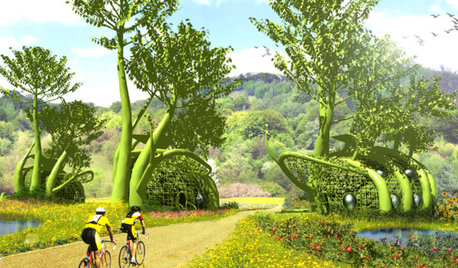
EVENTSOn Show: Weird, Wondrous Science Meets Design
Houses grown, not built. Power-generating soil. And snail poop that ... well, see for yourself in our coverage of a new Rotterdam exhibit
Full Story

TRANSITIONAL HOMESHouzz Tour: The Science of Blending Old and New
An interior designer helps clients pull together modern furniture and heirloom pieces in a classic home
Full Story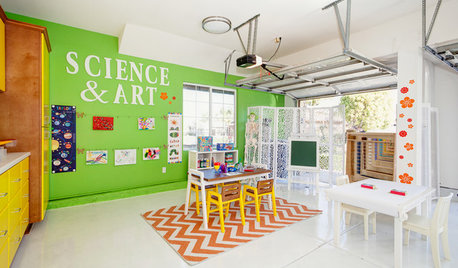
ROOM OF THE DAYRoom of the Day: Art and Science Room Proves Grandmas Are the Best
This grandmother transformed her garage into a science and art classroom where messes are encouraged every day
Full Story
PRODUCT PICKSGuest Picks: Mad Science
Get inspired by science fiction with 20 decorative items pulled straight from your favorite B movie
Full Story
COLORThe Science of Color: New Purple, Orange and Green Pigments Discovered
University researchers stumbled on a new blue pigment in 2009. Now they’re making others, which could show up in your home
Full Story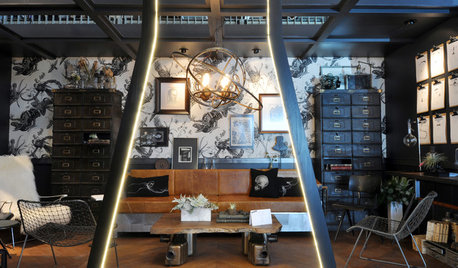
DECORATING GUIDES16 Lounges Go Wild for Science at San Francisco's Exploratorium
See the imaginative designs concocted and let us know which style formula works best for you
Full Story
PRODUCT PICKSGuest Picks: Science-Inspired Design Finds
Look to geology, chemistry, geography and other sciences for inspiration in home decor
Full Story

BEDROOMSDesign It Like a Man: Tips for Single Guys Planning a Bedroom
What guys should consider — aside from the Xbox — to design a bedroom that's comfortable, stylish and accommodating
Full Story
John Liu