

Heavy cream question
6 years ago
Featured Answer
Sort by:Oldest
Comments (9)
Related Discussions
Substitute for Heavy Cream?
Comments (8)If I need something creamy for a sauce....I sometimes put skim milk (which always is in my refrig) with some cream cheese....another thing that is always in my refrigerator. It's amazing how little cream cheese it takes to make skim milk "cream-like'...or perhaps sour cream like. And I never use the reduced fat stuff, I also think it tastes strange. When I am trying to reduce the fat in a recipe I will just use milk....and if I am looking for some thickness, I will whirr in the blender with a little cooked rice. I always have evaporated milk but that's only for certain things where that "boiled" taste is necessary...like Grandma's rice pudding and her pumpkin pie. Linda C...See Moreheavy cream substitute
Comments (25)I think there's no real proof that dietary fat makes you fat, and I don't think I'd skip the cream--the calories per serving can't be that much. I've linked to a study in the scholarly journal Nutrition, and here's an excerpt from the abstract: "The DGAC Report does not provide sufficient evidence to conclude that increases in whole grain and fiber and decreases in dietary saturated fat, salt, and animal protein will lead to positive health outcomes. Lack of supporting evidence limits the value of the proposed recommendations as guidance for consumers or as the basis for public health policy. It is time to reexamine how US dietary guidelines are created and ask whether the current process is still appropriate for our needs." Here is a link that might be useful: In the face of contradictory evidence: Report of the Dietary Guidelines for Americans Committee...See MoreHeavy cream in bread recipe
Comments (3)One of the chief characteristics of rye flour in bread is a really sticky dough, even with the proper amount of hydration. When the dough is sticky, we tend to add more flour, and often add too much flour during kneading, trying to get the dough soft and smooth like white bread dough. In the world of bread, dense bread usually means too much flour has been added, especially if it was a stiff dough. But let's also look at what happens from fat AND when the fat is added, because that has a cause and effect as well. Since the cream is high in fat (and I assume there was other fat in the recipe), adding it early in the mix will coat the gluten so it develops in short strands. This is the same method we use when adding fat to flour when making pastry. Where the fat coats the flour, water can't penetrate it and the gluten develops in short strands. The fat "shortens" the gluten - hence, short crust pastry. When fat, and large amounts of fat, are added early in the mixing, you will get a close crumb and not as much loft because of the shortened gluten strands. Adding fat late in the gluten development (towards the end of the kneading), you will get an open crumb and higher loft. Adding fat early in the mixing is how you get a close grained crumb for sandwich bread (so fillings and spreads don't drip through it). Adding fat late is how you achieve an open crumb for toasting (so the butter and jam have lots of pockets to fill). You can make the same enriched bread recipe and add the fat early in one loaf, and add the fat after the gluten has developed in the second loaf, and you will see a completely different size, crumb, and loft - even using the same recipe. It's not about what's right or wrong, but what kind of grain we want the bread to achieve according to how it's going to be used. You listed the amounts of flour in the recipe, but did you add more flour during kneading due to the stickiness of the dough? As always, only add enough flour to make a well-hydrated soft dough, and always consider the amounts of flour in the recipe as a good (or bad) guess, and you have to go by that often elusive "feel" of the dough, not the amounts of flour noted in the recipe. Rye bread is an additional challenge because the dough will remain sticky, even with the correct hydration. TIP: Add the high-gluten white flour and VWG a little at a time to your liquid first, and give it a really good workout between additions. Mix it with a Danish Dough Whisk (the perfect tool for making batters and doughs), or a wooden spoon if you don't have a Danish Dough Whisk, in order to work and develop the gluten during mixing. This is the best time to develop the gluten in a recipe with a mix of high-gluten and low-gluten or gluten-free flour/s. It may take two hundred (or more) strokes to develop the gluten while mixing, and mixing is a critical step where people get a little lazy and often fail to do a good job. If your dough is a shaggy mess when you start kneading it, it wasn't mixed properly. Add the low-gluten flour last, after you've done a good job of mixing the high-gluten flour in the mixture. Add only enough flour to make a soft dough. You should only require a small amount of additional flour during kneading if you did a good job of developing the gluten during mixing. There are a few tips for kneading rye bread due to it's stickiness: -Save some (or all) of the fat/oil in the recipe and oil your hands during kneading so you don't add too much flour. -Have a bowl of water handy and dip your hands into water during kneading, instead of adding more bench flour. It's always better to err on the side of a wet dough than a dry, stiff dough, and the wet hands won't stick as much to the dough, and will add a little hydration. The wet hand method is also good for kneading dough for English Muffins. A wet dough is what makes the characteristic holey texture in well-made English Muffins (but I digress). -Knead the dough on a Silpat (or other brand of silicon mat) because you won't need any, or very little, bench flour. Dough doesn't stick to the mat. If you don't have a Silpat, spray your counter with PAM cooking spray instead of using bench flour. -You can also place the dough in a gallon freezer-style zip-lock bag (the freezer bags have thicker plastic than the storage bags - a good thing). Press out the air and zip it shut. Knead the dough through the bag. If you need to adjust the hydration of the dough, you can still open the bag and add flour. When you are done kneading, turn the bag inside out to get the dough out. This is one bag you will toss in the trash because cleaning it is nearly impossible. -Get a pair of kneading gloves (aka dough gloves). Alcohol does not form gluten when it's mixed with flour like water does. It's used in pastry recipes so a little more liquid can be added to make it easier to roll-out so it doesn't crack, without over-developing the gluten strands from adding more water to achieve the same moisture level, which results in over-developed gluten and tough pastry. I suspect it does the same thing in your pancake batter. Beer in bread is mainly for the flavor. If you add a low-alcohol or alcohol-free beer to a bread recipe, you will get a completely different flavor, interestingly enough. Is your beer bread recipe a quick bread or a yeast bread? Typically, they are a quick bread, and the alcohol would be beneficial because quick breads are another bread we don't want a lot of gluten-development. -Grainlady...See MoreSubstitute for heavy cream in scones
Comments (25)Lars : It is a shame you can't make good Waffles without Cream. Here is a recipe for Waffles you will love. Give them a try and let me know !!! LOUÂS Pancakes and Waffles Recipe Light, Crispy but Tender. 2 ½ cups milk ( IÂve been using powdered milk) 2 eggs ( separated ) . 1/3 cup of veg. Oil 2 tablespoon of vanilla Pinch of salt ½ cup Sugar 1 cup of Wheat Flour 4 teaspoons Baking Powder All Purpose flour --------------------------------------------------------------------- Mix Pancake Batter: Put the first 6 ingredients ( except egg whites ) in a mixing bowl and beat until smooth. Put in the Wheat flour, Baking pwd. and some All Purpose flour. Beat until smooth. Add enough flour to thicken slightly, (were it leaves ripples while mixing ) not thin and loose. Beat the egg whites with a teaspoon of sugar, until peaked. Add ½ the egg whites to the batter and fold in easy. Beat the other ½ of the whites until very stiff and fold these in also. After the pancakes are cooked, I put plastic in between for freezing. For Waffles: Thicken a little more, to where you have to move it around with a spoon, when it is put on the waffle iron . Then do the egg white thing as in the pancake batter. When baked I cool them fast on a rack and put them in a plastic bag, and right in the freezer. If you overcook a little, dampen slightly with water, before you put them in the toaster oven. As for the waffle iron , I have a very old round one with adjustable heat Range. You will have to adjust to your Waffle Baker. It makes a waffle about ½ inch + thickness. For me this is just right, for the amount of butter and syrup that you can put on top. I found one to match at Macy's it is a Cusineart. I donÂt use the Belgium Waffle Maker ; except when IÂm adding Ice cream and fruit topping , because itÂs too much waffle for the amount of syrup and butter. But may be good for you.! If I want a Belgium Waffle, I just make a double decker and put fruit or whatever filling in between. Then you have more cooked surface area , on the Waffles....See More 6 years ago
- 6 years ago


Related Stories
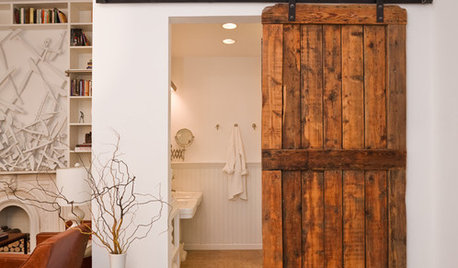
DOORS5 Questions to Ask Before Installing a Barn Door
Find out whether that barn door you love is the right solution for your space
Full Story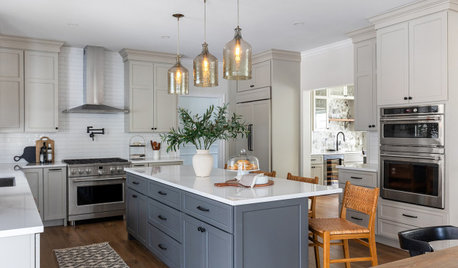
REMODELING GUIDES6 Tricky Questions to Ask When Planning Your New Kitchen
Addressing these details will ensure a smoother project with personalized style
Full Story
FEEL-GOOD HOMEThe Question That Can Make You Love Your Home More
Change your relationship with your house for the better by focusing on the answer to something designers often ask
Full Story
KITCHEN DESIGN9 Questions to Ask When Planning a Kitchen Pantry
Avoid blunders and get the storage space and layout you need by asking these questions before you begin
Full Story
GREEN BUILDINGConsidering Concrete Floors? 3 Green-Minded Questions to Ask
Learn what’s in your concrete and about sustainability to make a healthy choice for your home and the earth
Full Story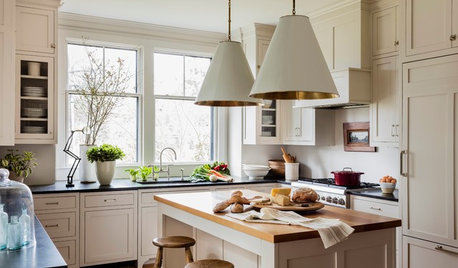
MOST POPULARHouzz Tour: Easygoing and Elegant in White, Cream and Gray
The renovation of an 1860s Massachusetts home creates a sophisticated, serene and comfortable living space
Full Story
MODERN HOMESHouzz Tour: Heavy Metal Rocks a Modern Missouri Home
Steel shows up all over this single-level family home, but wood and other textures warm the look
Full Story
REMODELING GUIDESConsidering a Fixer-Upper? 15 Questions to Ask First
Learn about the hidden costs and treasures of older homes to avoid budget surprises and accidentally tossing valuable features
Full Story
SELLING YOUR HOUSE15 Questions to Ask When Interviewing a Real Estate Agent
Here’s what you should find out before selecting an agent to sell your home
Full Story
GREEN DECORATING8 Questions to Help You See Through Green Hype
With the ecofriendly bandwagon picking up some dubious passengers, here's how to tell truly green products and services from the imposters
Full Story
Sherry8aNorthAL