Houzz Logo Print
hzdeleted_19722038

I'll find out if this is scientifically precise or not today...

7 years ago

I've been wanting to try to make my own sourdough starter and bread for a long time and kept chickening out. Every time I read through the instructions I decided it's just too complicated. And every recipe I see is different. So I happened to watch an old Julia Child episode on PBS the other day where she had a guest on that made the sourdough starter and then made decorative loaves with it. I wasn't too interested in the decorative loaves but they were pretty. So the starter that he does is a stiff one - he called it the "levain". His name is Joe Ortiz, wrote a very successful bread baking book. Anyway I followed the directions and already on the second step it wasn't going well. He said to break off a walnut-sized ball of the starter and mix it with specific amounts of flour and water. There was no way that the amount of water or starter was going to mix with the flour, way too dry and stiff. So I said to myself, "it's just flour and water, who cares?" So I just wound up putting in all the starter (it was still pretty stiff). And now I'm at the final refreshment and later will attempt to make a loaf. We'll see if what I did was a disaster or not. I'm hoping that since there are so many ways to do it that this will work regardless of the instructions otherwise. I also have enough of the original starter left to store in the frig. if this turns out well I can continue to make bread.

Comments (39)

  • 7 years ago

    Perhaps another bread recipe that takes the starter - levain - and mixes it with a normal amount of water and flour would be your next science experiment. It sounds like the ratio is way off if you can't mix the ingredients easily. My own starter is rather wet - Joe's is like a hard rubber ball.

    To know if your starter is ready drop a bit in a glass of water - if it floats then it is ready and has enough carbon dioxide to be the excited leavening you need. Sounds like yours wasn't.

    The recipe I like is Foolproof Sourdough

    User thanked nancyofnc
  • 7 years ago

    Yes, something definitely wasn't right on how dry it was. I'll use your tip of dropping a piece in water before I try to make a loaf, thanks for that. The ball of starter has grown each time but it is a slow process, we'll see.

  • Related Discussions

    Understanding Scientific Nomenclature

    Q

    Comments (23)
    Hello Paalexan ... "The short version of all those disagreements being that whenever you have high hobbyist interest in a taxonomic group, some of the hobbyists want to recognize all variation at the species level, which leads to large numbers of spurious species." I agree but at the same time taxa are being divided by new data which in a morphological or better yet a "visual sense" are very simalar .. example : the breakup of the genus Opuntia. This makes new taxa a bit "spurious" to the serious hobbyist. Also .. I think ... the motivation to accept new nomenclature differs between taxonamist and hobbyist. To the taxonamist new names often demonstrate scientific progress of some kind .. to the hobbyist confusion as to who is called what now ?? To the hobbyist the cost of accepting new names are not justified by the benafits. In this sense the taxonamist is the "splitter" and creator of too many "needless" taxa. In addition groups like Cactii and Orchids are also fairly complex in morphology and have been researched considerably more then other taxa and to no ones fault one would expect a long nomenclatural history. All this is complicated by variabilty introduced by cultivation. Lastly .. Who really is the taxonamist ? Does anyone or a single group really have the final word ? A hobbyist could very well bethe "expert". I would guess that in many groups of plants it is much easier for a single expert or small group of experts to agree and set nomenclature. In other popular groups of plants their is a very large audience that needs to agree on who is called what and why. More chance for disagreements and even intentional "revolts" against name changes. Just some more thoughts ... good chatting with you .. thanks for the Journal references ... very helpful !! Good Day ...
    ...See More

    So, had to go out for an oil change today...

    Q

    Comments (3)
    hi there - that is great, i would have done the same thing! i have been raising my gst's on three citrus trees from lowes, one we got two months ago, the other two are four years old - have had no problems, i assume the HD ones are treated the same way... shannon
    ...See More

    ok, so I'll post 'pics from today' too....

    Q

    Comments (7)
    Love the asiactic lily, a pretty one for sure. The shot from the roof looking down is not for me. Makes me dizzy and I don't care for the angle of looking straight down on everything. I want my feet firmly planted on the ground LOL! My favorite is Siloam Sambo. I find is quite interesting the way you have paired it with the red Coleus. Those match perfectly.
    ...See More

    Booker Prize 2017 - Long List out today!

    Q

    Comments (41)
    So - shortlist prediction time! The shortlist comes out on Wednesday; I have read (or tried to read) ten of the thirteen. That's enough to make a stab at it. And I reckon that this is the best longlist I've seen for several years. 4 3 2 1 by Paul Auster - I'd be surprised and upset if it wasn't shortlisted Days Without End by Sebastian Barry - didn't finish it, but I think it'll be shortlisted. History of Wolves by Emily Fridlund - I enojoyed it, but I don't think so. Exit West by Mohsin Hamid - I'm going to try to read this before Wednesday - I'll let you know. Solar Bones by Mike McCormack - I don't think so, but I'd be delighted if it were. Reservoir 13 by Jon McGregor - I don't think so, but I wouldn't object Elmet by Fiona Mozley - not read yet. The Ministry Of Utmost Happiness by Arundhati Roy - not read yet Lincoln in the Bardo by George Saunders - interesting. I didn't really like it, but it might be shortlisted. Home Fire by Kamila Shamsie - abandoned - didn't like it. Autumn by Ali Smith - liked it - it might be shortlisted Swing Time by Zadie Smith - abandoned - didn't like it. But it'l probably be shortlisted. The Underground Railroad by Colson Whitehead - overhyped, in my opinion, but will probably be shortisted. So - I suspect the shortlist will be 4-3-2-1, Days Without End, Ministry of Utmost Happiness (just because it's her first since The God of Small Things, which won the Booker), Underground Railroad, Lincoln in the Bardo and Swing Time. The shortlist I'd like to see, based on the ones I've read, would be 4-3-2-1, Solar Bones, Reservoir 13, Autumn, Days Without End and either History of Wolves or Exit West, if I like it. So, on to Exit West.
    ...See More
  • 7 years ago

    Way back when....when I had a schedule for bread baking of every Saturday, I would save about a good fist full of the dough, put it into a jar with a enough water to cover it and refrigerate until the next week, when I would add it to my new batch. It wasn't active enough to raise the bread in the time I was allowing but it sure did add to the flavor, I need to do that again. I don't make bread as regularly now, more as an "as needed" basis....but i am sure my hunk of old dough would keep for a while.

    User thanked lindac92
  • 7 years ago

    Ritaweeda, some people make the starter just before they make their bread and it works fine. The thing about fresh starter, however, is that it's not nearly as strong because there are a lot of microorganisms that the yeast has to fight with. It will give your loaves "terroir", the flavor of the earth it comes from. If you're using national brand common flour, however, that's not really a plus the way if you were catching the yeast from grapes from your yard or something.

    If you don't want to grow and keep a starter, you can get Carl's Oregon Trail Starter for an envelope and a buck donation. It's very well established, and dry so you can use it when you want. You can also dry some to keep for later, so you never need more.

    Levains are dry. That wasn't really wrong. Old Fashioned American starter was very wet, and had the consistency of milk. If you see a recipe calling for three cups of starter, that's what is meant. It already has a lot of water in it.

    Current standard is 100% hydration, which means there's an equal amount by weight of flour and water. I find that still too wet for me, and keep my whole wheat at 80% hydration (8 parts water to 10 parts flour) and my white at 70% (7 parts water to 10 parts flour). My levain starter, which has 5% whole wheat and 95% white flour, has 45% hydration (4.5 parts water to 10 parts flour). I haven't baked with it for awhile, but I think that's the same hydration as the levain itself.

    The levain starter feels dry and crumbly, but if you can get all the water in it and the whole in a shaggy ball, the water will distribute as it sits (like overnight) and it'll be damp and clay-like.

    I agree that levain recipes tend to be easy to understand, but the baking isn't so easy if you don't know what it's going to be like as you're working.

    If you just want the sourdough flavor, do what Linda suggested and just let some dough ferment in the fridge awhile. Count it as part of the flour and water when you make your recipe.

    If you're worried about a young starter rising properly, you can always add an eighth to a quarter of a teaspoon of commercial yeast (depending on the size of your dough). It won't be enough to speed up the rise, but will help it be strong and high.

    Rule of thumb -- more starter for a shorter rise and milder flavor. Less starter for a longer rise and more sourdough taste.

    Good luck!

    User thanked plllog
  • 7 years ago

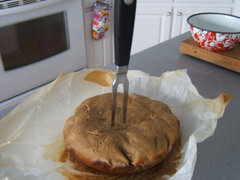
    So I went ahead and put the final ingredients in it to make loaves. I got that done about 7:00 a.m. this morning. It was supposed to be ready to form loaves in five hours. Not. And remember, I've been adding a certain amount of flour and water to it all along the way, so it should be having enough to eat. And it does seem to be alive - grows ever so slightly and changes into a very soft state that is lovely to handle. So I'm going to let it sit overnight and see what happens. The dough smells nice, not a real sour smell but not a normal yeasty smell, either. When I dropped a piece of it in water to see if it would float after 5 hours, it dropped to the bottom like a rock. I can tell it needs a lot more proofing. This is supposed to make 2 loaves of bread and it's not big enough to make a decent one loaf. If I did bake it now it would probably be very dense. I really wanted to try to do this without the help of adding yeast to it. That's the whole science project's purpose for me. We'll see. If I ever do successfully get a good loaf of bread out of it I probably won't be able to reproduce it since I've been fiddling with it now. If something good comes of it I'll take a photo and show you, if not don't hold your breath.

  • 7 years ago

    Another great source of your first sourdough starter is ordering it from King Arthur. It arrives wet and ready to use. Although you probably should feed it for a few days before you use it the first time.

    Buying known-good starter takes some of the stress out of learning how sourdough works.

    I find that generally speaking, sourdough bread dough is very forgiving. You can make all sorts of "mistakes", and they're all recoverable. Too much starter, too little starter, wrong hydration levels, forgot to develop gluten at the right time, forgot the whole thing on the counter because you had to run out of the house? None of those are fatal problems and you can still get wonderful bread.

    But you need the experience of being able to tell what (if anything) is wrong with the dough. And that's hard to teach. Just keep practicing. And keep breaking the rules. That's how you learn.

    User thanked M
  • 7 years ago

    Pillog, I think you are right, I might not get a rise on this at all. This morning I uncovered the dough and it hasn't seemed to have risen. There was a stiff crust on the top so I pulled that off and dumped it out on the counter see what it feels like. It's very pliable and stretchy and soft, but no lift. But when I stick my finger into it the indentation stays. So, I decided to put it on some parchment paper, set it into a round container and see if it lifts any at all. If it does, I'll do a dutch oven bake and we'll see what happens.

  • 7 years ago

    You can also "cheat" and add a small amount of yeast in addition to the sourdough starter. You still get the sourdough flavor, but a faster rise, especially if using the cold fermentation method. Peter Rhinehart's books recommend this for many of his recipes, but he also gives directions for the "purist" method - no added yeast. The differences aren't usually in quantity, they're in rise time. Purist dough needs to be kept at room temperature for a fairly long period of time to get going before refrigerating it for the rest of the rise.

    User thanked marymd7
  • 7 years ago

    This photo doesn't even call for the need to say that old saying. LOL!

  • 7 years ago

    You should have seen my first bread. I think my sourdough starter had all the wrong micro organisms. The "bread" looked more like Indian idli. And it tasted funny too.


    It only got better from there on. Took about a year of practicing to feel that I really had a good handle on how the dough behaves in different situations

    User thanked M
  • 7 years ago

    When you cover a dough to rest for hours on your counter, make sure it's air tight, with saran so it doesn't dry out....of course covered doesn't collect more wild yeast...but...
    All the levains I know are soft....mushy, like dough....pillog is the only one I ever heard say a levain is dry and crumbly
    Your starter didn't have enough "yeastey-beasteys" in it....either hadn't caught enough or they were still growing and maturing...I suspect both.
    The very definition of a sour dough starter is a starter that has "gone sour"....that gives off hootch and tests smaller than 7 on the Ph scale

    And I never heard of a sour dough starter that you make just before you make your bread.....unless you are calling yeast proofing in water and sugar a "starter".
    Try again....but give your starter at least a week....2 is better to mature, feeding and dumping regularly. Yo can use the waste in bread or pancakes, but will need to add yeast for a rise.

    User thanked lindac92
  • 7 years ago

    I'm not giving up but I'm going to try a different recipe. This expert baker that offered this recipe on Julia Child's program lives in California, maybe that is a perfect situation for his method, but not here in sultry, humid Florida. I'm sure we have completely different "bugs" floating around here. I've looked at a lot of videos about sourdough and most of them do a very wet starter, I'm going to try that next time. First I need to buy some more flour! And it's not like I've never baked bread, I do it frequently with good success with yeast. I just wanted to try it without it.

  • 7 years ago

    I think the problem is that you didn't actually allow your starter to grow to the stage where the natural yeasts (which are not floating around in the air but rather live in the flour itself) are starting to reproduce and create the gasses that make dough rise. Unless you start with a pre-established starter like Carl's Oregon Trail starter, this process can take a week or more with just flour and water. When I started mine, it took nearly two weeks before I got a bubbling, living starter. Using part or all rye flour can help in the early stages because rye flour seems to contain more yeasty beasties than your standard white flour. Once the starter is alive and active, you can begin feeding it white flour only if you prefer.


    Lots of great information to be found on starting, maintaining and using your own wild yeast starters here:

    https://www.sourdo.com/

    http://www.thefreshloaf.com/forums/general-discussion-and-recipe-exchange/sourdough-and-starters

    User thanked biondanonima (Zone 7a Hudson Valley)
  • 7 years ago

    And once I was able to get some organic rye flakes....used it to start a starter....and it got up and running fast...fed there after with white flour.

    User thanked lindac92
  • 7 years ago

    To be clear, I said a levain starter can be dry and crumbly after feeding before it sets awhile and fully hydrates. The actual levain you make with the levain starter is doughy rather than wet, but it should not be dry at all.

    User thanked plllog
  • 7 years ago

    All I can say is I followed this guy's recipe until the 2nd step proved something wasn't working like he said it should. So of course I started fiddling with it - probably should have left it be and do it's thing but that's hard to do when you don't have a clue. I'm not going to give up but it will be with a different recipe.

  • 7 years ago

    Most recipes that start with making a fresh starter use grapes or rye, take a few days to develop the starter, and make it pretty wet. However you do it, if the starter doesn't bubble and rise when you feed it, it's not ready. If it doesn't rise as starter, it's not going to raise bread. That's why most people develop a starter and keep it going (dormant in the fridge after it's well established, or dried and kept safe). The longer it matures, the stronger it'll be.

    Don't give up! It takes awhile to get it right.

  • 7 years ago

    To expand on plllog's point about starter being dry and crumbly after feeding, you can actually feed or maintain a starter at any hydration level you choose. At 100% hydration (1 part flour to 1 part water by weight NOT volume) it will be liquidy; at 50% hydration (2 parts flour to 1 part water) it will be a stiff dough. As long as you use enough water so that there are no dry bits of flour and you can manipulate the starter, there is nothing wrong with a lower or higher hydration (in my experience 50% hydration is the lowest I can go before it gets difficult to work). It's a matter of personal preference and your use/storage needs.

    I don't bake frequently and I am lazy about feeding my starter, so I want it to be able to live a long time in the fridge with no attention from me. Lower hydration keeps my starter fed longer than higher hydration in my experience. I also prefer not to have to adjust my ratios too much when I bake, so I try to keep my starter at approximately the same hydration as most of the breads/doughs I make, which vary between 65-75% (usually).

  • 7 years ago

    What's a levain starter....and how does that differ from a poolish or a biga?...Or sourdough starter for that matter? Aren't all starters basically a yeast repository? A bit of flour that feeds on yeast to inoculate a new batch of dough?


  • 7 years ago

    Sourdough or levain are usually terms used to refer to starters that contain only wild yeast, no commercial yeast. Poolish or biga are more accurately referred to as pre-ferments.

  • 7 years ago

    Adding to that, a levain is also a pre-ferment, the way I've heard it, but I know this in context from making/reading the recipes and bow to other wisdom if this is wrong. A levain starter is a piece of the levain that you keep for the next loaf. The trick is, if you're not using it right away (like in a week), it'll go dry feeling. As in dry and crumbly, though in an airtight jar it still has its hydration, but not on the surface anymore. You can feed it like you would any other starter. You dissolve it in its small portion of water, which takes awhile, then stir in the flour as best you can. In a couple of hours it'll be dough like the original levain, and won't feel so dry. Then, after it's been in the fridge awhile, it gets clay-like again.

    It's fine. I actually thought I'd killed mine with neglect when I was sick, but it popped up fine.

  • 7 years ago

    If youkeep your levain or biga or whatever in some water it won't dry out.


  • 7 years ago

    But the whole point of keeping a levain starter is to keep it at the right hydration. Starting with a wetter starter means doing all kinds of inside out math to get the hydration right. And, yes, one could just wing it, but I use it for recipes, rather than a regularly baked bread that I know by touch.

    The point wasn't the starter. The point was I was confirming to Ritaweeda that levains tend to be a lot drier than most.

  • 7 years ago

    I still have no idea what it is you are calling a levain.....and how it is different from a sour dough starter.
    And not really sure how you can use an exact recipe using a starter, because there are so many variables in levels of activity.
    Have you eve made a levain and used it to bake your bread? Have you used a sour dough starter?
    http://www.thejoykitchen.com/recipe/basic-levain

  • 7 years ago

    I didn't read through your link in detail, but it seems to be about how to catch a sourdough, not how to bake French breads using a levain.

    There is no difference in the yeast whether you call it sourdough or levain. Levain, in the recipes I have, is dryer. That's all. Less wet starter from which you make a preferment. I made my first levain by stepping down the hydration in my sourdough starter.

    Yes, of course, I bake with it, as I've said before. At great and gory length.

    My only point was to reassure the OP that the starter she thought was too dry was probably just what was expected in her recipe.

    I hope your questions are finally answered now that I've repeated myself several times. I will not engage in this anymore. This isn't productive.

  • 7 years ago

    Lindac92, this all boils down to semantics. Some people (including me) use the terms starter, sourdough and levain interchangeably, all to mean a pre-ferment containing wild yeast only. Unlike plllog, I do not define the words starter vs. levain based upon hydration level - to me they are one and the same. When I talk with other bakers about bread formulas, though, I use baker's percentages to be as specific as possible in case I am speaking to someone who differentiates between the two terms. I am just as likely to say "100g starter at 65% hydration" as I am "100g levain at 65% hydration," but even someone who doesn't use those two terms interchangeably will understand what I mean because the hydration level tells you everything you need to know.

    Personally, I maintain my starter/levain at about 65% hydration because it can survive a lot of benign neglect in the fridge at that hydration level. I change the hydration level as required when I pull it out to bake with it by feeding the portion I plan to use at the hydration level called for in my recipe. Most of the recipes you see for growing your own starter specify 100% hydration, but I think that is simply because it is so much easier to say "equal parts by weight flour and water" than to get into the complexities of baker's percentages. There is no reason whatsoever that starter/levain must be grown or maintained at 100% hydration.


  • 7 years ago
    last modified: 7 years ago

    I've copied the link to the video that I got this from in case anyone wants to see this thing - it's only 10 minutes long. In the video he calls it a "chef", but somewhere along the way it's called the "levain", maybe somewhere else online. Joe Ortiz Sourdough Starter


  • 7 years ago

    Did anyone read this website?

    https://www.thekitchn.com/what-the-difference-between-sourdough-starter-250218

    From that person's point of view a levain is just another name for a pre formenter I believe.

    Interesting discussion. I think I will jump on the sourdough starter bandwagon as well. Good luck to you!

  • 7 years ago

    I watched the video, and it looked wetter and had bubbles after the second ferment, 18 hours. But the first one was definitely drier.

    I've tried sourdough that I didn't like at all, too sour. And I've had some specifically at The Keg where they give you a loaf and it's absolutely delicious. I've tried finding their recipe online but without any success.

    Linda, I love the idea of keeping some dough and re-using it in a new loaf. Just regular, ordinary bread dough? I too, don't make bread as often as I did.

  • 7 years ago

    Blondaninoma....thanks....that's the point I was trying to elicit......a levain is simply a French word for what our pioneers and grandparents called sourdough starter....or just starter. Great grandma, when she was a bride didn't have a package of Red Star on her pantry shelf....nor did she have the corner A & P to go to for a wax paper wrapped loaf.
    If she made her own bread she had to have her own starter.....either in the form of a biga or a levain/sourdough starter. To try to differentiate between a sourdough starter and a levain is impossible......I am sure some make their sourdough starter with less water than others. It's a matter of semantics.
    sooooo....if I mix some of my levain with 2 cups of water and 2 cups of flour, cover loosely and allow to sit on the counter over night, does it them become a preferment? or a poolish? or just the beginning of some bread....;-)


  • 7 years ago

    Rita, that video was very interesting. I have never seen anyone use cumin and milk to create a starter! I would assume the cumin contains a desired strain of yeast, as does the milk. I am very surprised that it only took two days for his starter to come to life, though - that must also be a result of the milk and cumin. Plain flour starters take longer, even using rye flour. Anyway, I doubt that adding more water to his formula would negatively affect the bacterial action, so if you want to try again with something less dry, just add more water. The important thing is to wait until the starter rises/bubbles on its own, and that may take longer than two days (even with cumin!).

  • 7 years ago

    Lindac92, biga and poolish are actually different from wild yeast starters - both techniques were developed after the advent of commercial yeast as a way to add more fermented flavor to dough that might otherwise be bland due to the faster action of commercial yeast. I would not refer to a preferment using wild yeast a poolish or biga because by definition, these use commercial yeast. Furthermore, biga and poolish are separate from each other and not interchangeable terms - biga is by definition a low-hydration preferment, poolish is by definition a high-hydration preferment. I would still specify hydration level if I were making either for precision's sake, but most bakers have a good sense of what the typical hydration level is for both of them.

    https://en.wikipedia.org/wiki/Biga_(bread_baking)


  • 7 years ago
    last modified: 7 years ago

    Ritaweeda, I've watched the video. Did you use whole wheat flour? And if so, did you use factory or mill flour, or mill your own? Did you use the cumin? (That was very interesting. I've never heard of using cumin to catch the yeast. I've also never heard of adding milk for the lactobacillus. That'll come without it. The wild yeast and bacterium supposedly play well and thrive together.)

    This is an old fashioned way of doing it. There are easier ways that require less seat of the pants/art of the fingers.

    In order to get a start to finish bakeable levain in three feedings like that, you need not so "clean" food to start with. That means less pasteurization and other microorganism killing before you even get the foodstuffs.

    On the "walnut size" step, they didn't show every bit. First he worked the bits of the walnut into the water, then started pulling in dough from the ring bit by bit, then kneaded the dough and worked it over the last of the flour to fully incorporate it. It takes awhile. Doing this, you should oil and dry your hands before you start working so they don't soak up the water right out of the dough.

    In the video, he uses low to moderate hydration, but I don't know how you're supposed to follow what he does when he gives a measure then amends it by eye.


  • 7 years ago

    Yes I used whole wheat flour totally in the first step, but not organic or specialty milled, I used the King Arthur brand. I used it in every step that he said to use it and the amount that he said to use. Yes, I used the cumin and the milk and I hand-stirred it in like he did, then gradually added the flour, in each and every step. I tried to do it exactly as he did - in fact I watched it online and stopped it at every step and wrote down everything he said and did. But it wasn't good enough. And forget specially milled flour, it that's what it's going to take then I'll bypass sourdough bread. I just thought it would be so cool to be able to make my own bread from my own wild-caught yeast. I will give it another try but not his method.

  • 7 years ago

    Yes, his method is very specific and full of pitfalls. I never meant to imply that you didn't do it right. Only that it looks easier than it is because a lot of details aren't shown. The spoken directions could work, but it's easy to see how they could fail. I asked all of those questions to see if I could find a pitfall. It could just be the flour.

    So, re flour, it's much better to start with whole grains or the whole grain flakes Linda did or grapes with must than a factory milled flour. It'll be much easier to catch the yeast. I recommend whole rye berries from the bulk bin. They're just so easy! You can use them whole (but that's actually harder because you have to deal with the lumps) or grind/mill them or whirr them in the food processor. It's easiest if you have a scale, but you can do it by volume. You don't need to be to the gram. It's just flour and water as you said.

    Volume--use a cup of the rye and half a cup of water, stirred together and covered. A glass vessel is nice because you can see what's happening. Remember the water will flavor your bread, so use water that tastes good. just let the rye sit Once that's all bubbly, add some White Flour (unbleached is fine) and water--the same cup and half cup. That is, add the water first and stir until the starter dough is dissolved mostly, which makes it all a lot easier to handle, then add your flour (this order isn't necessary, just convenient).

    Mark the level on the outside with a piece of masking tape or a sharpie (alcohol removes it from glass). When it has risen to double or 8-12 hours have passed, pull out a cup and a half of the dough and discard the rest or put it in pancakes or something, and feed again. Always feed the same amount as the amount of dough you're keeping.

    Weight--same as above, but do equal weights of flour and water as opposed to the volume proportions.

    Keep discarding and feeding until your dough will reliably double in size within eight hours and hold its height for a couple of hours. Now it's ready to use.

    N.B.: Sometimes there's a die off of unwanted micro-organisms that ends up smelling fishy. It's normal. Just keep feeding and that'll go away in a day or two and it'll start smelling like bread dough.

    To use; Divide and feed your standard portion, put it in a jar, and right into the fridge. Feed the discard as you did the part you saved, with an equal total of flour and water to the amount of dough you have. Check your recipe for how much you need to make your preferment and keep feeding until you have that. You currently have "100% hydration". If the recipe requires something else you can adjust how much flour and water you feed with.

    Remember, longer ferment time with less starter means more sour taste. Shorter ferment with more starter means faster rise and less sour taste.

    If you want to bake with whole wheat flour, I'd still encourage you to use white flour for your starter until it's well established. It would help, as well, to use part white flour for the loaves. You can transition the starter to whole wheat in stages, with a larger and larger portion of WW, but don't do it all at once or you could shock your yeast and have to start feeding it several times a day again.

    For the first few months, at least, you should discard and feed your refrigerated starter at least once a week. Once it's good and happy, it can sit dormant for a long time. If it looks dark on top and smells boozy, it's just hungry. You can pour off the booze or stir it in (or drink it like the old farmwives used to do), and proceed with feeding. If it's very sad looking, discard the gray, and leave it out to warm up for a few feedings before putting it back in the fridge. It's not dead until it's warm and dead. :)

    It really is that easy.

  • 7 years ago

    I can understand Rita's pain. When I first started baking with sourdough, I bought what my grocery store labelled as dry sourdough starter. In hindsight, I am pretty sure I just got very expensively packaged flour. Without knowing what to expect, it took about two frustrating weeks of trying to carefully follow instructions. At some point I must have caught viable yeast and it started turning into a genuine starter. Nonetheless, my first loaf was ... odd. Again, in hindsight, it clearly wasn't a healthy starter just yet.

    Over time things got better and so did my bread making skills. I am pretty sure, if I repeated the experiment these days, I wouldn't have anywhere close to this much trouble, as I now know what a healthy starter looks like.

    For a beginner, I'd suggest that you either find somebody experienced to look over your shoulder, or to start with an existing starter. That's why I suggested using King Arthur's sourdough starter. It's already wet. Hard to mess that up.

    As with lots of cooking and baking, it's not actually difficult. But learning the skills takes time to practice. And while you are learning, it's frustrating if you make things more difficult than necessary. Start easy until you have a feel for how the culture handles, then you can make your own starter without all the pressure of having to succeed.

  • 7 years ago

    Agreed!

    I was determined to catch my wild yeast from wheatberries. The first time went moldy before it "caught". Then it did catch but feeding it whole wheat flour introduces a lot more micro-organisms for the yeast to battle. Plus, the whole grain doesn't have good "legs" so doesn't hold a rise well to begin with. I was determined to do it the hard way, and succeeded, but it was a tough go. I spent a lot of time crooning to my baby starter as some people do to their plants, urging it to eat well and rise.

    Whereas, my rye starter was very wet and didn't do well in long hibernation, and I just chucked it because it's so easy to catch a starter from whole grain rye. If I want another one, I'll either do that, or, more likely, transition some wheat starter to eating rye and more water.

  • 7 years ago

    I was interested to hear in Patrick Ryan's Irish bread video that in Ireland the "real bread" bakeries will give you starter. Kind of like the way people used to get barm from breweries, I guess.

    Anyway, I've always loved his idea for using a pyrex bowl for baking--dough in the lid, cover with the bottom to make a steam chamber:

    https://www.youtube.com/watch?v=2FVfJTGpXnU

Sponsored
Custom Home Works
Average rating: 4.6 out of 5 stars10 Reviews
Franklin County's Award-Winning Design, Build and Remodeling Expert