

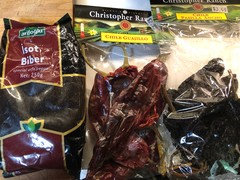
New (to me) chili ingredient
7 years ago
Featured Answer
Sort by:Oldest
Comments (15)
Related Discussions
Growing Thai Chili/Bird's Eye Chili Pepper indoor.
Comments (20)It's never a bad idea to answer questions 2 years late lol.... Because others will read the post and learn and it'll answer other peoples questions like mine. This is like a library, future chili growers will read this to learn how to grow hot peppers. This is my first winter with a chili pepper plant indoors. I had my plant planted in ground outdoors and it still had a bunch of peppers and some flowers on them, so I brought them inside and they peppers seem to be ripening. Some peppers have turned from green to red indoors . I'm using an 11W LED grow light. I also put a germinated Scotch bonnet seed and just transferred from paper towel to pot. Once it grows its first true leaves, I'll put the pot with my outdoor chili pepper and lemon trees which are all under the LED light and a medium window....See Moretrying new chili varieties this year .... can't eat the old 'hot
Comments (1)Vieja, you might want to check out the postings under hot pepper dangerous for you by gardenguy. The responses show the benefits of eating hot peppers. They are good for you....See MoreA NEW Record Hottest Chili Pepper?
Comments (24)I personally am not about to eat one of the superhots, yet I grow one or more of them every year. I've grown Douglah's, Scorpions, 7-pots, Bhut's, Red Savina, and 2 or 3 more. After a certain amount of heat, they are just too much for me. I love to make sauces and soups and such with them. 1/4 of a really hot pepper is enough to make a gallon of chili fireball hot. My personal favorite eating pepper is Chapeau de Frade which is decently hot and has superb flavor but won't send me to the hospital. The link above for crossing and segregation is Keith Mueller's website. The chart presumes you are making single seed selections and that all further crosspollination is prevented. You would grow one or more F1 plants and save seed. There is no selection at all from the F1 plants because you want the maximum amount of segregation in the offspring. Then you would grow the F2 plants and begin selecting based on plant and fruit traits and save seed ONLY from the plants that meet the desired traits. Then you would grow F3 plants and continue the selection process. The devil is in the details though, if you consider a single seed, then it will fit the chart above. But when you consider the entire population of plants grown out in a Filial generation, you could see every gene expressed that existed in the original cross. By the F7, if you have done the selection work properly and if you prevented further crossing, then you can have a highly homozygous line that breeds true for most if not all traits. The background mutation rate then becomes significant enough that it begins to influence the level of homozygousity. Typically, each new plant grown from seed will have 2 or 3 new mutations that were not present in the parent. The vast majority of these mutations are harmless and undetectable but once in a while one will show up that changes a significant plant trait. So the gist of this means that once you get to the F7, you are going to have about as stable a line as it is possible to achieve. Beyond that point, you are not going to achieve much because of the way the genetics work. That doesn't mean you stop growing them or that the breeding and selection work is done, it just means that the line is stable for all practical purposes. If you are a serious plant breeder, the F7 generation is where the really serious work begins. Grow out a large number of F7 plants. Then carefully go through each and every plant with a detailed list of traits that should be met. Rogue out all plants that do NOT meet the standard. Each generation thereafter has to do this same level of detailed selection to maintain the original line. From the above, for generations F1 to F7, you are figuring out which selections to INCLUDE in the population. Once you reach F7, you are figuring out what to EXCLUDE and therefore must be removed from the breeding line. DarJones...See MoreExploring New Ingredients
Comments (41)Much as I like to cook, I like to go out even more! We go for foods I won't cook at home, which saves money (no buying pkgs of this and bags of that of which I only need a little and rest goes unused), ensures portion control, and I never, ever have to spend time doing prep or washing dishes. Woohoo! Anyway, here are some of the more interesting dishes that have crossed our path in the last couple of months as we journey from restaurant to restaurant. Maybe some of you will find some inspiration for your own kitchens: Inexpensive ethnic: - A small Portuguese grocery store offered five different brands of linguiça (they have many more, but they rotate them according to availability and limited freezer space). We chose three to pan-fry and taste-test, two local Northern CA and one from Boston MA. Spouse is Portuguese-Chinese so linguiça is one of his Favorite Foods. The Boston brand was too smoky and had too much red wine vinegar in it to be eaten alone, but baked with cannellini beans was excellent. Locals win, which made us proud, LOL. - Tea-smoked salmon at a "this is California BBQ" place. Nice-sized filet, with gentle smoke flavors, not overcooked. A bright green cilantro sauce goes well with the fish. It's derived from a Barbara Tropp recipe in her long-ago China Moon restaurant/cookbook (still available on Amazon: http://www.amazon.com/China-Moon-Cookbook-Barbara-Tropp/). Tea smoking is a classic Chinese cooking technique, usually used on poultry. It's great with the salmon; even pleased my Spouse who is not a salmon lover. - Khashi Ko Masu, goat in a rich gravy which the menu describes as common in Nepalese households. We specified hot for the chile level. This Ko Masu curry showed how what is good home cooking can be as fine as anything at a four-star bistro. It had a complex and well-balanced spice mixture, richly flavored without being oily. We've had a lot of curries in our lives, but this ranked as one of the best gravies ever. A great bistro would drizzle this sauce over a few slices of lamb tenderloin and charge $30 a plate. This small friendly neighborhood Indio-Nepalese restaurant uses throwaway neck bones with almost as much meat on them, along with a full cup of gravy, for a bargain $8.99. - Thai coconut soup: Spouse chose chicken, with a heat level of "hot." Not the usual clear broth, but a creamy bisque-type soup. Flecked with chile flakes, full of juicy thin-sliced chicken breast strips and generous shavings of fresh young coconut, this was a phenomenal bargain at $3. The coconut cream was rich and thick, lightened up with not only lemongrass but kaffir lime leaves. We love Thai soups, and this was one of the tastiest versions ever. - In the SF Bay Area, KFC has a very different meaning for foodies. With our large Asian population, it means Korean Fried Chicken. Batter-fried wings are generously doused with a sweet, mildly hot gojuchang. At a new restaurant we tried, their version was tasty although not great. It's always been a one-dimensional dish, with nothing complex or subtle about it. Everything is in the execution, and this restaurant delivered a slightly better than average version. It wasn't quite our style preference; we prefer a lighter batter, juicier chicken, and less goopy sauce. But we're in the minority here; a great many people like hard-fried battered chicken with lots of goopy sauce. - Stewed tripe, Ethiopian style. Very tender strips in spiced butter and onions, but actually a little bland. We'd like to try it with a souped-up chile level, the way they make zigne, their stewed beef. Spicy stews with great injera, one of our favorite bargain loves. Upscale eateries: - Stopped by a local gourmet marketplace and chose a Prosciutto di Parma to taste-test against a Jambon Serrano. The winner was…both. We liked them equally well, especially in Spouse's beloved Croque Madame. Toasted ciabatta rolls with Swiss Gruyere, with gently fried eggs on top: the best breakfast sandwich ever. We also bought some merguez sausages, which are in the freezer so they'll get super-chile-hot! Perfect with eggs or creamy polenta, I haven't decided which to do yet. - Prickly pear crème brulee. Most fruit custards are unsuccessful creations; either watery and weak-flavored, or too thick and sweet. This was a well-executed balance of fruit and creamy custard, sweet but not overly so. A lovely rosy pink color, too. - Standard fritto misto of shrimp, green beans, artichoke hearts, shishito peppers, and fennel. It was the dip that made it outstanding: an "onion ash mayo". This was one of the few Scandinavian/Modernist touches we've enjoyed, a remarkable creation. It had great depth of flavor without any 'ashy' taste, or even a strong onion taste. It was just simply…yummy. All three diners wiped the dip ramekin clean! - A Southern version of minestrone: white bean soup with tasso ham, full of diced vegetables, sliced shiitake mushrooms and whole small white beans. The tasso ham was generously diced and gave the soup a gently spicy edge. Really lovely, well-balanced but not heavy. - Fried chicken which was fabulous (lightly battered, exquisitely juicy and flavorful) but even better were the Caribbean-style accompaniments: collard greens in spiced coconut cream, black-eyed peas, and spicy Ghanian peanut sauce. The peanut sauce was lightly spiced but not chile-hot, and when the coconut cream from the collard greens was mixed into it, this was a great combination. Many times peanut sauces are cloying in texture and taste; this was not. Some lightly pickled vegetables (cabbage, sweet green pepper slices and raw carrot slices) garnished the dish. Just that little hint of acidity livened up everything. - Duck paté salad, which wasn't a salad in the traditional sense. It was a long straight piped line of slightly foamed duck liver mousse, sectioned with three thin baguette toasts that were full of airy holes, toasted to the golden brown of Melba toast. Colorful segments of barely cooked kumquats were sprinkled over the plate. This was rich yet airy, visually stunning, and Spouse loved it. He said it was a perfect starter for a day that felt like summer. - Poached egg with caviar. The sous vide poached egg was on a bed of melted leeks. The caviar is sprinkled generously on top. On the side, in a napkin to keep them hot, were six fluffy blini, so good that Spouse kept urging me to request more blini so he could eat them himself! When you break the egg yolk, you get a wonderful soup of egg, leeks, butter and caviar to eat with the blini. A luscious, amazing dish. - Asparagus salad. White and green asparagus just-picked from the restaurant's garden, barely cooked. Tiny halves of hard-boiled quail eggs decorated the top, along with a scattering of pink rings of pickled pearl onions. Underneath was a housemade sauce gribiche. The asparagus was cooked but still crunchy, the eggs amazing with the gribiche. Traditionally another hard-boiled egg is sieved on top as a garnish, but the small size and delicate taste of the quail eggs made this unnecessary. Although the pickled onions weren't needed, they were surprisingly good with the asparagus by itself. It was a lovely, fresh, satisfying salad. - Fried calamari with apricots. The baby calamari rings had a light golden batter and were delicately tender. They came with a creamy vadouvan sauce, a judicious amount of finely diced barely-cooked carrots, and a few tart fresh apricot quarters. This was a wonderful combination of flavors and textures. Vadouvan is the French curry spice mix, and I suspect the name is often used on menus to coax reluctant diners into experiencing the flavor of curry mixtures as a seasoning, rather than just cheap Indian buffet food. Regardless of whether the mayonnaise was seasoned with true vadouvan or merely a mild fragrant curry, this dish turned out to be the winner of that evening's dinner. We literally fought over this one. ================ * One notable loser: Truffled chicken nuggets. Spouse was unable to resist seeing what an upscale McNuggets would be like. He received half-a-dozen two-inch neatly-cut cubes, with a crisp golden-brown crumb coating. Alas, they had an odd texture, as if the chicken breast had been cooked, shredded, and then recombined into the cubes. The black truffle flavoring on the chicken shreds was very heavy, almost overpoweringly so. It was an awkward pairing with the whole-grain creamy mustard sauce that underpinned the plate. Spouse ate it, but said he didn't really care for it and wouldn't order it again....See More 7 years ago
- 7 years ago
 7 years agolast modified: 7 years ago
 7 years agolast modified: 7 years ago
 PRO7 years ago
 7 years ago
- PRO7 years ago
 7 years ago
 7 years ago
- 7 years ago
- 7 years ago
- 7 years ago

Related Stories

EXTERIORSMini-Me Mailboxes Add Curb Appeal
The spitting image of their parents or merely sharing some genes, these mailboxes show that good design goes beyond the front door
Full Story
GARDENING GUIDESThe Surprising Ingredients Every Good Garden Should Have
See what to do — and not do — for lasting rewards in your landscape
Full Story
KITCHEN DESIGNKitchen Recipes: Secret Ingredients of 5 One-of-a-Kind Cooking Spaces
Learn what went into these cooks’ kitchens — and what comes out of them
Full Story
MOST POPULAR3 Top Ingredients of Modern Farmhouse Style
Want this popular look to have staying power in your home? Follow this recipe for a design that endures
Full Story
LIFE11 Ways to Cozy Up at Home in Chilly Weather
Feather your nest with extra layers and seasonal arrangements for coziness, comfort and entertainment
Full Story
KITCHEN DESIGNThe One Ingredient That Will Transform Your Kitchen or Bath
See how different applications of wood warm up these spaces
Full Story
BEFORE AND AFTERSA Chilly Massachusetts Bathroom Gets the Hotel-Spa Treatment
Luxurious details including a steam shower and radiant-heat flooring create a relaxing private master bathroom for a couple
Full Story
DECORATING 101The Key Ingredient Your Entry May Be Missing
The right mirror can reflect light, expand your space, bring in style and give you a chance for a last face check
Full Story
BEDROOMS5 Ingredients to a Romantic Bedroom
See how to use all the senses to create your most romantic sanctuary
Full Story
KITCHEN DESIGNNew This Week: Color Is a Key Ingredient in These 4 Kitchens
Vivid hues work with a range of textures and materials to deliver bright and character-rich designs
Full Story
sleevendog (5a NY 6aNYC NL CA)