

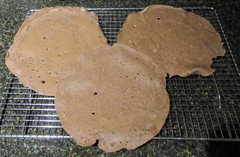
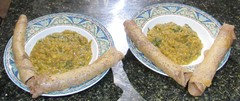
Injera bread from teff flour
7 years ago
last modified: 7 years ago
Featured Answer
Sort by:Oldest
Comments (14)
 7 years ago
 7 years ago
Related Discussions
Anyone grind their own flour?
Comments (17)christineny - Any standard enriched bread recipe will make burger/dog buns, so pick from any of your favorites. You really don't need a special recipe. I do have some tips I'll share that hopefully will make some sense. 1. If you happen to have muffin top pans (usually 6/pan and are very shallow, about 1/2-inch deep), they work great for helping to form a nice round burger/sandwich bun, but on a cookie sheet is just fine. There are pans designed for both hamburger and hot dog buns, but I've improvised and used what I already have. I also have a Pizza Piccolo Pan (12 shallow impressions - I got it from King Arthur) that I use to make small sandwich buns (1.5-2 oz. dough). I measure the dough 2-4 oz. for regular burger buns (depending on how large I need them). You can go larger if you like, just remember 1 oz. of bread is a serving, so you can have a lot of bread servings tied up in one bun - it's already at least 2-servings. After you form the dough ball, pat it to about 1/2-inch thick (oil your hands for easy handling of the dough). Cover and allow to rise per usual... 2. The amount of dough for hot dog buns is approximately the same size as the hot dogs you are going to use (also 2-4 oz.), rolled to approximately the same length and size as the hot dog you are using. I scale (weigh) the dough for hamburger buns and hot dog buns so that they are close to the same size when done. I bake hot dog buns two at a time in small loaf pans (3-1/4x5-3/4-inches). This is convienent for me because I can bake a couple if I have extra bread dough from making loaves, and we only use 2 at a time and these freeze nicely wrapped in a pop-up sheet of foil I get from Sam's Club. When the panned hot dog buns are done/cool, I pull the two apart and slice each one down the middle, but not quiet completely through. These are perfect for holding a hot dog that I butterfly open (one cut almost completely through) and grilled open. You can also place the hot dog size pieces of dough on a baking sheet to raise/bake individually. Another option is to place them in a pan for pull-apart hot dog buns - use a pan about 5-6 inches wide, which is the approximate length of most hot dog buns (disposable 8-1/4x5-1/4x1-inch foil pans work pretty good for 5 hot dog buns for regular hot dogs). I always keep individually wrapped burger/sandwich buns in the freezer. -Grainlady...See MoreIndian Flours in Baking
Comments (6)Having the ability to mill your own flours from a large variety of seeds/beans/grains is the BEST way to test and try all kinds of flours because you are assured getting fresh flour, and FRESH is ALWAYS best!!! I avoid commercial flours because any nutrients and oils have long since degraded from exposure to oxygen once the whole seed/bean/grain has been milled. You have NO idea of how long these commercially prepared flours have been warehoused and shelved.... If you study using gluten-free flours in general, you'll have better results with these non-wheat flours. You can usually find certain baking/cooking characteristics by looking at the group - bean group, seed group, etc. A quick search on the flour + recipes and you'll find recipes using most of these to give you an idea of how they work. -Using gluten-free flours in general, you nearly always need to use additional ingredients to reduce dryness, increase volume and tenderness, and enhance or mask flavor. -Jowar is another name for sorghum flour - a flour I've used in gluten-free recipes. A favorite cookie of ours is made with sorghum flour and Nutella. We have a GF sorghum flour mill just outside of town and I've developed cookie recipes for them. Sorghum flour tends to be gritty, so I often use it with a mixture of other textures, like oatmeal, unsweetened coconut in a fine shred, etc. You can also incorporate a "soaked flour" technique (as in sponging), to alter texture. Texture can change after freezing baked goods, oddly enough. -I tend to add 1/2 to 1 T. of corn starch to every cup of sorghum flour to improve smoothness and moisture retention. If there is a corn allergy to contend with, arrowroot flour can be used measure for measure where corn starch is used. -Guar Gum and xanthan gum are used as binding agents. You can add 1/2 t. xanthan gum per cup of flour for cookies and cakes; or 1 t. per cup for breads. -Additional fat or an extra egg yolk. This helps combat dryness and aids crumb structure. Egg whites are drying. -Extra chemical leavening (baking powder/baking soda) is often used for more "lift". -Some recipes will alter by how long you mix things, so extra mixing time may work better than less mixing time. -Rajgara (could be the same as your rajgaru) is amaranth flour. I harvested enough amaranth from 12 plants last year to last 5-years! I tend to use whole amaranth seeds like I would poppy seeds in quick breads, to increase protein, nutrition, and add a little crunchy texture, or as a breakfast cereal. Most of the amaranth consumed around the world is made into a gruel or thick soup flavored with fat or chilies. Amaranth seeds/flour needs to be cooked/baked, not consumed raw. If the seeds or flour is old, has been exposed to light or stored in a warm place, it will be bitter. I mill it in a seed mill (the seeds are too tiny to mill in a grain mill) and have several recipes where it's used as a portion of the flour in yeast breads to increase the nutrient profile. I wouldn't add any more than 10% amaranth flour. -"Dal" - is always some kind of bean or lentil. http://en.wikipedia.org/wiki/Dal I mill chana dal (immature garbanzo beans that look like split peas) into flour because they are low-glycemic and don't raise blood glucose. I use chana dal flour to make an "instant" hummus dip like I use milled pinto bean flour to make "instant" refried beans. "Urid dal flour" (or urad) is a black bean. I'll have to look through my Ayurvedic Cookbooks to see if any of those ingredients are used in food preparation. I'm sure they are, so that's another source for information. -Grainlady Here is a link that might be useful: Cook's Thesaurus - nonwheat flours...See MoreWhat do I need to know about WHITE whole wheat flour?
Comments (26)Kari & Clare - Kari - My sources for wheat: 1. locally grown hard winter red and white wheat (free or very cheap, but usually NOT chemical-free or organic) 2. Heartland Mill, Marienthal, KS - organic grains 3. Bob's Red Mill - soft white wheat (and other grains) 4. Wal-Mart - Hard Spring White Wheat - Prairie Gold (from Wheat Montana - chemical-free) - they also carry hard red wheat Bronze Chief. Wal-Mart has only recently started carrying Wheat Montana wheat around here - $5 for 25-pounds. Mills: 1. (A very old) Whisper Mill - which is an electric impact mill (now known as a Wonder Mill) - this mills most grains/seeds/beans into a very fine flour - fine flour = fine bread, coarse flour = coarse bread. 2. Marga Mulino Flaker Mill - for cracked grain, flakes, and coarse farina (for cooked cereal) 3. Corona Corn Mill - for coarsely milled grain and corn meal. 4. Porkert Seed Grinder - for small seeds, such as amaranth, poppy seeds, teff, etc. 5. Bosch Coffee/Spice - for milling flaxmeal. 6. Family Grain Mill - a hand mill, that also has an electric-powered motor to run it as well, that has a lot of attachments available for other uses (meat grinders, flakers, etc.). This is my back-up mill. You have to mill the flour twice to get a reasonably fine grind of flour. Source for recipes: I suggest you start by substituting unbleached/bleached flour in your favorite recipes with a portion of wholegrain flour. There are all kinds of books out there on whole wheat baking. I have a collection of 28 beans, seeds, and grains that I use milled and whole - included in that, several types of wheat. I develop many of my own recipes because I use really "odd" ingredients, including gluten-free baking. Here's a few books I like from the large selection in my library: RECIPES FROM THE OLD MILL (Baking with Whole Grains) by Sarah E. Myers and Mary Beth Lind WHOLE WHEAT COOKERY (Treasures from the Wheat Bin) by Howard and Anna Ruth Beck THE AMAZING WHEAT BOOK by LeArta Moulton THE SPLENDID GRAIN (all kinds of seeds and grains) by Rebecca Wood WHEAT COOKIN' MADE EASY by Pam Crockett --------------- Clare - Wheat comes in HARD (strong/high-gluten) and SOFT (weak/low-gluten) varieties. Whole Wheat Pastry Flour is milled from (low-gluten) soft red wheat, just like you thought. It's best used just as you described - in baked goods where you don't want a lot of gluten development - for the most part, anything other than yeast breads. Low-gluten bleached flour would include White Lily and Martha White - which are great for quick breads, pastry, etc. I purchase soft white wheat berries from Bob's Red Mill to mill into whole wheat pastry flour. I also use freshly-milled spelt and some rye, barley, and triticale for baked goods that need low-gluten flour, as an alternative to soft wheat flour. All wheat has a protein level that determins if the grain is hard or soft. Even in the same field you'll find protein (gluten) level differences from one side of the field to the other. If a portion of the field is shaded(usually at the edge of the field) and/or there's a low place in the field that retains water after a rain, the wheat that receives a lot of water/shade will usually have a low-protein count. Even though hard wheat may have been planted, the protein level is also determined by the amount of rainfall, and other factors. Soft wheats are characteristicly plump (a lot of endosperm), while hard wheat varieties (especially winter wheat) is small, wrinkled, and very hard when you bite it. When soft whole wheat is milled, the flour is exactly that - very soft to the touch. Hard whole wheat is much 'grittier' - due to the higher percentage of bran to endosperm ratio. All bleached/unbleached flour is milled from a combination of wheat protein levels to formulate the amount of protein for the type of flour needed. High-protein wheat is used for yeast breads, a combination of hard and soft wheat is milled for all-purpose flour, and pastry flour is milled from soft wheat. There are also fields of extremely high protein wheats (15% or more), but they are mixed with lower protein wheat to make flour. I've used some wheat that was 16% protein, and it took forever (lots of kneading and a very long fermentation) to develop the gluten in bread - 12-13% protein level is much better for yeast bread. Too much gluten will make a tough loaf of bread. The highest protein level wheat is durum wheat. Unlike hard red and white wheat varieties which are used for yeast breads, durum wheat is used in pasta. I mill durum for whole wheat pasta - NOT red or white varieties of wheat. Commercial whole wheat pasta is made with wholegrain durum wheat. The elements in wheat protein that we call "gluten" are actually a gluten group - GLUTENINS and GLIADINS. Glutenins provide the elasticity quality that allows bread dough to expand. Gliadins contribute to the viscosity and extensibility of bread dough. Red and white wheat varieties have a dominance of GLUTENINS and less GLIADINS. Durum wheat has a dominance of GLIADINS and less GLUTENINS. Therefore, even though durum wheat has a high protein level, it's unsuited for bread making, due to the type of protein. -Grainlady...See MoreNaan Bread
Comments (21)I, too, use a yougurt based dough. Eggs and sugar are more of a hallmark of western baking. They bake up lovely in my iron skillet on top of the stove. Most flatbreads will puff up on a hot skillet, even tortillas. It takes a village, literally. Like many other old bread traditions, the bread is made by bakers in a community and not everyone has their own ovens at home. Rather, it is purchased from vendors who keep the ovens going. it takes lot to heat up a clay oven. It is not something that is as causual as heating up to bake a cake. I have read that, in some communal settings, that there would be a communal oven fired up and all would bring their bread to bake it in the oven. They would prepare their own bread at home and bring it to the common oven. My husbands Italian grandmother used to do this, in her New Jersey Italian community. They lived in tiny apartments and having an oven for bread was not something that everyone had at home. Just as she had learned to do growing up in Italy, she id the same when she immigrated. She took her risen bread to the baker to bake for her, right there in Hoboken. Many still dont have the facilities to bake. That is what bakers are for. Sure that much of that has changed in our modern world . Too bad that we dont have good bread bakeries here in the US. If you do have a local bread baker, count yourself as among the lucky. They are far and few between, for sure. Naan was brought to the east by the Persians and the word is derived from the language of Persia. Given its origins, it is no wonder that it is a bread traditionally made with cultured products, and is a very basic old world bread using grains and oils. Ingredients such as sugar and eggs are not typical of that part of the world, the middle east. and the grain was likely to be some whole grain of some manner and not white flour. Not that you cant bake a rich egg bread in the same manner as you would a naan. But, old world flatbreads are a different kind of thing from the Western influenced breads and tend to be real basic. Reviewing a host of recipies for naan does give some that call for egg and a bit of sugar. Things do change, but it was originally a basic bread with grain and some oil and could also be used to serve and eat with, like a tortilla or pita bread. i bought some of that naan from Costco once, on a whim, and I did not iike it. It was sweet! Sweet has come to dominate much of what we buy, so I am not surprised. If it suits your taste, do it. It is your darned dinner and it matters to no one else but you. Not my preference, but it is not my dinner. In much of Europe bread is baked in loafs and not as quick baking flat breads like this. Especailly northern Europe, it is likely that one might have a warm hearth and some type of enclosed oven of some sort to bake the loaf, even a Dutch oven. But, in hot and sparse climates there is less need for heat and you are more likely to be baking something small on a hot rock of some manner. I also make a pita bread in the skillet. Pita and naan are very much alike, just different incarnations of grain, something to leaven it with, and some oil to dress it and something good to wrap it around or dunk it in. I have even baked potato bread as a flatbread in a skillet. Yougurt or buttermilk gives a nice texture and taste to bread, even that baked in a loaf. Lars, I saw your pizza oven video. Did you ever get it not burn up your pizza? I have a friend, an engineer, who built a brick oven out in his yard. It takes a while to get it going so you want to have enough to bake in it once you get it going. They have found that it is good for roasting a large hunk of meat in but have not had as much success with baking dough in it. He also has a satellite in his yard that he built . He is an electrical engineer who has built systems for NASA, a rocket scientist, if you will, so why would he not build a satellite for his yard? and a brick oven? He builds and she is a gifted cook who takes well deserved pride in her cooking skills. If any couple of folks ever needed both a satellite and an brick oven, it is these two....See More 7 years ago
 PRO7 years ago
 7 years ago
- PRO7 years agolast modified: 7 years ago
 7 years ago
- 7 years agolast modified: 7 years ago
- 7 years ago
- 7 years ago
- 7 years agolast modified: 7 years ago
- 7 years ago

Related Stories
KITCHEN APPLIANCESConsidering a New Kitchen Gadget? Read This First
Save money, time and space by learning to separate the helpers from the hassles
Full Story
LIFESimple Pleasures: The Joy of Baking
Fill your house with a heavenly scent and your heart with cheer by making time to bake
Full Story


annie1992