

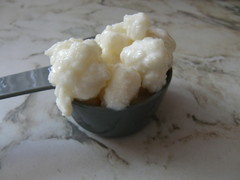
Anyone making milk Kefir?
8 years ago
Featured Answer
Sort by:Oldest
Comments (13)
 8 years ago
 8 years agolast modified: 8 years ago
Related Discussions
Kefir or Yogurt For Early Blight?
Comments (4)I sprayed with neem, but I read some posts saying neem isn't all that effective in the later stages of blight. It's not. Neem really isn't a fungicide. It's use as a fungicide is primarily due to it's being an oil. Horticultural oils can 'seal up' attachment sites making it more difficult for fungal spores to attach and infect and they can also smother existing spores so they can't develop. As such neem and all oil products are best used as a preventative rather than a cure. Now, is it that milk encourages fungus that curtails blight, or is it that it encourages bacteria, specifically lacto bacteria, which does the same? Some of the questions you are asking go beyond my knowledge so I won't comment/speculate and risk leading you astray on those, but will speak more generally. There are competing theories as to why milk seems effective against some fungal diseases on some plants. To the best of my knowledge it was first found effective against powdery mildew on grapes, but was subsequently tested against powdery mildew on some other plants and found ineffective or inconsistently effective. It has also had some testing for other fungal pathogens with mixed results. Corn meal is another means of controlling fungal pathogens. In this case it is suspected that corn meal, for whatever reason, attracts/feeds trichoderma fungi which are mycoparasitic and kill *some* other fungi. There are even commercial strains of lab bred trichoderma (T22 aka root shield is one). However, results are inconsistent. That's the primary problem when biological controls or substances meant to attract biological controls are employed. The biologicals require fairly narrow environmental parameters to work effectively and there is no way to guarantee nature provides them when/where needed....See MoreKefir making anyone?
Comments (8)You will find the most helpful and complete information at Dom's Kefir In-site (link below). I've been making kefir for many years and use it on a daily basis in our morning smoothie, as a substitute for buttermilk, drained and used instead of plain yogurt, sour cream and cream cheese, so it's versatile. I'll be happy to answer any questions I can. It is a healthier choice than yogurt, plus it's much easier to make than yogurt. I use the whey for many things as well, including soaking grains, for lacto-fermentation, as a refreshing drink in the summer (whey lemonade).... Along with introducing kefir and possibly other fermented (pre-digested) foods to your diet (I agree with arley about "The Art of Fermentation" by Sandor Katz), you may also want to read "Wheat Belly" by William Davis, M.D. When it was mentioned here several times I checked it out from the library and it was a real eye opener. Especially for a person who goes by the name "grainlady". You can also find clips on YouTube to give you a general idea. It's really simple to make kefir once you get started. Just keep everything clean. Scald the jars you ferment in with boiling water, as well as any spoon/strainer used to remove the grains. I have a slotted spoon I use to "fish" the grains out of the kefir. They float to the top when the milk begins to ferment, and that's how you'll know it's working. I also give the jar a swirl a few times during fermentation to keep everything well mixed, but it's not completely necessary. I never wash my grains, but you occasionally find that information. I plop them into a cup of milk in a pint jar and refrigerate it between use. I leave the pint jar at room temperature (after I take the grains out and place them in the quart jar) and there is generally more than enough good bacteria in the milk to make curds and whey, so don't waste it. The cooler the temperature, the longer it will take to ferment, but the kefir will also be smoother and less tangy. I generally ferment 2-1/2 c. milk at a time (I use powdered milk - Grandma's Country Cream non-fat dry instant - because that's what I store and use). Occasionally I'll get raw goat's milk and I'll ferment it, or if there is some heavy cream or half-and-half available, I'll add a little to the powdered milk for a richer/thicker curd. I also ferment reconstituted powdered coconut milk (Wilderness Family) and that is one of my favorites. The grains won't grow in coconut milk, so I make sure I put them back into milk for storage and will use them in milk a few times before using a portion of my grains in coconut milk. If I have an abundance of grains I will ferment some grape juice just for something different. Good luck.... -Grainlady Here is a link that might be useful: Dom's Kefir Insite...See MoreRecent posts regarding Kefir enticed me
Comments (3)Congratulations, and welcome to the world of kefir!!! The kind of milk you use is up to you. The grains I received were from a gal who's family ran a large dairy in Eastern Kansas, so they were grains that had only been used in raw milk. Since I do home food storage (I haven't purchased liquid commercial milk from a grocery store since 1981), I use reconstituted powdered milk - and have all the years I've made kefir (over a decade). No transition period.... Occasionally I'll have some 1/2 & 1/2 or whipping cream on hand and I'll add a little of it to the milk for a richer/thicker curd. I can also get a thicker curd by using more milk powder, but I think the grains "like" the additional fat provided by the 1/2 & 1/2 and whipping cream occasionally. I also use reconstituted powdered coconut milk for coconut kefir (you can also used canned coconut milk or make your own with unsweetened coconut and water - blended and strained). Occasionally when I get extra grains I'll make a batch or two with cider or 100% grape juice - but the grains don't thrive more than a few non-milk batches. I've also made it with raw goats milk, but not very often. It's not budget-friendly. Kefir can have a cleansing effect and your body will let you know how much is "enough", or too much. We only consume 2 servings of dairy each day, and the morning kefir counts as one of them. I use it in a smoothie-type mixture every morning. I also use it as a substitute for buttermilk in cooking/baking. Drain the curd and it's my substitute for plain yogurt, cream cheese, and sour cream - as needed. Where you will notice a difference in taste is when the temperature fluctuates. I personally prefer the more mild-tasting kefir fermented in cool winter temperatures (ambient temperature in our kitchen doesn't usually get above 64-degrees F in the winter), compared to the more sour/tart kefir made when the temperature is much warmer, but I use it all year and make it about every 4-5 days. It your kefir gets "gritty", that means the temperature is too warm for fermenting. The warmer the temperature, the faster it ferments. Sometimes in as little as 9-12-hours. My favorite is coconut milk kefir, but I only make it once a month, or so. It makes a nice add-in to orange or pineapple/orange juice, or used in desserts, and great topped with granola for breakfast or a snack. -Grainlady...See MoreGoat milk kefir, need help
Comments (4)I've used all kinds of milk products (powdered whole milk, powdered non-fat dry milk, whey-based milk substitute, raw goat milk, homogenized goat milk, homogenized cow milk, low-fat, 2%, whole....) for making kefir. I've been making kefir for around 7-years. I have some fermenting on my kitchen counter as I type, and made 2-cups of it yesterday. What I find is that the lower the fat, the more whey you get, instead of curd. But whey is good too. I use the whey for making whey lemonade, which is one of the most refreshing drinks when it's hot outside. I'm on the fence when it comes to homogenized and raw milk products - even though I'm a big fan of "Nourishing Traditions". I think getting the beneficial bacteria from kefir outweighs WHAT you make it in. I didn't have a problem with raw goat milk, other than I was afraid I'd contract some horrible bacteria from the family's filthy kitchen than I was about using raw dairy products. The "odd" taste must be what they are feeding the goats. To make kefir easy-to-swallow, which even my picky hubby likes, we use it as a morning smoothie. I use a Hamilton Beach Malt-Maker for mixing. The stainless steel cup for the malt-maker has 3 markings on the side. I put kefir up to the first mark (2/3-cup), 100% fruit juice of choice (grape, orange, pomegranate/blueberry is a favorite....and the strong flavor of it would probably mask any "farm" flavor of the goat milk), to the top mark (about 1-1/3-cup - so a 1:2 ratio (or to taste). We also add flaxmeal and a supplement powder, and give it a whirr... If that doesn't work, how about making water kefir - which takes different kefir grains than dairy kefir? Or fermenting fruit juice with the kefir grains? How about taking the drained kefir cheese and adding strong flavors (spices, onion, horseradish) and making a vegetable dip out of it. Mix kefir cheese with guacamole.... Go to Dom's Kefir Insite for more information. -Grainlady Here is a link that might be useful: Fermented Treasures...See More 8 years agolast modified: 8 years ago
- 8 years ago
- 8 years agolast modified: 8 years ago
- 8 years agolast modified: 8 years ago
- 8 years ago
- 8 years ago
- 8 years ago
- 8 years ago
- 8 years ago
- 8 years ago

Related Stories

MUDROOMSThe Cure for Houzz Envy: Mudroom Touches Anyone Can Do
Make a utilitarian mudroom snazzier and better organized with these cheap and easy ideas
Full Story
SMALL HOMESHouzz Tour: A Studio Makes the Most of Every Inch
Thoughtful design transforms a neglected London flat into a stylish multitasking home
Full Story
LIFEHow Do You Make Your Tea and Coffee in the Morning?
A morning cup is a must for many, and preparation comes in many guises. We look at coffee and tea habits across the Houzz community
Full Story
HOME TECHMake Home Sweet Home Even Sweeter With a Brewery Or Winery
New high-tech products make small-scale home beer and wine production easy and fun
Full Story
ENTERTAININGGot Hand-Me-Down Dinnerware? Make a Memorable Meal
They might be mismatched and not your style, but those inherited plates and forks can help bring meaning to your table
Full Story
PAINTINGWhat to Know About Milk Paint and Chalk Paint — and How to Use Them
Learn the pros, cons, cost and more for these two easy-to-use paints that are great for giving furniture a vintage look
Full Story
GREAT HOME PROJECTSHow to Make Your Garage a Storage Powerhouse
New project for a new year: Add shelving and containers to get your stuff off the garage floor — and still have room for the car
Full Story
BATHROOM DESIGNThe Cure for Houzz Envy: Bathroom Touches Anyone Can Do
Take your bath from blah to ‘ahhhh’ with just a few easy and inexpensive moves
Full Story
HOME TECHWhy Google Just Paid $3.2 Billion for a Company That Makes Thermostats
Smart home technology just got a new champion — and everyone is speculating about the reasons
Full Story
VACATION HOMESMake Your Vacation Home Pay Off
Renting your vacation house when you're not using it makes good financial sense. These tips can help
Full Story
dandyrandylouOriginal Author