

Arguments Pro/Con CCRC's
9 years ago
last modified: 9 years ago
Featured Answer
Sort by:Oldest
Comments (17)
 9 years ago
 9 years agolast modified: 9 years ago
Related Discussions
Trim off lower branches on Pine Trees? Pros and Cons?
Comments (39)I just feel like it drags on the ground and needs some space under. ??? ==>> actually ... given a big enough garden.. many conifer collectors specifically collect trees the 'skirt' ... that is.. grow to the ground and spread out ... but then.. i have 5 acres ... and space for such ... besides... once you lift the canopy.. you have to weed and mulch in the bare ground you created .. all that said ... its your plants.. do whatever you want with them .. make yourself happy ... and who cares what the rest of us say .. or think ... ken btw:.. a horticulturist walks into a bar and sees a biologist .. and says to himself.. who cares ..lol ... and his friend says.. but hes a professor ... and the horticulturist says... so what ... well this is an epic fail...lol: https://duckduckgo.com/?t=ffnt&q=conifer+skirts&iax=images&ia=images somewhat better: https://duckduckgo.com/?q=pendulous+conifer+that+grow+to+the+ground+and+create+skirts&t=ffnt&iar=images&iax=images&ia=images do whatever you want to your trees ... ken...See MoreEdenPure Gen3 pros and cons anyone?
Comments (34)Cayveman, I finally checked back on this thread. It's about thermodynamics and the conservation of energy, so in easy to understand terms when you have energy input (like the voltage and amps going to the heater) and what comes out has to be the same because the energy can't magically increase or be destroyed. It's simpler with electric resistance heaters because inefficiencies that we normally see in motors, pumps, etc. manifest themselves as heat which in this case we want. So the energy (kwh) can be directly converted to Btu's (Btu = Btu/hr average x number of hrs on). The reason I say Btu/hr average is that the heaters thermostat turns the heating element on and off. As for the heat lamp vs a std lamp, if they both draw 100 watts of power, they have the same heat output in Btus to a space. The std lamp would have a higher lumens (measurement of light) per watt but even the light after being absorbed and reflected by surfaces converts to heat. So there is ultimately no difference in the heat added to a room. Other items in your home such as TV's, dishwashers, etc. are not 100% efficient at doing the intended task, but all the input power in them as well converts into heat. So a dishwasher or refrigerator running helps heat your house as well as a portable heater in the winter but adds to the air conditioning load in the summer. Calculating the heat output is easy because all of the inefficiency of the motors and circuits in your appliances result in heat. That is not the case with your electric water heater because much of the heat is dumped down the drain with your bathwater and only a part of the heat stays in your home. Lastly concerning heating of air or water, the equation is the same for sensible heating or cooling (w/o removing moisture like an Air Cond. in the summer). What I think everyone is interested in is heating the space so a thermostat will show a higher temperature in the room. There is radiant heating used in non heated spaces where people have to stand in a line of site of the heater to feel the heat but that is like standing in front of a fireplace to keep warm. The equation for heating air or water is: Btu = mass x heat capacity x Temperature difference The difference is that water has a spec. wt. of about 62.4 pounds per cubic ft (Varies with temperature and can be found on the web.) Air is only about 0.075 pounds per cubic foot. (Varies with temperature and can be found on the web.) Also the heat capacity of water is 1.0 Btu/pound - deg F while that for air is 0.24 Btu/pound - deg F. Example: Small bathroom 5 ft x 9 ft with 8 ft ceilings at 40 degrees F. We want to heat to 80 deg F using a portable electric heater having an input of 1500 watts ( 5,119.5 Btu/hr input = output). Volume = 6 x 9 x 8 = 432 cubic ft Mass = 432 cubic ft x 0.075 pounds/cubic ft = 32.4 pounds Specific Heat of air = .24 Btu required = 32.4 pounds x 0.24 Btu/pound - deg F x (80 - 40) deg F = 311 Btu kWh= 311 Btu x 1 kWh / 3413 Btu = 0.091 kwh Time required to heat the room = 311 Btu x 1 hr / 5119.5 Btu = 0.0608 hr = 3.64 minutes You would actually take more than 3.64 minutes because you would be heating all the fixtures, walls, and if not insulated well other adjacent rooms. I asked my mailman if I could borrow one of his edenpure heaters for a test just to compare what Im describing above, the heating of a small bathroom with two types of heaters just for fun. I have the equipment to measure input energy and the air temperatures would have to be measured in several areas in the room every 30 seconds or so and recorded. There wont be a difference because its impossible but it might be interesting to post the test results. Could be done in the summer but you would have to heat the room to 100 deg F to get good results and preferably before the sun comes up (to eliminate another factor) and at about the same outdoor air temperature. What goes in has to be what comes out. It cant disappear or get larger. Not talking about heat pumps or air conditioners right now as that is a more complex subject and those units have COPs and EERs associated with them where the heat addition to a space is higher than the compressor energy used. They still dont violate the laws of thermodynamics about the creation or destruction of energy. Again this isnt saying everything is 100% efficient. Its just electrical appliances, heaters which wont have 100% efficient motors but the inefficiencies manifest themselves as heat. I used to sell pumps as a sales engineer and our pump curves would show the pump efficiencies which would vary depending on rpm, flow rate, and pressure. What this meant was that the motor and pump when combined might only be 75% efficient and was determined by tests performed by the pump and motor manufacturers that were shown on graphs that engineers used. The efficiency the manufacturer stated was based on the actual power required to pump a given flow and pressure compared to the theoretical power required (based on another engineering formula). All the electric power (watts) into the motor ends up as heat while moving the water. Pumping the water even heats it up slightly. Hope this clarifies things and I havent been too long winded. Even if its stored by being absorbed by a piece of copper it eventually is released into the air. It has to be the same as what's input. The same is true of a 100 watt light bulb no matter what type it is, although a heat lamp having larger diameter wire inside its bulb outputs a smaller percentage of light and more heat...See MoreInduction vs. Gas Cooking pros and cons
Comments (57)Back to the poster’s original question, if you are considering induction, buy a portable induction unit (less than $100) and see for yourself what you think. You can also test cookware and cookware noise. Even the “wimpy” portable units that plug into 110 volt outlet are surprisingly powerful. I bought a portable unit as a stop gap while waiting for our cooktop to be repaired. Now that it’s repaired I still use the portable unit instead of the built in electric. i was set on a gas range for an upcoming remodel, but now I want induction. As far as noise from cookware, Viking pots make noise on our portable induction cooktop. I have never had any noise from fissler pans or ikea sensuell pots and pans, even on high. I use the latter a lot. The IKEA sensuell cookware is as good as fissler but at 20% of the price (best kept cookware secret). Cooks evenly, holes heat, doesn’t warp, food doesn’t stick, easy to clean .......See MorePros and Cons of purchasing a black granite composite sink!
Comments (82)We put a charcoal gray (anthracite) Blanco Silgranit sink into our last home (about 12 years ago) and after a few years of use, we were less than pleased with its performance, especially for the price tag. At first, it was amazing and we loved how it looked! Over the years, we used it for everything - normal kitchen/dish washing use but also occasionally to wash out paint brushes, soaking clothes, even washing show chickens in it. (No utility room sink, so the kitchen sink was the go to spot.) We kept it clean and well cared for. We believed all the hype back then that Blanco sinks were impervious to just about everything and I guess we should have been more careful. It basically started looking blotchy and losing its color on the bottom. It then started pitting on the bottom and was no longer a smooth surface, especially around the drain. And the blotchiness wasn't really stains but rather "burns", according to what we had read online. By the time we were ready to sell the house, it was pretty unsightly and we had to replace it. (Due to the less than helpful Blanco customer service folks who refused to honor any sort of warranty, we went with a Kraus sink.) But we only had the Kraus sink for a few months before moving, so not sure how that one will hold up. So now I'm trying to decide what to do with our new (but 15 year old home). I like how durable stainless sinks are and how cost effective they are but since spots and smudges on the stainless steel appliances drive me crazy and I'm CONTSTANTLY wiping them off, adding one more stainless item to care for in this kitchen doesn't seem like a wise decision. Anyway, thought I would add my 2 cents. I still can't decide if I want to do another composite sink (but do a more reasonably priced manufacturer like Kraus) or go with something else. If I do composite again, I will definitely go with a darker color and be super diligent about ONLY soap and water going into the sink....See More- 9 years ago
 9 years ago
- 9 years ago
- 9 years ago
- 9 years ago
- 9 years ago
- 9 years ago
- 9 years ago
- 9 years ago
- 9 years ago
- 9 years ago
- 9 years ago
 9 years ago
- 9 years agolast modified: 9 years ago
Related Stories
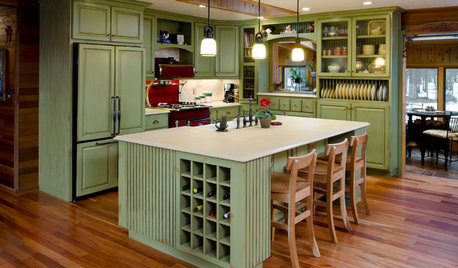
MOST POPULARHow to Reface Your Old Kitchen Cabinets
Find out what’s involved in updating your cabinets by refinishing or replacing doors and drawers
Full Story
LANDSCAPE DESIGN5 Reasons to Consider a Landscape Design-Build Firm for Your Project
Hiring one company to do both design and construction can simplify the process. Here are pros and cons for deciding if it's right for you
Full Story
DECKSDecking Materials Beyond Basic Lumber
Learn about softwoods, tropical hardwoods, composites and more for decks, including pros, cons and costs
Full Story
FARM YOUR YARDHow to Build a Raised Bed for Your Veggies and Plants
Whether you’re farming your parking strip or beautifying your backyard, a planting box you make yourself can come in mighty handy
Full Story
GREAT HOME PROJECTS25 Great Home Projects and What They Cost
Get the closet of your dreams, add a secret doorway and more. Learn the ins and outs of projects that will make your home better
Full Story
GREEN BUILDINGInsulation Basics: Heat, R-Value and the Building Envelope
Learn how heat moves through a home and the materials that can stop it, to make sure your insulation is as effective as you think
Full Story
BASEMENTSDesign Workshop: Is It Time to Let Basements Become Extinct?
Costly and often unnecessary, basements may become obsolete — if they aren’t already. Here are responses to every reason to keep them around
Full Story
HOME TECHThe Inevitable Future of Drones Around Your Home
As Google joins the push for airborne deliveries, it seems only a matter of time before neighborhoods are buzzing with drones. Is that OK?
Full Story
KITCHEN DESIGNKitchen Counters: Durable, Easy-Clean Soapstone
Give bacteria the boot and say sayonara to stains with this long-lasting material that's a great choice for kitchen and bath countertops
Full Story
REMODELING GUIDES11 Reasons to Love Wall-to-Wall Carpeting Again
Is it time to kick the hard stuff? Your feet, wallet and downstairs neighbors may be nodding
Full Story

Rosie