Houzz Logo Print
hzdeleted_19722038

Inquiring Mind...

9 years ago

Why is it that when we are making egg salad, tuna salad, etc. that the shells slip off the eggs so nice and clean yet when we are making something that we want to look pretty like deviled eggs the shells stick so bad that we are made to feel ashamed??

Comments (50)

  • 9 years ago

    That always happens to me! I hate it. Especially when I'm making them for someone.... I just try to make the filling look pretty. Then, about a year ago, I found this method for perfect hard boiled eggs. This is how I like to make hard boiled eggs so the peel comes right off when making deviled eggs:

    1. Add eggs to a saucepan. Cover with COLD water.

    2. Bring to a boil. Add 1 tablespoon vinegar or apple cider vinegar and 1 teaspoon salt. reduce to a simmer, cover, and cook for 12-14 minutes. Drain, cover with cold water. Peel eggs in a bowl of water.

  • 9 years ago

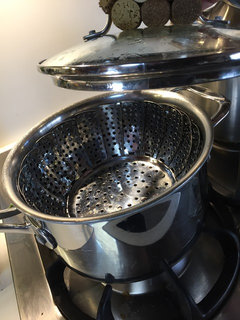
    I've been steaming rather than boiling eggs and I think they almost jump out of their shells now. I use a veggie steamer insert and cook, covered, for 12 minutes. Cool in an ice water bath.

  • Related Discussions

    inquiring minds want to know how the heckCASEY knows what college

    Q

    Comments (1)
    Haha, I don't!!! I ALWAYS guess the sports questions, sometimes I am right, often I am wrong. Here's my hint, if it's a sports question and you don't know it, guess the first answer. Better than wasting time on a question you don't know.
    ...See More

    georgysmom, this inquiring mind wants to know

    Q

    Comments (5)
    Lemon Curd Pound Cake 1 C. butter, softened 1/3 C. shortening 3 C. sugar 6 large eggs 3 C. A.P. flour 1/2 tsp. baking powder 1/8 tsp. salt 1 C. milk 1 T. lemon zest 1 tsp. vanilla extract 1 tsp. lemon extract Lemon Curd glaze Preheat oven 325. Beat first 2 ingredients at medium speed with heavy duty mixer until creamy. Gradually add sugar until light and fluffy. Add eggs, 1 at a time beating just until yellow disappears. Sift together flour and next 2 ingredients. Add to butter mixture alternating with milk beginning and ending with flour. Beat at low speed just until blended after each addition. Stir in lemon zest and next two ingredients. Pour batter into a greased and floured 10 inch tube pan. Bake 325 for 1 hour and 15 minutes to 1 hour and 30 minutes or until long wooden pick comes out clean. Cool cake in pan on wire rack 15 minutes. Meanwhile, make lemon curd. Remove from pan to wire rack and gently brush warm glaze over top and sides of cake. Cool completely. (my cake took one hour and 30 min.) Lemon curd 2/3 C sugar 1 1/2 T. butter, melted 2 tsp. lemon zest 2 T fresh lemon juice 1 large egg, lightly beaten Stir together first 4 ingredients in a small, heavy saucepan. Add egg and stir until well blended. Cook over low heat, stirring constantly, 10 - 12 minutes or until mixture thickens slightly and begins to bubble around the edges. (cooked mixture will have a thickness similar to heavy cream. Use immediately
    ...See More

    gazania, inquiring minds wants to know! :o)

    Q

    Comments (11)
    Carol, I have a pet spider also. He/she lives in the living room at the bottom inside corner of the entry door frame. At least once a week I clean up tiny wings and or legs or otherwise apparently inedible body parts that the spider tosses out. I am sure it is not the same spider that has been there for years, but there is always one there. It is very tiny, but is certainly earning my respect and it's keep. Other than lady bugs, I don't see any other bugs around. The LBs seem to know about what spiders do.
    ...See More

    Inquiring minds want to know.......

    Q

    Comments (5)
    My neighbor was talking about them too. She reads a web site called Gosselins Without Pity and they mentioned it there. She's not sure if it's true or just a teaser to get viewers to tune in. I don't know it there's any truth or just gossip. Here is a link that might be useful: Gosselins
    ...See More
  • 9 years ago

    Well, don't do what I did! lol! I got an invitation to a wild promotion party for a friend many years ago -- I decided to bring a huge tray of deviled eggs. I don't remember whether they peeled well or not, I was more worried about traveling and keeping them on the tray, so I decided to lay the eggs on a bed of shredded lettuce. The tray was so large that I ran out of lettuce, so decided to also use red cabbage. Do you see where this is going? lol!

  • 9 years ago
    last modified: 9 years ago

    I, too, discovered the steaming method accidentally! I always used an egg cooker and had no problem with the shells coming off nicely. Then a move/kitchen space caused me to question the need for an egg cooker and I left it packed away. I began to have a real problem with peeling, leaving ugly eggs. I didn't connect the dots till my daughter told me she had started steaming with no problem. Well, duh, thats what egg cookers do-steam. So I pulled it out and problem solved. Now I never have an issue. Interestingly enough the National Egg Board doesn't have this in their recommendations (unless they've recently changed).

    ETA: I always put them, immediately after steaming, into a bowl of iced water before peeling.

  • 9 years ago

    Haha - I thought the term for this problem falls under Murphy's Law...?

  • 9 years ago

    In my experience, the quality white eggs from the big supermarket peel much more easily than the organic free range brown eggs I prefer. It's not the color of the eggs, though. We had someone whose brown eggs peeled easier than white. It's those eggs. The white eggs may also be a lot older, because older eggs do peel more easily. But that's significantly older. A couple weeks in the fridge won't make a difference.

    Kenji Lopez-Alt at Serious Eats did a big study of the issue:

    The factor in my testing that made the most difference in how cleanly
    eggs released from their shells was the temperature at which they
    started: A hot start produces easier-to-peel eggs. And
    it doesn't matter whether that hot start is in boiling water or in a
    steam-filled pot or pressure cooker. All those eggs are strikingly
    easier to shell than those started in a cold pot.

    I generally use an automatic egg steamer, and always forget about this when I'm busy and will be making deviled eggs. :)

  • 9 years ago
    last modified: 9 years ago

    I don't know why no one makes it clear that the shell never sticks to the egg white.

    The fact is the shell sticks to the membrane and the membrane sticks to the egg white,

    dcarch

  • 9 years ago

    One thing I have observed is that eggs vary greatly in their freshness. I buy the cheapest eggs in cardboard cartons if I can get them, or organic in the recyclable plastic containers. That's my criteria, and I find the ones on sale are often quite old.

  • 9 years ago

    Thinking the anecdotal conclusions are faulty. I always buy organic eggs & always start them in cold water & some will peel easily, while every so often they stick. I thought it was related to how much air space was inside - which can be related to freshness, since the water in an egg will evaporate through the shell over time.

    I always drain the freshly cooked eggs & shake the pan to crack the shells all over, then cover w/ cold water. IMPE, this helps to loosen the shells. I also sometimes roll the cracked eggs between my hands to help loosen the shells.

  • 9 years ago

    The thing that makes an egg peel easily is a loss of moisture from the egg through the shell which makes it "looser" on the egg.. "Organic" eggs often are not washed and the shell holds the moisture better than supermarket eggs. Older eggs have lost some of their moisture and peel better. Adding vinegar to the boiling water to partly erode the coating on the shell ( that's why you add vinegar to the water when you color eggs) and then salting the cooking water will draw out some moisture....then dumping immediately to further shrink the egg inside the membrane and peeling quickly....and you won't have any problems.

  • 9 years ago

    There are a thousand "best ways" to peel a hard boiled egg. They all work, and none of them work. It all depends.

    There are old hens, young hens, hens are feed different diets, they are raised in different environments, there are hundreds of different breeds of hens, there are morning eggs and evening eggs, summer eggs and winter eggs, fresh eggs old eggs -------- There is not going to be one solution for a thousand kind of different eggs.

    As I said, the egg shell never touches the egg white. Only the membrane is in close contact with the cooked egg white.

    Why does the membrane sticks to the egg white? What is the science?

    I don't think old eggs has much to do with anything. True, there is less egg white from evaporation, but that only makes the air pocket bigger, not the egg white less round after cooking.

    There can be many factors that causes adhesion, The following science are the major ones relevant to eggs:

    1. Magnetic attraction. We can rule this one out if we are talking about eggs.

    2. Chemical/molecular - such as in glue. Possible, but I have not seen any study in finding out if the membrane is glued to the egg white after cooking.

    3. Mechanical - interlocking molecules between the membrane and the egg white. Possible, but I have not seen electron microscope investigation to proof one way or the other.

    4. Hydraulics - If you take two pieces of small flat plate of glass and put a tiny drop of water in between, you will not be able to pull the plates apart. there are two forces working against you, i.e. water surface tension and atmospheric pressure of 14 lbs/ sq. in. Those are the forces which can help a daredevil climb a highrise glass office building using two small suction cups. That I believe explains a lot why the membrane sticks to the egg white for all kinds of different eggs.


    dcarch (A.K.A. egghead wannabe) .


  • 9 years ago

    That may all be true, Squire Egghead, but I trust the experimental evidence provided by Kenji (side by side tests in the food lab) and Linda (decades of experience in the kitchen).

    It is true that it's the membrane that sticks to the eggwhite, but if you don't have a method for separating the membrane from the shell from the white, what does it matter? The eggs I use most rarely have a separable membrane. When a piece of white pulls away with the shell, you can't really scrape it off with a fingernail. If the shell came off the membrane, cleanly, peeling the membrane off the egg would be easy. I've met eggs like that. They're rare. The shells of the white eggs that are probably significantly older and otherwise more amenable for the reasons Linda stated, often pull off in a few large pieces. I think both the shell and membrane are thicker, which probably helps too.

  • 9 years ago

    I always just buy the eggs from the grocery store, never anything organic. I had to start steaming the eggs to just be able to get the shell off the eggs. Once I started to steam the eggs, I have never had a problem peeling them again. Back in the day, I never had any problem but about 10 years ago I began to no longer be able to peel an egg without it tearing apart. That's when I discovered steaming works!

  • 9 years ago

    I have had the same experience as you, Arkansas Girl. Once I started steaming eggs to cook them, I had no more problems with getting them to peel cleanly. Don't know why it works but it just does.

  • 9 years ago

    I believe I read/heard (Test Kitchen?), that even some steam at the end of cooking (boiling) worked to release the membrane. ? ?

    Q: a few years ago, I saw these eggs pin-prick gizmos. IIRC, pricking the egg before boiling was supposed to make it easy to peel. Is anyone familiar with this?

    I used to put eggs into boiling water (hot start), then in very cold water after cooking. They were easy to peel, but sometimes spilt and oozed in the boil. They invariably had that gray zone at the yolk/membrane. Then I tried the start eggs in cold water, bring to boil, remove from heat after boil is reached. Leave covered for ?~ 10 mins for hard boiled eggs with no gray ring.

    However, this method made the HB eggs resistant to neat peeling. The membrane stubbornly adhered to the egg white, even if the cooked eggs were place in water with lots of ice cubes. (The more ice cubes, the easier peeling, but still.)

    Nowadays, <frown>, I am greatly restricted in the amount of "cholesterol," saturated fat, and animal fat I'm allowed to eat. Darn! I love eggs.

  • 9 years ago

    I have tried the idea of pricking the egg, it didn't work. It just caused egg to ooze out the tiny hole.

  • 9 years ago
    last modified: 9 years ago

    Too many variables.

    Every googled method praises one over the other, fresh vs old eggs. And 6 quick hits do discuss the membrane, some in great detail.

    And a search here on GWeb has a posting just about every couple months so obviously an issue for many. I just did my own test. I fall in the total fail category 9 out of ten times probably because i keep trying different methods.

    I have a half dozen fresh organic eggs (local farm), 4 organic, (the oldest) in cardboard container, and a new dozen organic purchased Sunday, in plastic. Three different sources and no way to really know the age as who knows if they were stored before shipped.

    Cold water start, fail. Simmered hot water start, failed horribly. Steam insert....perfect. Used tongs and under cold tap water to peel, (i like them warm). Perfect yolks.

    One from each batch sat on the counter, the other remaining into ice water. Only the steamed eggs peeled easily all cooling methods and had a nice flawless egg white.

    So stick with what always works for you. The saucepans contact with your own stove depending on gas, elec coil, glass top, induction. I have used three different saucepans, small burner, medium burner. Even a tap on the counter, fat end, then ice bath. I tried room temp eggs vs cold from the fridge. I've poured out the hot water and have run cold tap water for a bit.

    How to steam a large batch i'm not sure but some do batches of 12-24 in a pasta pot w/insert.

    Now i need a recipe for cooked egg yolks for the crap ones.

  • 9 years ago

    I always used to prick the big end of the egg or release the air pressure, kept the shells from cracking and oozing egg into the water....especially if you put the eggs into boiling water instead of cold water.
    The gray zone comes from over cooking the eggs....also from not cooling promptly...which is the same as over cooking.


  • 9 years ago

    Thanks Arkansas girl and Lindac.

    So, Lindac, did you say (a couple of posts up) that you put eggs into boiling water? And prick wide end? How long timed? You don't use the stem or cold water start method. I've got to be nuts; hear I am thinking about cooking eggs and I'm supposed to eat max 1 or 2 a week, so probably with save me "egg budget" for cooking or baking that uses eggs. Maybe I'll go off and eat a Peep.

  • 9 years ago

    I'm with Murph's Regulation for the original question.

    As for the OT stuff, the argument of membrane vs shell is simply an argument of syntax, we all know what the issue is and syntax arguments don't help, don't make any difference and IMO don't apply. And one person's "science" isn't always supported by others' experience.

    I can only give *my* experience. I don't get freshly laid eggs. No real source without a long trip so it's store-bought eggs. I don't buy Eggland's Best, organic, can't get brown eggs (not that it matters) and there's usually not a lot of options except occasionally on size. And they will vary on freshness. You can tell how fresh they are by the pack date on the carton (not the "best by" date), but I've never paid attention to it. I've never found it to make a real difference. I don't boil eggs, I simmer them. Kenji Alt explained why you shouldn't boil eggs if you want them hard. I want to try steaming but just haven't. I generally start with either cold or tap hot water and don't notice a difference except the time to bring it to a simmer. I use the bring to simmer, shut off the heat and let it sit about 12 minutes, cold water bath to get them cooled to handle and peel them. I crack the large end as little as possible so I can get a hold of the shell (and hopefully the membrane) and SLOWLY pull on it. I maintain people often cause their own problems by snap-and-yank method on the shell and too many tiny bits and pieces. I can hear the suction release on the egg and can pull the shell off in a few large pieces. It's cleaner and more effective for me. I hate picking little pieces of shell that fly everywhere. You can't rush it and it works for me. Do I ALWAYS get perfectly shelled eggs? No. Do I consistently get good to excellent results? Yes (and I purposely shunned the pun that is usually included).

    While there probably is some truth to the different hen, different feed, different breed and any other such argument, the fact is that you don't control any of that when you buy eggs so they're all moot points.

    Seems to me that a lot of people cook eggs to keep in the refrigerator for lunches and snacks. I never hear complaining about peeling them. Perhaps that is telling.

    How to shell gets asked so often, gets the same arguments every time, and the issue never is settled and I doubt it ever will. Do what works for you.

  • 9 years ago

    I plan to try the steaming. I have my own chickens and have been using the 3 to 4 week old ones for hardboiling but that rarely helps. I use the same method Cynic described above but I don't want to crack them all since like he mentions, I like to keep a bowl of them in the fridge for snacks--they still tear up.

  • 9 years ago

    Petalique...at one time I did poke the big end and drop into boiling water....no more. I did it that way because my mother did....
    Now I put my cold eggs into cold water, add a goodly splash of vinegar and a good spoonful of salt and turn on the burner....when they start to jiggle, I turn the heat way down to a bare simmer and let it simmer for about 10 minutes, then run the pan to the sink, dump the hot water and run clod water into it. When the water in the pan is no longer warm to the touch I bank the eggs on the pan to crack all over and add ice to the pan, and begin to peel. Never a problem...if I don't get distracted and cook too long or forget to keep running cold water until they are cool.
    There is a definite effect of the ratio of water to eggs....more cold eggs take longer to come to a boil. If I am only boiling 3 or 4 eggs, I will bring to a blil and pop a lid on the pan and leave it for about 8 minutes....then do the cold water thing. But too many eggs and they are partially cooked by the time the water comes to a boil.

  • 9 years ago

    I have always steamed eggs, and whether it's the egg steamer or the steam oven or the stove, it doesn't make my favorite eggs peel any better. Nor does the slow and deliberate method Cynic described. Chilling the boiled eggs for a couple of days helps, but not complete. Better results rather than nasty mess, mainly.

    I'm saving Linda's method to try for Passover. It's worth a shot. Or else I'll buy the white eggs. :)

  • 9 years ago

    I always steam my eggs, store bought or home grown. I now get eggs from my daughter and we steam our eggs. Works well for us.

    Sue

  • 9 years ago
    last modified: 9 years ago

    Plllog, I too enjoy Kenji’s work. I think he has contributed a lot to
    the food world and I have the deepest respect for his knowledge.

    However, let’s be cognizant of the fact that Kenji is a graduate of MIT,
    but his field of study was not in science. He was a graduate in architecture.

    It is amazing how much he knows about science even though he was
    educated in architecture, but sometimes he will miss on a few things when it
    comes to science.

    The topic here is about peeling hard boiled eggs. He made many eggxperimemnts
    (sorry, he started the puns first), but to quote him: “Eggs started in boiling
    water or steam came out well above 90%. I don't have a fully satisfactory answer
    for this phenomenon -------“

    It is surprising what Kenji said, if he had experimented with literally several
    thousand eggs, at the end, with his eggxpertise, I eggxpect (OK, no more puns) he should have more to
    offer than just “I don't have a fully satisfactory answer for this phenomenon
    ------“.

    No postulations, theories, guesses, hypothesis, diagnosis ----!!?

    It seems to me, at one point he did have a chance which may point to a
    possible answer.

    He said, “The many cracks makes it easier to gently peel
    away the shell under running water."

    As I said the basic science of hydraulics, atmospheric pressure and
    surface tension may have a lot to do with why the shell adheres to the membrane
    and the membrane adheres to the egg white.

    We all know you can’t peel off a wet slice of cucumber from the knife
    when you are slicing. Same thing happens when the egg shell is close to the
    membrane and the membrane is close to the egg white. But when you allow more water
    to seep in from the edge, the increased thickness of water destroys the surface
    tension, as well as the suction of atmosphere pressure. This is similar to when
    you lift up slightly an edge of the suction cup, you will be able to pull the
    suction cup off the surface that is is stuck on.

    Anyway. Steaming may be better because (I am hypothesizing):

    If you boil an egg, you can actually see tiny air bubbles escaping from
    the egg shell. When the egg cools off, water will be drawn into the egg making
    the shell and the membrane stuck together. In steaming, while the egg is
    cooling off, moisture continue to evaporate, thus making the egg smaller, and
    therefore separation of the egg white becomes easier.

    Just MHO.

    dcarch

  • 9 years ago

    Thanks, Dcarch. I don't think being a trained architect means someone is devoid of other scientific knowledge, and I've known trained physicists who were baffled by the real world. Qualifications aside, what I meant about Kenji, is that he tried different methods with the same eggs.

    I don't doubt your science. What I said was that it didn't help me getting the brown eggs to peel without marring the white to know that it's suction and the membrane (which I did sort of know before). The whole question is how do you get the membrane to loosen from the shell? Perhaps use a hypodermic to blow air into the egg first????

    I've boiled eggs in water like two times in my whole life. I always steam them. The brown eggs I buy are just a mess when peeled. Your explanation for why they peel better when steamed makes sense. But since these eggs are a nightmare to peel, steam or no, it doesn't help.

    I blame the chickens!

    Usually, I give my guests the very best, but this year for Passover I might skip the free range, soy free, organic feed eggs (meaning that they're allowed to peck at bugs but the food they do give them is organic and not soy (which is good for a couple of my guests who are very sensitive)). The plain ol' white eggs from the chain store might work better.

    Or I'll just get Danish long eggs and slice them and be done....

    Though I suppose I could make a mold and steam up my own fancy chicken long eggs...

  • 9 years ago

    It worked again. Amazing. I have found my method, (fingers crossed). Organic brown eggs. Have not used that steamer basket in years.

    So thanks to all the steamer people. This time i just transferred to a bowl of cold tap water with the water running. Just a minute and let rest a few. That way they were still warm.

    If i ever need a dozen i might just do a test first with three, being a new carton.

  • 9 years ago

    I discovered steaming eggs about a year ago - I think I read about it on Martha Stewart's site, and have been a convert. I still buy organic eggs, but instead of the farm fresh ones I usually buy, I go to Trader Joe's and get theirs for deviled eggs. I figure they are a little bit older and do seem to peel easily when steamed.

  • 9 years ago

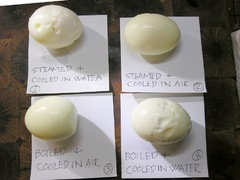
    In 2012, I posted here a very small experiment I did, which showed the importance of water re-entering the eggs and the impact of the shell's adhesion to egg white.

    dcarch

  • 9 years ago

    Interesting, dcarch. I've always just left the steamed eggs in the steamer to cool off naturally. I was thinking that maybe I should cool them in cold water but, after seeing your experiment, I'll just carry on with leaving them alone to cool.

  • 9 years ago

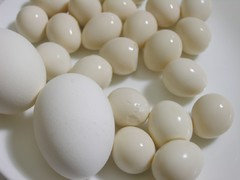
    Once you have found the way that appeels to you, then you can even peel quail eggs to make deviled quail eggs. :-)

    dcarch

  • 9 years ago

    I also always cool them in air, but my good organic eggs peel more like Dcarch's cooled in water ones!

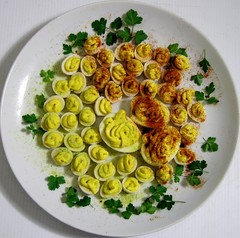
    Pretty plate of eggs. If you'd like to come here for Seder and peel quail eggs for me, I'm sure the guests would love them.

  • 9 years ago

    I was too tired to try Linda's method, but have a good progress report.

    I also forgot to buy old white eggs at the correct store, so got Trader Joe's extra large cage free veg fed brown eggs. The problem with the brown eggs is that they have thinner shells, but they were the only XLs and I thought they'd make nicer devilled eggs.

    My other concession was to preheat the combi-steam oven, rather than doing them in the egg steamer. That way I could put them in hot, as Kenji said to do.

    Years ago, someone suggested steaming them right in the egg cartons. I did that too. Did I mention I was tired? As I surmised, the cartons got waterlogged and weak, but I pulled out the whole wire rack and cooled them on it, and it worked pretty well.

    Yes, air cooled in the wet cartons on the hot rack on the cool tile counter, until warm but not hot, then refrigerated. I tested one, also to make sure it was fully cooked. I don't know about the rest, but it was perfect. The white was tender rather than rubbery, the yolk soft and no gray ring. Just right for devilled.

    But how did it peel? you ask. Well. !!! I was pulling at the shell instead of cracking it all over, just as if it were a white egg, and did manage to pull a big gouge out, but I think if I were being careful, it would have been fine. Most of the shell/membrane came off easily. Much different from the nightmare that is my normal eggs.

    Moral: Buy old, steam hot. :)

  • 9 years ago

    Not related to peeling eggs but in how to serve the deviled eggs. I have multiple egg dishes but they serve 18 at most. That is never enough for any family party I take them to. I bought several fridge storage plates for the fridge. They are porcelain and hold your eggs upright. Mine are from IKEA but you can find them a lot of places. They are meant for those who have their own chickens I guess and hold a dozen eggs in your fridge. Anyway, I now cut my hard boiled eggs across instead of the traditional lengthwise and serve them on those dishes. They actually look really pretty!


  • 9 years ago

    I've never made deviled eggs, (what?!). For obvious reasons not having a method that worked until now. First time will be Sunday, yay.

    Thanks Anne! I'm going to use your upright method. Testing tonight or tomorrow. I have friends that don't eat yolks so i'll be researching options. I'll make two or three varieties. I prefer my Mom's traditional method. Might have to make 2 dozen.

    Plllog, i tried the carton method in my steam oven, removing the top half of the carton...perforated pan, but the smell of wet soggy compressed fiber-board is an odd nauseating scent, to me anyway. I'm only making a dozen so may just stick with the steam method that has been working so well.

  • 9 years ago
    last modified: 9 years ago

    I can peel an egg in less than 30 seconds. It's so easy. Cover eggs in water, bring to a good boil and turn off the burner. Let set on burner for 13 minutes, put in cold water and peel immediately. To peel put the egg in a wide mouth glass, cover opening with your hand and give it a good shake until very very cracked. Perfect peeled eggs every time, promise!!! Try it!!!

  • 9 years ago

    Sleevendog, I have to say that the particular cartons I used didn't smell. Thank goodness! That would have been a nightmare.

    For the non-yolk eaters, it's probably the fat content they don't like. If that's the case, a nut and fruit paté might be nice, or finely minced chicken or tuna salad--fine so the proteins do most of the gluing together, without needing a lot of mayonnaise or other fat. If you want easy, just put a plump, round grape in each one.

    Caminnc, interesting method. But that just cracks the egg. That's not the hard part. The eggs I usually buy, done in the automatic steamer, are impossible to get the paper thin little pieces of shell/membrane off of without ripping the eggwhite. The combination of potentially older eggs (given the close to dying nature of so much at TJ's) and starting in a hot oven worked.

    Anne, your upright eggs in the holder sound darling! And different. I have a couple of lidded plastic 18 egg holders, which are for the fridge and carrying rather than serving. I'll cut and prepare the filling Friday, so they only need to be squirted on Saturday. (Last year I got a Wilton press that works amazingly better than a piping bag for me.) They'll be plated individually with the fish and orange slice as a single course, saving the need for decorative egg holders. If I had to do them for a buffet, I think I'd line a tray with lettuce and parsley and just set the eggs into that, with tongs to retrieve them.

  • 9 years ago

    I spent a whole summer in high school peeling eggs and doing other prep stuff for a hospital cafeteria, back in the days when food was still mostly real. We steamed huge pans of them in the steam chamber and rarely had any trouble peeling them, but the real secret was the peeling technique. Rap the wide end of the egg on the sink side, because that's where the air pocket will be, then roll the shell off under running water.

  • 9 years ago

    Yep. Writersblock, that's a good way. Assuming you have the kind of eggs where the shell rolls off. :) Peeling was never an issue for me before I started using these eggs. :)

  • 9 years ago

    I spoke too soon. Only about a quarter of them peeled cleanly. Another quarter to third peel well except for one small part, usually near the pointy end. Some just looked like they had small pox. Sigh. Luckily, since they were plated with the fish and orange, it didn't show as badly.

  • 9 years ago
    last modified: 9 years ago

    I've used every method imaginable and I know exactly how fresh (or not) my eggs are, because I have the hens that lay them. My eggs are a mixture of brown, blue, green, cream and speckled, and the color makes no difference, it only denotes the type of hen that laid it. All eggs start out white, color is only deposited onto the shell while the egg is being laid. The color of egg shells diminishes with the age of the hen as an older hen has less of the substance that colors the shell during the laying process. In fact, you can rub the brown right off a freshly laid egg by just rubbing it with your thumb/finger.

    Feed makes no difference either, except in the flavor and nutrient content of the egg, which is no small matter, but it won't help when peeling. My hens used to get commercial feed and table scraps, now they get special organic vegetarian high Omega 3 feed and table scraps, and there's no discernible difference in peeling.

    Anyway, steaming made no difference for me, neither did starting with cold water or boiling water, peeling immediately while the egg was warm or after chilling the eggs. Cooling at room temperature seems to be a bit easier for peeling purposes but the eggs can more easily overcook, the timing can be tricky. Poking the shell didn't make a difference, nor did adding vinegar or baking soda or salt.

    I do crack the egg on the counter and roll it around until it's cracked all over, then start peeling at the wide end. I don't peel until I'm ready to use the egg because they get slimy and I don't like that. Sometimes they peel well and sometimes not. Eggs over 2 weeks old peel best for me, as the egg ages it "dehydrates" a bit and there's more air and less egg, that's why a stale egg floats. But it doesn't always work either.

    So, a fool proof method? In my opinion, it doesn't exist. There is no possible way to get every factor right every time, so it's as much luck as it is skill. I got a perfect 11 out of 12 for my Easter deviled eggs, but the batch before that was closer to 1 good and 11 bad. Good thing they were egg salad because they were ugly!

    The best way to get a dozen perfectly peeled eggs? Cook two dozen and plan on making potato salad with half of them...

    Annie

  • 9 years ago
    last modified: 9 years ago

    Annie, thanks for all the insights! Yes, indeed, to the brown of the eggs, but, at least in the ones I can buy at the store, the brown eggs have much thinner shells. White eggs have peeled well for me in the past, but are harder to find from nicer farms, but I'm going to look for some thick shelled white eggs to see if they're any easier. I also ordered some wire egg racks to make it easier to use the steam oven since my automatic egg steamer is getting icky. :)

  • 9 years ago

    I decided to try the room temperature cooling method this past weekend and I was pleasantly surprised!

    I steamed mine (added to the steamer once it was hot).

    I must admit that as Annie warned, mine were little overcooked, but all but one were SO easy to peel. And that one was from a completely different (newer) carton of eggs so I suspect that the age also played a role.

    Having said that, I am supremely confident that the next time I try this method, my eggs will also look like they have the pox!

  • 9 years ago

    pllog, the color of shell should not have a bearing on how thick the shell is. Where the eggs come from does. As a hen ages, the shells get thinner, so if a farm "depopulates" their hens at a younger age and gets new hens, the shells will be thicker. If a farm keeps their girls for more than 20 months, as I admit I tend to do, the shells can be thinner and they don't lay quite as many. Nutritional issues also have a bearing on the thickness of egg shells. Chickens getting cheap feed without sufficient calcium often have softer shells, so a farm that's cutting corners by feeding inferior feed can have that problem. And sometimes you just get picky eaters and sometimes they eat too many worms and bugs and not enough "real food", kind of like kids living on fast food all the time, and they don't get the vitamins they need. I offer oyster shell to my hens free choice pretty much all the time to help stave off any problems.

    Annie


  • 9 years ago

    I never have a problem peeling eggs but not sure why. .......by b that I mean not site if it is one thing I do or the combo.

    I use "older" eggs, at least a week in the fridge, I stream them, plunge them in cold water, and roll them around on the counter until well cracked all over.

    Now let's talk fillings ! Mine is the yolks, mayo, horseradish, dijon mustard and a splash of hot sauce they are called deviled !

  • 9 years ago
    last modified: 9 years ago

    Thanks, Annie. The eggs I usually buy come from smaller growers. I'm pretty sure the chickens get good feed, but I don't know anything about the ages of the hens. The shells aren't soft. Just thin compared to the white eggs my mother buys. I figured that was also to do with the breed, so learning about the age is something new to me. The brown ones also have a finer texture, but sometimes little bumps, whereas the white ones, besides being thicker, have a more porous (larger pores?) texture, and remind me of plaster. Of course, they're both calcium carbonate, but the brown shells texture doesn't make me think plaster.

    Filling? I was in a hurry and it was late. I think this time it was mayonnaise, white wine vinegar, dijon, powdered ginger, S&P, and ... something ? There was supposed to be smoked Spanish paprika on top, but they were plated without it... They were good and tasty, but not so spicy as to bother the old folks.

  • 9 years ago

    I like to use brown eggs (or Araucana if I can get them) for hardboiled/deviled eggs because it is so much easier to spot a piece of shell left on than with a white shell.

  • 9 years ago

    Powdered ginger? Now that sounds interesting!

  • 9 years ago

    Plllog, that makes sense. Your mother probably buys eggs produced by battery hens, who eat what's put in front of them, but they don't get the table scraps, the bugs, the greenery outside. Their feed tends to be "perfectly" balanced, with no chance of inconsistencies.

    I have 8 eggs in the fridge already boiled. Now I need to make some deviled eggs. I even saw a recipe that had a chunk of bacon stuck in the top as a garnish, bacon and eggs, all in one bite!

    Ginger sounds interesting, though, and I love a sprinkle of Penzey's Smoked Paprika on top.

    Annie