

Dutch oven bread using heirloom grains?
9 years ago
Featured Answer
Sort by:Oldest
Comments (10)
 9 years ago
 9 years ago
Related Discussions
whole grain bread recipes?
Comments (8)You can usually replace the white flour with whole grain flour for up to 1/2 of the specified amount with little change from the original texture/raising. Add gluten, usually 1½ to 2 tablespoons per cup of whole grain flour. Yes, one must experiment a bit, but that's mostly to get the texture and lightness you prefer. BTW, gluten is best if kept frozen, because its shelf-life is extremely short. Just measure the frozen gluten powder right into the measured whole grain flour, stir and it will be thawed before the yeast needs it. If one uses molasses or honey instead of sugar, then the amount of liquid added should be adjusted downwards, to about ¾ of the equal amount. That means that if one changes ¼ cup white granulated sugar to ¼c [which is 4 tblsp] honey and the recipe calls for 1 cup water, remove 1 tablespoon of water from the cup. (That sounds worse to read than it is to do!). Brown sugar is white sugar with molasses added, so it is somewhat wetter than white but not as wet as honey... I find it easier to toss in an extra teaspoon of flour for each tablespoon of brown sugar. OR one can use ¼ less honey than the specified amount of sugar. That can get a bit tricky because the yeast needs "X" amount of sugar in order to rise properly and lessening the specified amount of sweetening can cause the bread to be dense/heavy. I don't really recommend it, but you may find it fun to play around. Are you doing everything by hand, or are you using a bread machine?...See MoreWhen Pigs Fly Bakery Six-Grain & Pumpkin Seed Bread
Comments (6)@gg33nyc This recipe isn't baked in the bread machine, so my guess is that it shouldn't be hard to adapt. It will help if you have a mixer with dough hook, but if you know how to knead by hand, it should be fine. Watch some videos if you don't. I'd suggest combine the liquid and sweet as it says in the first direction. Mix the dry in the main mixing bowl, and make a well (shape doesn't matter) as in the second direction, and add the yeast. Add the liquid gently onto the yeast, and stir lightly to make sure all the yeast is wet, then stir the mixture well to distribute everything. Knead until the dough comes together and forms a well stretched, glutinous lump—which is a standard baking instruction which means knead until it's done. This is where the inexperience could get you. The variables are how the instant yeast gets right to work, how well mixed the ingredients are, how efficiently you knead, and how much pre-kneading the bread machine did. This is also something best learned hands on. 5-10 minutes of good kneading is probably what you need, but the windowpane test doesn't work for seed breads. The poke method could, maybe should?, work. Checking out some videos can help. Kneading develops the gluten, which is what holds the bread up. The seeds want to make it fall down, so it's particularly important. Keep trying even if it's not perfect the first time. Your hands and eyes will learn how to see and feel the gluten development. Also, check some videos for how to draw and shape a loaf properly. There are a few different methods. The rest of the instructions are for making without a bread machine. Ovens differ, so keep an eye on it. You may find a different temperature, and/or time works best for your kitchen. This is an easy to read outline, without too many distracting details: https://www.thekitchn.com/bread-baking-tip-how-to-tell-w-156772 Good luck!...See MoreWhole grain artisan bread
Comments (17)1. What you are probably experiencing are rancid oils in the whole wheat flour from exposure to oxygen and heat, combined with an odor from over-proofing. Wheat as a grass and wheat as the hard seed, have nothing in common for flavor. Trust me on this one - I grew up in the middle of wheat fields and participated in wheat production from seed to harvest. I grow wheatgrass for juicing and 25-years of milling my own flour and making all our breads and baked goods with it, and I've never experienced any flavors or aromas like you describe. Try another loaf using a dough rising bucket to control your first rise and see if you get different results. Dough can over-proof during the first (second, optional rise, although it's not often used anymore) and the final proof/rise (after it's formed for baking). 2. Purchased commercial flour isn't "fresh". It may have been recently purchased, but the only way to get "fresh" flour is to mill it yourself, or purchase it at the mill as soon as it's been processed and bagged. We have no idea when commercial flour was milled, conditions during transporting and warehousing (temperature/humidity) and how long it's been sitting on the shelf in the store. Depending on how it's bagged and stored, flour can also absorb strong household, refrigerator or freezer odors. --If you are considering adding bulghur, that's another wheat product I would suggest making yourself from whole wheat berries - fresh is best. It's susceptible to quickly going rancid from exposure to heat, light and oxygen; and it's mainly adding "tooth" (a grainy, chewy texture, as well as additional fiber), but not a lot of flavor. I do have a good recipe for Bulgur Wheat Loaf if you want me to post it. You can't mask rancid oils or that vinegar scent from over-proofing dough. As a foods judge at fairs, smelling the bread is an important part of judging, and can tell you a lot about it. 3. "Artisan Bread" means it's made by hand. After that, it's up for interpretation, and that interpretation gets very broad. What you are describing is a lean, light wheat bread, free-formed into a boule (ball). The term "artisan" is more commercial than anything else. Up until bread was made with some kind of machinery, it was all "artisan" bread - made by hand. Some claim an "artisan bread" has to be made with a starter, not baker's yeast. Another interpretation may mean it's formed by hand, but the dough can be made with the assistance of a machine (stand mixer or bread machine). Panned soft sandwich bread can be an "artisan" bread. It doesn't have to be formed into a boule. 4. Poking dough with two fingers after the first rise in the bowl is an inaccurate method for testing dough for reaching "double" - use a dough rising bucket instead. For the final proofing (after the dough is formed) to show the loaf is ready to bake, testing it by gently pressing it with a finger and leaving a slight indention on the surface is not much better for accuracy. You really need to be able to eyeball the dough, and make sure you are using the correct size pan for the correct amount of dough, and know the dough's rising characteristics. For instance, using a no knead - Bread in 5-minutes a Day recipe, those loaves generally don't "double" in bulk before they are ready for the oven. You'll also get a big difference if you form a flat-ish boule instead of a high dome. They also take different baking times, so bake bread to the correct internal temperature, not by time, looks, or the ever inaccurate - tapping on the bottom. --Cover formed dough for the final proof with plastic wrap - it's not possible to put it in a dough rising bucket. The dough rising bucket is used for the first (and second - if using it) fermentation of the bulk dough, not formed for baking dough. --Where many people go wrong -- they allow the dough to rise to the size they want the finished loaf. In an approximate, rule-of-thumb measurement, the dough represents 1/3 of the finished size, you allow the dough to double in bulk and that = 2/3 of the finished size. The last 1/3 is accomplished through oven-spring when the dough finishes rising in the oven. 5. Since bleached/unbleached flour is no longer bromated (added chemicals), it doesn't have the extensibility it once did and it doesn't stretch as far before over-proofing as it once did, so just UNDER double is actually a better gauge, and just UNDER double is nearly always a better gauge when using 100% wholegrain flour, or a mixture of wholegrain and bleached/unbleached. Whole wheat flour isn't as extensible as bleached/unbleached flour because of the bran. 6. A dough rising bucket is nothing more than an opaque plastic tub with straight sides and a tight fitting lid. They are available through King Arthur Flour, but I got mine from the local restaurant supply store for about half the price, where they are considered - food storage containers with a lid. I like those with graduated markings on the side, but a recycled plastic ice cream tub will work just fine. --Just make sure the container you use has straight sides. A slant-sided bowl is also an inaccurate gauge because it's smaller at the bottom and flairs out at the top, so it's very difficult to gauge "double". --I have these plastic food storage containers in several sizes to accommodate different amounts of dough, and also have round as well as square containers. It's all about the straight sides. The one I use the most is 2-quarts. My standard recipe for 100% whole wheat bread makes about 1-quart of dough. I know it's double when it reaches the 2-quart line. --If you use an unmarked container, just use a ruler to measure where the dough is in the container. You could also tape a 6-inch ruler on the side of the container. Double the measurement of dough pressed in the bottom of the container and mark it on the container. So if the dough measures 2-inches, it will be "doubled" when it reaches the 4-inch mark. If you mark it with a piece of masking tape, mark whether the top or the bottom of the tape is the measure, or you can accidently be adding the width of the tape and over- or under-proof the dough. Beth Hensperger's "Bread Made Easy" - A Baker's First Bread Book - shows step-by-step pictures and includes pictures proofing dough in a dough rising bucket (pg. 32), with the two-finger test as the option. Keep at it.... Bread is the most humbling food we make :-). A trip to your local library may also provide books and videos that can help. Information and experience..... -Grainlady...See Moredutch oven use it like an oven?
Comments (21)rhome410 - Wow! I didn't even know Le Creuset made a 13.25 qt pot. Here's the thing - it's going to be so heavy when filled that even I would shy away from using it. And then there's the expense. For that kind of money, you would be better off with the All-Clad Stainless 12-Quart Stock Pot ($326.88 on Amazon). It gets top marks from Cooks Illustrated in part because "The aluminum core runs up the side of the pot". Since I personally won't be spending over $300 on a stock pot any time soon, I have a couple of other recommendations: 1. I'm not aware of another stock pot like All-Clad that go all the way up the sides, but Cooks Illustrated next highest rated is the Cuisinart Chef's Classic Stainless 12-Quart Stock Pot which gets very high marks, is ever so much more manageable than the Le Creuset and only costs around $60. Because it has a wide base, it will help a little with the bottom sides not burning, but you're still going to have to watch them carefully. 2. For heavier braising and thick soups/stews, for myself, I bought the the Mario Batali Braiser Oval 9 Qt enamel on cast iron pot. Cooks Illustrated rates these Mario Batali pots nearly as highly as Le Creuset and they're about half the price. They don't make a round one that size, but the shallower part of the oval is still 11" and provides for reasonably even burner coverage on my range (although if I remember correctly you actually have a more high powered range at home than I do). Hope this helps. plllog - great advice (along with everyone else) on "fish stick/chicken strip" making. The rounded sides on your your Le Creuset soup pot work better for at least 2 reasons: 1. A pan with 90 degree sides allows heat to enter from both the bottom and the side so, in effect, the food in the corner is getting up to twice as much heat - even more for a perfectly square or rectangular baking pan taking heat on 3 sides (ever noticed how the corners of brownies are quick to burn). 2. Rounded sides allow for more complete and efficient stirring therefore also reducing burning. These two reasons are probably why most pots are actually round/rounded in the first place. You'll note that practically all good casserole dishes (made for long cooking without stirring) are round/rounded on all edges. Interestingly, this can be even more important for microwave cooking....See More 9 years ago
 9 years ago
 9 years ago
- 9 years ago
- 9 years ago
- 9 years ago
- 9 years ago
Related Stories
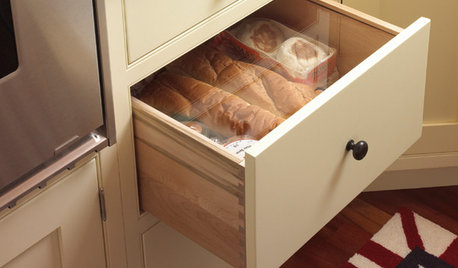
KITCHEN DESIGNKitchen Ideas for Bread Lovers
Any way you slice it, a kitchen designed with bread in mind conveys warmth and homeyness
Full Story
MY HOUZZMy Houzz: Contemporary Belgian Style Transforms a Dutch Country Cottage
Travel mementos and art fill this couple’s comfortable weekend countryside retreat in the Netherlands
Full Story
FEEL-GOOD HOME12 Very Useful Things I've Learned From Designers
These simple ideas can make life at home more efficient and enjoyable
Full Story
GREEN BUILDINGHouzz Call: What Have You Salvaged for Home Use?
If your floors, furniture, exterior materials or other home elements have a past life, we'd like to hear the story
Full Story
HOUZZ TOURSMy Houzz: Stunning Rotterdam Renovation
A Dutch couple snags an amazing home for — wait for it — one euro
Full Story
KITCHEN DESIGNKitchen of the Week: Chestnut and an Open Fire in Connecticut
Antique chestnut boards give a kitchen with a wood-burning oven vintage flair, balancing its modern amenities
Full Story
KITCHEN DESIGN8 Stunning Stain Colors for Kitchen Cabinets
Transform raw wood for custom-looking cabinetry with a stain that fills your need for color but lets the grain show through
Full Story
ART8 Ways Vermeer’s Work Can Make Its Mark in Your Home
Go Dutch with stained glass, Oriental rugs, checkered floors and delft tile
Full Story
HOUZZ TOURSMy Houzz: French Country Meets Southern Farmhouse Style in Georgia
Industrious DIYers use antique furniture, collections and warm colors to cozy up their traditional home
Full Story
KITCHEN DESIGN12 Items Worth a Spot on Your Kitchen Counter
Keep these useful tools and accessories out in the open to maintain high function without spoiling the view
Full Story



plllog