

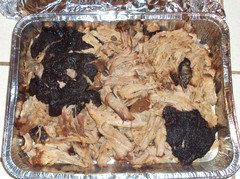
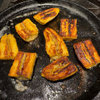
Question & update date w/pic... pork shoulder blade Boston butt roast
9 years ago
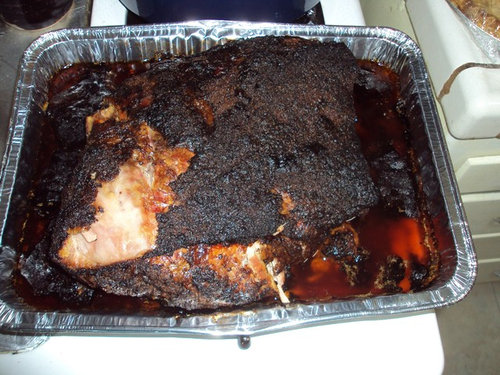
Featured Answer
Sort by:Oldest
Comments (8)
Related Discussions
brining a butt
Comments (32)I was born in VT. Many of my mothers relatives lived there too. A couple of years ago, I was in Burlington VT visiting an uncle, and found a shop that sells cheese ends. Basically, they are bits, chunks, and all shapes and sizes of Cabot cheeses. The cost per pound was only about $2, but that was because they had several different cheddar chunks all clumped together. I bought about 8 pounds and it took a while to use it all up. I make a 'mean' mac and cheese, and use a bit of mustard powder as well as onions, and some Velveta to get it to be a bit more creamy. I mix in some no fat milk, along with a big dollop of margerine. Its mostly Cabot chedddars though, and is a real 'comfort' food. Mixed with some bits of cooked hamburg, you now have even more flavor and texture. There is a specific brand and type of pasta I use, which is a bit larger than regular elbows, and it gets cheese inside each elbow, its a 'casserole' type pasta.. Yum! An interesting thing about pepper, is that once its freshly ground and added as a meat rub and baked, the 'heat' will deminish. Tellicherry peppercorns are one of the best there is. I make an 'egg mcmuffin' with eggs, either homemade sausage patties, or slices of home made Canadian bacon. These are placed bewteen a split, toasted English muffin, with a slice of American cheese. I have a round metal ring form that I use to make the egg portion, and use both the 'Egg Beaters' product, but also add some powdered egg. It cooks up much firmer and holds up better to freezing. I use 6 inch wide FS bags and then freeze them. When I want one, its an easy thing to leave sealed, and allow it to heat in the microwave for about a minute. I flip it over and continue to thaw/heat it. The bag will expand and pop open due to steam buildup. Once that happens its usually done. The popping of the plastic bag can be heard, but doesn't seem to explode any of the contents inside the microwave. Only problem I see is that becaue of the intense heat, the muffins (which contain gluten) will firm up, making for a very chewy muffin, kind of like a bagel. If I want it to be a bit more tender, its removed from the plastic bag, and is wrapped in a paper towel and heated a bit slower, with about 40 second intervals while flipping it over a couple of times. A 1000 watt microwave is what I have, so your results may differ. Both the eggs and cheese are fine when frozen and thawed, and I even see a bit more moisture coming from the egg part, so thats a good sign....See More4 Qt Nesco Roaster Score
Comments (56)cynic, as an aside to the roaster discussion, I use a big green unbreakable Stanley Thermos. It's not pretty, but I got mine because all th farmers and construction workers I know used them. Mine will keep a pot of hot chocolate steaming hot for several hours while the kids go tobogganing, so we're talking outside in a Michigan winter and usually stuck right into the snow. I used them a lot for camping, I could make coffee at breakfast, put it into the Stanley and it would still be drinkable at supper. Oh, and I've put ice water in it or iced tea when spending a few hours out in the hay field and it keeps ice in the liquid for a couple of hours too. I can definitely recommend them, although my oldest one is over 20 years old, so I'm hoping they haven't "improved" them. Annie...See MoreWhich is harder to DIY - 4' square or subway backsplash?
Comments (57)I didn't graduate from ECSU. I quit after my first year which would have been in 1981/82. Gee, when I went there it was actually still called ECSC....LOL. okay, so I am seriously dating myself :) Let's see, my fav pizza places were in New Britain or Southington. I left CT in '91 so I don't even know if they are still around. But see, if you miss a place in RI you just get in the car and you are there in no time! If I drive North for an hour I am still only on the other side of Indianapolis. Man, I remember jumping in the car with a friend just because we felt like walking around in Newport. Never gave it a thought :) Yes, I miss Ethnic foods. Anyone who knows how to cook true ethnic food never seems to move away from the Coasts. But boy do we have a gluttony of steak places around here.... yuk! And the pizza? Try No Greeks in Indiana, period! and no Diners.... and no Italian......well, except for Olive Garden (oh joy!) haha Dang, now I am hungry for things I couldn't get no matter what I was willing to pay! we will be in CT and The Cape this summer and I will eat, eat, eat. :p...See MoreMeat article in the New Yorker
Comments (3)Is this it? Red, White, and Bleu What do we eat when we eat meat? by Bill Buford December 3, 2007 Text Size: Two butchers (and one pigs head) in the Rungis Market, on the outskirts of Paris. Photograph by Jonathan Becker. Keywords Meat; Fearnley-Whittingstall, Hugh; "The River Cottage Meat Book (Ten Speed; $40); Picard, Martin; "Au Pied de Cochon"; Reynaud, Stéphane; "Pork & Sons" (Phaidon; $39.95) Is it possible that meat is now openly enjoying a renaissanceÂthat itÂs finally cool to be a carnivore? If so, it has been a long time coming. Meat-eaters, having already ceded the moral ground to vegetarians (no one has ever really come up with a persuasive rejoinder to the claim that a warm-blooded, pain-feeling creatureÂs life shouldnÂt be taken for your supper), have more recently had to accept that their diet is probably the source of much of the worldÂs heart disease and much of its obesity. That diet is also sustained by an industry that is just flat-out evil: the factory farms, the egregious economies of waste in fast food, the ghastly genetic manipulations of chickens and turkeys, the pigs raised in no-room-to-move confinement, the reckless use of antibiotics and growth hormones (as well as the frightful possible consequencesÂearly breasting in children, difficult-to-defeat superbugs), the contamination of fields and rivers by noxious excrement runoffs from feedlots the size of small nations, the tricks and shortcuts adopted by supermarkets (cheap animals fattened on cheap grain, butchered by high-pressure hose, and packaged at their bloated maximum weight). And yet, at a time when things could not seem worse, there is a generation of people (in their forties or younger) who are thinking hard and philosophically about their food and are prepared to declare: Enough! IÂm a meat-eater and proud of it! Three books by authors from three backgroundsÂa farmer, a chef, and a pig-slaughtering, bacon-loving descendant of butchersÂare remarkably alike in their gleeful chauvinism about being carnivores. The farmer is Hugh Fearnley-Whittingstall, a British food celebrity. He is forty-two, principally a journalist and television host by trade, who wears inexpensive horn-rimmed glasses so familiar to his British audience that they are now a piece of instant anti-branding branding. The look, like his dress (muddy Wellington boots, soiled linen jacket, the mess of the occasional apron) and his long, sometimes washed, hippyish brown hair (often pictured dangling in his face and over the dishes he is preparing), conveys a no-nonsense disregard for appearances and petty courtesies and an earnest commitment to a higher truth. This literary personaÂthe thinking manÂs amateurÂwas created for him by accident, in 1989, when he discovered that it was probably the only thing he could be. Unemployed after earning a "useless" degree in philosophy, politics, and economics from Oxford, Fearnley-Whittingstall had accepted a friendÂs invitation to apply for a job chopping vegetables at the River Café in London. The restaurant was between identities: no longer what it had started out to be (a canteen for the Richard Rogers architectural firm, next doorÂone of the chefs is married to Rogers) but not yet the dining destination it has since become. For twelve months, Fearnley-Whittingstall was in culinary heaven. He had never learned so much so quickly. He discovered the seasons, and their bounty, and was paid to make food from it: could things get any better? They couldnÂt, because he was fired. He was told that, actually, he wasnÂt good enough. He was disorganized, and incorrigibly messy: he was Pigpen in the kitchen. For Fearnley-Whittingstall, it was a heartbreaking momentÂheÂd discovered both his calling and his inability to follow it. In a variation of the pedagogical imperative (those who canÂt, teach), he concluded that if he couldnÂt make a living in the kitchen he might be able to make one writing and broadcasting about it. He embarked on a new profession, and was increasingly surprised by the passion of his convictions. He was now a man more and more committed to what he saw as the greater good: principally, food that hasnÂt been ruined by supermarkets (which, in his eyes, represent the single most destructive influence on the way we eat). That commitment has now been expressed in nine television series, three specials, and ten books. One of the first, "The River Cottage Cookbook," is based on Fearnley-WhittingstallÂs experiences living in a house with some land, the home-away-from-home that he established in Dorset, in rural southern England, where he set out to plant vegetables and raise livestock. He started with a cow named Marge (he has since stopped naming the creatures he kills), and soon acquired enough animals never to have to buy anything but diapers and detergent from a supermarket again. "I reckon that two pigs, two lambs and a beef steer will put meat on the table about five times a week for a family of four," he writes, with the pride of a man who, at harvestÂs end, has met the challenges he set for himself at the beginning. He urges others to do the same: "Most of the meat we eat comes from industrially farmed animals who lead miserable lives and are fed on inappropriate diets." And though he recognizes that few people have back yards roomy enough for, say, a cow, he figures that just about everyone with a porch should be able to raise a couple of pigs. (You imagine the English suburban future with a cloud of porcine poo, like a London smog from the fifties, hanging tenaciously over the Home Counties.) "The River Cottage Year" was next, a month-by-month Christmas card of a book, with multicolored pages, progressing from green to yellow to purple, followed by Fearnley-WhittingstallÂs magnum opus, "The River Cottage Meat Book" (Ten Speed; $40), a five-hundred-and-fifty-four-page effort to get down on paper every thought he has had in his work with animals as food. The cottage of the title, meanwhile, has moved to Devon, is no longer a cottage as such, and is nowhere near a river. It is a great agrarian laboratory ("Even if I donÂt live at River Cottage anymore, I like to think that River Cottage lives with us"), with classroom kitchens (courses include "All About Chickens" and "Hugh Cooks Christmas"), a working farm, a modest mail-order business (hemp oil, nettles soup, nettles beer, and pig-in-a-box), a greenhouse, and sheep, saddleback pigs, saddleback boar, a herd of Devon Ruby Red cattle, and some Nubian goats. For Fearnley-Whittingstall, it seems, the most compelling meat comes from a cow, and, to this day, one of the great meals of his life is a standing rib roast he ate four years ago with his family on Boxing Day, the first that had been carved out of an animal he had fed and looked after himself. But meat from just about every other animal is discussed as wellÂthe obvious quadrupeds, domestic and wild fowlÂplus various pieces of offal, including lungs ("lights," in British butcher parlance), brains (a nightmare to extricate and, besides, one animalÂs taste pretty much the same as anotherÂs), and the other bits between nose and tail ("I usually have a cooked ear or two in the freezer"). Most of this is photographedÂillustration is an essential feature of the bookÂbut so, too, are the meats as they are being consumed. Fearnley-Whittingstall, itÂs evident, is still messy. We see a half-eaten steak, the fat congealing; a cassoulet after everyone has helped himself to it; a plate rim smeared with grease; a sideboard stacked higgledy-piggledy with dishes, cutlery, leftovers, and wineglasses cloudy from finger smudges. There is a dog: licking fat that has dripped from a table where a pig has been carved up or sitting on a bench with Fearnley-Whittingstall, having just had a bite of his homemade pork pie. Advocating the flavors of bird jellyÂthe juices that set after a chicken has been cookedÂFearnley-Whittingstall tells us about the happy "discovery" of the roasting pan "a day or so later" and eating up its unwashed, solidifying, crusty remains. I found myself wondering, DoesnÂt anyone do the dishes down there at the cottage? Fearnley-WhittingstallÂs occasional efforts to explain butchery, like boning a leg of lamb (encouraging his readers not to bother with a professional but to do the "hatchet job yourselfÂitÂs quite easy to improvise"), reveal a tolerance for chaos ("ItÂs a bit tricky to explain") that may be without precedent among people who make a living from preparing food. For all the disarray, there is a coherent ideology. It is evident in the opening pages, an eleven-photograph sequence that shows the author taking two cows to slaughter. The pictures are not sensational, but they are unflinching. The first is of the animals boarding a trailer, the floor covered with hay, backed up against a corral (a dirt road, a wooden gate, early-summer foliage, a green-diffused light, Fearnley-Whittingstall, in his familiar Wellies, coaxing them along). Then: a captive bolt gun pressed against the top of an animalÂs head. Then: the animal on its side on a concrete floor, collapsed, blood starting to pool. It is raised by its hind legs and hung upside down to drain blood. It is skinned, a thick white fat being peeled off the body in a single rug piece. This is followed by a tug-of-war removal of the unwieldy, instantly expanding intestines, like a white plastic trash bag filled to bursting, and the sawing of the carcass in half, the moment when conventional butchering begins. There is little accompanying text, apart from a rhetorical aside:Why is it considered entertainment when a predator kills another animal in a wild-life film, Fearnley-Whittingstall wonders, "whereas the final moments of human predation of our farmed livestock are considered too disturbing and shameful to be made available even for information." The reader understands the point. Meat comes from an animalÂa banal connection that has been obscured by the way supermarkets prepare and present our foodÂand the animal has to be killed. If you fear the sight of a carcass, you shouldnÂt be eating from it. This opening sequence informs the rest of the book, implicitly posing the question: Is the meat youÂre eating good enough to justify killing an animal? (Sometimes I wondered if the author wasnÂt a closet vegetarian, after all.) The question also seems to have informed Fearnley-WhittingstallÂs winningly capricious life, the way his desire to know more about what he was eating led him to experiment with one animal, then a dozen, then a farm, then a bigger farm, without any sense of limits. Who knows what will be next? The author doesnÂt. That author, at least as he presents himself in these pages (where his sentences sound as though they had been screamed into a microphone while being filmed during a gale), is manifestly a passionate, good-hearted slob of a philosopher, distinguished overwhelmingly by his skepticism. Our meat has been ruined by the people who produce it: How can you believe them? Trust no one! Find out for yourself. And the bookÂs satisfactions are not in its many meat preparations (including steak-and-kidney pie, Lancashire hot pot, beef in stout, shepherdÂs pie, and a version of sausages in batter called Flying Toad in the Hole with posh gravyÂeach a revival effort and each definitively without appeal) but in the glimpses of the author amid his own farm animals, prepared to test every received opinion about meat and how you cook it. Why do people baste birds? he asks. ItÂs useless, crisps up only the skin, and doesnÂt penetrate beyond it. Why do cows eat so much grain if it isnÂt good for them? A cow, he then discovers, will eat virtually anything, its passivity being the reason it has been so successfully domesticated, and abused. (Scientists have found that feral cows return to eating grasses, the diet of their genetic forebear, the aurochs, and one that their digestion is designed to accommodate. Grass-fed beef, a rarity in the United States, is healthier, better-tasting, more exercised, and has superior marblingÂthe integrated development of fat in the animalÂs tissuesÂthan grain-fed, but requires more land than do animals in a pen.) Are testicles worth eating? Yes! What happens when you remove fat from two kinds of meat? They taste almost the same. Why does store-bought beef exude water when you cook it? Because it is (a supermarket trick) wet-aged rather than dry-aged, making it heavier, but less good. Where can you age meat? Anywhere thatÂs coolÂon a rack in your refrigerator, a pantry, a porch in December (or a New York fire escape in winter, I discovered, after leaving a wild turkey on one for eight days). How do you roast a pig on a spit? Fearnley-Whittingstall tried, and characteristically botched a half-dozen animals before finally nailing the technique, and, in the event of your ever having to cook one, you will want a copy of his book nearby. The chef is Martin Picard, forty-one, a French-Canadian, native of Montreal, round and pudgy-soft with curly, dark, unkempt hair, a scraggly beard, and a rug of chest hair, and the proprietor of what might well be the most immoderate, unreservedly unhealthy eating establishment in North America, Restaurant Au Pied de Cochon. PicardÂs book, "Au Pied de Cochon," is not a book, exactly, but an "album": it has no acknowledged author but, rather, a list of recipe writers, photographers, an illustrator, and an interviewer on a copyright page; no title but only a logo; and no conventional publisher, having been "produced" in both French and English editions by Picard himself. It is an unabashed celebration of meat and animal excess and the commitment to filling up your stomach to stay warm during winter nights: a hymn to saturated fats. There is no cookbook like it, because its aim is to representÂwith cartoons and wacky biographical sketches of suppliers and step-by-step picture instructions of one improbably meaty, glisteningly unctuous dish after anotherÂthe buzz and magic and self-destructive aura of a restaurant that is like no other. You look at the menu and think, You donÂt go there to eat; you go there to die. Hugh Fearnley-Whittingstall expressed a hope that, one day, chefs would learn to butcher again and buy the whole animal, which they would be compelled to cook in new ways. (Restaurants get venison fillets, pork tenderloins, and rib-eye steaks in individual shrink-wrapped packages, and prepare them within a predictable range of variations.) Picard hasnÂt needed the encouragement. He makes black puddings and trotters, and a round, bloated piggy stomach servedÂin a surf-and-turf pairing inspired, no doubt, by some Newfoundland fisherman with animals running around his porchÂin a lobster sauce. He prepares venison tongue three ways: with a tarragon sauce, in a pot-au-feu, and pickled. He sensibly uses pork stock in many dishes, though itÂs an ingredient you almost never see in cookbooks. His fatback is fried and served in a paper cone. He does unspeakable things with foie gras: using it in hot dogs, pizzas, hamburgers, or as a giant, door-stopping wedge atop French fries, melted-cheese curds, and a "gravy" made with pork stock, egg yolks, cream, and even more foie gras. (The dish, a local favorite called poutine, may sound disgusting; IÂve eaten it and can attest that it is much worse than it sounds.) Picard is not high-end. His genius, according to Anthony Bourdain, who has written an introduction, is in his recognition that "now, right now, is the perfect time to give the whole world of fine dining the middle finger." In fact, his middle-finger salute is directed not only at the world of fine dining but also at vegetarians, animal-rights defenders, anti-gun lobbyists, and anyone opposed to the killing of animals. Picard is not earnest. He is cheeky and provoking. The book opens with a photograph of him in a boxerÂs stance (the gloves, the trunks), in the restaurantÂs meat cooler, ten carcasses hanging from meathooks, where he is squaring off against a dead pig before an audience of his bare-chested male staff, sitting in deck chairs, wearing sunglasses and swimsuits (and surely freezing). It ends with Picard in the woods, squatting in an outhouse, and reading the volume we have in our hands. In between, there are various photos, all of them irreverent, with animals or creatures as props: of two men wearing sea urchins like sunglasses, or pig heads arranged in a vat of boiling water so that they seem to be screaming, open-mouthed, in pain, or freshly killed birds in a mock courtship. At a time when animals are abused by industrial farmers, manipulated, mismanaged, malnourished, and generally disrespected, this sort of thing is akin to a hunterÂs putting a cigarette in the mouth of the just-shot trophy buck and taking a picture. Like Fearnley-Whittingstall, Picard depicts animals being killed and gutted, but his images are more confrontational and involve considerably more blood and a blade he wields himself. "Whether you uproot a carrot and bite into it, or slaughter a deer and cut it into steaks," he writes, "it should be remembered that each effort to procure food is inherently tinged with violence: it is the passage from life to death, and back again towards life." Picard is not, however, an uncritical meat-eater. Like Fearnley-Whittingstall, he has a particular fondness for game: the least ruined of all animalsÂmeat before it was corrupted by the unnatural selection of livestock cultivation. (Our meat is determined largely by what an animal eatsÂbreed is a very minor considerationÂand a wild animal is likely to have the least manipulated diet of all.) Picard knows that his love for pigs, the animal traditionally used in many Québécois preparations, is potentially problematic, because of the abuses in the pork industry. But he is also convinced that bad meat comes from animals that have been badly raised; that you find good meat by finding good producers of it and patronizing them. He gets his pigs from François PirsonÂs farm in nearby Saint-Grégoire. He gets his chickens from Jean-Pierre Clavet in Yamachiche. The approach is one that all of us can follow. Find good suppliersÂdowntown, in the next town, by mail order, or on the WebÂget to know them, and stick by them. You should always know the first name of the person you buy your meat from. Picard rarely offers beef in his restaurant, because he has yet to find a producer he trusts. The butcher, Stéphane Reynaud, forty, is a butcher not by trade but by upbringing, being the nephew and grandson of butchers in the village of Saint-Agrève, on the Ardèche plateau, in southern France. He now runs a restaurant just outside Paris that specializes in pork, but he is always home for the annual slaughtering and butchering of a pig in winter. Although European Union regulations (as well as the practices of modern hygiene) prohibit butcher shops from killing anything on the premisesÂonly certified slaughterhouses are authorized to kill an animalÂthe annual pig slaughter in a small hilltop village goes largely undetected. The event gives Reynaud a chance to reminisce about a pig killing thirty-three years before, when, accompanying his grandfather to a local farm, he sat on the imitation leather seat of his truck and witnessed for the first time the festivities surrounding the event. The temperature then, as now, was considerably below freezing. The pig then, as now, weighed four hundred pounds, and produced six and a half feet of blood sausages, sixty cooking sausages, fifty cured sausages, fifty Ardèche sausages, forty-four pounds of pâté, eighteen pounds of roasting pork, two cured hams, and two pork bellies. The only difference between the two occasions is in the beverage: eight glasses of wine for Reynaud today; two cups of hot chocolate for the seven-year-old, plus a late-morning snack of sliced bread with butter. But the bounty of the pork preparationsÂfrom the blood sausages to the belliesÂgives the book its structure. "Pork & Sons" (Phaidon; $39.95) is the story of killing a pigÂthe kind of killing that has been done every year for a very long timeÂand the many things you can then eat afterward, and it is distinguished by an unusual tranquillity of purpose. In this respect, it is different from the Picard or the Fearnley-Whittingstall. It is a cookbook, showing you the five, or ten, or sometimes twenty recipes for each category of pig-slaughter preparation: autumn fruits (apples, quinces, pears, and a splash of Calvados) with your blood sausages, for instance, or in a tart made with fennelÂingredients that might still be available when your blood sausages have just been made. Or summer ingredientsÂarugula, say, or sun-dried tomatoesÂfor the hams, because a properly cured ham needs some time and you wouldnÂt touch one before then. But there are affinities among the three books. Reynaud, too, includes a photograph of an actual slaughter, although it is minuscule, the details barely visible, along with one of the bloodletting: he, too, seems to recognize that weÂre losing our connection to our animals. The way he addresses the issue of quality is remarkably understated and telling. "You donÂt get good hams without good pigs," he writesÂitÂs his only instructionÂand the implication is that, if you donÂt know what a good pig is, you know enough to find out. His book is written in the quiet confidence that you will be reading it only if you are interested not just in meat but in the whole animal it comes from. About halfway through my reading, I stopped. The book had made me want to cook what it was describing. What I then purchasedÂtrotters, knuckles, a shank, the bellyÂnow seems absurd. You donÂt go shopping for leftovers; I should have bought a whole pig. Other preparations, consisting of the animalÂs more conventional parts, made more sense: a shoulder stewed with Venetian-trader ingredients (dates, apricots, saffron, and cinnamon), or one cooked as a confit and served with grapefruit and preserved lemon. I still havenÂt done anything with the recipes for feet and earsÂclever ways of making something out of very littleÂbut noted them, because you never know when you might need them. My only disappointment was in a piece of neglect for which the publisher is probably to blame. It is also evident in the Fearnley-Whittingstall. All these books, recognizing our supermarket-induced ignorance, make an exaggerated, outsized effort to teach us the cuts. This, Picard tells us, is what a pork loin looks like, and he shows us a photograph. These are the twenty-seven famous cuts of beef, Fearnley-Whittingstall tells us in the British edition of his book, and he includes precise pictures, along with a diagram illustrating exactly where each one comes from. These are all important cuts in a pig, Reynaud tells us in the original French edition, and sets them out in a series of perfectly detailed cartoons. In the American edition, though, Fearnley-WhittingstallÂs twenty-seven cuts have been replaced by a blocky, useless diagram of seven sections of a cow: it teaches us nothing, and serves only to compound our ignorance. In ReynaudÂs American edition, there are, incomprehensibly, three illustrations of the loin, each vague and each different from the others. In the recipes, the various treatments of the shoulder are reduced to a Boston Butt, that obscure piece of American pig butchering, which is not a whole shoulder but only the fatty top part of one. (Frankly, I had no idea what a Boston Butt was, having assumed that it came from the rear.) What none of these writers acknowledges is probably something that all of them discovered right before their books were published: that there is no universal, accepted practice for cutting up an animal, that it has always been nationally and sometimes regionally determined, and that there is not, therefore, a universal set of butcherÂs terms that can be translated from one language to another. Maybe, in this respect, Fearnley-WhittingstallÂs instructions for butchering a piece of lamb are the most sensible after all: the only way youÂll learn is by hacking into it, and so you may as well brave the mess. ItÂs the first step toward understanding that meat comes from an animal, and that good meat comes only from a good animal. â¦...See More 9 years ago
 9 years agolast modified: 9 years ago
 9 years agolast modified: 9 years ago
- 9 years agolast modified: 9 years ago
- 9 years ago


Related Stories

REMODELING GUIDES6 Tricky Questions to Ask When Planning Your New Kitchen
Addressing these details will ensure a smoother project with personalized style
Full Story
MOST POPULAR4 Obstacles to Decluttering — and How to Beat Them
Letting go can be hard, but it puts you more in control of your home's stuff and style. See if any of these notions are holding you back
Full Story
KITCHEN DESIGNA Designer Shares Her Kitchen-Remodel Wish List
As part of a whole-house renovation, she’s making her dream list of kitchen amenities. What are your must-have features?
Full Story
BATHROOM DESIGNWhy You Might Want to Put Your Tub in the Shower
Save space, cleanup time and maybe even a little money with a shower-bathtub combo. These examples show how to do it right
Full Story
MOST POPULARIs Open-Plan Living a Fad, or Here to Stay?
Architects, designers and Houzzers around the world have their say on this trend and predict how our homes might evolve
Full Story
KITCHEN DESIGN11 Must-Haves in a Designer’s Dream Kitchen
Custom cabinets, a slab backsplash, drawer dishwashers — what’s on your wish list?
Full Story
MOST POPULARModern Party Etiquette for Hosts and Guests
Learn the mannerly way to handle invitations, gifts and even mishaps for a party that's memorable for the right reasons
Full Story
DECLUTTERINGDownsizing Help: How to Edit Your Belongings
Learn what to take and what to toss if you're moving to a smaller home
Full Story
MOST POPULAR8 Little Remodeling Touches That Make a Big Difference
Make your life easier while making your home nicer, with these design details you'll really appreciate
Full Story
KITCHEN DESIGNDream Spaces: 12 Beautiful White Kitchens
Snowy cabinets and walls speak to a certain elegance, while marble counters whisper of luxury
Full StorySponsored

Columbus Design-Build, Kitchen & Bath Remodeling, Historic Renovations
lindac92