Houzz Logo Print
anniedeighnaugh

Changing American Diet

10 years ago
(x-post at home decor convo)

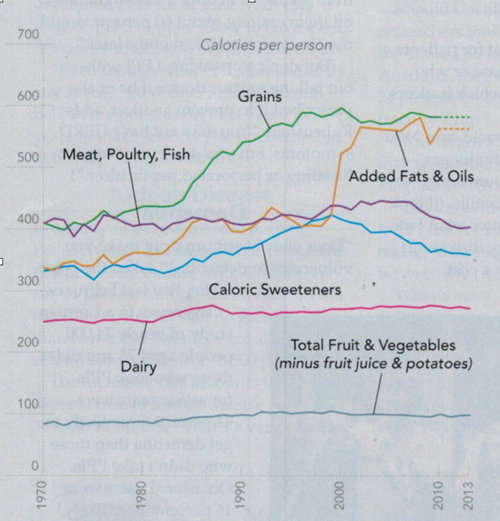
I so enjoy all that I learn from reading the Nutrition Action Letter. They had a good article this month on how the US diet has changed. I think it lends some interesting insight into the obesity epidemic.

The data suggest that it isn't carbs vs. fats...it's carbs + fats. And that makes sense as we seldom eat one without the other. Whether it's sweet like apple pie or salty like doritos, we usually enjoy them best together.

The era of low-fat diets would seem to have helped keep the calories from added fats from rising at the same pace as those from grains...though they still rose vs. 1970....but once fats became more acceptable, they shot up quickly to be on par with grains. The major increase in fats is in salad and cooking oils. In 1970 we consumed about 10 lbs per person and now it's about 35 lbs.

And for all the big push to eat more fruits and vegetables, from a calorie point of view, we've changed little. While in this chart, dairy looks little changed, the details reveal that we eat a lot more yogurt which was almost nothing in 1970 to about 10 lbs per person today. But the biggest gainer was cheese. We used to eat about 7 lbs per person in 1970, and today it's over 20 lbs. With all the accompanying saturated fats. The big loser in dairy is whole milk which went from 17 gallons per person down to about 3.

Comments (53)

  • 10 years ago

    It's encouraging to see sugar/corn syrup/whatever dropping.

  • 10 years ago

    Caloric sweeteners are any sweeteners that have calories, so that would be sugar, high fructose corn syrup or other corn syrups, dextrose, maltodextrin, fructose, etc.

  • Related Discussions

    Has gardening given you a better diet?

    Q

    Comments (49)
    Aliceg8 - Marie Callendar's is pretty good. I grew up on Swanson Pot Pies (with enough pepper it wasn't too bad) Here's the recipe as I copied it down (can't remember from where - guess I need more fruits, veggies & fish in my diet right Digit?). I usually just use this as a guide and put however many veggies I feel like (usually more taters & carrots) I'll note changes in parenthesis Chicken & Dumplings 2-1/2 to 3 lbs chicken thighs (can also use a whole chicken) 5 c water 4 red potatoes cut in sixths (I like yellow taters since they're not as waxy but still hold together) 3 carrots, cut in sixths (can use baby carrots) 2 celery stalks, cut in sixths 1 onion, cut in eighths 10 oz frozen peas (or fresh added right before adding dumplings) S&P to taste (I add garlic powder, a couple of bay leaves, fresh or dried rosemary, sage, lemon thyme (or poultry seasoning) to taste since I think it's a little bland with just salt and pepper) In a large stockpot cover chicken with 5 c of water, (I add seasonings at this point); cover and boil on medium heat until tender, about 50-60 mins. Skim fat (optional (-:). Remove chicken, let sit until cool enough to handle. Remove skin and shred chicken. Return to broth. Add remaining ingredients. Cover and cook 20 mins. (*note - fresh herbs can be finely chopped, or left whole and removed before adding dumplings) Dumplings 1-1/2 c flour 2 tsp baking powder 3/4 tsp salt 3 Tbsp butter (I use margarine) 3/4 c milk 1/4 fresh parsley (optional) Sift flour, baking powder & salt, cut in butter/margarine. Stir in milk and parsley. Drop into hot stew. Cook uncovered 10 mins, then cover and cook 8-10 mins until dumplings are done. Hope you like it. Even with 5 of us, there is enough for leftovers, just add more water to thin the broth some, heat to a boil and make more dumplings.
    ...See More

    Messing with my diet --anyone else?

    Q

    Comments (17)
    Hi Wintercat and Barb: I'm glad to see rose-growers here in Cooking Forum. Roses are NO longer important to me ... already have too many (60+ roses). My focus is taking care of my family through healthy cooking. I agree with everyone that daily exercise boost up the metabolism. Yesterday I spent 1 1/2 hour shoveling the ice .. was sweating & hot for hours afterwards. Grainlady has a good point that healthy fats like Coconut oil raise metabolism. Omega-3 is used to treat Raynaud syndrome: defined as excessively reduced blood flow in response to cold, or extreme pain with cold temp. My kid eats at least 1 cup of walnut per day, plus 2 tablespoons of flax oil (high in Omega-3 and Omega-9). My kid is always warm. Studies show that Omega-3 increase the "brown fat" storage with higher metabolism. My kid hates it when school made her wear her coat during recess. She never wear gloves nor hat, even in our freezing zone 5a winter. I notice the same effect when I have walnut or flax oil for dinner: very warm at night, so I only use that during the winter. The "China Study" is a landmark book by Dr. Campbell. According to Wikipedia, "Dr. Colin Campbell, Jacob Gould Schurman Professor Emeritus of Nutritional Biochemistry at Cornell University, and his son Thomas M. Campbell II, a physician. It was first published in the United States in January 2005 and had sold over one million copies as of October 2013, making it one of America's best-selling books about nutrition." I read that book twice, it showed that a vegetarian diet resulted in higher metabolism than a high-protein diet, plus reduced rate of cancer & heart-attack. The book included lab. studies on rats which showed they are much more active on a vegetarian diet, than a high-protein diet. Here's an explanation from Wikipedia "... consuming diets high in protein and fat transfers calories away from their conversion into body heat to their storage form as body fat." On sensitivity to cow-milk, Wikipedia explained, "... autoimmune diseases are more prevalent among people who live at higher geographic latitudes, and also among people who consume a diet high in animal protein, particularly cow's milk. ... Vitamin D is important for the proper regulation of the immune system, and that for people who live at higher geographic latitudes, a lack of exposure to ultraviolet sunlight can result in a deficiency. The consumption of animal protein, especially casein in cow's milk, results in higher concentrations of calcium in the blood, which inhibits the process by which the body activates vitamin D in the kidneys to a form that helps repress the development of autoimmune diseases.[21] Here is a link that might be useful: The China Study book by Dr. Campbell This post was edited by Strawberryhill on Tue, Jan 14, 14 at 9:44
    ...See More

    Diet questions answered here

    Q

    Comments (2)
    TeeeeeeHeeeeeeeeee!
    ...See More

    The Changing American Diet

    Q

    Comments (1)
    I've been listening to Doctor Radio on Sirius-and they have been touting Fat Protein plus Fiber is best-and very low carb in their latest studies. I don't catch the whole conversation as I am in and out of the car, so I don't know the particulars. I think it is when the heart doctors are on the radio mostly is when I hear it. I have no idea-just was surprised to keep hearing it.
    ...See More
  • 10 years ago

    snookums -- Here you go (many other outlets ran this, from NPR to Fox News -- just google sugar industry study): http://www.nytimes.com/2016/09/13/well/eat/how-the-sugar-industry-shifted-blame-to-fat.html

  • 10 years ago

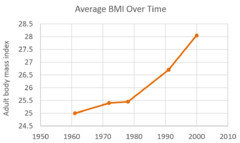
    Body Mass Index:

  • 10 years ago

    looks like the increase in grains is the same as the increase in BMI! Coincidence? I don't think so! Is that when the food pyramid was invented? I wonder if it really has to do with the fact that bread is so much easier to come by and to eat a sandwich rather than eating a home cooked meal with most women/moms working full time these days. I don't think people are really paying that much attention to the food pyramid actually. Other than to justify that all that bread they consume must be OK since it says so on the food pyramid?

  • 10 years ago
    last modified: 10 years ago

    While people might
    not actually look at food pyramids, we did hear to eat bread and pasta a lot for health and weight reduction.

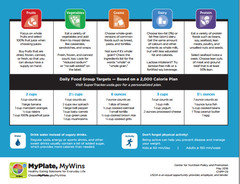
    Here
    is an old food pyramid dated 1992. USDA. Center for Nutrition Policy and
    Promotion.

    -----------------------------

    -----------------------------

    These
    are their current recommendations for 2015-2020:

  • 10 years ago
    last modified: 10 years ago

    Here is the new food pyramid posted at a teaching hospital. This is in line with what the functional/integrative medicine doctors are teaching. Some of these doctors recommend staying away from grains and potatoes altogether, as well as choosing full fat dairy because of all the sugar added to low fat versions (if you eat it at all). Lots of healthy fat.

    The numbers are difficult to read:

    30-60% calories from vegetables - half raw & half cooked

    10-40% calories from fruits

    10-40% calories from beans and legumes

    10-40% calories from seeds, nuts and avocados (healthy fats)

    20% or less calories from whole grains and potatoes

    <10% calories from eggs, fish and fat-free dairy

    Rarely: beef, sweets, cheese and processed foods

  • 10 years ago

    I don't agree with the new pyramid either. And I never eat fat free or low fat dairy because of all the carp they add into it. I will stick with good old fashioned whole milk. I don't drink that much anyway.

  • 10 years ago
    last modified: 10 years ago

    Which new pyramid don't you agree with and what do you subscribe to? I don't agree with the USDA's new one, MyPlate. I do agree with the last one, posted at a teaching hospital.

  • 10 years ago

    I'm one of those who eats cheese everyday. I feel better when I don't drink milk and I can't seem to digest yogurt so cheese it is.

    The food pyramid has been around since the 70's because I do remember studying it then. Turns out (I did check) that it was developed in Sweden in 1974.

    Snookums - what I like about the pyramid that you posted is that it is based on calories. I know I won't convert anyone but basing your diet on plain and simple calories is so much easier than counting grams of fat, grams of sugar, grams of carbs, etc.

    And when it comes to fats - how many people understand the difference between saturated or unsaturated fats, and for sugars - how many understand the difference between natural sugars and added sugars. How many people have the understanding to read a food ingredient label, how many people have the ability to read and understand proper food nutrition articles - not many.

    The majority of people don't want to have to wade through charts telling them how many grams of fat, sugars etc they should be eating and then having to break down each food they eat into those categories and then start adding and comparing.

    Counting calories is one number per food item and you just add it up and come up to the total at the end of the day and hopefully it's somewhere around 2000. Really simple. I do know that many here will tell me I'm wrong, but what's wrong is all the mixed messages that consumers are getting. Mixed messages about the latest fad diets are creating diet and health issues for so many people.

    I have a running partner who changes diets every month and wound up with digestion issues because she never settled on one way of eating. And she has a biology degree and still got confused.

    Me - I count calories and in 2009 lost 42 pounds and it's still off and at 63 my blood numbers are excellent.

    I follow Michael Pollans 7 words of "Eat food, not too much, mainly plants" and his 7 rules. Really really simple to understand and to follow.


  • 10 years ago
    last modified: 10 years ago

    I just heard that one the other day - eat real food, not too much, mostly plants. Very simple indeed. Thanks for reminding me to recite that!

    It's not bad to overeat plants either, even as much as you want, although maybe not fruit. Aside from their high nutrition value, they are so filling, as are the healthy fats, that they curb your appetite so much anyway.

    I don't like counting either. I try to focus on eating healthy things and listening to my body saying it is full.

  • 10 years ago

    I also count calories on my new eating plan that enabled me to lose 25 pounds in the last year. I try to get sufficient protein, fruits and vegetables and a modest amount of healthy fat (vegetable and olive oil). I mostly avoid bread and refined carbs, including white rice and pasta. I feel very satisfied eating this way and allow myself the occasional treat. Eating a certain amount of fat made a real difference to my enjoyment of food. For example, I enjoy stir fried or oven roasted vegetables as a change from plain boiled food.

  • 10 years ago

    Eat *slowly*. Ignore the gigantic advertised/restaurant 'portions'. Drink water. Don't buy stuff that is bad for you! (Skip those center aisles of Poison Food & Drink at the grocery store.) Never eat from a container of nuts, chips, cookies, whatever; take a portion and put the rest away -- in a cupboard. Leave fruit on the kitchen counter; store other foods out of sight. Allow yourself ONE small amount of 'bad-for-you' food ONCE a day. WALK!

  • 10 years ago

    Nothing specific mentions fiber. It used to be a non-issue. Now it is pointed out in many places. I check the fiber content and then check the carbs. Subtract fiber from carbs and you get your net carbs. If you have enough fiber (most places recommend way more than I can manage), then the carb intake is not as important as some might believe.

  • 10 years ago

    I have a problem with the new pyramid in that I don't think it's realistic. At 31 calories per cup of broccoli, if you were to get even 50% of your daily calories (assume a reasonable 2,000 calorie per day diet) you'd need to eat over 32 cups. Ain't gonna happen.

    I like Schwartzbein Principle which is also about eating real food. Eat the protein you need, the fat you want and the carbs needed to maintain a healthy weight. Balance each meal and snack with protein, carbs, fats. Eat vegetables at least 3x per day.

  • 10 years ago

    Meat and dairy are carcinogenic. Joel Fuhrman says to eat

    Greens

    Beans

    Onions

    Mushrooms

    Berries

    Seeds

    for maximized nutrition.


  • 10 years ago

    As a person who doesn't like cheese in any way, shape, or form, I have long been aware of how it is now in everything. In years past, it would clearly be stated on a menu if cheese was present but now I have to ask about everything from appetizers to desserts. I used to joke that it was part of the reason for the obesity epidemic but now I really believe it.

  • 10 years ago
    last modified: 10 years ago

    I will have to look into how to eat that many vegetable calories. Good point. Certainly they have that figured out and aren't expecting people to be able to eat 32 cups of vegetables a day.

    It doesn't say how many calories overall. I think of that pyramid as a guide in terms of food groups and their proportions.

    I could never eat 2000 calories a day and maintain a good weight.

  • 10 years ago
    last modified: 10 years ago

    Love Dr. Fuhrman. He says to eat a big salad every day and a bowl of bean/vegetable soup. As much as you want. Very filling.

    Then very little animal products.

  • 10 years ago
    last modified: 10 years ago

    I thought it was very interesting that a renowned teaching hospital had that new food pyramid posted. Usually this sort of thing gets pooed and thinking is very slow to change.

  • 10 years ago
    last modified: 10 years ago

    Food industry spends a lot of money on promotion. Didn't look at above link but it is now being realized the sugar industry managed to steer everyone in the wrong direction (focusing on fats and blaming these for heart disease etc.) years ago, with sugar currently being the one single bad actor that consistently stands out - it doesn't just rot your teeth.

  • 10 years ago

    I follow that chart pretty diligently. I do love cheese though and have mozzarella every day in my panini. I would say at least 2/3 or more of my diet is fresh fruits and veggies. Never canned or frozen. Fresh fruits are 3/4 of my lunch with the egg, cheese, and avocado panini the rest. I am never hungry from noon till dinner at 8. Eat nothing in between. No fruits for dinner but a small salmon and over 1/2 the plate of veggies. Most are steamed, rarely raw unless it's a salad. No drinks except many glasses of lemon water during day and coffee at both meals.

  • 10 years ago

    Here's a problem: appetite decreases with age. My MIL, who was rigorous about maintaining a healthy weight, began to have nutritional issues for several reasons:

    1) she didn't understand nutrition anyway, coming from a 6th grade education

    2) she naturally liked fruit, salads, and (unfortunately) what I call 'soft white carbs', since she had bad teeth (typical with immigrant Asians, btw).

    3) declining appetite made her look at a plate visually: if it looked too full, even if I was very careful about a modest portion for her, she would only eat half.

    Finally, one day after a heat spell, she fainted after getting up that morning. Since it had been so warm (no A/C in our house) I had been making salads and sandwiches for dinner, of which she was doing her now-usual "I'm not that hungry, I'll eat half and have the rest later" - which, I found out later, she never did.

    Because all of us were "on our own" for B/L, I had not concerned myself with what she was eating. Clearly, this was a mistake which needed an immediate plan of action.

    Calculating what she had eaten over the previous 3 days, I came up with about 5-6 grams of protein total. Since her weight for the last 60 yrs was 130 lbs., give or take 5 lbs at most, that intake was clearly insufficient. After talking with her doctor, he agreed with me, so together we made some adjustments to stabilize her diet vs her insistence upon not overeating.

    Her energy rebounded noticeably. We had no more incidents although it was always a fight to get her to eat nutritionally rather than fill up with sweets. Basically, I increased her daily protein intake, making sure it was a COMPLETE protein, and cut down the white carbs as much as possible.

    Per WebMD, these are the daily protein requirements:

    You need protein for your muscles, bones, and the rest of
    your body. Exactly how much you need changes with age:

    • Babies need about 10 grams a day.
    • School-age kids need 19-34 grams a day.
    • Teenage boys need up to 52 grams a day.
    • Teenage girls need 46 grams a day.
    • Adult men need about 56 grams a day.
    • Adult women need about 46 grams a day (71 grams, if pregnant
      or breastfeeding)

    You should get at least 10% of your daily calories, but not
    more than 35%, from protein, according to the Institute of Medicine.

  • 10 years ago
    last modified: 10 years ago

    I love how they come up with "about 46 grams protein for women", not taking into account height and metabolism fluctuations. I'd rather see them provide a range.

    I'm also one of those who prefers whole dairy to the reduced fat stuff with all those extra sugars and crud. Otherwise, I'm on board with the teaching hospital pyramid that snookums presented.

  • 10 years ago

    That new pyramid has you eating hardly any meats/proteins, I do not agree with that! They have beef right down there with sweets? That's just stupid!

  • 10 years ago

    I just follow my own "common sense" diet. For me, this means to eat as little as possible of ALL processed and packaged foods. Going back to basics was really easy.

    and then I cut out HFCS, and hydrogenated fats.

    Moni

  • 10 years ago

    The new pyramid seems to be missing my largest protein source (unless I missed it) which is lean poultry. Also, I have trouble with the ranges since there's a huge difference between 10% and 40% for say fruits in terms of carb intake.

    If you haven't seen theOmniHeart diet, you might take a look.

    The OmniHeart study (Optimal Macronutrient Intake Trial for Heart Health) compared the effects of three
    heart-healthy diets, each of which lowered blood pressure and improved blood lipids. All three diets follow
    the principles of the Dietary Approaches to Stop Hypertension (DASH) dietary pattern with some
    modifications. The three study diets differed in the amount of carbohydrates, protein, and unsaturated fat
    while keeping the calorie levels the same. One OmniHeart diet emphasized carbohydrates, another diet
    emphasized protein, and the third emphasized unsaturated fat.
    The study findings showed that the protein-rich and the unsaturated fat-rich diets provided additional benefits
    on blood pressure and blood lipids and further reduced estimated ten-year risk of heart disease than the
    carbohydrate-rich diet. The trial was supported by the National Heart, Lung, and Blood Institute of the
    National Institutes of Health.

  • 10 years ago
    last modified: 10 years ago

    I guess it depends which studies you choose to follow. You can find them to support just about anything. People will discredit any of them just as easily. There might be different or inconsistent outcomes because we are not all the same. They are finally realizing this with other things.

    Dr. Fuhrman is one who promotes eating very little animal products because he believes they are carcinogenic (among other things, iirc). His plan does allow for a few small portions of meat each week but includes alternate sources of protein. His food recommendations are also based on long-term scientific studies and says it results in better health/cardiovascular health than DASH and a long list of other popular diets. I don't believe he is simply making it up.

    I tend to listen to them all and draw my own conclusions by experimenting with what makes me look and feel the best.

  • 10 years ago

    Looking at the three Omni menu plans, wow. There are so many unhealthy things, imo. Obviously they would disagree! lol

  • 10 years ago

    For myself, if I ate mostly all fruits and vegetables for the day, I would feel like total HECK! My blood sugar would be so messed up, I'm sure I would have a splitting headache!

  • 10 years ago

    I am way way healthier in the last 35 years since I haven't had a bite of meat. Even just the thought of beef rotting in my intestines makes me gag. This proves one can live a very healthy life with no meat ever. I take no meds, only have seen a doctor in the past 35 years for a yearly or semi yearly checkup, no flu, rarely ever even a head cold. Charts come and go and I ignore them. I have no sugar in my diet except what occurs naturally in fruit.

  • 10 years ago
    last modified: 10 years ago

    "This proves one can live a very healthy life with no meat ever."

    It shows that you can live a very healthy life with no meat.

    " There might be different or inconsistent outcomes because we are not all the same. "

    I agree

    I think that some broad generalizations are OK, e.g. that maybe it isn't good to go through life eating nothing but Reese's Peanut Butter Cups. But there is quite a bit of variation in lifestyles, calorie use, needs according to age that might affect the 'pyramid' that is best for you.

  • 10 years ago

    Dr Fuhrman is a media personality, not a medical expert. Medical experts don't have websites that sell bottles of salsa, containers of soup and T-shirts.


    Most anyone can lose weight and feel better by changing their eating patterns and getting more exercise. The From and To don't matter as much as leaving behind old habits, paying attention to one's diet (which too many people don't do) and eating in new ways.

  • 10 years ago

    What do you eat for protein, Lily?

  • 10 years ago

    You're full of soup Elmer Fudd and are grossly uninformed. Not reading past irritating, inflammatory, defamatory first paragraph. That's the only reason you post to these threads.

    You also like to promote unsafe computer practices with bad advice which leads me to question your motives and activities in that regard.


  • 10 years ago
    last modified: 10 years ago

    My first two sentences are factual and not intended to be anything but that. You're welcome to disagree with that or anything else that I say.

    As someone with time managing a large IT department (as a sideline, I should say) and a career (non-engineering) in Silicon Valley working with many of the companies whose products we all use, I'll push back on your suggestion that I'm uninformed. In the world of PCs and the Internet, just as in the world of health and medicine, there are too many alarmists and BS slingers who put out warnings and "information" that lead to fear and misinformation among people who are less informed but easily spooked. Isn't it funny that many of these warning-spreaders happen to sell products and services that can fix the problems they tell you about. I try to speak up when I see self-serving BS or Chicken Little advice. Nothing more or less.

  • 10 years ago
    last modified: 10 years ago

    "Most anyone can lose weight and feel better by changing their eating patterns and getting more exercise."

    Perhaps in the short term. Long term weight loss and increased exercise have been shown to be problematic for many, new research shows that there are physiological reasons and not just lack of will power that contribute to that difficulty.

  • 10 years ago
    last modified: 10 years ago

    Agree Lucille. I'm out of my element here as far as in-depth knowledge goes but I know that the suggestion of "lack of will power" is an overly simplistic notion for a very nuanced subject. On the other hand, paying greater attention to diet and getting regular exercise are both healthful undertakings, whether or not done as part of a weight loss program.

  • 10 years ago

    Snookums: For protein , I eat cheese, yogurt, at least one egg a day, nuts, usually walnuts and pecans, quinoa,spinach a little fish. I'm not vegan. I eat nothing from a land animal but do eat some salmon.

  • 10 years ago
    last modified: 10 years ago

    Lily, I gotta say that the visual of meat rotting in my intestines is awful. But then again, so is the visual of veggies rotting there. Yes, folks, I've seen the unfortunate life forms in the back of my fridge when they've been forgotten!!! I do think we are not a cookie-cutter species -- some of us really DO need meat (or at least seafood) to both feel and be healthy. Unfortunately, the Standard American Diet includes too much for the majority of us. Along with a bunch of other things I doubt we should be having... I'm of the belief that seafood made us as a species smarter over the aeons.

  • 10 years ago

    i think most diets have something good to offer. you, as an individual, have to decide what is best you and your health issues/needs and what u can stick to for life, i think the word "diet" is so misleading. it connotes that u are dieting for a week, a month and then u go back to how u were eating before and the cycle starts all over again!! the words should be "diet lifestyle". once u find a way that u are happy with on more than one level, stick to it for rest of your life.

    i have and i am so happy with it. i feel better, look better and have more energy than i have had in about 15 years. Big difference!!! i have basically cut out processed foods, white anything and sugar. i don't pair my fats with good carbs and vice versa. very easy when u get used to it and now i don't think about it at all. i enjoy eating this way because i know i feel better when i do. so for me its a simple choice.

  • 10 years ago

    When you follow a lifestyle that you like, your mind will accept it in a few weeks and then it's unnatural to go off it. I don't eat sweets and when I do have to at b-day party, I feel sluggish. Very occasionally I have ice cream but desserts in general leave me cold anymore. Not the case many years ago when I had a wonderful baker, my mother.

  • 10 years ago

    While the diets in the omnihealth may include some things that may be considered "no-nos" they are certainly part of what average americans eat. Including them in a diet that makes it easier to live with is probably a good thing as it's evident the majority of people are not capable of sticking with a strict diet for very long. If people could follow a reasonable diet that will help them maintain a normal weight and has added benefits for the heart and blood profile, it'd be far better than what most of folks are doing now.

    Beyond that, I am a big believer in individualized diet plans. DH has poor kidney function and needs to limit salt and protein; my GF is pre-diabetic and has to limit carbs; I've had my gall bladder out and have to be careful about fats. It's all about what works for you.

    However, I think the point of the initial chart, is that if we are looking to understand why 2/3 of americans are overweight or obese, it's because we eat too much, esp grains and fats.

  • 10 years ago
    last modified: 10 years ago

    I figure that's why they include those things. I have had doctors give permission slips for junk food and poor dessert choices. Unfortunately, indulging in them even as treats often leads to more consumption than planned for a lot of people. I just find some of the so-called healthy recipes I see in advertising from local hospital dietitians, for instance, to be total junk and very old school. Some I wouldn't have wanted to eat decades ago either.

    They are now finding people can lose weight on high fat diets - healthy fats. Diets of 50-60 percent fat calories, weight melts off, blood looks great (Dr. Hyman, Cleveland Clinic). It depends what else you eat. All those previously recommended carbs are killing people by spiking blood sugar and making them hungry all the time.

  • 10 years ago

    I used to have quite a healthy diet - until I developed acid based kidney stones. Now I have to really watch purines and oxalic acid - as many do. I believe it was on this forum that someone posted that a healthy diet is her trigger - that sums it up exactly. Purines and oxalic acids are high in so many foods. I eat nothing from a can and do not add anything to foods such as spice etc. Fortunately, my blood pressure is perfect and my cholesterol is good. I can't eat yogourt (it is fermented) - but can eat custard made at home with 1% organic milk - and yes, sugar. I do use too much olive oil though. I have one prescription and do not take OTC anything unless I have a severe migraine that will not go away.

    Since I had anorexia 50 years ago I know the calorie count of everything whether I eat it or not (not necessarily a good thing).


  • 10 years ago

    On the radio today a nutritionist said the best way to control weight or change your diet is mind over matter. Don't give in. Stick with it and soon your mind will control your impulses

  • 10 years ago

    This is my food pyramid. I eat a Ketogenic diet. I've done it this way for over 2 years. I'm roughly 150 pounds, give or take one or two pounds. I've managed to take off 50 pounds eating this way. I've kept it off for 18 months (when I reached my weight loss goal). I don't count calories. I just avoid processed food, with the exception of low sugar ketchup, mayonaisse and mustard and a few salad dressings. We do eat the occasional Russel Stover sugar free chocolate and Chapmans sugar free ice cream sandwiches. Everyone needs a little dessert now and then. :)

  • 10 years ago

    It's very true that when you make the change to healthy foods, desires for the old junk go away. Your tastes change and cravings for the bad stuff disappear. But you do have to stick with it to reach that point! Unfortunately, we are bombarded with bad stuff one way or another all the time, making it more difficult.

    Even people without health problems have different dietary needs and reactions. Everyone is different.


  • 10 years ago
    last modified: 10 years ago

    Getting rid of those carbs, grains and sugars will definitely trim you down! Much healthier too.

    We also need a good amount of healthy fat to keep our brains healthy. It thrives on it.