Houzz Logo Print
jasdip1

Kefir

10 years ago
last modified: 10 years ago

A member of my local Freecycle group has kefir grains that he's offering. I'd like to know more about them, and I know that GrainLady for one, uses them.

Can I use regular 1% milk? I don't buy any other kind of milk.

Comments (37)

  • 10 years ago

    I use both dairy and water kefir grains. Dairy kefir is used as a substitute for plain yogurt, buttermilk, drain the curd and used instead of sour cream, drained even more and used as a substitute for cream cheese. I use water kefir as a low-sugar replacement for fruit juice and pop/soda. I've used the same dairy kefir grains for 15-years.

    I do the unthinkable - I use non-fat dry powdered milk (Country Cream) to make mine because I only use powdered milk and whey-based milk substitute products (since 1981), so 1% milk will be fine. My favorite "treat" is to make it with coconut milk (how to: http://www.culturesforhealth.com/learn/recipe/milk-kefir/coconut-milk-kefir-recipe/), and you can do that with a few of your dairy kefir grains, and then put them back in your 1% milk when finished.

    I do add some half-and-half or cream occasionally (if I happen to have some in the house) if I think they are getting "slow" and the shot of fat will perk them up. You will get a richer curd the higher the fat content. And just like making yogurt, you can add some dry milk powder to your 1% milk for added protein and a richer/thicker curd.

    -I usually make 2-2.5 c. of milk in a quart jar at a time.

    -When I rest my grains I put them in 1-cup of milk in a pint jar with a lid on it, and refrigerate it. When I remove the grains to make the next batch (plastic slotted spoon), I leave the remaining milk the grains were stored in in the same jar (with a lid on the jar) on the counter and it will also make kefir even without any grains in it (some people toss this milk, but I use it). There is usually enough good bacteria from the grains to make kefir (especially if you rest the grains for a week, or so).

    -The grains always float to the top once the milk starts to "turn" and I scoop them out with a slotted plastic spoon when it is the consistency I like.

    -You can use your fingers to pluck the grains from the top of the jar, but make sure they are washed with soap and water and thoroughly rinsed so there isn't any soap residue.

    -I always wash my kefir-making canning jars by hand, rinse well, and air-dry or dry with a clean dishtowel (a used towel could have something on it that could cross-contaminate a clean jar). I scald the jar and the lid (I use plastic one-piece lids designed to fit canning jars) with boiling water just before using them. It is my understanding that the sheeting action chemicals from dishwasher detergents and rinse-aids can interfere with the good bacteria, so I never wash my jars in the dishwasher.

    -The curd is VERY fragile and will break apart easily. Once you shake a bottle of kefir it will become a liquid and remain liquid.

    -If the ambient temperature is too hot, the curd will not have a smooth texture and it will clabber very quickly. If the ambient temperature is too cold, it will take much longer for the kefir to make the curd (but winter kefir is my favorite because it's more mild and creamy smooth due to the cooler temperatures for fermentation).

    -I use cold milk out of the refrigerator to make my kefir.

    -When my grains get about as big as a quarter, I divide them by pulling them apart with my (clean) fingers. They will break naturally at the weakest point into 2-3 pieces.

    -The grains will grow quickly if you make consecutive batches of kefir (no resting in the refrigerator between batches), and will grow very slowly the more time they are at rest in the refrigerator between fermentation.

    The best places to find out more about kefir:

    Cultures for Health: http://www.culturesforhealth.com/ 

    Dom's Kefir In-site: http://users.sa.chariot.net.au/~dna/kefirpage.html

    If you have any other questions, fire away and I'll be happy to help you out.

    -Grainlady


    Jasdip thanked grainlady_ks
  • 10 years ago

    I've started my kefir! I have my grains in the milk. I have some kefir from straining the grains given to me. I tasted it, and it tastes like watery yogurt. The fellow who gave it to me thought it might not have been sitting long enough, but I like the taste fine. I gave some to Smudge, our 16-yr old Maine Coon and he licked the bowl clean. He likes yogurt, but of course we don't give it to him very often. I'm hoping that kefir might have health benefits for him too.

    I'm noodling around, trying to figure out how to make cheese, yogurt, etc. I'm not sure how to get it thick enough, unless I perhaps let the kefir ferment a second time, in a separate jar. Will that thicken into cheese?

  • Related Discussions

    Kefir Grains

    Q

    Comments (1)
    Hi, did you manage to get some milk kefir grains ?.. I live in Plainsboro. If you are still maing Kefir, please let me know if you have some extra to share Thanks
    ...See More

    Kefir 'cheese'?

    Q

    Comments (22)
    Updating my kefir experimentation results: I made a kefir cheese ball, by hanging the curds is a bag until solid, then adding dried onion flakes, red pepper flakes, granulated garlic, basil flakes, salt, pepper, and a little sugar to try to balance the sourness of the cheese. I still didn't care for it without the butter and cream cheese, but my son loved it with crackers, so I sent it home with him. If I have extra cheese, I'll save it for his visits. I made sugar cookies today, using a drop cooky recipe that I've been using for many years, but I substituted 1/2 cup kefir cheese for 1/4 cup of the butter, and left out 1 Tbs of the milk. Since the cheese was a little 'curdled' and very sour, I added a couple of Tbs. of corn syrup and substituted 1/4 tsp of baking soda for 1/4 tsp. of the baking powder, because of the lactic acid. Oh my, are they good!
    ...See More

    Kefir limes

    Q

    Comments (5)
    I guess it depends on your winter setup. If you order now, I would make sure you repot it into the right mix (with Harris trees you will have to do that bc the pots are small) and then make sure you have adequate light for it through the winter months.
    ...See More

    Why does my kefir taste like soap?

    Q

    Comments (8)
    Jasdip, from about November through April or May, I let it ferment for a full 24 hours and then about May through October, just twelve hours or so. I drink a pint a day during my 45 minute morning commute. I sweeten it with honey, aloe syrup, or (gasp) Splenda. Occasionally, I add nothing. When I ferment for 24 hours, just before I go to bed, I remove the grains to a clean pint jar, fill with milk and set it on a shelf over my sink. I put the strained kefir in the fridge to chill until morning, when I prepare it for the drive to work. When I ferment for only 12 hours, in the evening I put the jar, still with the grains in it, into the fridge. In the morning, I take it out of the fridge, remove the grains to a clean jar, add milk, and onto the shelf it goes. Then I prepare the kefir for my commute. I've used it in salad dressings. I know you can cook with it, but my understanding is that heat destroys the benefits. So I'm not willing to waste it that way, because it is one of my favorite things to drink. If yours is more tart than you like, you could culture it for a shorter period of time or thin the grains and use fewer of them. When my grains get to be too much for the jar, I'll eat them while watching tv with DH, LOL.
    ...See More
  • 10 years ago

    I make kefir cheese by draining the kefir curd in a yogurt cheese strainer (or a permanent coffee filter will also work, you can also line a strainer/colander with coffee filters for this process, it just depends on how much kefir you are going to strain). This separates the whey (liquid) from the curd (and the most amount of draining happens within the first 30-60 minutes). It's the same process used when making yogurt cheese. Many of the same characteristics and processes are similar for yogurt and kefir. I made yogurt for 25-years before making kefir. I once tried draining the kefir curd long enough to make a cottage cheese substitute (read about it on Dom's Kefir In-site) but dismissed the whole process as a futile attempt for the small amount you get.

    How many grains do you have? How large are they? How much milk are you using when you make kefir (ratio of milk to grains)? What is your ambient temperature?

    In order to get a good solid curd from the milk the grains were resting in (once you remove the grains), they had to be resting in them for many days. When I've had my grains resting in the refrigerator while away on vacation, it will already have a thick curd. The cold temperature merely slows down the process, not stop it. You just need to note your timing and the results you get, and adjust accordingly for the results you want to get.

    Each batch of grains will be different in strength, and the strength changes according to the type of milk used and how frequently you use the grains, VS how long they rest in the refrigerator. If I want a spurt of growth I'll make 3 or 4 consecutive batches without resting between batches (something I'll do if I'm going to share some grains with someone). I slow down the growth by resting them more often, or resting them for a longer period of time.

    Because I use powdered milk, I double or triple the strength of the milk powder to the amount of liquid or else I would get more whey than curd. Whey separates from the curd the longer it ferments. You will see a distinct line of whey (clear to yellowish in color) and curd the longer it ferments. I often ferment mine for 12-24-hours (depending on the ambient temperature), remove the grains anytime during that process, and continue to ferment it another 8-12-hours. It depends on how I'm going to use it, and sometimes what time of the day I start my kefir. In the winter I'll start making kefir late in the afternoon and let it sit overnight, and in the summer I'll start a batch in the early morning and remove the grains by late afternoon/early evening.

    There are no "absolutes" when it comes to making kefir. It's the same with another famous ferment - sourdough starter.

    The lady I got my grains from only used raw milk for making kefir (they have a large dairy in eastern Kansas). She wouldn't believe how I use powdered milk or canned or powdered coconut milk for making kefir..... ;-)

    -Grainlady


    Jasdip thanked grainlady_ks
  • 10 years ago
    last modified: 10 years ago

    The man I got them from came here and showed me how he does it. Personally I think there's too much milk in the jar, which is why the kefir itself tastes mildly like yogurt. But again, I don't want it to taste too strong/sour.

    I actually have some chia seeds soaking in it for a pudding, that I'll top with frozen fruit later.

    There are baby grains as well as larger ones. About 1/3 cup I'd say. He filled my pasta sauce jar with milk. Classico jar. Oh, it's marked on the jar! A pint.

    He said to keep it out of light, so it's in the cupboard next to the cups and mugs so that I remember.

    We're in a major heat wave here, humid and hot. 30+°C.

    I was looking on youtube and found this lady. She makes kefir, kombucha and cultured foods.


    Donna Schwenk


  • 10 years ago
    last modified: 10 years ago
    1. 1/3 c. of grains will easily ferment 2-3-cups of milk (about 1 to 1.5 T. of grains per cup of milk). Just be sure to leave some headroom in the jar for the fermenting gasses that build up. A pint jar is a nice size for resting the grains (in 1-cup of milk) in the refrigerator for a few days between fermenting, but you need twice that much room and milk for fermenting.
    2. Yes, keep them out of direct sunlight (not light). I leave mine on the countertop, just as Donna Schwenk does in her video (she does nearly the exact same things with the same jars and strainers as I do). There is no window or direct sunlight near the area, but the electric lights don't bother the fermentation.

    During the day I'll give the jar a swirl in order to redistribute the grains in the milk. Swirling it is not absolutely necessary, but I think it speeds the process and you get a smoother finished product.

    3. Your "major heat wave" is what we call a blessed break from the hot weather (LOL). But is that how hot it is in your home/kitchen? If it's that hot inside your home, then you will need to find a cooler place to ferment (a basement, for instance). It's not uncommon be 104°F (40°C) outside in the summer where I live, but it's about 75-77°F (around 24°C) with air conditioning indoors. If it's too hot the kefir will get grainy, almost like there are crystals in it, and it will be very sour and have an unpleasant texture. It could even damage the grains.

    1. Add a chai tea bag to the second ferment, and then add some chia seeds to the flavored kefir when you refrigerate it when it's completed the second ferment (add a few drops of stevia or your favorite sweetener at that time - not during the second ferment). That's a favorite around here.

    2. I made kombucha for 6-months and stopped. Now I make water kefir and like it MUCH more than I did kombucha.

    -Grainlady

    Jasdip thanked grainlady_ks
  • 10 years ago

    Our temp outside yesterday was feeling like 40C with the humidex. It reached 34C actual temperature.

    It's 28C inside now, as I don't have a/c. But it's inside my kitchen cupboard.

    I'm so confused on the whole thing. Sigh.

    It probably wasn't 1/3 cup, as he just put the milk in my pint jar. I just loosened the lid to let any gases out, and swirled/tipped the jar. I know we won't be able to drink 2 cups of it every day, plus that's a lot of milk that we'll by buying every week. We like cereals, so to add milk for kefir in addition to what we normally use is a lot. I'll be resting it in the frig I'm sure.

    I'm still not sure I know when it's ready, or when it's kefir.

  • 10 years ago

    Your kitchen is boarder-line too warm for making "good" kefir. Good call to park (rest) the grains in the refrigerator for awhile, or until it cools off a bit.

    The finished kefir will keep for a long time in the refrigerator (easily a week or two in the coldest part of your refrigerator). If you don't use the resting grains after about a week or so in the refrigerator, just change the old milk for new milk and they should be fine.

    You'll develop a rhythm for using the kefir and how often you need to make it, and figure out different ways to use it (and the whey if you drain it). I was so stressed out when I first got my grains that I would count the number of grains to make sure I had them all (I had 7 of them)....(how dumb was that!) After a few weeks they had multiplied 3-fold. If the dairy kefir proves not work out for you, you might try water kefir grains and get nearly the same health benefit from it as you do dairy kefir, and you may find it more user-friendly.

    For me, dairy kefir is a great way to extend the use of a food storage staple for us - powdered milk - and to improve the nutritional profile and the benefit of all the alternative uses it has (substitutes for: plain yogurt, buttermilk, sour cream, and cream cheese).

    Although it's most effective (health-wise) when it's NOT cooked, you can still use it to make pancakes/waffles, and most recipes that call for milk or buttermilk. Check our the recipes at Cultures For Health: http://www.culturesforhealth.com/learn/category/milk-kefir-recipes/

    -Grainlady

    Jasdip thanked grainlady_ks
  • 10 years ago

    Grainlady, I put some honey and chia seeds in the kefir to make a pudding. When I went to look at it, the chia seeds were all stuck and clumped together. I separated them best as I could with my fingers and we ate it over frozen fruit. It tasted delicious, but the clump surprised me. Was it the honey?

    I'm finding all kinds of uses and recipes and I'm going to like using kefir. I made my second batch tonite......it smelled just like yogurt. I added some half-and-half to this batch to see if it will thicken more. I'm wanting to make sour cream and cheese!

    We drink 1% milk. Would I get 'better' kefir if I bought a bag of 2% just for kefir?

  • 10 years ago

    As granddaddy mentioned, you will get the hang of it. It becomes just another minute or two of your day/morning prep and some experience watching it, tasting it, to get the point where it is easy/comfortable.

    We never buy milk so we were buying the little kids pints at first then started stocking some powdered milk. A qrt of 2% is on the shopping list as i want to increase the volume the next few weeks to make some cheese.

    It needs to be drained/strained. I line a mesh strainer, (a funnel works), lined with a coffee filter, then over a qrt pyrex glass measuring cup, cover it with a loose bag and let it strain/drain in the fridge for 24hrs. Makes a thick spreadable cheese like a goat cheese. The liquids will end up in the pyrex. You can drink that liquid or use in salad dressings, marinades, in bread recipes...we add herbs and garlic to the 'cheese'.

    I've never had it thicken more than a loose yogurt so hoping for a thicker product is not what kefir is. 1%, 2% has not made much difference but different dairy milk does. Just like making fresh mozzarella, ultra-pasteurized organic does not work.


  • 10 years ago
    last modified: 10 years ago

    Jasdip-

    Chia seeds tend to clump if you don't mix them into things well - I use a tiny balloon whisk for the task. Even in water they tend to clump when I make chia gel, and whatever liquid/semi-liquid you put them in you need to stir them several times over the first 5-10 minutes to prevent them clumping until they start to hydrate. But each time you stir your kefir you break up the delicate curd and it will no longer be "yogurt-like", but the chia seeds will help make up for that.

    I agree with Sleevendog - I doubt that you will see any difference between 1% and 2% milk. I use reconstituted fat-free dry powdered milk! You will, however, see a difference if you add a little powdered milk. It will add milk sugar (lactose) which the grains love, and will increase the amount of protein, and therefore help thicken the curd.

    Although I can use drained kefir curd as a substitute for sour cream, I prefer making it with heavy cream and buttermilk, if I have that option. It takes soooooo much kefir to make a small amount of substitute sour cream....

    How to:

    Sterilize/scald a jar with hot water that will hold the amount of sour cream you want to make - plus some headroom (I usually make 1-cup at a time). Allow the jar to air dry.

    Mix 1 c. heavy cream and 1-1/2 tablespoons of cultured buttermilk in the jar.

    Stir to mix. Cover the jar with a coffee filter (hold it in place with a rubber band). Let sit in a place with a consistently warm temperature (I put it in my oven with the light on - especially in the winter when my kitchen is cold - and place it in the middle of the oven, some distance from the light). Let ferment 24-hours. Place a lid on the jar and refrigerate for 24-hours more before using it.

    This sour cream is great for cooking. It won't separate, curdle and break like commercial sour cream sometimes does.

    -Grainlady

    Jasdip thanked grainlady_ks
  • 10 years ago

    The higher the milk fat the thicker the kefir, try using heavy cream to make kefir cheese- its wonderful!

  • 10 years ago

    We used the kefir in our smoothies, so far and we really like it.

    We had chia pudding made with kefir, I broke up the clumps.

    I have another chia/kefir pudding in the fridge and I've stirred it a few times. Even though I used a whisk with yesterday's pudding it thickened into a blob.

    Veda, I wrote out a recip making cream cheese using cream, I'm dying to try that.

    The kefir that I've got working now.......I put some 1/2 and 1/2 in as an extra bit of thickener. It's not making any difference, but the yogurt smell is definitely there, so it's working. I've yet to have it so thick that it coats the strainer like all of the videos I've seen.....it pours right through leaving the grains. The taste is all there though.

  • 10 years ago
    last modified: 10 years ago

    Thanks Veda. It's been 24 hours, so I wasn't sure. When I got the grains, the kefir was thin, so I'm certainly willing and able to let it sit there and do its thing. It smells nice and yogurty, so it's definitely working.

    Oh, Grainlady, the temperatures were so much more comfortable today.....22C outside.

  • 10 years ago

    Here it is this morning......36 hours of sitting. It's the consistency of milk.


  • 10 years ago

    What a difference a few more hours makes. 10:30 this morning I looked at it, and there were grains throughout. I strained it, and it's definitely more sour/tart than what we're used to. I'm going to add some milk to it when we use it with the chia pudding etc. to cut the sourness.

    I'm going to do more noodling around.....am I on the way to making sour cream, since I used some 1/2 and 1/2 in this batch?

    I'll do it again and strain it in a coffee filter and see if something comes up.

  • 10 years ago

    Your grains must be really small or very weak. The next time use less milk - 25% to 50% less - and see if you get more curd in 12-24 hours, and then build up over time as the grains grow and get stronger.

    In the summer, my first ferment (2 to 2-1/2 cups of milk) is usually done in 8-12-hours with a thick curd (although not as thick as yogurt, but spoonable), and I rarely use a second ferment (without the grains). Using full-fat coconut milk will also give you a thick curd.

    If you want slightly effervescent (fizzy) kefir, put a lid on your jar during fermentation. That's why it's called the "champagne" of fermented dairy products - the fizz.

    -Grainlady

  • 10 years ago
    last modified: 10 years ago

    I'm going to make pancakes out of this kefir. It's definitely more sour, and not something that we'd drink as is. I'll also try it in a smoothie.

    I put the lid on this morning, when it wasn't doing anything. Then it worked. I did have a lid originally........not air-tight, so that gases can escape. Then I removed it and tried the coffee filter and elastic.

    We had the pancakes this morning, and they are a hit!

  • 10 years ago

    Jasdip I'm impressed at how quickly you've gotten into making kefir. You seem to have all the bottles and containers and equipment necessary which I feel is a big part of the preparation for learning to make it at home. I am itching to try it, but have not found the confidence as yet, and the more I watch videos the more complicated it seems. My daughter still has MRSA in her body after two serious attacks, must take antioxidants the rest of her life, and I feel daily kefir might be a big help to her. I have IBS and wonder if kefir would be a deterrent in any way. I'm enjoying following your process, and hope you are successful with this venture.

  • 10 years ago
    last modified: 10 years ago

    Pink Mama, it's getting ahead of me! I actually have more grains than we need and someone is coming today to pick some up. It's unbelievable that I have enough to share already.

    We make smoothies, it makes excellent pancakes. I made both pancakes from scratch, and then substituting kefir for the water in boxed mix. Both turned out fantastic. Light and fluffy.

    Biscuits is another thing. I also have a bowl of kefir and chia seeds made into a pudding. I put fruit in it and just gobble it up. I put chunks of fresh cantaloupe in it.

    I don't have a thick consistency, it's still thin, but the healthy qualities are all there. Just the other day it separated on me, with the yellowish liquid whey on the bottom and the grains on the top. It was only about an 18-hour ferment, so we watch it very closely.

    I don't need to have any extra kefir at this point, so I have my grains in the frig, giving them a break for a while. In a few days I'll make another batch. The whole fermenting process is fascinating as anything.

    The smoothies I've been making lately are real thick. Bananas, avocado kefir, chia seeds, orange juice concentrate and anything else I can think of to put in. We had a big glass each, and I poured the rest of the smoothies into popsicle molds. They should taste good!

    Oh! The separated batch (whey and curds) I drained the curds and got cheese. I use it like I would feta. I put it on salads, on my tabbouleh that I made the other nite, etc.

  • 10 years ago

    Thanks for your helpful input, Jasdip. Still having trouble deciding if I can handle all this. Where did you find the necessary bottles, jars etc?

    Pink

  • 10 years ago

    I use whatever jars I have around the house........canning jars, pickle jars (very well washed) etc. The lid is not sealed tight, but on loose, so that gases escape.

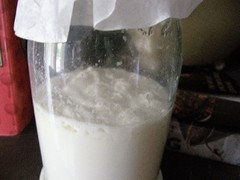
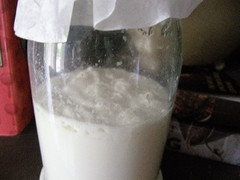
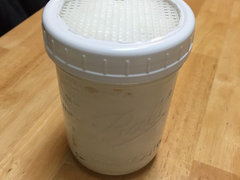
    I've seen some fermentation where there are air-lock lids, mine aren't like that at all. Or even a coffee filter on top fastened with a rubber band. Here's an early picture. I have a lot more grains now.

  • 10 years ago
    last modified: 10 years ago

    pinkmama, the "equipment" is minimal and inexpensive. I bought kefir grains off Craigslist for about $10. I bought two large mason jars with lids from Target and a big slotted spoon. That's all you need. Through trial and error I found skim or low fat milk made far too thin kefir. I now use good quality (Horizon) whole milk. Put the kefir grains in one of the jars and pour several cups of milk over it. Cover top with a paper towel and rubber band. After leaving it about 3 days on the countertop, I then pour the kefir into the other mason jar, holding the slotted spoon over the top to catch the grains. It takes a bit of finessing but beats using (and then having to wash) a strainer. Takes all of one minute. Then I pour new milk on the grains to start a new batch; and put the "done" batch in the fridge (with a tight lid) until cold. Easy peasy. I've been doing this for 6 years now with the same grains, and the kefir is excellent!

  • 10 years ago
    last modified: 10 years ago

    Cassandra, you've confirmed what I've been wondering. Pretty much all of the websites use raw milk. It's not legal to sell raw milk, here in Ontario, perhaps even Canada.

    Since we drink 1%, I'm not buying homo just for kefir. All of the kefir is thin like milk, it's not thick at all. That doesn't matter, using it in smoothies, but it's very tart and sour to drink as it is. Also my salad dressings are very watery, vs creamy.

    I just put some half-and-half in my batch and see if it helps.

  • 10 years ago

    Jasdip when I first started making kefir, it was a stretch to go to whole milk versus the skim I'd had for all my adult life! But now I love it. Whole milk was the key to successful kefir for me. However, I still often stir in a dollop of Greek yogurt to make mine even thicker--I add fruit and eat with a spoon. So that's a way to thicken too-thin kefir. I don't know about using half and half but I suspect it would be equally good.

  • 10 years ago

    I'm going to buy a bag of homo milk just for kefir and see if it thickens for me.

    We can't keep up to it! The grains are growing like crazy, and I've got 2 posts up on Freecyle to get rid of some. It's too sour for our tastes to drink it as is. I do pour some on my cereal, just as a way to use it, topped up with milk, and it's very tart.

    Yesterday I tried a second ferment, using orange peels to try and mellow it.

    But we make smoothies with it, pancakes, made cheese. I try to use it every chance I get. I made a ranch dressing yesterday, but it's not thick. I even bought some buttermilk powder and added some mayo hoping that it would thicken. The flavour is good in the dressing, just that it pools in the dish.

  • 10 years ago

    Cassandra, you are so helpful. I've drunk skimmed milk for years but will happily give it up to make thicker kefir. It's the amount of tartness that concerns me. How does one know in advance if one will enjoy that?

  • 10 years ago

    Well, I don't know if you will know without trial and error! Over time I've come to like mine thicker and quite tart and frothy! But I didn't start that way. Do start slowly as it can do a number on your stomach at first if you are not used to it. It is powerful stuff! As I believe I mentioned the degree of "doneness" depends a lot on the room temperature. It is hot summer now and the curds separate from the whey in about one day of the kefir sitting on the countertop. In winter it can take about 3 days to be "done" to my satisfaction. So you'll have to play with it and decide what you like.

    As a bit of a story my young nephew was in Slovenia touring around the countryside this year (as young people are wont to do I guess) and kept coming across farm stands selling some drink. He didn't know what it was and was appalled when he tasted it--some type of sour milk--horrible he said!! I laughed when I realized it was kefir! It goes WAY back to the old country and in history.

  • 10 years ago

    My grains are multiplying like crazy and I've given some away on Freecycle and Kijiji. Just yesterday and girl was excited to have some to make her own. She grew up on it, in Russia.

    Another girl is coming tomorrow. She had some grains in the past but killed them, and she misses her home-made kefir.

    I did a second ferment with some orange peels, and it's slightly thicker. I've got lots of grains to experiment with, which is fun.

    I just made more kefir and chia pudding, with the slightly orange-flavoured kefir. I put bananas and pineapple in the pudding when I ate it and it was delicious.

    I came across a recipe for Kefir bread, which should taste slightly like a sourdough bread. I'm making that on the weekend. We like the beer bread, so this should be good, as well.

  • 10 years ago
    last modified: 10 years ago

    I just bought water kefir grains -- I haven't used them yet. Should I store them in a cool dry place until use (refrigerator, or the bedroom with the A/C window unit? It's awfully nasty in the house right now!)

    I've watched a few You Tube videos, but any additional pointers from our resident experts such as Grainlady would be appreciated, re water kefir.

    Also I will be out of town for three weeks in the fall. I want to know the best way to store the grains once I start to use them. I see that one can keep them going for a week in the fridge without "help" -- but I'd like to find out about longer term storage.

    Thanks in advance!!!

  • 10 years ago

    Artemis, I'm not sure about water kefir, but milk kefir can be stored in the frig in milk for a few weeks, as long as the container is large enough for them to feed off.

    This is a great site on all kinds of cultured foods......

    water kefir

  • 10 years ago

    I remember reading that it's not good to put them in the frig and take out, regularly. So far I've given grains away to 3 people with a couple more coming this week. I still have lots.

    The heat is crazy here, in the 30's C every day. I get kefir in hours. The other day, it separated into curds and whey overnight. So I have it in the frig again and will take out tomorrow where I can keep an eye on it.

  • 10 years ago
    last modified: 10 years ago

    I love hearing about others experiences with kefir! I've been "doing" kefir for about three years now. Grainlady has consistently been my best source of info. Thank you Grainlady! Our temps have been in the 100's (F) and I have found that 12-15 hours gives me the tartnesss I enjoy without being TOO sour. DH hates it, so I don't have to share. In this heat, the cycle goes like this: take the pint jar with kefir (including the grains) out of the fridge in the morning, put a solid lid on the jar and give it a good shake, fish out the grains with a plastic fork and put them in a clean pint jar and fill with whole milk. I bought plastic lids for Ball jars, heated a knife and cut most of the top out, got some large square plastic canvas mesh (the kind used for coasters and such), cut it to fit over the top of the jar, then add my holey lid. It sets on the shelf over my sink, not anywhere near a window, until I put the jar in the fridge before I go to bed. The kefir I separated goes into my travel cup to enjoy on my way to work, usually with a little agave nectar, but sometimes plain. In what we Californians laughingly call winter, I'll give the milk and grains a full 24 hours to ferment.

  • 10 years ago

    Donna, so it's absolutely fine to refrigerate the grains every day??

    I took mine out of the frig this morning and about the top 1/3 of the jar has the grains. I'll wait a little longer so that it spreads further down the jar.


  • 10 years ago

    Jasdip, I don't put it into the fridge to make the kefir, but to halt overproduction because of our intense heat. I don't do that during the winter, and let the kefir "brew" for 24 hours. I'm not sure if you and I are thinking of the same thing as grains. The grains are the cauliflower looking blobs and you certainly don't want them to fill your container. In my pint jar, I use about two tablespoons of grains. And my kefir is thick and creamy (cuz I use whole milk, I guess). When I have more than that, I either just eat them or place them in a bit of milk in the fridge if I don't know anyone who wants them and change the milk every couple of weeks. Secretly, I'm always afraid something will happen to the grains I'm using and I'll be SOL.

  • 10 years ago
    last modified: 10 years ago

    Donna, I know you put it in the frig to slow it down. I do the same. I've read that the grains shouldn't be refrigerated regularly. It's okay to do when going on vacation (covered in milk) but not to make a habit of it.

    My little guys are multiplying like mad and I put grains in smoothies, and have given some away on Freecycle/Kijiji. I've had people thrilled that I have them, because they've killed theirs off.

    For the first time in my life, I bought Homo milk for the kefir. Mine is not thick and creamy using 1% so this is purely an experiment.

    I love, love using the whey (from a too-long of a sit, and my batch separated into curds and whey) in cranberry juice etc. It's really good. That's how I made the cheese; from the curds.

  • 10 years ago

    Jasdip, this summer is the first year I've done it this way. I've been doing it for a couple of months and I see no difference in the way the kefir tastes, how thick it is, etc., so I don't think it's doing the grains any harm with their daily chill. I go to bed at 11:00 p.m. and I'm up by 5:30, so we're only talking about 6 hours a day in the fridge. But, remember what I said about keeping some in the fridge constantly? I change the milk every couple of weeks, and then when it's time to thin the herd in the kefir I make daily, I will replace some of the grains in the working jar with a few from the one I keep in the fridge, throw the rest of the "fridge kept" grains out and put the extra from the working grains in the fridge to start that standby jar going. Hope that made sense. It seems to be working for me and may be part of the reason I am not inundated with grains as you seem to be.