Advice on retirement gift
10 years ago
last modified: 10 years ago
Featured Answer
Sort by:Oldest
Comments (35)
- 10 years ago
- 10 years ago
Related Discussions
My retirement party and gifts
Comments (1)Congratulations on your retirement! You'll have a lot more time for entertaining now .... I'm glad the party was so great. Good for you!...See MoreNeed advice on closing retirement account.
Comments (23)Hi again dolcemia, I am pleased that your husband has a retirement plan ... and that you have one, as well. At what age can you begin to draw on them? Usually they are set up to begin at age 65 ... can you choose to begin drawing before that? For example, in Canada, the Federal pension, to which we all contribute, which began over 40 years ago, intends to have us retire at 65, with full pension (if we made full rate of contributions ... which you don't, if you earn anything near minimum wage, meaning that low income hurts, even into retirement). If I choose to retire earlier, they won't allow me to do it before age 60, and for each 2 months that I retire before age 65, they reduce my pension by 1% ... which means 6% per year, and if I chose to retire at age 60, there would be a 30% reduction. On the other hand, if I choose not to retire until after age 65, I get a bonus of 1% for each 2 months extra that I work and contribute, 6% per year. Is your pension set up so that as inflation continues over the years, does the amount of your pension increase, as well? If there is a provision for it to increase due to inflation, it's almost certain that it won't increase at the same rate as the rate of inflation, but less ... which means that it won't cover as many expenses as the years go by as it would earlier. They call that a pension being indexed for inflation. Is your husband's pension indexed to inflation? ______________________ Do you owe money on credit cards, that you don't pay in full each month when the bill arrives? Is it/are they mainline cards, or cards issued by stores? Do you know what rate of interest that you pay on those unpaid balances? Usually on mainline cards it's about 15 - 18% annual rate. Usually on store-issued cards it's up around 25 - 28% annual rate. If I loaned you $100. and said that you owed me $25. per year for the use of it, would you consider me some kind of rascal? May I ask you a question ... have you heard the saying, "A penny saved is a penny earned"? Do you believe it? If you say that you agree, I'd like to disagree, in terms of much of the stuff that, when you buy, you might be able to save a dollar on the purchase. When you consider most of the stuff that you buy ... when you prepare your income tax, can you deduct the price of it as you calculate the amount of tax that you owe? For much of the goods that most of us buy ... the cost is not deductible. Which means that we have to buy it using money that we've already paid income tax on, i.e., after-tax money. Let's suppose that you could save $1.00 on a purchase that you make. If you're in 25% marginal tax rate (i.e. the rate of tax that you pay on your top dollar of income), that means that you have to earn $1.33 before-tax, then pay 33 cents tax, leaving yu with $1.00 in hand to go out to buy that item. So .. if you save $1.00 on the cost of the purchse ... you've saved $1.333 of extra earnings, right? Plus... if you pay that 28% on a store-issued credit card, most of the things that you bought when using it were not tax-deductible, right? Which means that, if you're in 25% income tax rate, you have to earn $36.00 pre-tax income, then pay the 25%, or $9.00 income tax, leaving you with $27.00 ... oh,oh ... not quite enough to pay that $28.00 owing. Drat!! When you buy a car (or do you lease) do you pay cash for it, or do you finance it? If finance, do you shop around to find the best rate of interest and terms? Are you a member of a credit union, or are there some in your area? Sometimes they offer lower rates, or better terms, than the usual market offers. Do you try to pay the loan off as soon as possible? I recommend that. Be sure to pay off the loan quite a while before you need to replace the car. Then keep putting away that amount of money (or nearly as much) each month, building a fund to enable you to make a far larger down payment on the next car. It would be best if you can pay the full cost in cash ... that lets you put the amount of interest into your own pocket that you'd been paying earlier to a lender. I like keeping my money in my jeans over paying others to borrow theirs. Do you have an emergency fund? That is, if you had no family income for 3 months (or, even better, 6 months ... or, better yet, a year) would you have anough money available that you would still be able to live fairly comfortably? It's important to have such an emergency fund, in case unexpected expenses crop up ... including if we get laid off from work, especially if permanently, as your husbnad is dealing with at the moment. I recommend learning how money works - it's an interesting hobby. And, know what? It pays well ... very well. As I said earlier .. pay off your store-issued credit card balances fully when they come in each month ... save yourself 35%. And that saving is ... guaranteed. Where else can you earn 35% on your money ... guaranteed!?!? Good wishes for making your money work harder for you than for the other fellers! ole joyful...See MoreNeed advice on buying vacation/future retirement home close to be
Comments (21)To clarify some things about our ideas to buy on Isle of Palms - while we're going to hold off on buying, and may not ever buy on the island itself, the area around it seems to be exactly what we're looking for our retirement years. The island is less than 13 miles to downtown Charleston, and only 20 miles to the Charleston Int'l airport. Even closer than Charleston is Mount Pleasant, about 4 miles away (across the Inter-coastal waterway and a marsh), which has plenty of shopping, restaurants, medical care including a decent hospital. In addition to wanting to live close to the ocean, we want to live near good medical care (this is most important), shopping (I'm not going to stop doing DIY projects on any home I live in until my body gives out - it's my hobby), airports, etc. I love the beach - every vacation we can we go to a beach - we've visited many of the east coast beaches over the years - I never get tired of it. My husband loves salt water fishing. We have a boat that he takes onto the Chesapeake Bay all the time to fish, and we go tubing on the Potomac River with our grown kids and grand kids (who are still very little). We've planned on retiring to as close to the (right) beach as possible for at least 20 years and I think it's safe to say that we're not going to change our mind about that between now and when we actually retire. And I definitely don't want to ever live someplace rural again - did that as child and have family still there - definitely not for me. Even if we were young I don't want to live in a place where there aren't plenty of doctors, including all types of specialists, and I don't want to live someplace, where if one of us was in the hospital, the other would have to drive over an hour back and forth. I'm honestly surprised at how many people I know who retire who don't care about that aspect at all. So - given what we know we want/need, we've been considering all the areas close to the Atlantic between Wilmington NC and Jacksonville FL. A few years ago we visited every place that even seemed to come close to what we want. But when we were looking before our income and savings were a fair amount less than they are now, and housing costs and interest rates were higher, so it limited where we would be able to afford to buy, so we didn't consider some of the areas we could afford now. And this is a retirement place we're talking about - being able to vacation in it before retirement is a bonus. We could wait until we retire to buy, but as I said in the original post, I don't want to miss an opportunity to buy while the prices are low AND the interest rates are low. But I do think we need to slow down and take our time - visit and stay there during different seasons, including the heavy tourist season, and make sure that it's what we want. We may find that living on an island/beach itself is not that great and that we should go back to what we always considered to be our only option - living on the mainland, but close to the beach. People seem to think that prices will be low for a while - I don't want to buy and then see prices drop even lower - and that interest rates will be low for a while too. So I realize that there is no rush - but I still don't want to kick myself years from now for missing any "deals of the century". I know this was long - sorry about that - but I think my first post gave the impression that the whole idea of buying at/near a beach, and this one in particular, was hurried and not thought out. While rushing into it right now is undoubtedly a bad idea, I don't think the concept of buying a home sometime soon for retirement in a few years, if the prices and interest rates are really low now, is a bad idea....See More35 year old teacher seeking solid retirement planning advice
Comments (15)I'm a teacher too, and I can give you some advice on some of these topics. I am 100% sure we're not in the same state because you make more money than I do (though I have 24 years experience). - First, you sound like you're doing very well for your age. You should pat yourself on the back for realizing the importance of saving and thinking about retirement well before most people your age. - I'll second the point about talking to your potential fiancée about finances ahead of time. Do not just assume it'll all work out. - Buying a house is a sound investment. I assume you'll sell your current paid-for house, so you'll have about 120K to put down on a new one -- excellent. Even if she brings little to the table for this project, the two of you should be able to knock out the borrowed 100K within five years (even if you have a baby soon). With no mortgage, you'll be amazed at how much easier it is to live comfortably and still save! - Do you have a savings account for a new car? Since yours is paid for, I suggest you begin paying a car payment into a savings account. Once you get yourself "a car ahead" (meaning that you're ready to buy a new car when you need it, so that you're not wasting money on interest), it's easy to STAY "a car ahead". - I have the impression she's a teacher too? If the two of you work at the same school, consider becoming a one-car family. We did it for several years (until I started teaching, and our schedules were completely incompatible), and it was a MONUMENTAL money saver for us. It was the single biggest thing that allowed us to get off to a good financial start in our 20s. - If you hate your job (I do at times, really, I do) but want to stay in the pension system, could you do something else within the school system? Could you be the tech guy? the athletic director? could you do something different as a state employee -- a possibility, if your pension systems are linked? - I don't think you need to think about life insurance at this moment. Not to be crass, but if you died today, would anyone be worse off financially? With no wife or children, probably not. Once you're married, you probably won't need it yet. If you were to die, your wife could use your pension pay-out and your other investments to pay off the modest house payment you anticipate taking out, and she'd still have her job to sustain her. You WILL need life insurance once you have a child. If you were to die and leave your wife with a toddler, she'd have years ahead of her in which she'd be a single parent, and although her salary would be enough to put food on the table and clothes on their backs, your life insurance would be there to educate the child in the future. The life insurance would also assure you that your wife would be able to take some time off work, and that she'd be able to put aside a good chunk for retirement. Remember, she too will need life insurance. If she left you with the toddler, you'd need the same help. - The two of you probably need disability insurance more than you need life insurance. Statistically, you are more likely to be disabled than to die young. And becoming disabled is the real nightmare scenario (from a financial standpoint). Consider: You're in an accident or you become sick. You cannot work, so your household income's slashed in half. Yet your medical bills are sky-high. Your wife is still working, but she's also doing ALL the housework and ALL the childcare AND is trying to help you with your physical therapy. She's burning through her sick days taking you to the doctor. THIS is the nightmare scenario: She's overworked, AND she can't take advantage of your life insurance. Avoid it by signing on for disability insurance. - Another thing you should do after you marry is to write wills. As a teacher, you probably have access to your an employee's credit union? They probably offer such services for a low price. - About your pension: Do you know the details for the pension in your state? In my state you're fully vested at 10 years (so, yeah, you'd be a fool to leave at 9.5 years), and you can collect a full pension at any age once you've put in 30 years. You can collect a reduced pension at 20 or 25 years, though the dollar amount is reduced, and you can't begin collecting until 65 (65?) if you don't put in the full 30 years. Once you find out the details for your own state, you can "run the numbers" and see when it makes sense for you to leave teaching. It might be sensible for you to aim for 20 years, then do something else -- but you have to get the facts, then do your homework. - How secure is your state's pension? This is public knowledge, so look into it. You do not want to put all your eggs into the "staying in teaching" basket, if your state's weak in the pension department. As the people in Detroit! - In my state the pension program (defined benefit program) is being exchanged for a defined contribution program. This has its pros and cons, but overall it means that the new, younger teachers aren't going to get a pension. Why does this matter to you? Because if you ever leave, then return to teaching, you'll come in under those new rules! - An above poster mentioned Social Security. In my state, teachers DO pay into SS, so I will collect an SS check one day. You seem rather financially savvy, so I assume you know whether you've been paying into this or not. - I disagree with the above poster who says you're essentially screwed if you choose to have children AND want to retire at a reasonable age. The key is that you have to choose to live FRUGALLY. My husband and I are 48 and 51, and we have two college students. When we married, we had between us $200, college degrees and jobs, one car, and a brand-new mortgage. We chose to be frugal from the very beginning: We maxed out our 401Ks, even though it meant we couldn't afford vacations. We built an emergency fund, then started a savings account, putting away 1/4 of our after-taxes paychecks, even thought it meant we rarely ate out or bought new clothes. When our savings account grew, we started investing, even though it meant we had to remain a one-car family. Today we live in a house that's paid for, have significant investments, and are easily able to pay for our two college students' expenses -- they will graduate debt-free. My same-aged friends who wail that they can't afford their kids' college tuition don't like to hear that we buy used clothing, drive an 8-year old car, etc. The key is knowing the difference between needs and wants -- and being self-disciplined enough to stick to a budget. - Finally, I think you're off to a good start. If you and your wife are both about 10 years into teaching, then 20 years from now the two of you can expect the following: 1. You'll be about 55 years old, and as a person who can "see 55 from where she's standing", it's not "old" -- at 48, my knees hurt sometimes, but I can still hike all day and can pretty much still do whatever I want. 2. You'll live in a house that's paid for. 3. You'll have two teacher pensions. 4. You'll have teacher health insurance in retirement. 5. You'll have two Social Security checks. 6. You'll have the investments you've already begun. 7. If you have a child soon after your marriage, that child will be finishing college (and beginning to support himself) about the time you retire. You'll be able to have all these benefits AND you can work part-time (or seasonally) so you can avoid dipping into your investments too early. Though you're not earning big bucks now (or ever), you'll be well prepared for retirement. If the two of you put in a total of 60 years of teaching to earn these benefits, you'll have WORKED for every penny, but you'll have a comfortable retirement....See More- 10 years ago
- 10 years ago
- 10 years ago
- 10 years ago
- 10 years ago
- 10 years agolast modified: 10 years ago
- 10 years ago
- 10 years ago
- 10 years ago
- 10 years ago
- 10 years ago
- 10 years ago
- 10 years ago
- 10 years ago
- 10 years ago
- 10 years ago
- 10 years ago
- 10 years ago
- 10 years ago
- 10 years ago
- 10 years ago
- 10 years ago
- 10 years ago
- 10 years ago
- 10 years ago
- 10 years ago
- 10 years ago
- 10 years ago
- 10 years ago
- 10 years ago
- 10 years ago
- 10 years ago
Related Stories

DECORATING GUIDES10 Design Tips Learned From the Worst Advice Ever
If these Houzzers’ tales don’t bolster the courage of your design convictions, nothing will
Full Story
LIFERetirement Reinvention: Boomers Plot Their Next Big Move
Choosing a place to settle in for the golden years? You're not alone. Where boomers are going and what it might look like
Full Story

LIFEGet the Family to Pitch In: A Mom’s Advice on Chores
Foster teamwork and a sense of ownership about housekeeping to lighten your load and even boost togetherness
Full Story
KITCHEN STORAGEKnife Shopping and Storage: Advice From a Kitchen Pro
Get your kitchen holiday ready by choosing the right knives and storing them safely and efficiently
Full Story

DECORATING GUIDESDecorating Advice to Steal From Your Suit
Create a look of confidence that’s tailor made to fit your style by following these 7 key tips
Full Story
FEEL-GOOD HOMESimple Pleasures: Treasuring the Gift of Grandparents
You can enrich your family life by bringing generations together for shared meals, quilting projects, storytelling
Full Story

CHRISTMASGift Giving the Simple-ish Way
If buying holiday gifts drives you to the spiked holiday punch, try these easier but still rewarding traditions
Full Story
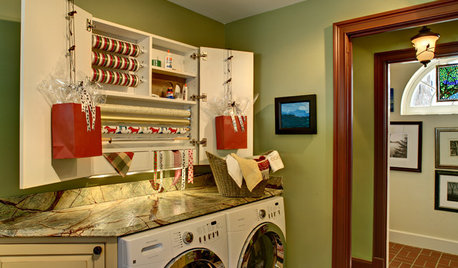
HOLIDAYS9 Ultimate Gift Wrapping and Crafts Stations
Ribbons spooling through an open door; colored paper nipping at your nose — workstations like these make the holiday season even brighter
Full Story
LIFEYou Said It: ‘Limit the Gifts’ and More Houzz Quotables
Design advice, inspiration and observations that struck a chord this week
Full Story

HOUZZ TOURSWe Can Dream: Rural Retirement Home a Haven of Beauty and Tranquillity
A retired couple builds a spacious Japanese-inspired indoor-outdoor sanctuary to enjoy with extended family
Full StorySponsored

Central Ohio's Trusted Home Remodeler Specializing in Kitchens & Baths
Sue_va