

Finally Got "The Americans" Season Two (2014)
11 years ago
Featured Answer
Sort by:Oldest
Comments (14)
 11 years ago
Related Discussions
2013 rose season/2014 rose season
Comments (13)I had similar experiences. Like Seil I had a hard winter, lots of dieback, too much rain and cloud cover, so much BS, but some spurts of great roses blooming. Sara, last year I had more roses and could cut a bouquet whenever, not this year, about 1/3 less blooms. However, right now the bushes are looking good with chance of frost tonight. I plan on cutting this evening! I do think I had more fun growing and enjoying my roses this year than in the past....See MoreSaturday's Season Finale Photos
Comments (23)Nat - Some of the lates do rebloom. Amber Finale has an instant rebloom scape. But most will not because come August, I don't water much. I'm a teacher and the beginning of school is such a killer, I'm too tired to water except on the weekends. For people who water and who have a long growing season, I would think lots of lates would rebloom. Mantis - My wonderful framing is mostly an attempt to avoid the weeds - but they're in the photo anyway. LOL Celeste - With reblooming, I'm sure I'll be posting a few photos now and then. The cats are not as available or photogenic when it's so hot, and this week we'll be near 100 most days. Debra...See More2014 growing season and varieties
Comments (52)My beans are all finished for the year, vines pulled, seed collected with the exception of the Andean/Ecuador beans, the frame they're growing on is now covered with plastic, these last few (with the white flowers) are still flowering and producing beans, I'm thinking these ones are day length sensitive the rest have been finished for awhile. This has been a fun experiment but doubt if I will grow them again. I have a fair amount of seed from them so if anyone wants to play with them :), I would think they are one used as a dry bean, the pods are as tough as shoe leather. I had trouble with two varieties, North Carolina Speckled Long Greasy Cutshort' and 'Soissons Vert' started in pots, they looked sickly so tossed them and started more seed. I finally got a few 'NCSLGC' going up a pole and we manages a few snaps from them but it was the one accidentally dropped beside the 'Mr. Tung's' pole, this one grew like it was on steroids. We had several meals off it and I harvested a fair amount of seed. 'Soissons Vert', I ended up with one healthy vine so I have enough seed to try again next year. The 'Chinese Red Noodle' did just OK, not great but we did get a couple of meals and the 'BJBB's', planted in the greenhouse gave me enough for a couple of meals and enough seed to grow again, they are so tasty. Everything else did great, I still had a few seed left of 'Poletschka' so planted those, from 15 plants I got 2.85 lbs of seed, I didn't try them as a snap or shelly so can't comment on how they taste. I'll keep a sample in the freezer but the rest I'll give to my neighbor, he uses a lot of dry beans we don't. Annette...See MoreMy 2014 Seed Order (almost final - would love input!)
Comments (6)Shelley, Viva Italia is pretty compact--reaching maybe 3 or 3.5' in height. It doesn't spread out a whole lot, so you can plant them closer together than you'd plant an indeterminate. I prefer indeterminates because tomato plants that are 6 to 8' tall generally give me a larger harvest than those that are 3' tall. It makes sense as there is twice as much plant there with the taller varieties. Heat tolerance, like beauty, is in the eye of the beholder. What a person considers heat tolerant can hinge, largely, on what level of heat their area has. A hot summer in Pennsylvania, for example, is not the same thing as a hot summer in southern Oklahoma. I have not noticed that Viva Italia is any more or less heat-tolerant than any other paste tomato. For me, paste tomatoes set fruit in hotter weather in the summer than slicers do, and since they do that, I tend to think of all pastes, as a group, as being better heat-setters than slicers and beefsteaks. I don't necessarily notice a huge difference between paste varieties in terms of which one is still setting fruit when my daytime high is 95 versus 98 versus 102, but it is clear to me that they continue setting fruit in July long after the heat and humidity have shut down most slicing types. The spacing of tomatoes is a hugely complicated subject. I vary my spacing from year to year, depending on the variety I'm planting as well as what sort of weather I am expecting. I space them farther apart if it is going to be a wet year because they will get a lot bigger, and space them more closely if I expect a drier year. I space them farther apart if I know from experience that the variety I'm planting grows into big monster plants. I space them more closely if experience has shown me that they tolerate closer spacing. I might space them more closely in a bed that's been super-enriched that year with the addition of tons of compost, and might space them farther apart if that bed didn't get much compost lately. So, I cannot tell you how closely I space tomato plants because I vary the spacing from year to year, and even from one raised bed to another in one year. In general, three foot spacing is fine, and four feet is better for the largest indeterminates. You can space some determinates 2' apart although 3' apart is better. Some years I want to grow too much of everything and cram plants in much more close to one another than I should. What works for one variety doesn't work for another. You just have to experiment with different spacing in different situations until you learn what works for you in your soil and with your temperature and with your moisture levels. With Tess' Land Race Currant, I don't like to plant anything within 4 or 5' on any side of it because it is a monster plant. It would be smarter to just plant it out in the middle of the yard where there's nothing within 8' of it. So, you have to know your plants and how they grow in your soil in the average year in order to determine what spacing works best for you. Closer spacing often gives you fewer fruit per plant, but if it enables you to plant more plants in the square footage you have available to you, you still might get a larger harvest overall. I always plant 4 times as many tomato plants as I need (though never as many as I'd truly love to plant) and I plant them twice as close together as I know I should. Virtually every year I get all the tomatoes we can eat fresh, all the tomatoes I wish to can, dehydrate or freeze, and still have plenty to give away, so I won't change planting that closely....but I wouldn't necessarily recommend such close spacing to someone else because I don't know what their soil, their moisture levels, and their weather will allow. Make sense? In a perfect world, I'd plant my indeterminate tomato plants 4' apart in rows 6' apart, but in the real world, they are lucky if I plant them in 3' apart in rows 2' apart. I'll have a two-foot pathway, then a 4 or 5-foot wide raised bed that has two rows of tomato plants, then another 2' wide path, then another raised bed. I don't even measure how far apart they are. I just eyeball it, though I've done it long enough that I can eyeball it pretty well. What works for me with the soil I have and the fertility level it has reached after 15 years of improvement might not work for someone else with different soil. So, spacing is something you have to master for yourself in your own conditions. Because the heat tends to shut down production at some point in June or July, I try to get all my canning done in June and the first part of July, and then I can just yank out the paste tomato plants and focus on other parts of the garden. Usually by mid-July, I've 'had it up to here" (lol) with canning tomatoes and am ready to move on to making pickles or canning peppers or whatever. Some people in some parts of the country that cannot put their plants into the ground until late May or early June haven't even starting canning tomatoes yet, and there I am already done....and glad to be done. Canning in August when the high temps are 105 to 110 or even higher is not my favorite activity. I'd rather be done with all the canning before we get that hot. Finally, the single factor that plays the greatest role in what sort of fruit set I get in any given year is simply how early I can get the tomato plants into the ground. My average last frost date is March 28 but we usually have a freezing night about once a week through the first week in May. If I waited until May to put transplants into the ground, it likely would get too hot for fruitset before they even had time to flower and set fruit, so I'd have to wait until autumn to harvest tomatoes. Instead, I plant as early as I possibly can, cover up the plants with floating row cover when cold weather threatens, and do whatever I can to get those plants flowering and setting fruit before the heat sets in. This involves lots of guess work and lots of hand-wringing when April brings an Easter snow storm a month after I put tomato plants in the ground. Heat tolerance will carry you and your tomatoes only so far, but you can win the war by planting early, early, early. Gordon Graham liked to put his tomato plants in the ground two months prior to his last frost date in Edmond, and he often had to stack two WOWs on top of one another to protect his tomato plants from late freezes or frosts or snow or sleet. I have a sloping garden so WOWs don't work for me....they just topple over and roll downhill when I fill them with water. I use floating row cover instead, and in some years when early warm weather was followed by snow around Easter, I have built low tunnels of PVC pipe and 6 mm greenhouse plastic and kept the tomato plants covered by the low tunnels for almost 3 weeks. Since our weather seldom cooperates with us, we just have to work around it in order to achieve the garden harvest we want when we want it. My best tomato year in ages was in 2012 when I was able to start putting tomato plants in the ground around March 10th. We still got really hot in June and were really dry in July and August, but the plants had set huge loads of fruit in April and May, so that I was able to just keep harvesting them pretty deeply into summer. A year with an early last freeze like that is pretty rare---maybe once a decade or, in a really good decade, maybe twice. I correctly concluded, based on the January and February weather, that I could plant in March that year and it all worked out. However, you're really just guessing when you take that sort of risk and it can just as easily not work out. If my soil temperatures and air temperatures are in the right range for the tomato plants, I'll plant early more often than not. It is the air temps and the soil temps that either allow the tomato plants to grow or not, not a specific date on a calendar, so I tend to plant when my brain tells me to, not when a calendar says it should be safe. As erratic as our weather is, I almost never do things the same way two years in a row. That is part of what makes gardening fascinating.....it is like playing chess with the weather and you have to use whatever strategy it takes to help you win the game. Tracy, I was sort of assuming that TLC would have BI seeds, but didn't want to guess. Thanks for confirming that. Carol, Thanks for linking the recipe. Dawn...See More 11 years ago
 11 years ago
- 11 years ago
- 11 years ago
- 11 years ago
- 11 years ago
- 11 years ago
- 11 years ago
- 11 years ago
- 11 years ago
- 11 years ago
 11 years ago
Related Stories
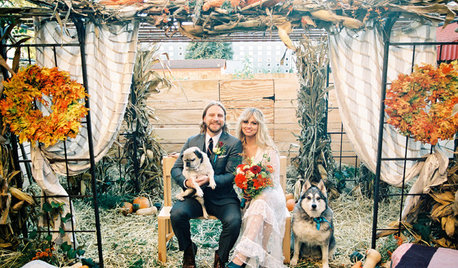
WEDDINGSHow One Couple Got a Perfectly Intimate Backyard Wedding
Vintage pieces, natural materials and close family and friends are an ideal combination for a Pittsburgh couple
Full Story
HOUSEKEEPINGGot a Disastrously Messy Area? Try Triage
Get your priorities straight when it comes to housekeeping by applying an emergency response system
Full Story
Call for DIY Projects: Show Us What You've Got!
Share a Pic of Your Handiwork with the Houzz Community
Full Story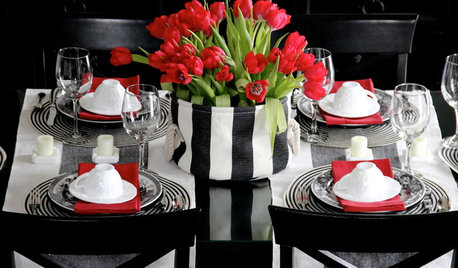
ENTERTAININGGot Hand-Me-Down Dinnerware? Make a Memorable Meal
They might be mismatched and not your style, but those inherited plates and forks can help bring meaning to your table
Full Story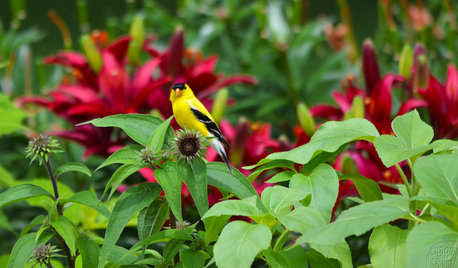
GARDENING GUIDESBackyard Birds: How to Care for American Goldfinches
The American goldfinch is a bright-in-the-summer visitor and one of the only vegetarian songbirds. Here's how to give them a healthy habitat
Full Story
DECORATING GUIDESCelebrating the Great American Quilt
They speak of family, history and beauty. Is it any wonder quilts transcend design styles?
Full StoryGARDENING GUIDES13 North American Backyard Birds to Know
Find out about these enchanting native species and learn how to attract them to your yard
Full Story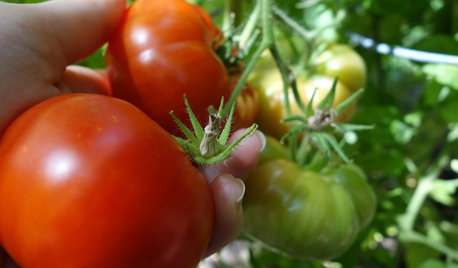
LIFEKitchen Traditions: Tomato Season Meets a Family Legacy
Somewhere a Sicilian great-great-grandmother is smiling at a bowl of American-made sauce
Full Story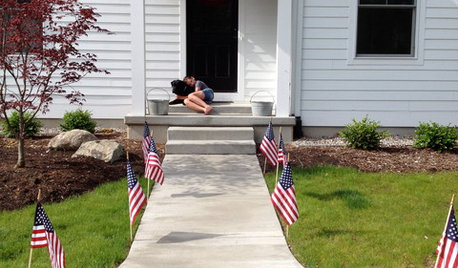
MOST POPULARHow to Hang the American Flag at Home
We’ll show you how to display the American flag on your house for Memorial Day, the Fourth of July or all year round
Full Story
ROOTS OF STYLERoots of Style: The Indelible Charm of American Tudors
Rich details and an intimate scale give this English-inspired architectural style memorable character and flexibilty
Full Story
Fran