

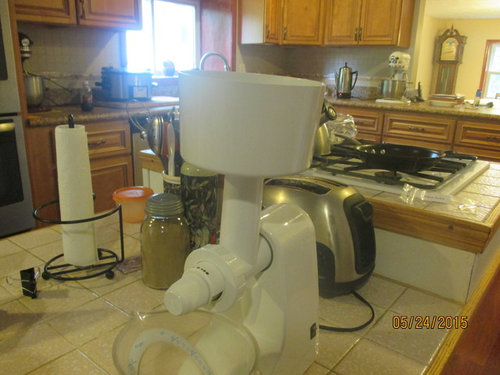
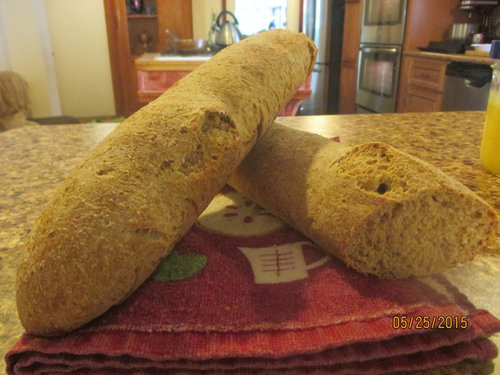
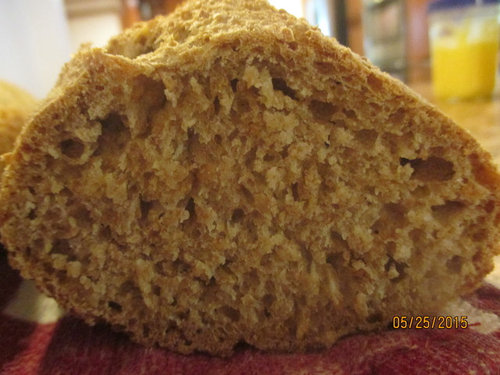
My first flour from the grain mill...
11 years ago
last modified: 11 years ago


Featured Answer
Sort by:Oldest
Comments (7)
 11 years agolast modified: 11 years ago
Related Discussions
Electric vs. Manual Grain Mills
Comments (1)I don't know about a manual mill because I have never used one. I recently started using my Mil-Master for wheat and it mills as fine as store bought whole wheat flour is one pass....See MoreRe: Fresh Milled Grains and Bylers's in Seymour, Mo.
Comments (11)Yeah, I just checked some of those prices against those on Bulkfoods.com, where I order a lot of my stuff. Bulkfoods' price for a pound of yeast is $6.34. They have several different kinds of sugars so I don't know which to compare. Their rolled oats are $8.35 for 5 pounds and $3.45 for 1 pound. I checked KA's prices and it's $5.95 for two pounds. I can't tell how many pounds are in the bag but it looks like it says .54 per pound so that would come out to five pounds. In that case, $2.70 is a very, very good deal. I want to go there so badly! Plus I have a little genealogy work I could do on the way there or back, in Cabool, MO. But I just don't feel like I can leave the house unattended right now, what with the caliber of friends DGS has made. Last spring, when we went to Marienthal, DGS was at Church camp for the week and we were able to board the dog and lock the house up. He's too old now for church camp, and I feel like these friends of his wouldn't think twice about coming in and raiding our freezer. And maybe worse. Lately he's been putting his friends ahead of us so I just don't feel comfortable about leaving for several days as long as DGS lives here and has a key. Not only would I not trust him to let his friends have full access, but I'd worry every minute that I was gone that he would leave for work with the house left wide open, or leave for work and leave them alone in my house. I wouldn't feel so bad about a day trip, because the risk is less, but going to Bylers would require more than that....See MoreHelp me make my own flour, cracked grain etc.
Comments (14)Lalitha- Sorry, I don't have any experience with, or information about, the mills you are inquiring about. One rule-of-thumb I can share: stones grind finer than steel burrs, and an impact mill the finest flour of all, and that's about all I can help you with; other than a great respect for German workmanship and they are indeed very handsome mills. The price would be my biggest deterrent. Even though I have a couple stone mills, I also keep extra stones for the mills because they can chip, flake and break (check for stones and grit in your grains/seeds/beans before adding them to the mill hopper), or glaze over from too much moisture in your grains/seeds/beans. The stones are also made from a variety of things, including man-made "stone". When using a stone mill, you may need to mill the grain on a coarse setting, and then run the flour through again on a finer setting in order to get the fine flour (especially necessary for making cakes and a fine-crumb for yeast/naturally-leavened breads. How an impact mill works: "Impact grinders use rows of 'blades' placed in circular rows on metal wheels. One wheel turns and the other wheel is stationary, like the stone grinder. But this is where the similarity ends. The two wheels are aligned so that the rows of blades intermesh, running extremely close, yet never touching the blades on the opposite wheel. The rotating wheel turns at several thousand RPM. As grain is fed into the center of the fixed wheel, the interaction between the two wheels `impacts' the grain and pulverizes it [Grainlady note: the grain "explodes" rather than being crushed] into fine flour as the grain works its way to the outside of the wheels." For REAL sandwich bread--- I would suggest purchasing a Pullman (Pain de Mie) Pan (a square pan with a lid). This pan will allow you to make that crustless, close-grained bread that will help you transition from commercial sandwich bread to homemade. A close-grain crumb is what you want in order to be able to cut thin slices, hold moist spreads (without dripping through a hole), and still be able to hold together to eat out-of-hand. That's the more-or-less "technical" characteristics for sandwich bread. A more open crumb is best used for toast. All those lovely places to hold melted butter and jam. I have a 1-pound Pullman Pan (perfect for hubby and me), and a 2-pound for when the house is full of family visiting. Another tip for making a fine-crumb bread is to add the fat early during mixing. The fat coats the gluten, similar to making short-crust pastry. If you want a more open crumb (as well as more loft), add the fat late in mixing, after the gluten has developed. For making 100% whole wheat bread (or multi-grain where one of the grains is wheat), I suggest using hard (spring or winter) white wheat over red wheat. White wheat flour has a mild flavor and lighter color and is less acidic-tasting than the flavor associated with "whole wheat bread" made with red wheat varieties. White wheat has the same plant traits and nutrition as red wheat varieties, it's just missing the genes for the bran color. There are three genes that make up the bran color. Early varieties of red wheat (such as Turkey Red) had all three genes and are very dark in color (bran, flour and finished product) and a strong "whole wheat" taste. Most of today's varieties of red wheat have one or two of those genes, while white wheat has none. I use and store both red and white varieties of wheat. Step back a generation or two and use a sponge method over the quicker straight (or direct) dough method. You'll find you get a finer texture. The "wait" gives the bran in the wholegrain flour time to soften (the hard sharp shreds of bran can actually cut the gluten strands), and you'll get a high-rising loaf of bread. According to "CookWise": "Researchers suggest that an ideal standing period is 2-1/2 hours." I typically use an overnight sponge with 100% wholegrain flour works well to lighten the bread. If I'm in a hurry, I use a 2-1/2 hour sponge with good results. I also add 1/4 t. ascorbic acid per loaf to counteract the negative effects from Glutathione (found in wheat germ) on gluten-development. This will help prevent baking those squatty loaves of 100% whole wheat bread. -Grainlady Here is a link that might be useful: King Arthur Flour - Pullman Pan...See MoreNutrion of milled wheat: Freeze flour vs. dough
Comments (2)As a longtime home flour miller, FRESH IS BEST when it comes to maintaining the nutrients in flour, as you already know. Studies have shown that vitamin loss begins as quickly as 3 hours after milling. I'd choose to make bread and freeze it, but you can also freeze the flour ASAP after milling. Freezing only slows down the nutrients and germ oil from degrading in the flour, it doesn't stop it, so it's also only a short-term solution. Bread (baked) will have a storage life of about 3-months in the freezer. Using honey in your breads destined for freezer storage will help them keep better than using sugar in the recipe. It helps maintain the moisture in the crumb. It's also important to wrap breads tightly. I suggest one or two layers of plastic wrap, then foil. The tight wrapping helps keep the moisture from migrating from the crumb of the bread, through the crust and forming ice crystals. I freeze nearly all my breads and I never have a problem with ice crystals. I also slice the bread AFTER it's thawed. Unfortunately, frozen dough has an even shorter freezer life than either the baked bread or freezing the flour. Frozen dough keeps 4-8 weeks. And as Annie pointed out, you can have a yeast failure when you freeze dough. A "good" freezer dough recipe will use more yeast than a normal recipe because freezing will kill some of them. Commercial frozen dough has a much higher ratio of yeast in it. I hope you get your mill soon because I'm sure you will love it. I saved my $1 bills (seemingly forever) so I could purchase my first mill, and now I have a bevy of them!!! -Grainlady...See More- 11 years ago
- 11 years ago
- 11 years ago
 11 years ago
- 11 years ago

Related Stories

MATERIALSFabric Focus: Decorate With Grain Sacks for Quick Farmhouse Style
Vintage and reproduction grain sack material creates thick, durable upholstery for sofas, chairs, pillows and more
Full Story
HEALTHY HOME6 Tips From a Nearly Zero-Waste Home
Lower your trash output and increase your quality of life with these ideas from a mom who did it to the max
Full Story
DECORATING GUIDESPop Culture Watch: 12 Home Trends from the '80s Are Back
Hold on to your hat (over your humongous hair); interior design elements of the 1980s have shot forward to today, in updated fashion
Full Story
FEEL-GOOD HOME12 Very Useful Things I've Learned From Designers
These simple ideas can make life at home more efficient and enjoyable
Full Story
REMODELING GUIDES8 Lessons on Renovating a House from Someone Who's Living It
So you think DIY remodeling is going to be fun? Here is one homeowner's list of what you may be getting yourself into
Full Story
KITCHEN DESIGN20 Kitchen Must-Haves From Houzz Readers
We asked you to tell us your top kitchen amenities. See what popular kitchen features made the list
Full Story
WHITE KITCHENS4 Dreamy White-and-Wood Kitchens to Learn From
White too bright in your kitchen? Introduce wood beams, countertops, furniture and more
Full Story
KITCHEN STORAGEKnife Shopping and Storage: Advice From a Kitchen Pro
Get your kitchen holiday ready by choosing the right knives and storing them safely and efficiently
Full Story
WOODWORKING5 Holiday Decorations to Craft From Scrap Wood
Give them as gifts or let your own home reap the rewards — these quality crafted pieces will last through many holidays to come
Full Story
LOFTSMy Houzz: Letting Eclectic Style Roll in New Orleans
Behind the graffiti-art exterior of a onetime rice mill, art and antiques playfully mix against a backdrop of brick
Full Story




plllog