

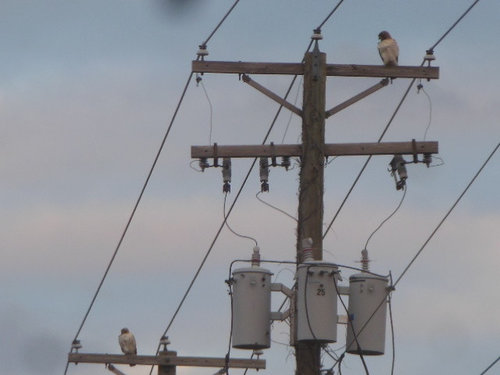
Can you identify these hawks?
11 years ago


Featured Answer
Sort by:Oldest
Comments (7)
 11 years agolast modified: 11 years ago
 11 years agolast modified: 11 years ago
Related Discussions
Do hawks hie from other hawks?
Comments (1)Its sounds like you probably have a pair of Red tails and probably a sharpie or Coopers Hawk. In general, Hawks don't prey on other healthy adult Hawks. Larger Hawks will attack the nests of smaller hawks. About the only exception is probably a large Goshawk would have smaller Hawks on the menu and be able to catch them. But in your case, a Red tail trying to catch a Sharpie is like a Suburban trying to catch a Corvette. In one of the few studies I've seen, the highest Sharpie mortality was from owl predation, which leads them to roost in dense cover. Your probably just seeing an increase in raptor activity as Hawks begin pairing up and will start nesting in a few weeks....See Morehelp identifying hawk - no pic
Comments (3)Could be. Here's what the breast of an immature Cooper's Hawk looks like. Only thing is, they're brown above, not light gray: The two-tone call you describe is atypical for a Cooper's Hawk, too -- their call is usually a series of one-note harsh keks. But if it was an immature, possibly they make a different call -- especially if they're frustrated while hunting for food. Behavior sounds more like it was hunting. It probably had seen something yummy-looking lurking in the tree and was trying to get at it. I wonder if you could have seen a Goshawk? The males are a few inches larger than crows, but length can be difficult to estimate. If there's a forest anywhere near you, it's a possibility -- they do breed in the NE corner of PA and winter in all of PA. Their display call is described by Sibley as a "wailing gull-like KREE-ah, repeated regularly. Juvenile begging call a plaintive scream kree-ah." I'm not sure that the recording I've linked below is that call, but there it is for what it's worth. Call at nest is described as a loud, cackling kye, kye, kye, which is what this recording may have captured. From the underside their tail looks rather as you've described it, and they do fly with their tails closed as well as open. When flying with tail closed, the shape is similar to a Cooper's Hawk -- the wings are a bit longer and thinner. > You can go to the Cornell site at http://www.birds.cornell.edu/programs/AllAboutBirds/BirdGuide/ to hear sounds of the Cooper's Hawk (it's really annoying that this site doesn't convert URL's embedded in posts to links.) Here is a link that might be useful: Goshawk recording...See MoreIdentify Hawk in backyard
Comments (7)Sure looks like a young Cooper's hawk. Cooper's hawks and sharp-shinned hawks (both immature and adult) look very much alike and can be very difficult to tell apart. Sharpies are the smaller of the two (a little larger than a blue jay) and Cooper's are crow-sized. Sharpies also have a square-tipped tail whereas the tip of the Cooper's tail is rounded which appears to be the case in your photo. Both fly with shallow wingbeats in a quick flap, flap glide pattern though the smaller sharpie will have quicker, more spastic wingbeats than the larger Cooper's. Hope that helps. Beautiful hawk you have there and nice pictures! One question to the experts: Anyone seeing an eye stripe or is it just me? I really doubt is a young goshawk but just wondering....See MoreCan You Scare a Hawk Away?
Comments (178)cheryllynn744: (The thread that will never end :-) Your question is what started this thread, lo, those many years ago. Best thing I've been able to do is to use one of those New Year's noise-makers that you crank that makes an ungodly noise--something the hawk has not previously heard that will freak him/her out. I have a stuffed owl up in my back yard, and it might as well not be there. For me, it worked fine for a week, and every bird in the vicinity was stressed out and came to squawk at it from a safe distance, and some were bold enough to get quite close. Couple of Bluebirds flew right above it, and hovered (as Bluebirds will) for a few moments, checking it out. But unless you move the decoy almost daily, songbirds soon learn that it is no threat to them, and they won't pay any more attention to it. Been there for about a year, and most of its feathers are gone, but it still has the silouhette of an owl--to no avail. -------------------------------------------------------- Recent hawk episode for me involved a dove nesting in my window sill. Doves--like pigeons--are "ledge nesters", and sometimes only place a few sticks on a ledge to keep the (2) eggs from rolling away. My dove built a little more elaborate nest, with lots of sticks forming a nest between my double-hung window and double-hung storm window, about 4 inches apart. I had the storm window raised about 10 inches, quite by mistake, and a dove nested there last year (between the 2 windows) and fledged 2 baby doves. Success! Another dove used the same nest this year, and added sticks to it. Unfortunately, the dove began setting on eggs about March 4th, where there were no leaves on the trees (yet) in my area, and the dove was more visible than last year. One morning about 2 weeks ago, I heard a THUMP on the window about daylight, and I opened the curtain and looked out. The dove was gone, the 2 white eggs were exposed in the nest, and a Peregrine Falcon was sitting on a tree limb outside the window, no more than 3 or 4 feet away. The Falcon saw me through the window pane, and flew off. The dove stayed away the rest of the day, and did not come back and begin setting on the eggs (again) until the next day. I thought it was rather remarkable that it even returned, after being attacked by a hawk (falcon). I had no idea how it survived the attack, since it seemed more-or-less trapped there, inside the two windows. But the THUMP sounded like the falcon hitting the window, so somehow, it slipped away. Maybe the falcon tried to attack from above, and hit the glass above the dove. I had an idea the falcon would come back and try again and sure enough, about 4 days later, another WHUMP on the window. Same result--I looked out, the dove was gone, the eggs were exposed, and the Peregrine Falcon was 3 or 4 feet away on a tree branch. But this time, I had gotten my crank, New Year's noise-maker out of the closet and had it on my dresser. I grabbed it, and ran up the hall and opened the front door as quietly as I could. The falcon was still sitting in the tree, and I eased out and cranked-out a bunch of raucous noise while running toward the tree, and the falcon freaked out and flew out of the tree. Unbelievable that the dove returned AGAIN, only a few hours later, and began setting on its eggs again, the very same day, after (somehow) surviving the second strike by the Peregrine Falcon!! Again, it sounded like the falcon hit the glass above the dove. The falcon did not return, and the dove continued setting for about 3 or 4 more days. Then one morning I heard noise in the window, and I peeped out to see the dove turning the eggs over beneath it, and it appeared to be examining them. Soon after, it flew away, and left the nest and the eggs, and did not return. After the dove did not come back many days later, it was obvious the dove had abandoned the nest, and I raised the window and got the 2 eggs out, and put them in my basement. I have an idea what I will find when I crack them open; I think I'll find 2 babies that were nearly ready to hatch until the dove flew away after the first falcon strike and stayed away for more than a day. I believe the eggs may have got too cold that night she was away, and the babies inside probably froze--or otherwise died wiithout their mother there to keep them warm. Shame that she spent weeks there, only to have it end that way. But amazing that she had the resolve to return after 2 falcon attacks and continue to TRY and hatch the eggs. And more amazing that she escaped with her own life. wt...See More- 11 years agolast modified: 11 years ago
- 11 years ago
- 11 years agolast modified: 11 years ago
 10 years ago
Related Stories
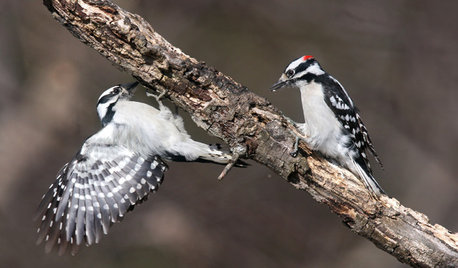
GARDENING FOR BIRDSBackyard Birds: How to Identify Two Common Woodpeckers
Downy and hairy woodpeckers have similar coloration and behavior. But there are two big differences that separate them
Full Story
INSPIRING GARDENSWhat We Can Learn From Longwood Gardens’ New Meadow
Sustainability, ecology, native plant communities ... this public garden is brimming with lessons on horticulture for home gardeners
Full Story
HOUSEPLANTS8 Houseplants You Can't Kill
They're forgiving and let you forget. Houseplants don't get any easier than this
Full Story
GARDENING GUIDES4 Ways Gardens Can Go Beyond Aesthetic Beauty
Our landscapes can play an even more meaningful role if we rethink their purpose
Full Story
LIFEHow Your Landscaping Can Keep Burglars Away
Prevent home break-ins with strategic landscaping and good practices instead of menacing — and maybe less effective — measures
Full Story
LANDSCAPE DESIGNHow Low Can Hedges Go? Discover Unusual Garden Borders
Short enough to step over, high enough to be a stretch ... check out these radically different hedge styles and tell us your opinion
Full Story
THE ART OF ARCHITECTUREDesign Practice: 11 Ways Architects Can Overcome Creative Blocks
When inspiration remains elusive, consider these strategies for finding your creative muse
Full Story
FENCES AND GATESA Deer Fence Can Be Decorative as Well as Protective
You need a monster-size fence to shelter your garden from deer, but it doesn’t have to look like a monstrosity
Full Story
MODERN ARCHITECTUREEntryway Appeal Can Hinge on a Pivot Door
Larger, heavier and often more dramatic than their swinging cousins, pivot doors fit right in with modern homes
Full Story
LIFEThe Polite House: How Can I Kindly Get Party Guests to Use Coasters?
Here’s how to handle the age-old entertaining conundrum to protect your furniture — and friendships
Full StorySponsored
tmff