

help-info for Blue Berry Ash
21 years ago
Featured Answer
Sort by:Oldest
Comments (10)
 21 years ago
- 21 years ago
Related Discussions
Blue berries please help
Comments (11)Gary, you're right, and it is best to have the same types. All I meant is it is not always easy to figure out what you have! Pink Lemonade is a good example! Cara's Choice and Pink Lemonade were both released by Dr. Mark Ehlenfeldt Cara's Choice is just as strange. here's some info on Pink Lemonade PINK LEMONADE is a cross of NJ 89âÂÂ158âÂÂ1 x Delite (V. ashei) and was originally tested as ARS 96-138. The female parent, NJ 89âÂÂ158âÂÂ1 came from a cross of two triploids, NJ 856âÂÂ1 x NJ 859âÂÂ1 made by Dr. Nicholi Vorsa (Rutgers University). The clone NJ 856âÂÂ1 is a cross of G-434 (a sibling of âÂÂPink ChampagneâÂÂ) x NJ 85-CS (an albino-fruited, wild, 2x selection of V. corymbosum). The clone NJ 859âÂÂ1 is a cross of V. darrowi >Florida 4B= x Rancocas (see attached pedigree). The cross that produced PINK LEMONADE was made by M.K. Ehlenfeldt at Chatsworth, New Jersey in 1991. PINK LEMONADE was selected in 1996 by M.K. Ehlenfeldt at the Marucci Center for Blueberry & Cranberry Research and Extension, Chatsworth, NJ. The selection was subsequently evaluated by M.K. Ehlenfeldt between 1996 and 2004, and also evaluated at USDA-ARS/Oregon State University test plots in Corvallis, Oregon. Its general characteristics are, mid-late- to late-season ripening, moderate yields, medium-sized, glossy fruit, bright pink fruit-color, mild pleasant flavor, and good firmness. The bush of PINK LEMONADE is vigorous, upright, and full. Leaves are glossy green and lanceolate, with a serrated leaf margins. Leaf surface texture is smooth, very similar to that of V. ashei. Limited observations suggest that PINK LEMONADE has some resistance to the blighting phase of Monilinia vaccinii-corymbosi (mummy berry). Flowering time is similar to other southern blueberry germplasm, with flowers developing earlier than hardy northern cultivars such as Bluecrop. Plants are hardy in New Jersey, but fruit production is irregular, producing reduced, or no crops in years with late spring frosts, and moderate crops in years with mild spring temperatures. Cropping ability is most likely related to flower bud deacclimation and hardiness in spring. The ideal area of adaptation of PINK LEMONADE is unknown, but its background suggests that it might perform equally well, or better, in milder climates, including areas where rabbiteye cultivars can be grown. Because of the inherent self-fertility problems of rabbiteye germplasm, it is recommended that another rabbiteye cultivar be planted with PINK LEMONADE to ensure good cross-pollination. In some southerly locales, âÂÂFlorida RoseâÂÂ, a pink-fruited cultivar recently released by the University of Florida, may be suitable for this purpose....See MoreDark blue-black berries, mid-September, N. FL
Comments (6)I think the species might be americanum or chenopodioides. Note that the leaves are not toothed on these two. Here is a link that might be useful: S. americanum on Dave's Garden...See MoreChinese white ash, resistant to emerald ash borer?
Comments (17)the peeps who interpreted what i meant to say were correct ... additionally though... of all the diversity out there.. why do you want to bang your head on the brick wall called ash ... just before EAB came along.. in 2000 .... i invested in 6 autumn purple ash at 40$ each ... and spent ten years watching them grow wonderfully .... i just finished removing the last of them last spring .. nothing more disappointing than watching your investment.. and emotional attachment die to the vermin ... and also had some other conservation dist. ash [in other words.. green and white] and they succumbed before the other ... contrary to claims that one version was bug proof .... so i asked... why.. why.. why????? you cant find anything other than an ash or an oak???? heck.. i would plant a maple before i would plant an ash ... and i hate maple.. lol ... perhaps a new post on what we would recommend beyond ash.. would give you a multitude of ideas other than ash ... since you have so many oaks .... on the other hand.. if you are talking about investing a few bucks.. and are the experimenting type.. and have no qualms about chainsawing them when the bug hits.. go for it .... which as a farm owner you probably are.. as compared to those who get all emotionally attached to the plant babes, and who have a coronary killing a bug infested tree ....... what the heck ... worse thing that happens is you find out an ash is an ash ..... and EAB is indiscriminate .... good luck ken ps: as an aside.. is it possible that it could be against the law to plant ash.. since so many states are destroying them????? i know its a crime to cross state lines with cut ash.. could it be a crime to plant????...See MoreBlueberry/Berry Hedge Permaculture concept design
Comments (4)Like you, I wanted a berry hedge. I decided to plant them along a road shoulder, so that I could just walk along the road and pick berries without getting bitten by copperheads or rattlesnakes. Twice, copperheads have crawled over my boots or snapped at me while I was picking berries in the fields. The road shoulder was an ugly miux of rubble, rocks and clay, so I dumped leaves and brush over the rocky mess and made dirt. Then I planted currants, blueberries, raspberries and gooseberries, and I let wild blackberries stay. Turns out, the red currants LIKED the ugly rocky clay mess and did not do so well in the black humus dirt I made. All the berry plants are doing "okay", but not thriving. Also, I made three mistakes with the raspberries: I moved wild raspberries out from under a giant walnut tree because I thought they were trying to ramble their way into the sun. Later I read that raspberries LIKE being under trees, if it shades them from hot afternoon sun. I tried to weed all of the yellow coneflower (Rudbeckia lacinata) out of the raspberry patch. It turns out, they are perfect for each other. The coneflowers don't even start to grow until after the raspberries have berries. When the coneflowers bloom, honey bees go crazy, so that's a plus for them. Also, they have a marvelously strong stalk with a fork, and this FORK becomes a perfect support for the raspberry canes! Last fall, I broke the tops out of the dead weed stalks, and helped the raspberry canes into the forks. Right now, the canes are loaded, since I pruned them back in winter to force them to make berries instead of ramble. I moved some wild raspberries to part of the road that caught water draining down the mountain. Water stood in the road in winter, and it drowned the berries: They do not like wet feet. I question whether or not your servicebery will grow under the tree canopy. When I saw wild serviceberry, it was growing all alone on top of a cliff! I haven't heard about these irrigation ditch hedges before. Is this a common practise in permaculture? Areyou trying to imitate the seep on a cliff or something? (I read that sandstone cliffs hold water, and that's why water seeps out of the base of these cliffs. Blueberries grow on top of them here, even though they appear to be "dry" cliffs.) If not, why are you irrigating? Isn't that a really artificial practise? I mean, irrigation has drained the aquifers in the midwest , so why are you interested in irrigating? Are you diverting water or it there naturally? I guess you can tell I haven't read much about permaculture. [I read Holmgren's book, that's all.] But I am really, cincerely curious why you would irrigate and call it permaculture. It seems artificial to me, any irrigation. I don't water anything. If it won't grow where I plant it, I move it. Instead, I am tryiung to add humus to the soil to make it hold water better. But ifyou are trying to imitate a sandstone seep, then it makes a little sense. I do collect rainwater, but I keep it covered so the mice and bugs don't drown in it, and I only use it rarely....See MoreRelated Professionals
Waco Landscape Architects & Landscape Designers · Worcester Landscape Architects & Landscape Designers · Coldwater Landscape Architects & Landscape Designers · Murrieta Landscape Architects & Landscape Designers · Bronx Landscape Architects & Landscape Designers · Spartanburg Landscape Contractors · Poughkeepsie Landscape Contractors · Redding Landscape Contractors · Huntington Architects & Building Designers · Plainfield Architects & Building Designers · Cleveland Architects & Building Designers · Lima Architects & Building Designers · San Diego Architects & Building Designers · Fort Collins Architects & Building Designers · Bismarck Architects & Building Designers- 21 years ago
- 21 years ago
- 21 years ago
- 21 years ago
- 21 years ago
- 21 years ago
- 11 years ago
Related Stories
GARDENING FOR BIRDSFeed the Birds: 6 Plants for Abundant Winter Berries
Be kind to your fair feathered friends during lean food times by planting a shrub or tree loaded with nutritious snacks
Full Story
CONTAINER GARDENSPatio-Perfect Berry Bushes Like You’ve Never Seen
Small enough for pots but offering abundant fruit, these remarkable bred berries are a boon for gardeners short on space
Full Story
GARDENING AND LANDSCAPINGBe a Citizen Scientist to Help Wildlife, Learn and Have Fun Too
Track butterflies, study birds, capture stars ... when you aid monitoring efforts, you’re lending Mother Nature a hand
Full Story
MOST POPULAR7 Ways to Design Your Kitchen to Help You Lose Weight
In his new book, Slim by Design, eating-behavior expert Brian Wansink shows us how to get our kitchens working better
Full Story
GARDENING GUIDES6 Rockin’ Red Plants for Winter Gardens
Use the bright berries or branches of these cold-climate favorites for outdoor garden interest or container arrangements anywhere
Full Story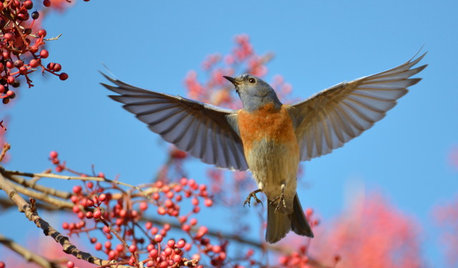
GARDENING GUIDESHow to Bring the Joy of Bluebirds to Your Garden
Attract these beautiful songbirds with nesting habitat and food sources, including berry-producing trees and shrubs
Full Story
REDRavishing Reds, Pinks and Purples for Fall 2012
Whether you love a fine wine color or go cuckoo for berry, this season's runways are offering some hues for your home to savor
Full Story
GARDENING GUIDESGreat Design Plant: Amelanchier Signals Spring With Airy White Blooms
With roughly 20 species of serviceberry native to the U.S., bees can feed on the early-season blooms while birds enjoy the summer berries
Full Story
KITCHEN DESIGNKitchen of the Week: Tile Sets the Tone in a Modern Farmhouse Kitchen
A boldly graphic wall and soft blue cabinets create a colorful focal point in this spacious new Washington, D.C.-area kitchen
Full Story
MATERIALSWhat to Ask Before Choosing a Hardwood Floor
We give you the details on cost, installation, wood varieties and more to help you pick the right hardwood flooring
Full StorySponsored
sterculias