Houzz Logo Print
jasdip1

Do you turn your chicken when roasting?

15 years ago

I've read where some people recommend turning the bird when roasting for an even all-round colour and crisp skin.

Start with the bird upside down, then half-way flip it breast-side up.

I've thought about trying it, then of course, I forget.

Comments (28)

  • 15 years ago
    last modified: 11 years ago

    Nope....I just roast it....breast up.

  • 15 years ago
    last modified: 11 years ago

    Me either. Sometimes I will arrange fresh herbs under the breast skin but otherwise I just stick it in the oven and let it rip.

    Alexa

  • Related Discussions

    How Do You Tell When Chicken Manure is Fully Composted?

    Q

    Comments (15)
    cavamarie, people have concerns about e-coli and I know nothing about that. I've used fresh manure in gardens almost every year I've gardened and I've never sacrificed fruit for foliage as you would expect. I've only had a problem once---in a spot where a ton of fresh chicken manure sat for a month before I could get it spread. Everything we planted in that drenched spot died. Mix the manure in well before you plant and I think you'll have results similar to mine, providing you, like me, need to apply nitrogen fertilizer every year. I have 16 chickens. I clean their house once a year (where I suppose, it's technically been composting)and spread it on my garden straight from the coop prior to planting. I used much fresher chicken manure in my early 20s---sometimes with dead chickens in it---which I got from a farmer. With really fresh manure I spread it three weeks before planting per advice I received from an "Organic Gardening" course I took in 1974. People always tell secondhand horror stories about chicken manure, but I've never heard a horror story from someone who's actually used it. I'm always worried that my experience with chicken manure won't pan out in the rest of the country, so rather than take my word for it, try it in half of your rows and see for yourself.
    ...See More

    When Is the Roast Chicken Cooked?

    Q

    Comments (12)
    You can find instructions ranging from 160° to 180°F for the internal temperature of a roasted chicken. I probably roast a chicken at least once a week or every 10 days. I roasted it at 500°F and a small 3 pound chicken is done in about 50 minutes. I look for an internal temperature of 170°F. The bird should rest for 10 to 15 minutes minimum before carving and by then the internal temperature will have risen to close to 180°. If I'm roasting a large turkey at 500°F I will occasionally cover the breast near the end if it has started to brown to much, but I haven't had to do that with chickens. This is one of the best roasting charts I've seen. It actually has beef right at 125°F for rare.
    ...See More

    Do you truss chicken before roasting?

    Q

    Comments (21)
    LOL! Oh, I do love this group! How we just dissolve into "spreading legs" and "wanton chickens" so easily. This place is always good for a laugh. And I love the idea of the "cook's treat" piece of bread to hold in the stuffing - that is right appealing to me. Teresa, who doesn't currently truss, but might have to start once the Nesco roaster oven arrives - I see lots of roast chicken in my future!
    ...See More

    Do you use a roasting bag for your turkey?

    Q

    Comments (9)
    I used the bags for the last 3 turkeys I cooked.They work great! Turkey is really moist and juicy and so much easier clean up.Just don't overcook.Bought the bags today to cook 2 turkey breasts.I cut an onion in quarters and stuck it in the bag with the turkey then season as usual.
    ...See More
  • 15 years ago
    last modified: 11 years ago

    I do AnnT's Simplest Roast Chicken. OMG so good.
    Perfect skin, moist and delicous.

    A search should turn up the recipe, if not I can post it or maybe Ann will post it herself.

    Nancy

  • 15 years ago
    last modified: 11 years ago

    Nope, no turning here. I tried it once, and didn't find it beneficial.

    Annie

  • 15 years ago
    last modified: 11 years ago

    Absolutely. That’s why a rotisserie chicken is good.

    However, not so much in a convection oven and not necessary if you are making a beer can chicken.

    dcarch

  • 15 years ago
    last modified: 11 years ago

    I roast chicken in two different ways. For a smallish (3 to 4 lbs) bird I use Marcella Hazan's technique with the two lemons inside. It does involve turning the bird once. For a bigger bird (5-6 lbs) I use Barbara Kafka's high heat technique which does NOT involve turning.

    Each of these recipes yields great tasting chicken with crispy skin and moist breast meat. Here they are:

    Chicken with Lemons from Marcella Hazan’s Essentials of Classic Italian Cooking

    Marcella sez: If this were a still life its title could be "Chicken with Two Lemons." That is all that there is in it. No fat to cook with, no basting to do, no stuffing to prepare, no condiments except for salt and pepper. After you put the chicken in the oven you turn it just once. The bird, its two lemons, and the oven do all the rest. Again and again, through the years, I met people who come up to me to say, "I have made your chicken with two lemons and it is the most amazingly simple recipe, the juiciest, best-tasting chicken I have ever had." And you know, it is perfectly true.

    Ingredients

    A 3- to 4-pound chicken
    Salt
    Black pepper, ground fresh from the mill
    2 rather small lemons

    Preheat oven to 350 degrees.
    Wash the chicken thoroughly in cold water, both inside and out. Remove all the bits of fat hanging loose. Let the bird sit for about 10 minutes on a slightly tilted plate to let all the water drain out of it. Pat it thoroughly and it dry all over with cloth or paper towels.
    Sprinkle a generous amount of salt and black pepper on the chicken, rubbing it with your fingers over all its body and into its cavity.
    Wash the lemons in cold water and dry them with a towel. Soften each lemon by placing it on a counter and rolling it back and forth as you put firm downward pressure on it with the palm of your hand. Puncture the lemons in at least 20 places each, using a sturdy round toothpick, a trussing needle, a sharp-pointed fork, or similar implement.
    Place both lemons in the bird’s cavity. Close up the opening with toothpicks or with trussing needle and string. Close it well, but don’t make an absolutely airtight job of it because the chicken may burst. Run kitchen string from one leg to the other, tying it at both knuckle ends. Leave the legs in their natural position without pulling them tight. If the skin is unbroken, the chicken will puff up as it cooks, and the string serves only to keep the thighs from spreading apart and splitting the skin.
    Put the chicken into a roasting pan, breast facing down. Do not add cooking fat of any kind. This bird is self-basting, so you need not fear it will stick to the pan. Place it in the upper third of the preheated oven. After 30 minutes, turn the chicken over to have the breast face up. When turning it, try not to puncture the skin. If kept intact, the chicken will swell like a balloon, which makes for an arresting presentation at the table later. Do not worry too much about it, however, because even if it fails to swell, the flavor will not be affected.
    Cook for another 30 to 35 minutes, then turn the oven thermostat up to 400 degrees, and cook for an additional 20 minutes. Calculate between 20 and 25 minutes total cooking time for each pound. There is no need to turn the chicken again.
    Whether your bird has puffed up or not, bring it to the table whole and leave the lemons inside until it is carved and opened. The juices that run out are perfectly delicious. Be sure to spoon them over the chicken slices. The lemons will have shriveled up, but they still contain some juice; do not squeeze them, they may squirt.
    Ahead-of-time note: If you want to eat it while it is warm, plan to have it the moment it comes out of the oven. If there are leftovers, they will be very tasty cold, kept moist with some of the cooking juices and eaten not straight out of the refrigerator, but at room temperature.

    and here is Kafka's recipe:

    Simplest Roast Chicken from Barbara Kafka’s book Roasting

    5- to 6-pound chicken, wing tips removed
    Freshly ground black pepper, to taste Kosher salt, to taste
    1 lemon, halved
    4 whole garlic cloves
    4 tablespoons unsalted butter (optional)
    1 cup liquid for deglazing (optional) : chicken stock, fruit juice, wine, or water

    Place rack on second level from bottom of oven. Heat oven to 500°F.
    Remove the fat from the tail and crop end of the chicken. Freeze the neck and giblets for chicken stock. Reserve chicken livers for another use.
    Stuff the cavity of the chicken with the lemon, garlic, and butter, if using. Season the cavity and skin with salt and pepper.
    Place the chicken in a 12 x 8 x 1 1/2-inch roasting pan breast side up. Put in the oven legs first and roast 50 to 60 minutes, or until the juices run clear. After the first 10 minutes, move the chicken with a wooden spatula to keep it from sticking. (Figure it will take a total of about 10 minutes per pound.)
    Remove the chicken to a platter by placing a large wooden spoon into the tail end and balancing the chicken with a kitchen spoon pressed against the crop end. As you lift the chicken, tilt it over the roasting pan so that all the juices run out and into the pan.
    To make a sauce, pour off or spoon out excess fat from the roasting pan and put the roasting pan on top of the stove. Add the stock or other liquid and bring the contents of the pan to a boil, while scraping the bottom vigorously with a wooden spoon. Let reduce by half. Serve the sauce over the chicken or, for crisp skin, in a sauce boat.

    She notes: If there is no lemon, garlic, or butter on hand, roast the chicken without them. Or play. Use peeled shallots or a small onion, quartered. Add some leaves from the top of a bunch of celery, a couple of sage leaves, or a Bay leaf. Try a few juice orange or blood orange wedges. Vary the deglazing liquid to change the flavor of the gravy or to match what's in the bird. Basic Chicken Stock-or canned-is the starting point, but use part wine-whatever is left over, red or white-or a little vermouth. Make one third of the liquid orange juice if oranges are in the bird. This is not astrophysics. Have fun.

  • 15 years ago
    last modified: 11 years ago

    No, I tried it years ago and realized it wasn't necessary to turn a chicken or turkey in order to get a perfectly cooked bird.

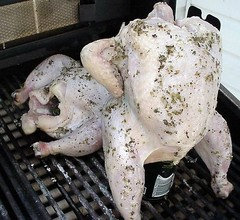
    A few years ago I did a side by side test of two chickens cooked on the grill. One on the grill over indirect heat and the other with a beer can shoved up it's "cavity" and guess what? There was no difference in flavour.

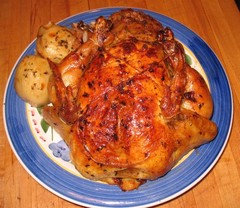
    {{gwi:2080214}}

  • 15 years ago
    last modified: 11 years ago

    Ann, that vertical chicken appears to have a rather indignant attitude.

    I guess I'd be indignant too in such a situation.

    Hey, you creative CF'ers, any captions for that top photo?

    I'm thinking something along the order of "Hmph. He always falls asleep right away."

  • 15 years ago
    last modified: 11 years ago

    Lol arley! Ummmm....... Jessy?

    No flipping here, I follow Ann's lead and use high heat, it's always delicious.

    Di

  • 15 years ago
    last modified: 11 years ago

    I use high heat, place the chicken over a "rack" of carrots, potatoes and sometimes squash, and never turn.

    No need.

  • 15 years ago
    last modified: 11 years ago

    Yes, I definitely turn a turkey when roasting!

    Why? Because my mother did.
    And it seems to be the best way to get moist white meat.
    None of us care much for the breast,
    but it seems to go better if I turn a couple of times.
    Gets the juices flowing better.

    I very rarely roast a whole chicken anymore.
    Just buy the parts we like, whether for roasting, or frying.
    Whatever chicken dish I make.

    Rusty

  • 15 years ago
    last modified: 11 years ago

    No doubt all the above methods will produce great tasting chickens. Taste has a lot to do with seasoning; However, as jasdip is asking:

    “I've read where some people recommend turning the bird when roasting for an even all-round colour and crisp skin. “

    For an even all-round colour and crisp skin, it will be difficult to achieve in a typical home oven without turning. The bottom of the chicken tends to have juice drip down and coat the skin, making it difficult to crisp and brown, furthermore, the temperature is seldom even from top to bottom. Turning the chicken solves the problem.

    In Ann’s pictures, grilling in a BBQ is different because you have a very hot fire broiling from the bottom directly.

    Turning a big chicken in an oven is not difficult if you have the chicken’s cavity facing you in the oven. You can use a heavy spatula inserted in the cavity to lift up and turn. Better yet, use oven-safe washable silicone gloves.

    dcarch

  • 15 years ago
    last modified: 11 years ago

    I just opened this thread and saw AnnT's picture.

    My initial thought for a caption was 'now where did I put that beer can..'

    Ann, congrats, I love that photo.

  • 15 years ago
    last modified: 11 years ago

    Love the picture! I wouldn't expect much difference though. Isn't the point of turning to get the breast basted? That wouldn't happen with a beer can stuck up it's vent (Julia Child's word - I'm still laughing at that) following the course of gravity.

  • 15 years ago
    last modified: 11 years ago

    The Balsamic Chicken recipe from Sara Foster's "Foster's Marketplace Cookbook" calls for the chicken to be flipped once during preparation. It's our favorite roast chicken recipe.

    You pour lemon juice, white wine & balsamic vinegar, plus some other seasonings, over the chicken when it first goes in - breast side down. The point is to have the breast side sop up some of those flavors, as well as to help keep the breast meat from drying out. When you flip it, you end up with crispy, glazed skin. In any case, it makes for a really tasty, juicy chicken.

    I also like the Chicken w/ 2 Lemons that arley posted and have done it that way for company & Sunday supper numerous times.

    My Foster's cookbook is at the lake. If anyone wants the recipe, I'll retrieve it this weekend and post it.

  • 15 years ago
    last modified: 11 years ago

    Nowadays turning the chicken is part of my standard process. I baste the chicken w/ melted butter during roasting and it is hard to baste fully if the chicken isn't turned. Roast it breast-down at first, then breast-up for the remaining time, and usually crank the broiler for the last few minutes.

  • 15 years ago
    last modified: 11 years ago

    The last one I roasted I used my rotisserie, and it was a bit of a pain to get the chicken to stay on - I had to do some severe trussing. The instructions said to roast it at 350° for I forget how long, but it did come out very nice and the breast meat was juicier than when I just roast it in the oven. My favorite method, however, is to shove seasoned (with sumac, garlic, herbs, etc) butter under the skin of the breast, thighs, and legs, and roast it that way on the barbeque without turning but with frequent basting. I got this method from a French Algerian chef who teaches at the local branch of the Cordon Bleu (in Pasadena). He got the method from his Algerian relatives, even though he grew up in France.

    If I'm roasting a turkey, I do the dry salt method at high heat, which requires planning three days in advance. That results in extremely moist breast meat for the turkey, but I only do it once or twice a year.

    Lars

  • 15 years ago
    last modified: 11 years ago

    Thanks for reminding us, dcarch, that jasdips question was about turning when roasting to get a nice even color and crisp skin.

    All other facts aside, turning is the only way I know of to accomplish this when roasting in an oven.

    Cooking on a grill or under a broiler is completely different.
    At least in my humble opinion.

    Rusty

  • 15 years ago
    last modified: 11 years ago

    I never turn the chicken when roasting. I also use the high-heat roasting method. After about 10 minutes or so in the oven, I do move it to make sure it's not sticking on the bottom. I've roasted many birds, no doubt about it, you're not going to get a juicier chicken than roasting that way.

    Now I will say that the bottom does not get as crispy - but it will taste as good!

    IMHO

    Lori

  • 15 years ago
    last modified: 11 years ago

    I think the question was "Do you turn your chicken when roasting?"

    The answer is NO. I know from experience that it is extremely easy to roast a chicken to an even all around golden colour and crisp skin, without starting it breast down. And there is also no need to baste to get a perfectly roasted chicken or turkey.

    Ann

  • 15 years ago
    last modified: 11 years ago

    Guess I'm the only one who cooks a Traditional Chicken, with Stuffing ???
    In a Waterless Cooker and Lid, with Potatoes and Vegetables.
    Always good without the fuss.
    LOU

  • 6 years ago

    I’m roasting a five and a half pound turkey in the oven and I am watching the skin starting to burn in my very small apartment oven. I turned that sucker over and the skin under was all white. If i had known, i would have started it breast down. So, I have never before but this time I took a new turn.

    BTW I agree Marcella Hazan rocks the kitchen. I love her books.

    Luis

  • 6 years ago
    last modified: 6 years ago

    I cover the breast with bacon then foil. Remove the foil for the last hour....for a Turkey, that is lol

    Never turn a chicken.

  • 6 years ago

    I did initially, breast side down, then midway through baking breast side up. Stopped doing that as it's something of a hassle and the chickens were fine... but last time I did turn it - my personal experience was that it was far more moist throughout - I had forgotten how much more, and makes for better leftovers, but that's just my opinion. I do cook mine in a CSO (cuisinart steam oven), and still have to cover the breast area with foil so it won't get too dark.

    Islay, my DH wants to marry you ; ) Bacon. I think that's all I need to say : )

  • 6 years ago
    last modified: 6 years ago

    Islay, that's how I do pheasant, but I use salt pork that is mostly fat.

    Lately I've been spatchcocking chicken, so that it will cook a bit faster, and I can use the backbone (and wing tips) that I remove to make a stock while the chicken is cooking. I start the stock before I start the chicken. If I have a meat cleaver, I also cut off the tips of the legs and put those in the stock. This makes it easier to eat the legs.

  • 6 years ago

    I don't turn it, the rotisserie handles the task.

  • 6 years ago

    Lately, spatchcock when roasting whole chickens and turkeys. It's pretty easy with chickens; a bit of a challenge cutting along the backbone with turkeys, but I bought a better pair of poultry sheers which helps. I like how evenly it cooks and how nice the skin comes out.