

Car accelerating on its own
21 years ago
Featured Answer
Sort by:Oldest
Comments (46)
 21 years ago
- 21 years ago
Related Discussions
'Every Generation Makes Its Own Mark'
Comments (25)I am not disagreeing with Laag's take on sustaining lawns in his local conditions, but I think he glosses over the extent that most homeowners feel compelled to expend resources on keeping their lawns green and weed free. An awful lot of chemicals get applied to lawns to kill grubs and weeds, that also wind up in the local water supply. It may also be a matter of semantics, but the rainfall levels he cites are necessary over the entire year to keep grass evergreen and growing, and do not reflect what is needed to keep grass alive and growing in the southwest, or parts of the midwest and southeast. It takes much more water than naturally available to keep grass green in much of the USA, and most people who have lawns are unwilling to accept a brown lawn in summer, or use species that might go summer dormant under low/natural rainfall amounts. In these parts of the country, there are definitely other plants besides turf grasses that can remain presentable at height of summer and use less water. Even the trend towards using supposedly low water use Dwarf Tall Fescues is a bogus ploy to continue planting lawns here in California, in my opinion. They still need too much water to make sense as the predominant plant cover in our local climate. While much of wild California can also be considered natural grasslands, and survive on even lower rainfall amounts that Laag cites, they can not be maintained as mown, evergreen surfaces without huge amounts of additional irrigation. Even the really drought tolerant species that can serve as mown lawns, such as Buffalo Grass, will go winter dormant here in California, and don't satisfy the urge to have a year round green landscape. If we are talking about lawns as a ground cover that is to be maintained without irrigation, will be mowed, and is expected to remain evergreen during the warm months, there are few parts of the country outside of the far north and wetter northeastern USA that will sustain lawns as the American public prefers to grow them. In my opinion, in these parts of the country, and especially here in the arid west, lawns just don't make sense as a sustainable garden practice. I predict they will continue to lose popularity as the default plant choice in areas where water is in short supply, and cities are usurping agricultural water supplies here in the west so that cities will not have to ration water. So far, the water continues to be available for urban users to use as they prefer, but since over 70% of urban residential water use is used to irrigate gardens, the cost is going to get so prohibitive that people will vote with their wallets, and lawns will disappear over time. Perhaps there will be a trend towards using winter dormant Buffalo Grass and similar for people who must have lawns here in the arid west, but even the subtropical lawn grasses such as Bermuda grass or St. Augustine grass require regular summer irrigation to keep them alive here. I highly doubt that the vast American public will agree to keeping lawns in their future if it costs them over $300 a month to irrigate them, and few will be willing to have a summer dormant lawn that greens up again in winter, which would be the default condition here in California without irrigation. I also predict that ground cover alternatives similar to lawn will continue to become more popular here in the arid west, with homeowners converting to mowable Carex species such as C. pansa and similar, which can get by with less than half of what a Tall Fescue lawn uses to stay green. I have often tried to interest garden design clients in using very drought adapted turf species such as Kikuyu grass, Pennisetum clandestinum here locally, but few are willing to accept the aggressively spreading nature and coarse wirey texture of this grass. Not even when I explain that this is a grass that in my local coastal northern California conditions can remain green all summer with absolutely no summer irrigation, when it has clay loam soils and receives some regular summer fog which moderates the summer temperatures as well as significantly reducing evapostranspiration. I have also had great success planting lawn meadows using Carex tumulicola, which only needs mowing once a month, and can remain green with just once every 2 month irrigation in summer here in coastal conditions. At least here in California, I think that fescue lawns are a dying breed, and will be replaced with something else as the cost of water continues to climb, and possible mandatory limits on landscape irrigation are imposed across the state. I don't see this as environmentalists running amok, but just plain common sense, and dealing with the local conditions as they are, rather than applying some design sensibility inherited from regions where grass actually grows and survives without irrigation....See Morecar insurance - rental car coverage
Comments (3)The liability might not automatically cover the rental car because somebody else could be using your car while you are gone, meaning you'd be insuring two cars for the price of one. It depends on the laws of your state. If your agent says that liability DOES extend to the rented vehicle, ask them to point it out in your policy. When it comes to insurance, if it's not in writing it isn't true. Credit card coverage is usually very good, but again be sure to read all the fine print. There are likely to be "exceptions" and "exclusions." Plus, it usually covers damage to the rental only. Keep in mind that even though credit card coverage would pay for repairs, the rental company will still want to collect the daily rate from you while the vehicle is out of service. Typically, the insurance will NOT cover that....See MoreWhat cars have you owned/driven?
Comments (33)1929 Model A Ford, 4 dr with window shade, roll-up, style curtains on rear side windows. Color black - was there any other color? 1949 Plymouth, 6cy, 2dr, 3-sp manaul, column shifter, Blue, the last of the fast back designs. (Horrible rear visibility) 1954 Dodge, 4dr, w/ Red Ram V-8, 3-sp stick. This one was not a large displacement engine, rated only at 140 hp, but was the smoothest running engine that I have ever owned. Color: White top over Blue bottom. 1960 Plymouth Valiant, slant six, 100 hp, automatic, 4 dr, blue. Low torque engine - couldn't get out of the way of itself. Good fuel mileage. No power steering - didn't need it - very good handling. The next year, a longer stroke engine was offered with much more torque. This one was very driveable and became the engine of choice. 1964 Dodge Dart, 273 cid V8, 4 dr, automatic, white w/red interior. This one was a good compromise between, power and fuel economy and room. I wish that I had another similar car today. This one was well liked. The engine was a thin wall cast version of the 318, but with a smaller bore. The bore centers were the same as the 318, thus it was manufactured on the same engine line as the 318. Many engine parts were interchangeable with the 318. 1969 Dodge Coronet, 4 dr, 318 cid V8, blue Just an ordinary sedan to hold my growing family. EPA fix-ups began to appear and degraded performance a bit without any fuel mileage increase - lower compression and a low ratio rear end ( 2.71 to 1) Though I put 115,000 miles on it before moving on. 1974 Dodge Sedan, 400 cid V-8. EPA had struck this engine hard. It was based on the admired 383 V8, an engine upgrade option for station wagons and police cars. To meet EPA requirements, Chrysler lowered the compression ratio and installed a very mild cam. The resulting power was so embarrasing that chrysler bumped the displacement up to 400 cu in to gain back a bit of performance. (An earlier 383 in good tune would run cicles around it.) 1974 Oldsmobile Cutlass, 4 dr, V8. Bought used for a 2nd car and commuter. Had to put in a valve job after 1 yr ownership. As it neared the end of its life, sold it to a junk yard. I didn't want to see this on the road again as it had become dangerous. The body metal holding the rear body mounts had corroded away. The best part of this car: The radio. 1975 Buick Apollo, 270 cid V-8 (Oldsmoblie engine), 4 dr, Yellow. The smallest V8 made by GM. Not a good car. Was purchased as 2nd car for a winter-beater and comuter. Let my kids learn to drive with this one - they were not going to win any stop light drags with it. In fact, they were lucky go to get across a big intersection before the light changed to red. I bought this car during a period of runaway inflation. It was 3 yrs old and loosing value at a lesser rate than my hard earned cash in the savings account. That became part of my rationale for picking it up for a 2nd car. 1976 Buick Estate Wagon, 4 dr, 455 cid V8, Clam shell rear gate and window; 19 ft long! This one was the family land barge and vacation machine. The family had now grown to 5 and this station wagon held us all in comfort on long trips. This was the first year that GM put catalytic converter on all of the Buick line. (GM had put catalytic converters on a few select models the year before as a field trial.) With the converter, Buick put in a better cam and iginition advance curve and got better power plus 2 more miles per gallon. I garaged this one every winter taking it off the streets just before road salting began and it stayed off until next spring after a rain had washed away the salt. I kept this one 13 yrs and it was in very good condition the day I traded it in. It was showing signs of a catalytic converter plugging up, otherwise, the engine was in fine shape. 1980 Chevrolet Citation, V6, 4dr + hatch back, green, my first front wheel driver. A fair car. Had a very good useable interior layout and driver visibility - wished there was a car with those features today. Had too much braking on rear wheels compared to the front - gave the car a tendency to swap ends while braking on slippery surfaces. Over- sped the engine one time when the tranny failed to catch 2nd gear on a downshift - it went all the way to 1st gear at 45 mph. Loosened a rod bearing. GM got the steering geometry right on this one - no torque steer. The Chrysler K-car was plagued with torque ateer. 1983 Chevrolet Citation, V8, 4dr, white Engine was de-tuned a bit, but otherwise the same as the 1980. 1981 Pontiac Phoenix (twin of the Citation), 4 cy "Iron Duke", 4 dr., Brown. A dog. Served as a commuter. When climbibng a grade, engine vibration could be strongly felt in the steering wheel - each firing of the cyliners were perceptable. No. 2 son, a new driver, burned the engine up while driving home from a days outing with the guys. He had not been watching the oil level - it ran out. 1989 Dodge Dynasty, 4 dr, V6, Light blue 1st yr for Chrysler's new computer controlled transmission. It had issues - shifting algorithm should have been revised. It was programmed to give good results on the EPA fuel mileage test, but otherwise, was bad for commuting traffic. Car was too softly spring - people riding in back tended to get car sick. 1992 Dodge Dynasty, V6, 4dr, White. A much better car. Better handling. Held front alignment very well. Shifting algorithn improved, but still had glitches. I put 90,000 miles on it and sold it (cheaply) to my daughter. She moved out of state and later sold the car to her friend. By then, the rocker panels were holed out. I saw the car two years ago and it was still running with upwards of 140,000 miles on it. 1992 Jeep Cherokee, inline 4.0 L 6CY, 4dr, with part and full time 4-wheel drive, Red. Really liked this one. Gas mileage wasn't great, but it took us all over the lower 48 states and into places where an ordunary car could not go. We photograhed many interesting scenics using this vehicle. This one was my prime winter time driver - great in snow - can't beat it. 1998 Dodge Stratus, 4 cy, dual overhead cams, 4 dr, red. An OK car - not great, but OK. Its gets very good gas mileage on trips and that is what I bought it for. Runs great. I beem garaging this one very winter and there are no rust spots. 1998 Jeep Cherokee, in-line 6 cy, 4 dr, again with part and full time 4 wheel drive, Deep Amethyst Purple (appears black under many lighting conditions). Replaces the red Jeep which was getting body rust, but ran well - had 190,000 miles on it....See Morecar sounds like it's revving
Comments (4)If you have a tachometer, what was the rpm and approximate outdoor temperature? Newer models (less than 10 yr old) with 4 cylinder engines may idle at 1200 rpm when first started in cold weather (20 F or less). The idle speed should pull back to about 700 rpm as the engine warms. What make an model do you have? Older Jeeps have 2 cooling fans: one belt driven through a viscous clutch and an electric fan. On start up, the viscous clutch is fully engaged and the fan is noisy. If the fan is cool or cold, the viscous drive will gradually reduce and the fan will become more quiet. This noise is more noticeable when the observer is outside the car....See More- 21 years ago
- 21 years ago
- 21 years ago
- 21 years ago
- 21 years ago
- 21 years ago
- 21 years ago
- 21 years ago
- 21 years ago
- 19 years ago
- 15 years ago
- 15 years ago
- 15 years ago
- 14 years ago
- 13 years ago
- 13 years ago
- 13 years ago
- 13 years ago
- 11 years ago
- 11 years ago
- PRO11 years ago
- 11 years ago
- PRO11 years ago
 11 years ago
 PRO11 years ago
 10 years ago
- 10 years agolast modified: 10 years ago
 10 years ago
- 10 years ago
 10 years agolast modified: 10 years ago
- 10 years ago
- 10 years ago
 10 years ago
 9 years ago
- 9 years ago
- 9 years ago
 9 years ago
- 9 years ago
- 9 years ago
- 9 years ago
 8 years ago
- 8 years ago
- 7 years ago
Related Stories
LIFEYou Said It: ‘It’s Different ... But Then, Aren’t You?’ and More Wisdom
Highlights from the week include celebrating individuality and cutting ourselves some decorating slack
Full Story
HOUZZ TOURSHouzz Tour: A Modern Mountain Home Takes Off With Its Own Airstrip
In Colorado, a glass and concrete home hugs a former hayfield that’s now a launching pad for antique planes
Full Story
KITCHEN DESIGNWhy Your Kitchen Wants Its Own iPad
Cooking-school gateway, recipe database, foodie networking ... an iPad in the kitchen has uses far beyond being a message center
Full Story
HOUZZ TVHouzz TV: This Dream Midcentury Home in a Forest Even Has Its Own Train
Original wood ceilings, a cool layout and, yes, a quarter-scale train persuaded these homeowners to take a chance on a run-down property
Full Story
LIFEYou Said It: ‘It Was a Symbolic Gesture to Myself’ and More Quotables
Design advice, inspiration and observations that struck a chord this week
Full Story
ORGANIZINGOrganizing Secrets: It’s the Little Things
Get these 8 small areas under control for a major boost in overall tidiness at home
Full Story
GREEN BUILDINGHouzz Tour: An Innovative Home Shows What It’s Made Of
Homeowners design their Washington, D.C., residence with sustainability in mind and to accommodate them as they get older
Full Story
REMODELING GUIDESWhat It’s Really Like to Live Through a Remodel
We offer a few tips for remodeling newbies on what to expect and how to survive the process
Full Story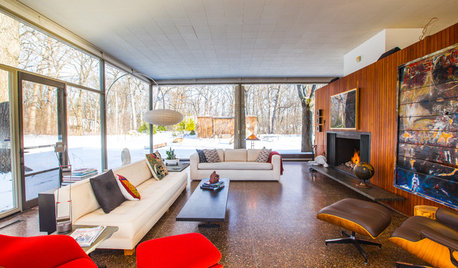
HOUZZ TV FAVORITESHouzz TV: See What It’s Like to Live in a Glass House
Tour a couple’s midcentury modern Illinois home, where floor-to-ceiling views of nature are all around
Full Story
GARDENING FOR BUTTERFLIESGardening for the Bees, and Why It’s a Good Thing
When you discover how hard bees work for our food supply, you may never garden without them in mind again
Full StorySponsored
brianl703