Houzz Logo Print
claireplymouth

Red-shouldered Hawk?

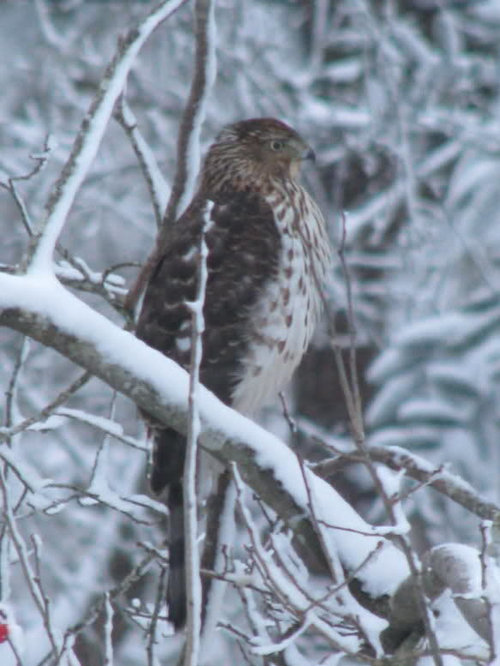
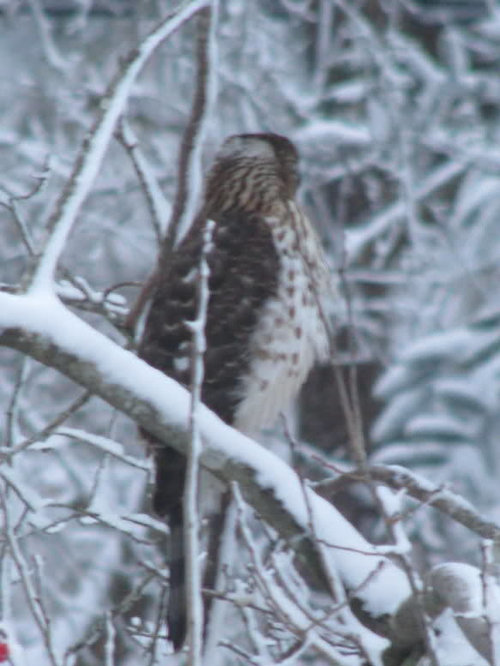
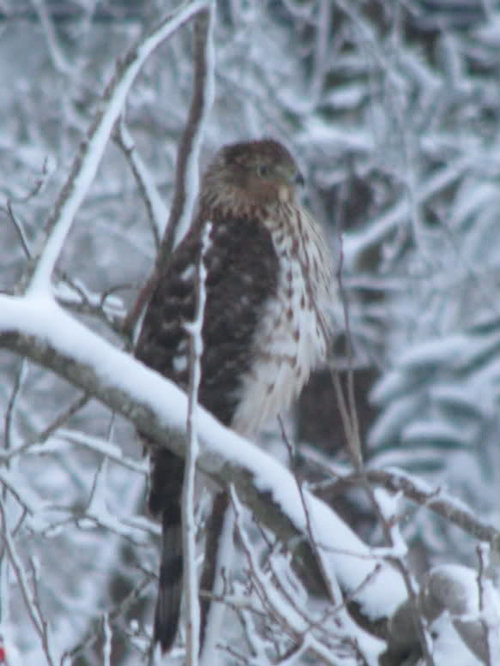
I'm trying to learn to identify hawks, but I have a long way to go. This hawk appeared in my yard as a major snowstorm was winding down - it seemed to fall down the trunk of a tree (probably just missed a strike against something) and flew up to center stage where most hawks perch to look around. My impression was it was squirrel sized.

I'm guessing juvenile Red-shouldered Hawk, not Cooper's or Sharp-shinned, but I'm by no means certain. The three shots are almost identical, but I chose them to show the head, the nape, and the tail.

Thanks,

Claire

Comments (22)

  • 16 years ago

    Looks like a juvenile Sharp-shinned to me.

  • 16 years ago

    Hi Claire, Hi Alan,

    Definitely an accipiter (looka that tail!). I agree about Alan's ID.

    Also: I believe RSHawks migrate south for the winter, not staying in snow-climates. Could be wrong there, but I don't see/hear the in NJ in the winter.

  • Related Discussions

  • 16 years ago

    Hawks confuse me.

    Accipiter is certainly very reasonable for this area, but I have some problems with that identification. I've driven myself crazy with online identification sites, such as Cornell's Tricky Bird IDs: Sharp-shinned Hawk and Cooper's Hawk and Tricky Bird IDs: Accipiter Photo Gallery.

    The bird's shape doesn't seem to fit the Cooper's but the spots on the breast don't fit the juvenile Sharp-shinned which supposedly is heavily streaked. The tail is longish, but maybe not as long as the accipiters. The head and bill seem too elongated for the Sharp-shinned.

    According to several of Cornell's sites, the Red-shouldered Hawk does winter in southern New England. Also, on a different thread I posted a photo of what I was expecting to be identified as a Sharp-shinned Hawk, and I was told it was a Red-shouldered Hawk (photo taken in mid-summer). So they do seem to be around here.

    I certainly don't mind if the bird is a Sharp-shinned Hawk, not a Red-shouldered, but I'd feel better if I could identify it when I see it.

    Claire (sigh)

  • 16 years ago

    I forgot to say thanks, Alan and Elly, for your input.

    Claire

  • 16 years ago

    I would agree with the others, definately an accipter. The tail says that, I usually look at the tail in relation to where the wings end.

    I would bet 90% its a sharp-shinned and 10% Coopers. Its harder to tell when they are "puffed up" when its cold out.

  • 16 years ago

    Thanks Chris. Looking back at the photos, I'm struck by the air of calm self-confidence of this hawk. I'm glad it's much smaller than me.

    Claire

  • 16 years ago

    Based on those tear-dropped shaped breast streaks and the shape of the head profile and beak, I am going with Cooper's Hawk on this one. Just doesn't seem to "fit" Sharp-shinned.

    BN

  • 16 years ago

    BN: That head bothers me too. This is a photo I took on Dec. 13 of what I think is a Sharp-shinned Hawk on the same tree. Both the head and the way the bird holds its body don't seem to be the same as the mystery hawk.

    I also have a few photos of an adult Cooper's Hawk, taken last year on the same tree. I'm considering taping a yardstick to that tree.

    Claire

  • 16 years ago

    Claire, I think that you have adult Coopers in the last set of pictures.

  • 16 years ago

    Alan, I figured that was an adult Cooper's Hawk. I included it for comparison of the head and body. I have about 40 shots of that hawk from that day - turning the head this way, and that way, and turning around. I found a few that had the same orientation as the mystery hawk so I posted those.

    However, this is my favorite (a very different orientation):

    Bottom line is that I'm still not convinced that the first hawk has been identified.

    Claire

  • 16 years ago

    OK, back to the juveniles. This photo was taken in March, 2008 and I'm guessing this one is a Cooper's. I'm trying to find similar postures and weather to compare with the juvenile mystery hawk. Head and bill shape are similar, the spots are different.

    Claire (who is thinking the first hawk may always be a mystery)

  • 16 years ago

    Claire,
    I've spent time on your pictures, and am begining to go with Coopers in all of your pictures, but have ruled out Red-shouldered.

  • 16 years ago

    Thanks, Alan, for taking the time to help me identify this hawk. I'm more comfortable with Cooper's than with Sharp-shinned, although I still have a sneaking wish that it could be a Red-shouldered.

    This afternoon I was counting for PFW and watching the dusk visitation of cardinals and native sparrows. Suddenly a small dark grey hawk about the size of a cardinal struck, missed and flew off. That must have been an adult sharpie.

    Claire

  • 16 years ago

    We haven't posted this for awhile. Sometime you have to stir the pot just to see what happens.

    Both birds were on the same fence. We manipulated the board width in one picture to be the same as the other. That makes them the same proportion to the fence and to each other. Not much size difference as there would be between a 10" male Sharpie and a 20" female Coop. BnB

    {{!gwi}}

  • 16 years ago

    Looks like puffed-out Sharp-shinned Hawk to me

  • 16 years ago

    Thanks Rachel - I saw (and photographed) the hawk again yesterday and it looked way too big to be a sharpie. Maybe it will hang around long enough to get its adult plumage and identification will be easier.

    I also have been hearing a Red-shouldered Hawk calling in the brush beside the house, and one was reported in my area on the Christmas Bird Count.

    Claire

  • 13 years ago

    Hi Claire,

    Found this old thread; thought I'd rehash the past. Ha! I can't help myself. I'm a hawk watcher.

    Your opening photos were undoubtedly an accipiter. The grey/black banded tail is the dead giveaway. The length of it is more pronounced than that of any buteo. The wing tips of a Red-shouldered Hawk come just about to the tip of the tail when perched. A Red-shouldered would never have grey/black as its tail colors and wouldn't have such a distinction between tip of wing to tip of tail. Also, notice how widely spaced the banding on the tail is; a RSHA juvenile would have narrowly-spaced light brown/dark brown banding on a much shorter, tapered tail. Juv RSHA would have heart-shaped streaking on chest down to the belly.

    Since you have familiarity with the small size of Sharpies and believed this to be too large, I'd day you had a juvenile Cooper's hawk here.

    Also, Blue Jays frequently imitate Red-shouldereds to freak out feeding birds and lay claim to what they leave behind. Tricksy birds, they are. Perhaps you've heard them do that. But you may have heard a RSHA in your woods as they seem to cling to the east coast year-round rather than fully migrate out.

    This post was edited by TMFF on Thu, Feb 7, 13 at 17:31

  • 13 years ago

    Thanks, TMFF. Juvenile Cooper's Hawk is certainly reasonable since I often get them here.

    This is a Cooper's Hawk that visited about a week ago and stalked around looking for little birds.

    Same bird, different aspect when it didn't find any hidden birds to hunt and just stopped and perched looking annoyed:

    Claire

  • 13 years ago

    A couple more things to help with future hawk ID (I know how challenging it once was for me) :

    Here's the view across my street a few months ago. Notice the shape of this red-shouldered's tail. It's shortish and it tapers in at the tip; it's not a long tail of even width all the way down. Crappy photo but the silhouette is distinguishable. This is an adult RSHA but the tail shape would be the same in juvies.

    Also, this is as close as this RSHA would let me get and it forced me to abuse my optical zoom. It flushed as I tried to get a tad closer. In some cases they are getting more used to humans, though. But they typically aren't ones to stay calm with a human nearby. That can vary, though, but mostly in suburban populated areas where they have learned to stalk feeders, etc.

    Hope that helps sort through some of the ID overlap hawks (esp. juvies) tend to have.

  • 13 years ago

    Ah, now that's definitely not like the Cooper's Hawks (or Sharp-shinned) I see here. Silhouette and tail are good markers. I need to see more hawks close up (preferably with name tags on them).

    Thanks,
    Claire

  • 13 years ago

    Claire,
    Terrific photos! You have some that are better than I get in my field guides.

    I have another adult RSHA photo to share. In the first one, the bird is sitting fully upright which gives the tail some length. But notice the banding- thick black bands with thinner white between.
    Then this RSHA got irked with my presence (2nd photo) and got ready to flush. You can see how the wings and tail don't have that much of a difference in length.

    This post was edited by TMFF on Thu, Feb 7, 13 at 20:47

  • 13 years ago

    I decided to stop harassing this bird. :-)

Sponsored