

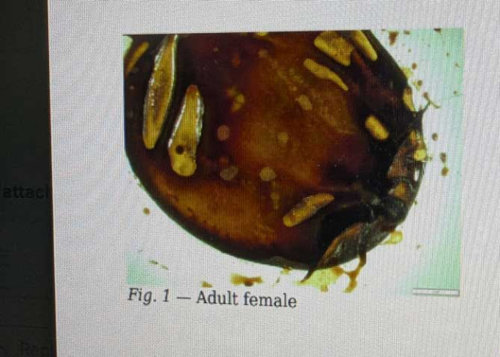
Engorged for 100 hours! (a tick)
5 months ago
Featured Answer
Sort by:Oldest
Comments (10)
 5 months ago
 5 months ago
Related Discussions
ticks
Comments (32)Another reason (also probably related to global warming): invasion by Japanese barberry! A good reason to rip out this invasive. A recent study by researchers at the CT Agricultural Experiment Station found that the number of ticks present in woodlands infested by Japanese barberry was hugely greater than the number in woodlands where barberry is not present. "In 2008, a sampling of areas with more barberry showed an average of 496 ticks infected with the bacterium that causes Lyme Disease, whereas areas without barberry showed an average of 89 ticks." This refers to results reported in a paper that will be published in an upcoming issue of Environmental Entomology. The theory is that the areas where barberry patches exist have higher humidity level than areas where they don't (no idea why that is but it's apparently a scientific fact). Higher humidity apparently improves tick survival rates. Here's the reference: Williams, S. C., J. S. Ward, T. E. Worthley, and K. C. Stafford, III. 2009. Managing Japanese Barberry (Ranunculales: Berberidaceae) Infestations Reduces Blacklegged Tick (Acari: Ixodidae) Abundance and Infection Prevalence with Borrelia burgdorferi (Spirochaetales: Spirochaetaceae). Environmental Entomology (In Press). Another study by Yale researchers determined that climate impacts the prevalence of Lyme Disease. Deer ticks live for two years and obtain one blood meal during each of their three stages of life. In the moderate climate of the northeastern United States, larval deer ticks feed in the late summer, long after the spring feeding of infected nymphs. This long gap between feeding times correlates to more cases of Lyme Disease reported in the Northeast. The Yale paper appears in the April issue of Applied and Environmental Microbiology. Interesting stuff. A good argument (as if bigger, more potent poison ivy wasn't enough of one!) for doing something about global warming ASAP. Here is a link that might be useful: CT Ag Station Tick Testing Results for 2008...See MoreTicks,ticks,ticks!
Comments (37)To quote the sage advice of the Springfield, MO band, "Big Smith": "If we didn't have those bugs attachin', we'd never know the joy of scratchin'" :) My job requires me to be miles in the wildnerness all day, nearly every day, all summer long. So, I just CAN'T use the poisons because I'd constantly be bathing in them. We just duct tape the bottom of our pant legs to our hiking boots, tuck in our shirts, and keep a roll of duct tape handy for seed ticks. Otherwise, we just enjoy the glorious feeling that comes from scratching those bites! Makes us know that it's truly summertime! Generally, we have between 1 and 1000 ticks on us by the time we get home, but we're happy and tired and know we're ALIVE! I know, I know, this isn't really helpful advice to most. But really, aside from the slim chance of a disease, there's really a lot of psychology involved in the desire to be rid of the "pests". Also, FWIW, I've heard that a tick must be attached 6-12 hours before a disease can be transmitted, presumably because the tick must be filled with some blood to have it sqeezed/regurgitated back into your body during removal. So, if you just keep up with picking them off.......See MoreGot the tick report back.
Comments (21)Good idea, Quilly--thanks! I agree, Maire. It really is upsetting. At least veterinary medicine seems to have a handle on it. There's a vaccine for dogs, and possibly a reliable test. The first time I got infected I was prescribed 10 days of Doxycycline. I then asked for enough to get me to a month, and I thought that was good. But then my vet told me dogs are given 2 months worth! So I went back to my doctor and got more. The really scary thing is that within our own health care system there's no consensus on appropriate treatment, and they're still relying on a quite unreliable test. I'm told there's a far better test out there, but it costs $500-700, and insurance won't cover it. Insurance won't pay for the so-called Lyme Literate MD's either. I have my reservations about them, as apparently anyone can call themselves Lyme Literate and charge megabucks for their services. Cure Unknown, an excellent book by a medical journalist, very well researched, tells how some researchers have found the bacteria of Lyme and its co-infections in patients with many other seemingly unrelated illnesses, including Parkinson's and amyotrophic lateral sclerosis (Lou Gehrig's disease). The same book, I believe, describes how a patient was actually cured of the latter disease after being treated with antibiotics for the Lyme. There's so much still not known about these infections, and the cases are multiplying like crazy. I ordered two more books today. At least reading books on the subject makes me think I'm doing something....See MoreTicks--even with Frontline
Comments (11)Well, I have a vet appointment later this week, but I'd like to get some xanax for storms, or big upsets. My 8-year old Golden developed thunder phobias while we were in Phoenix. This was a difficult move for many reasons and it took 6 months after the movers came for us to finally get here. I could tell she was adding anxieties. Now she doesn't like gun shots, loud noises, unexpected movements, car rides, etc... If it's an short event (gun shot) we do a "settle" exercise and she can calm down. A thunderstorm brings: panting, shaking, clawing, alternating pacing, and cowering, trying to climb on top of my head, she urinates, and this is always followed by diarrhea (that she usually manages to contain until the storm subsides and she goes outside). What concerns me most is the fact that she's adding fears. I'm going to try to desensitize her to the storms, but we need drugs to break this association. I know it's not just the thunder as she starts freaking long before I even realize a storm is coming in. I'm sure she's sensing the pressure change and the static, which she's come to associate with bad things. The first 6 years of her life she was nearly shock-proof; I do not remember her being afraid of anything--sometimes to my great dismay. When she's really upset, I just cannot distract her. "Animals in Translation," was written by an autistic woman who says she made a compression machine for herself when she was overwrought. She says they seem to work on animals much the same way and it's very calming. I'm hoping that a multi-pronged approach will help my dog: compression, distraction, drugs... Can you think of anything else that might help? Thanks so much for sharing your knowledge....See More 5 months ago
- 5 months ago
 5 months ago
- 5 months ago
 5 months ago
- 5 months ago
 5 months ago

Related Stories

MONTHLY HOME CHECKLISTSTo-Dos: Your September Home Checklist
Prep your home for cooler weather with these tasks to do in an hour, over a weekend and during the month
Full Story
MONTHLY HOME CHECKLISTSYour Fall Home Maintenance Checklist
Prep your house and yard for cold weather with this list of things to do in an hour or over a weekend
Full Story
FURNITUREForever Furniture: A Buyer’s Guide to the Dining Table
There comes a time when a make-do piece of furniture won’t do. We give you a leg up on choosing the right table for you
Full Story
HEALTHY HOMEHow to Get Rid of Mosquitoes Indoors and Out
Follow these tips to keep your summer bite-free and healthy despite the uptick in mosquito-borne diseases
Full Story
REMODELING GUIDES10 Things to Do Before the Renovation Begins
Prep and plan with this insight in hand to make your home remodeling project run more smoothly
Full Story
KITCHEN DESIGNA Cook’s 6 Tips for Buying Kitchen Appliances
An avid home chef answers tricky questions about choosing the right oven, stovetop, vent hood and more
Full Story
HOUSEKEEPINGHow to Clean and Care for Your Mattress
Find out what you should do to protect your mattress from dust, moisture and stains
Full Story
KITCHEN DESIGN7 Essential Features of a Well-Designed Kitchen
Make sure your new kitchen not only looks good but also functions beautifully
Full Story
FURNITUREHouzz Call: Show Us Your Furniture Makeover Project
Have you reupholstered a tattered chair, transformed a dresser or revitalized bookshelves? Share your handiwork!
Full Story
HISTORIC HOMESThe Winchester Mystery House Hits the Big Screen
Helen Mirren’s new movie delves into the mind behind the bizarre California mansion. We go behind the scenes
Full Story
laceyvail 6A, WV