Houzz Logo Print
jrb451

Do You Avoid “Single Use” Plastics?

last year

I was reading an article today about the harmful effects of single use plastics and their prevalence in the food industry; especially for take out, to go, leftovers, etc. I know some folks take reusable bags/sacks to the grocery to cut down on the use of plastic bags but I’ve never seen anyone bring their own container to take home uneaten food from a restaurant. Does that happen? If so, what do they use? Is that too gauche?

Comments (69)

  • last year
    last modified: last year

    Snot is definitely a green but the tissues would be brown. So a good balance all in all.


    As for plastic: reduce, reuse, recycle - in that order. Shops here stopped giving out free plastic bags some years ago and suddenly people discovered they didn't need them after all. Even a tiny price was a deterrent. Just 10 pence was enough to change behaviour.


    jrb451 thanked floral_uk z.8/9 SW UK
  • last year

    Quoting Lonejack: " I don't stress about it. "

    I try to do my part with concern on a more macro scale. I try to make better choices with alternatives with bigger consequences concerning things I can act on or make choices about. Plastic forks with takeout and plastic bottles for ketchup are too small to be concerned with. What I do or don't do with these contributes nothing to having a concern for more thoughtful conduct by me and by others. I'm not in to trying to feel good about doing things that really have no consequence. I have no feelings or guilt about it, and I'm not that needy as to try to make something insignificant into more than it is. .

  • Related Discussions

    Single event albums or large yearly...what do you use?

    Q

    Comments (3)
    I have albums for each of my kids and grandkids but most of their photos are in photo boxes. As I scrap, I add them to the albums. I like to use 3 ring binders so I don't have to scrap in order but can put them in order in their albums. (If you can follow that run-on sentence!) For vacations and special events I create theme albums. Our Alaskan cruise is 4 albums long!! There is no right or wrong way to scrap so go and follow your heart. Sue
    ...See More

    how to avoid degradation of plastic sheeting due to PVC pipe

    Q

    Comments (1)
    anti hotspot tape is the usual way to do it, it helps with abrasion too.
    ...See More

    Plastic parts, where to avoid and where to find metal insides?

    Q

    Comments (7)
    You either misunderstood the explanation, were given the wrong information, or are trying to perpetuate an old wives tale. If the model number is identical, then online and local plumbing store items will have the same parts construction (with the exception of possible product improvements). How could anyone ever order replacement parts if the model number meant nothing? However, it is relatively common to have parts number variations that are very close, but not identical, and this may be important. You need to be very specific when trying to buy online vs. local. One letter or digit can mean its a significantly different product. I've also found that most local stores (and big box stores) are very close in price to online, and will usually match online prices. I bought a large number of plumbing fixtures last year (mostly Kohler) and got the first batch locally. The local price was within a few dollars of the online price on items that cost several hundred dollars, and it was much easier to return locally. Bruce
    ...See More

    What size pot do you use when burying hosta in pot to avoid roots?

    Q

    Comments (5)
    As Ken said, the size of the pot should correspond with the size of the hosta at the time of planting. I've only planted a hosta pot in the garden twice. For the first one, I choose a big pot for a very small hosta. It died. For the second one, I chose a sturdy pot a bit bigger than the root system the hosta already had. I have had it in the same pot for about 4 years. For the first two years, the hosta grew well. The third year the hosta looked good, but would often start to wilt. I attributed that to the fact that it was time to repot it to a larger pot---but now I believe it was because the tree roots had entered the pot and were drinking up the water. The fourth year I pulled the pot out of the soil. Roots had invaded the pot through the drainage holes. Not only that, but the tree roots had encircled all around the pot on the outside. I didn't repot the hosta. I left the pot slightly higher than soil level. Before winter I turned the pot to make sure any new roots had not entered the pot and planted the pot at the proper level for winter. So if you want to try it, I think it works pretty well. A few points: (1) Do not use an overly large pot for a small plant. (2) Turn the pot at least once a season or more (to break invaded roots). (3) Remove a bit of the soil from the top of the pot yearly and replace with new soil/compost. I've never tried the double pot method though it sounds like a good idea. It just worries me that the pot with the hosta will not possibly drain well enough using the two pot method---especially with clay type soil.
    ...See More
  • last year

    I do what I can to minimize my impact. I know the earth has cycles but we seem to be speeding that process up and refusing to admit it is happening. You can argue that humans have nothing to do with global warming but you cant argue it isnt happening since ice shelfs and glaciers are melting. We arent preparing for what is coming.

    Plastics are another ball of wax. Since it has been learned how dangerous and forever it is we are using more and more. egg cartons are now plastic and food trays are foam and I wonder if the wood pulp became too valuable to make disposables out of or what.


    patriciae

    jrb451 thanked HU-279332973
  • last year

    Frankly, I think one of the greenest things we can change is to fly a lot less—- not a popular option. Meanwhile we are counting the number of paper towels we use.


    I'm pretty curious how this would help anything. Wouldn't the alternative conveyances cause more problems?

  • last year
    last modified: last year

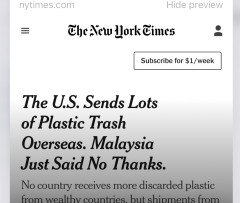
    ❗️👀Southeast Asia flooded with imported plastic waste meant for recycling | PBS News

    Last year, the U.S. exported more than 950 million tons of plastic waste meant for recycling and a significant portion of that ended up in Southeast Asia. The region has been inundated with plastic scrap after China blocked all but the cleanest plastic waste imports in 2018. Special correspondent Fred de Sam Lazaro reports on how Thailand is dealing with the problem of plastic.

    Read the Full Transcript

    Notice: Transcripts are machine and human generated and lightly edited for accuracy. They may contain errors.

    https://www.pbs.org/newshour/show/southeast-asia-flooded-with-imported-plastic-waste-meant-for-recycling

    -~~~


  • last year
    last modified: last year

    The issue is really best addressed on a larger public scale - as in making it mandatory for the co.s producing all this wasteful material responsible for it throughout its lifecycle. If they had to be responsible for it, I think there would be a change. Doesn't that happen in other countries?

    We have a system whereby laws can make that possible, however, it seems that large business interests take priority over the common good here in the USA.

  • last year

    The reason that I mentioned flying is that it is frequently discretionary, most flights are made by a relatively small number of the world’s population, and all flights together constitute a lot of carbon.

    If I don’t fly to Spain I might drive somewhere else instead, but I belive that there would likely be a reduction in carbon released. If Itake a train that is more energy efficient.


  • last year

    We visited a coastal community a few years back and stayed there a week. None of the food establishments we visited used styrofoam, cups or clamshells. No plastic straws. Only bio-degradable cups and recycled paper to-go containers. pretty impressive, I thought.

  • last year

    Here in my peninsular state, our gov., in his infinite wisdom, signed a law prohibiting local gov'ts from passing their own regulations over single use plastics 🙄

  • last year

    @rob333 (zone 7b) "I'm pretty curious how this would help anything. Wouldn't the alternative conveyances cause more problems?" I think the point is unnecessary travel, especially long distance.

    I see no reason to avoid trying to reduce plastic use on a small scale as well as on a larger scale. It all adds up. Is this large scale or small scale? (note that many of the stats are from 2018 and are surely much higher now - the article states the plastic industry plans on increasing their products by 40% in the next 10 years following the date of the article. The date of the most recent source cited is 2023, but I can't find a date of publication. I donate $ to them and receive their newsletters. The footnotes/sources of the stats are available at the link.)

    10 Facts About Single-Use Plastic Bags

    1. The world uses 5 trillion plastic bags a year.
    2. Americans use an average of 365 plastic bags per person per year. People in Denmark use an average of four plastic bags per year.
    3. It only takes about 14 plastic bags for the equivalent of the gas required to drive one mile.5
    4. In 2015 about 730,000 tons of plastic bags, sacks and wraps were generated (including PS, PP, HDPE, PVC & LDPE) in the United States, but more than 87% of those items are never recycled, winding up in landfills and the ocean.
    5. About 34% of dead leatherback sea turtles have ingested plastics.
    6. The plastic typically used in bottles, bags and food containers contains chemical additives such as endocrine disruptors, which are associated with negative health effects including cancers, birth defects and immune system suppression in humans and wildlife.
    7. It takes 1,000 years for a plastic bag to degrade in a landfill. Unfortunately, the bags don't break down completely but instead photo-degrade, becoming microplastics that absorb toxins and continue to pollute the environment.
    8. Chemical leachates from plastic bags impair the growth of the world’s most important microorganisms, Prochlorococcus, a marine bacterium that provides one tenth of the world’s oxygen.
    9. There were 1.9 million grocery bags and other plastic bags collected in the 2018 International Coastal Cleanup.
    10. In 2014 California became the first state to ban plastic bags. As of March 2018, 311 local bag ordinances have been adopted in 24 states, including Hawaii.12 As of July 2018, 127 countries have adopted some form of legislation to regulate plastic bags.

    Source: Center for Biodiversity

    Wrapping our garbage in plastic bags is one huge source of plastic pollution. If people would switch to compostable garbage bags, it would make a huge impact.

    We need to be more like Denmark.

  • last year

    FWIW, we roofed our house last year using Malarkey shingles. I wasn't aware of them beforehand, but they use recycled tires and plastics in their shingles. Very good impact resistance to hail and we got a 17% discount on our homeowners' policy. Malarkey Shingle Info

  • last year

    We can reduce or reuse our single-use plastics all we like, but … walk into any store, be it Staples, or Michaels, or a grocery or department or convenience store, and you see plastic. Acres of plastic. Remote controls and shirt buttons, tchotchkes, tableware, car parts, computer accessories, luggage, pens, paint cases, beauty tools. I suppose they are not single use, but look at how much there is! Eventually it all goes … where?

  • last year
    last modified: last year

    Let's look at the person just above who posted the long list.

    -If she avoids single use plastic and encourages others to do so, the effect will be lower Asian and other takeout food sales and perhaps more in-restaurant dining. And little else. Most of the plastic pollution in the ocean comes from Asia and poor countries elsewhere.

    -If she stops burning wood for heat and encourages others to do so, the effect is likely to be fewer child asthma attacks.

    Which is more impactful and important? Does doing the first provide an indulgence or absolution for doing the second?

  • last year

    We can be extremely resorceful when there is a will for change!

  • last year
    last modified: last year

    And how about all those shipped products in bubble wrap, air pillows and mailing bags?

    Plastic packaging is everywhere - and constitutes so many products now - try finding kids' toys that don't have plastic.

    And FWIW, the Federal summer lunch program and our health dept.s require serving individually packaged items, for food safety, so lots of plastic waste there.

    P.S. Conservation's not a zero sum game - it is possible to do more than one positive thing at a time.

  • last year

    " And how about all those shipped products in bubble wrap, air pillows and mailing bags? "

    What do you propose to do this week, carol, to reduce the use of bubble wrap and air pillows? Are you going to agonize about it a little each day?

  • last year

    There are surely wonderful innovations that can be imagined by those who understand materials and can imagine novel ideas. Expecting those innovations from a group such as this is unnecesary. But yes, assign it to college engineers, material science people, and creatives.

  • last year

    @jrb451 thanks for that info about Malarky roofs. I am not quite ready for a new one, but will definitely check into them when the time comes.

    @carolb_w_fl_coastal_9/10 I order from Target sometimes and if the item isn't in the store for me to pick up, they will ship for free. I noticed a while ago that they had stopped using plastic packaging and pillows and are using brown paper much of the time. (They do wrap liquids in a plastic bag to prevent leaks, tho). Another reason I love Ridwell, is that they recycle bubblewrap and plastic bags/pillows. They contract with Trex to turn it all into decking materials.

  • last year

    A lot of companies are now shipping things wrapped and cushioned by brown paper. Maybe more will follow their lead. I am trying mightily to avoid all plastic. DH who worked at the EPA for 40 years with much of it in water and helped to write the Clean Water Act should be ashamed of himself as does not try to avoid at all. Makes me so angry.

  • last year
    last modified: last year

    I haven’t read this entire thread, so this could have been mentioned already.

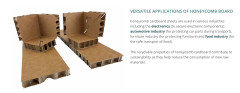
    The comments about bubble wrap caught my eye. I have noticed that a lot more things are being shipped in honeycomb cardboard/paper.

    https://www.novapor.com/en/materials/honeycomb-cardboard/


    Lisaam, I agree that if there is a need for something, someone will come up with something.

  • last year

    In addition to that honeycomb packing paper there are also cornstarch based peanuts that melt with water. Need more options and to increase usage.

  • last year
    last modified: last year

    I think a lot of shippers like Amazon are reducing the amount of shipping material, including plastic. If you look at some of the photos and reviews on Amazon for the products, you’ll notice as some complaints about things cracking and breaking because of the lack of packing material.

    We try to recycle or reuse things bubble wrap. You can always reuse when you mailing something to somebody or just use it as a lampshade.

    There’s one restaurant I get takeout food from sometimes and it’s hot food and they serve it in these good size Styrofoam clamshells. The recycling here does not use them or take them.


    ed


  • last year
    last modified: last year

    Styrofoam is very difficult to recycle and isn't accepted in our kerbside collection. Single use Styrofoam, like take out containers, is now banned here, as are plastic cutlery and straws. Egg cartons are made of cardboard.

    jrb451 thanked floral_uk z.8/9 SW UK
  • last year
    last modified: last year

    Well, it wasn't hard to find this Lisa. I did look further, and there is a possibility for greener ways to fly, but that is far into the future. I'd say, I agree with the article's assessment, but my BIAS is showing since it was my premise before I even looked. I admit it, I am biased. I am happy to continue driving places even though, I know it's in that bigger 27% portion of the carbon emissions. And fly every other year. I don't contribute that much to either portion since I work from home most of the time, and take very very few vacations.


    Air travel accounts for 2.5% of global carbon emissions. In the US, flying accounted for 8% of transportation emissions, but less than 3% of total carbon emissions. It’s a drop in the bucket when compared to other industries in the United States:

    • Transportation: 27%
    • Electricity 25%
    • Industry 24%
    • Commercial/Residential 13%
    • Agriculture 11%

    So, when looking at the math, flying isn’t really the worst climate offender out there. There are far worse industries out there. Shouldn’t we focus on them?

    Cutting down carbon emissions from flying isn’t going to make a big dent in total emissions.

  • last year

    If I can't do a lot, at least I can do a little. Every little bit helps.

    jrb451 thanked cyn427 (z. 7, N. VA)
  • last year
    last modified: last year

    Americans don't understand *public* anything -- health, transportation, housing, welfare, etc. We're also averse to anything Not Invented Here. We think we are so special, creating the most prosperous nation on earth -- while actually we were given unheard of resources. Only now are we beginning to see that there is an end to all that bounty -- any need to conserve. The rest of the First World knows a different reality.

    To illustrate: We met an astounded Dutch couple at a wedding. This was their first visit to the states. They'd decided to drive from the east coast to this event in Santa Rosa, California. They could not imagine the scope of America, nor the amount of land still undeveloped. They'd gotten to Denver, then turned in the car and flew the rest of the way.

  • last year

    Right on, cyn - nobody can do everything, but everybody can do something.

  • last year
    last modified: last year

    " nobody can do everything, but everybody can do something. "

    My earlier point was that people who do positive little things and little else have really done nothing. And many also do negative bigger things and leave those out of conversations.

    They're wrong to tout their "enlightened attitudes" when really they've stopped short of making a positive difference.

    There are plenty of people with sincere concerns and motivation who find ways to be involved with efforts that have an impact. For me, it's a case of putting your conduct where your mouth is. Earn the right to talk the talk by setting an example. Half or incomplete efforts are shallow and phony.

    Trust me, I know from experience. To believe even half of the things one hears of a politically correct nature in social settings in my area (which is rather blue and very environmentally conscious) you'd think that all of one's friends and neighbors are on the list for future canonization. The reality is quite otherwise. I suspect the same is true in other places too and also among comments made in this forum.

    The hypocrisy is obvious and palpable.

  • last year

    I just read this thread top to bottom and I only see one person consistently demonstarting their ”enlightened attitudes”. I am sure we can all agree the problem with plastics will be solved eventually but not by cranky old folks on the internet. LOL


    The solution could be Mycelium. They are making packing materials from mushrooms.


  • last year

    " I only see one person consistently demonstarting their ”enlightened attitudes” "

    I hope you're not referring to me.

    I'm demonstrating a normal BS detector, nothing more.

  • last year

    So do you want to be nothing ELmer? That in my estimation is where your are. You are not responsible. OK. But I do not believe you are not responsible. We are all responsible. Very few people are so stupid that they dont get why they are in fact responsible. Let's pretend though. I hated "lets pretend" as a child and still do.


    patriciae

  • last year
    last modified: last year

    patricia, thanks for bringing the right phrase.

    I'm against "Let's pretend". People here have done that. Don't point out little irrelevant things you do and pretend you're an environmental champion. A lot of little things adds up to a little total. That's not enough.

    To those who think there are problems that need to be acted on aggressively, which I believe is the case, don't think you're doing your share because you wash plastic baggies to reuse them. But do nothing else. That's make believe. You need to do more.

    Don't compost paper waste to keep it out of landfills, tell everyone what a good environmentalist you are, but do nothing else. If you care, you need to do more.

    Don't pretend.

    That's what I've been trying to highlight and your phrase helps me. Thanks.

  • last year

    I definitely try to avoid plastic when possible especially at the grocery store; for example, it's convenient to just grab the apples that are bagged up but I've changed to picking up the ones not in the bag

    Recently, I was able to purchase yellow sungold tomatoes in the cardboard pint containers and so avoided the clamshell ones, even though those were multi-colored which also looked really good

    So many peanut butter, oils, etc, are being sold in plastic these days and I always spend that extra minute or two to find the glass jars.

    Our city has banned plastic bags at retail outlets which is good - those used to get into the trees and I've seen less of that...

    Just a few examples of what I'm into :)


    This is an interesting discussion :


    https://philosophy.stackexchange.com/questions/41875/what-fallacy-argues-that-we-should-do-nothing-because-we-can-not-do-everything

    jrb451 thanked lat62
  • last year

    I don't think hypocritical behavior, which I suspect each of us sometimes experiences and can usually identify, requires reference to theoretical philosophical principles to understand.

  • last year

    Surely you’ve heard the Starfish Tale? Click to read

  • last year

    Interesting article lat62 - thanks for the link - I like this:

    "How things are need not imply anything about how they should be, or what we should do."

  • last year
    last modified: last year

    Starfish Tale - no. Should I have? And don't call me Shirley. ;-), one of my favorite movie lines

    There are a lot of parables in religious texts. Many adherents of certain sects who view such texts as being inerrant nevertheless pick and choose which to thump and which to ignore, as it suits them. That's hypocrisy of a similar kind to what I've seen in this forum.

    Some of you, especially our friend from Florida, get too worked up trying anything and everything, whether sensible or not, to disagree with me, and stop looking at the road and drive into the weeds. I don't really have anything more to say

  • last year

    @lat62 what a great site and interesting article...so on point! Thanks for posting it. Logically fallacious - perfect!

  • 5 months ago
    last modified: 5 months ago

    I thought you were gone from this thread, Elmer - short term resolution?

    o j

  • 5 months ago

    "I thought you were gone from this thread, Elmer - short term resolution?

    o j"


    This thread is eight months old! Your comment makes no sense 😑

  • 5 months ago
    last modified: 5 months ago

    Perhaps he didn't notice the date stamp?

    I think that happens a lot - especially when houzz highlights posts from years back in the sidebars

  • 5 months ago

    I didn't see this thread before when it was more current but I thought I should add my 2c worth as someone living in a state where single use plastics, except in the limited sense of commercial packaging, are actually illegal.

    Single use plastics such as straws, take away containers, plastic bags etc, were all banned by our state government over two years ago iirc. Guess what? Life has gone on.

    Contrary to what Elmer said above, there has been no decrease in sales of take away food. We just use compostable containers. Everyone carries some kind of fabric shopping bags, or paper bags can be purchased for a small fee. When I order groceries I pay a small fee for paper bags (otherwise they supply the groceries in reused cardboard boxes from the stock room) and I pass on the clean paper bags to the local lunch shop to use for large take away orders or to the local charity shop to use for their customers.

    Vegetables and fruits come in compostable plastic bags or paper bags. I reuse the compostable plastic bags for other purposes and then put kitchen waste in them. Many local authorities operate a green waste system where food scraps and other compostable substances are collected separately, composted and the compost given free to the ratepayers who want it. Other recyclables are also collected separately (the local authorities supply at least two garbage cans, one for recyclables and one for non recyclables and some supply a third for green waste) and sent to recycling centres.

    Soft drink bottles (glass or plastic) and cans can be collected separately by the purchaser and handed in to special recycling centres to receive 10c per item. We get back about $100-$120 per year just returning our own soft drink bottles and cans, but there are people who earn extra cash collecting those discarded or from people who don't want the bother of returning them themselves. In some areas, people put their unwanted soft drink containers into a box at their front gate to be collected by such people.

    I have little patience for people who say, "Oh, I can only do a tiny bit so I won't do anything as it won't make any difference." It was everyone doing a tiny bit that got us into this mess. Yes, big corporations should also be held to account, but that doesn't absolve the person in the street from taking any responsibility. For instance, if every person in the US gave just $1 per week to charity, that would generate $350 million per week for charitable purposes. Imagine what good might be done with that kind of money.

    jrb451 thanked colleenoz
  • 5 months ago

    No.

  • 5 months ago
    last modified: 5 months ago

    " Contrary to what Elmer said above, there has been no decrease in sales of take away food. "

    You've grossly misunderstood and misconstrued what I said. The cause and effect I described is quite different from what your comment suggests. This topic ended long ago.

    You can reread my earlier comment to see what you got wrong or don't. It doesn't matter to me. I don't feel the need to straighten it out because I believe what I said before was clear.

    In my state, one which has been a leader in the US for decades about being first to enact various environmentally protective laws-

    - Here, there were local ordinances as early as 2007 and a statewide law in 2014, concerning charges for and requirement for using recyclable bags. I wonder if the charge and requirement for using renewable bags at grocery stores happened here first or where you are first?

    -restaurants are not permitted to use a "clean bag" from Individual A to package food for Individual B.

    - Other than paper bags, the newly developed "compostable" containers and bags that are in wide use are NOT permitted to be placed into the sorted residential waste destined to be composted. Which is to say, the receptacle for yard and food waste. They go with general refuse to landfills. So, they're really of little benefit other than if compared to plastic. Paper articles are more earth friendly.

    My household is careful about putting "recyclable" materials into the proper refuse container, even though the truth is, much what's picked up is NOT recycled. Many don't realize it's a feel good but accomplish-little situation.

    Recycling was found to be working only when monetarily advantageous. Meaning, there's no governmental funding for the proper disposition of potentially recyclable items. If it doesn't pay for the hauler to do so, it's often not done.

    Something everyone can do to benefit the environment is to stop burning wood for heat. Many bleeding hearts that pop up here and there with their favorite tear jerker continue to do that and also drive cars larger than they need.

  • 5 months ago

    Your words, Elmer:

    " If she avoids single use plastic and encourages others to do so, the effect will be lower Asian and other takeout food sales and perhaps more in-restaurant dining." Nope. Takeout food sales have not decreased, or even decreased in favour of in-restaurant dining. Some popular restaurants have even moved into smaller premises as their core business trends more to take away sales, and it made little sense to maintain a large, empty dining room while the Door Dash and Uber Eats folks were lining up to collect orders.

    And I dispute the following statement:

    " Other than paper bags, the newly developed "compostable" containers and bags that are in wide use are NOT permitted to be placed into the sorted residential waste destined to be composted... So, they're really of little benefit other than if compared to plastic."

    Even in a landfill, they will break down and eventually compost, which plastic will not.

    Many countries are making recycling an economically viable proposition and one that is becoming more viable as time goes on.


  • 5 months ago

    Restaurant owners are in business to make money. Part of that is managing costs (have you ever managed a business?). I suspect plastic containers are cheaper than other kinds, that's why laws are passed to require use of the "other kinds".

    You have some people coming over and you told everyone you will pick up some kind of Asian takeout food for the meal.

    You've resolved to avoid single use plastic items. You call to place the order. You ask if they can put the food into non-plastic containers. They say "No, that's all we have".

    Do you break your resolve or take the business elsewhere? That's what I had in mind.

  • 5 months ago

    I would say, speak to the business owner about your preference for organic compostables. If they don't want to, due to expense, express that you'd be okay to pay a little more for it... it's a process to help people to accept change and with PFAS everywhere it's also about health concerns.


    My friend began a business years ago to introduce compostables to our local restaurants and it was such a win-win! very few restaurants around here use styrofoam anymore, due to customer preference not a law.


    Two decades ago, our elementary school stopped using disposable plates and utensils for our halloween parties etc. it was 'just bring your own from home' note to parents and kids who cared. Taking care to avoid waste is actually easy, fun, and satisfying. Parties with black plastic garbage bags full of paper plates and plastic forks etc. are very yesterday.


    My son has now convinced our local Namaste Shangri-la Indian restaurant to dish up his food into a glass container from home, where at first they said no. They're not just transferring it, they take the container into the kitchen for him. Just show up with your own container and ask!


    I see the 'breaking resolve' dilemma and I have such pride in the younger generation to call BS on that more and more.


  • 5 months ago

    There was a Japanese restaurant in Sydney iirc, which was famous for being run by an environmentally conscious owner who insisted that all customers bring reusable containers with them for placing any leftovers into and taking them home with them. Single use plastics were not permitted and food waste also wasn’t an option. Customers who turned up without a container were turned away.

    It’s pretty common for take away coffee places here to serve coffees in the customer’s own ”Keep Cup”, which is a reusable lidded cup with a drinking spout, usually insulated as well.

    DH and I just drove down south for the weekend, and were commenting on how litter free the highways are now that single use plastics have been banned and payment for returned drink containers has been instituted.

  • 5 months ago

    I probably wasn't too interested back when this thread first appeared, but finally since it resurfaced I took a look.

    Again, it's not a topic of interest to me, but I have to chuckle that it can become contentious so easily.

    I saw that OJ 's comment appears to have resurrected it, so for that I'm glad. I always like hearing from OJ.

  • 5 months ago

    Evidence continues to grow that microplastics are in the air, water, soil, food, and even the human body. The status quo is not the answer.

    Any efforts to help improve health and the environment are commendable, no matter how large or small. Anyone who leads an organization or business knows that their large, impactful decisions are influenced by each and every one of the people in their group. Think of the Himalayas - many tiny rocks amassed together to create such imposing mountain ranges.